Working from home in Germany is no longer just a temporary fix or a trendy perk; it's become a permanent fixture in the professional world. With nearly a quarter of the German workforce now clocking in from a home office at least part of the time, the country has truly embraced this new way of working. This shift has opened up a whole new world of flexibility and opportunity.
The Reality of Remote Work in Germany
The conversation in Germany has moved on from if remote work is viable to how to make it work best. While the idea is popular, what "working from home" actually means can differ wildly from one company to another. To find a role that genuinely suits your life, you need to get to grips with these nuances.
The landscape isn't one-size-fits-all. You'll find a whole spectrum of remote work models, each with its own culture and set of expectations. Figuring out these differences is your first big step to a smarter, more targeted job search.
Differentiating Remote Work Models
Not all remote jobs are created equal, especially in Germany. Companies generally offer one of three setups, and knowing which is which will save you from mismatched expectations down the line.
- Fully Remote (100% Home Office): This is the dream for many, offering maximum flexibility to work from anywhere in Germany. You'll see these roles most often in tech, digital marketing, and other service-based fields.
- Hybrid Models (Mobiles Arbeiten): This is the most common arrangement you'll find. It’s a blend of office and home days, often on a fixed schedule like three days in the office and two at home. It aims to offer a balance between focused work and in-person collaboration.
- Office-First with Remote Options: Here, the office is still the main hub, but employees get the flexibility to work from home when needed. This is pretty standard in more traditional industries.
My best advice for job seekers is to read job descriptions like a hawk. A phrase like "mobiles Arbeiten möglich" (mobile work possible) usually signals a hybrid model, not a fully remote one. It's crucial to get crystal clear on this during the interview process.
Industry Disparities in Remote Adoption
Your chances of landing a remote gig depend hugely on your industry. Some sectors have adapted seamlessly, while others are still tethered to on-site work for very practical reasons.
Recent data paints a clear picture. As of early 2025, about 24.5% of German employees worked from home at least part-time. That figure has been remarkably stable for years, proving this isn't just a passing trend.
But when you break it down by industry, the differences are stark. The service sector is leading the charge with a 34.3% home office rate, while manufacturing is at 16.9%, and construction lags way behind at just 4.6%. You can explore more on these remote work statistics and global comparisons to get the full picture.
This gap makes perfect sense when you think about it. Jobs in IT, consulting, media, and finance can be done from almost anywhere. On the other hand, roles in manufacturing, retail trade, and construction simply require a physical presence.
To give you a clearer idea, here’s a look at how home office rates vary across key industries in Germany.
Work-From-Home Rates by Industry in Germany
The data shows a clear divide between industries that can easily operate remotely and those that require on-site presence. For job seekers, this table is a great guide for where to focus your search.
| Industry Sector | Home Office Rate (%) | Key Takeaway | | :--- | :--- | :--- | | Service Sector | 34.3% | By far the most opportunities. Think IT, consulting, marketing, and finance. | | Manufacturing | 16.9% | Hybrid roles are common for administrative, sales, and management staff. | | Trade | 12.5% | Mostly limited to e-commerce, corporate HQs, and support functions. | | Construction | 4.6% | Very few remote roles, usually for project management or back-office staff. |
Knowing this landscape helps you channel your energy effectively. If you're set on a work-from-home arrangement in Germany, targeting service-oriented companies will dramatically boost your odds of finding a role with the flexibility you’re looking for.
Navigating Your Legal Rights and Responsibilities
When you start working from home in Germany, getting your head around the legal side of things is non-negotiable. It might seem a bit dry, but understanding a few key terms and regulations is your best tool for negotiating a fair deal and working with confidence.
These rules aren't just red tape. They directly affect who pays for your office chair, what your insurance covers, and how you manage your working day. The first hurdle for many is simply decoding the language in their employment contract, where two very similar-sounding terms have vastly different meanings.
Telearbeit vs. Mobiles Arbeiten: The Critical Difference
German law doesn't just have one catch-all term for "remote work." Instead, it draws a hard line between two distinct models, and the one in your contract determines who's on the hook for costs, equipment, and safety.
Telearbeit (Telework): Think of this as the formal, old-school version of a home office. Your employer is legally required to set up a permanent, fully-equipped workstation in your home. They must provide and maintain everything—the desk, the ergonomic chair, the computer, you name it. They also foot the bill and are responsible for ensuring the setup meets Germany’s strict occupational health and safety laws.
Mobiles Arbeiten (Mobile Work): This is the flexible, modern approach you're far more likely to encounter. It simply gives you the freedom to work from anywhere outside the main office, whether that's your kitchen table, a local café, or a co-working space. The key takeaway here is that your employer's obligations are significantly reduced. They'll usually give you a laptop, but they aren't legally required to pay for your furniture, internet, or electricity unless your contract explicitly says so.
Most remote work agreements in Germany today are classified as mobiles Arbeiten. This offers maximum flexibility, but it also means the responsibility is on you. Always read the fine print in your contract for any clauses about expense reimbursement.
Knowing which category you fall into is crucial. If your contract says Telearbeit, your employer has a much bigger role to play in your setup. If it's mobiles Arbeiten, you have more freedom, but also more personal responsibility.
Key Regulations You Should Know
Beyond the terms in your contract, a few core German laws will shape your remote work life. A basic awareness of these will help you ensure your arrangement is fair, compliant, and safe.
Working Hours and Breaks
The German Working Hours Act (Arbeitszeitgesetz) follows you home. The rules don't change just because you're not in the office.
Your workday is limited to an average of eight hours and can never exceed a hard cap of ten hours. You’re also legally entitled to a 30-minute break after six hours of continuous work, which increases to 45 minutes if you work more than nine hours.
Accident Insurance Coverage
What if you trip over a cable on your way to the kitchen for a glass of water? For a long time, the rules around statutory accident insurance (gesetzliche Unfallversicherung) were murky.
Thankfully, recent updates have clarified things. You are now generally covered for accidents that happen while you're performing work-related tasks at home. This protection even extends to the journey to and from taking your kids to daycare before starting your workday.
Data Protection at Home
When you're handling company information from your living room, you effectively become a part of the company's security system. The General Data Protection Regulation (DSGVO, or GDPR) applies just as much at home as it does in the office.
This means you need to take practical steps to secure sensitive data. Lock your screen when you step away, use a password-protected Wi-Fi network, and be mindful of who might overhear work-related phone calls. Your employer should give you clear guidelines on their data security policies for remote work—make sure you follow them.
How to Find and Secure a Remote Job in Germany
Landing a role that lets you work from home in Germany is entirely possible, but it calls for a smart, focused strategy. While the shift towards remote work has opened up a lot of doors, these opportunities aren't always just sitting there in plain sight. Real success comes from knowing exactly where to look, how to frame your experience, and what to say when you get in the virtual interview room.
Your first move? Target the right platforms. General job boards have their place, but many German companies stick to local, well-known sites for their remote positions. Concentrating your efforts here will get you much better results than casting a wide, international net.
Where to Find Genuine Remote Opportunities
To find companies that are genuinely all-in on remote work, you need to get familiar with German-centric job boards and the right search terms.
StepStone.de: As one of Germany's biggest job portals, StepStone has some seriously good filtering options. Get comfortable using terms like "Home-Office", "Remote", or "Mobiles Arbeiten" in the search bar. You can even filter by location if the role requires you to be in a specific region for the occasional team meeting.
Xing: Think of this as Germany’s answer to LinkedIn. It's a powerhouse for job searching and, just as importantly, professional networking. A lot of recruiters on Xing will reach out to candidates directly, so it’s essential to have a sharp, complete profile that clearly highlights your experience with remote work.
Specialised Remote Job Boards: Don’t forget to check international platforms that feature German roles, like Remote.co or We Work Remotely. These are especially great if you're looking for a job in the tech or startup world.
This chart really drives home where you're most likely to find remote-friendly listings on the main German job sites.
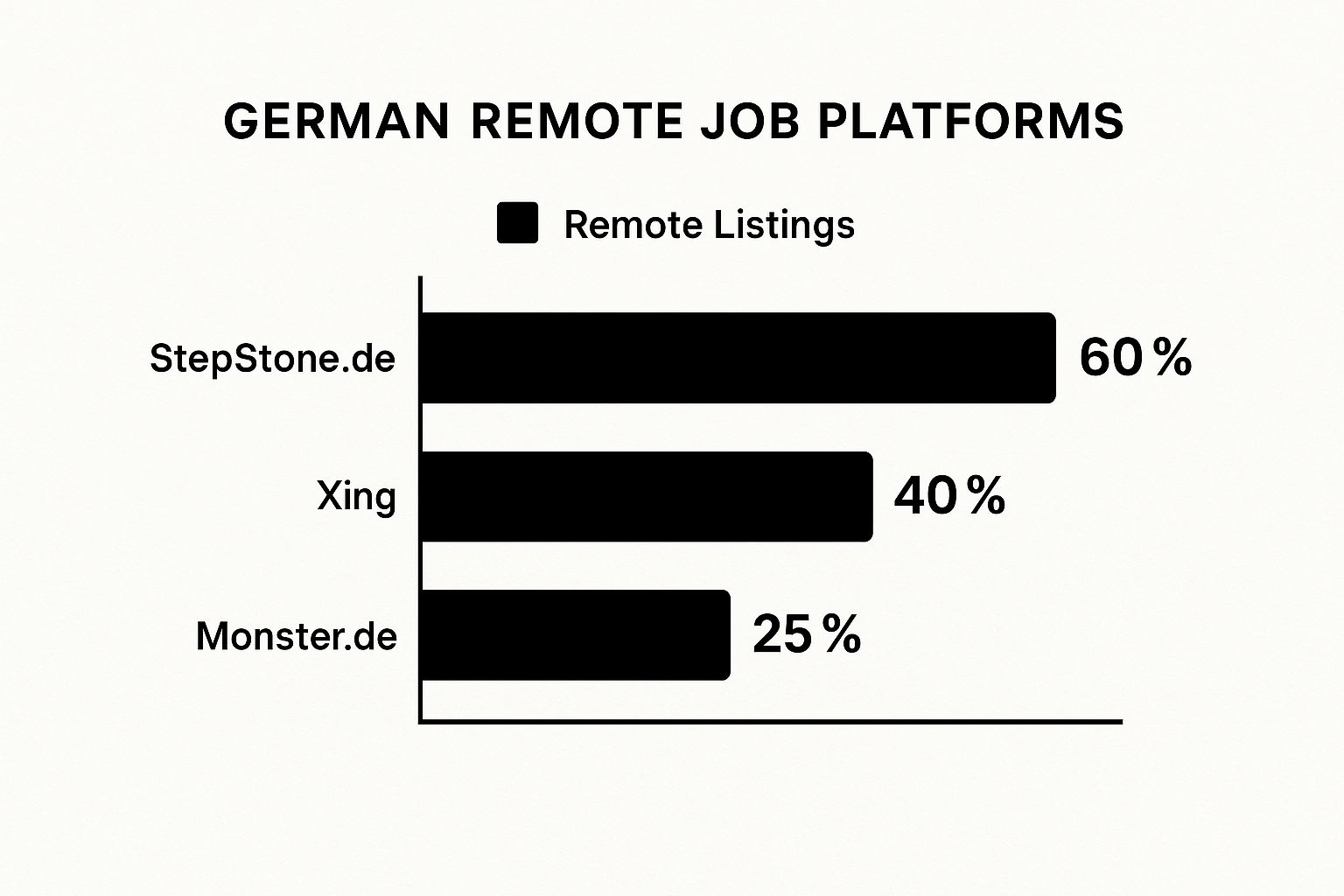
As you can see, focusing your energy on a platform like StepStone.de just makes sense—it’s where you'll find the highest concentration of roles that fit the bill.
Tailoring Your CV for Remote Roles
Your CV, or Lebenslauf as it's known here, needs to do more than just be a history of your past jobs. When you're going for a remote role, it has to actively sell your ability to work independently and be a productive team member from a distance.
German recruiters are specifically looking for proof that you can deliver great work without someone looking over your shoulder. You have to frame your experience to spotlight the skills that make or break a remote employee.
Instead of just listing responsibilities, rework your bullet points to show off real achievements. Think along these lines:
- Self-Management: "Successfully managed project timelines and deliverables with minimal supervision, resulting in a 15% ahead-of-schedule completion rate."
- Digital Collaboration: "Proficient in using Asana, Slack, and Microsoft Teams to coordinate with a distributed team across three different time zones."
- Proactive Communication: "Initiated and led weekly virtual check-ins to ensure team alignment and maintain project momentum."
The pandemic really accelerated remote work adoption in Germany. In the early stages, about 36% of employees started working from home, and an impressive 44% of them reported a better work-life balance. This cultural shift means employers are now much more open to candidates who can prove they have these skills. You can dig into more stats about the rise of remote work in Germany on Statista.
Preparing for the Remote Work Interview
Once your CV gets you in the door, be ready for questions that dive deep into your remote work style. Hiring managers in Germany want to be sure you're disciplined, an excellent communicator, and capable of integrating into their company culture from afar.
Be prepared to give concrete examples. When they ask how you stay motivated, don't just say you're a self-starter. Talk about your daily routine, how you structure your tasks using a system like time-blocking, and what tools you rely on to track your progress.
You can pretty much count on hearing questions like these:
- "How do you ensure you remain connected to your team when working from home?"
- "Describe your ideal home office setup. What do you need to be productive?"
- "How do you handle distractions or technical issues when you're working remotely?"
Your answers need to scream professionalism and reliability. Show them you have a clear grasp of both the challenges and the perks of working from home. Talking about your strategies for setting boundaries and avoiding burnout is also a huge plus—it shows you’re a mature candidate thinking about long-term success.
Automating parts of your job hunt can free you up to prepare for these crucial conversations. For example, using an AI-powered job application tool can help you focus your energy where it truly matters.
Getting Your Home Office Set Up (And Tax-Compliant)
Working from home in Germany isn't just about finding a quiet corner to open your laptop. It's about building a space that keeps you productive and, just as importantly, making sure you're set up to take advantage of Germany’s tax rules for remote work. The German tax office, the Finanzamt, has some specific guidelines, but they're a lot more straightforward than you might think.
A properly organised workspace is really the foundation of it all. Before we even get into the tax side of things, let's talk about what makes a practical and ergonomic setup. This isn't just about being comfortable; it's about creating a sustainable routine that prevents burnout and keeps you focused for the long haul.
The Essentials for a Solid Home Workspace
You don't need to break the bank on fancy equipment, but investing in a few core items can make a huge difference to your physical health and how much you get done each day.
- An Ergonomic Chair: Seriously, don't skip this one. A proper office chair that actually supports your back is your best defence against strain and aches after long hours at the desk.
- A Dedicated Desk: I know the sofa looks tempting, but having a real desk helps your brain switch into "work mode" and separates your professional life from your personal time.
- Decent Lighting: Staring at a bright screen in a dark room is a fast track to eye strain and headaches. A good desk lamp, especially one that mimics natural daylight, can work wonders for reducing fatigue.
- A Rock-Solid Internet Connection: For any remote job, a stable internet connection is your lifeline. Make sure your plan can handle video conferences and big file transfers without dropping out at a critical moment.
Once you’ve got your physical space dialled in, it’s time to look at the financial perks. Germany offers a couple of great ways for remote workers to claim deductions, and getting your head around them can mean real savings come tax time.
German Home Office Tax Deductions: What You Need to Know
The key concept to understand here is the Homeoffice-Pauschale, which is essentially a home office lump sum. This was brought in to make life easier for the millions of people in Germany who now work from home.
It's beautifully simple. The lump sum lets you claim a flat rate for every day you work exclusively from your home office. As of 2023, that amount is €6 per day, up to a maximum of €1,260 per year. That works out to 210 home office days you can claim annually.
The best part about the Homeoffice-Pauschale is how easy it is. You don't need to meticulously track and submit receipts for your electricity or heating bills. You just need to keep a record of the days you worked from home and claim the total.
This deduction is for pretty much anyone who works from home, even if your "office" is just a desk in the corner of your living room. You no longer need a completely separate, dedicated room to qualify, which was a huge hurdle under the old rules.
The "True" Home Office Deduction
Now, there is another, more in-depth way to claim expenses, but it comes with much tougher requirements. If you have a separate room in your home that is used almost exclusively (over 90%) for your work, you might be able to deduct the actual, pro-rated costs of that room.
This can include a percentage of your rent, utility bills, and other related costs. The Finanzamt is extremely strict about this, though. A desk in a spare bedroom that sometimes has guests won't cut it. This option is really meant for freelancers or employees whose home office is their one and only place of work.
To make it clearer, let's break down the two main options.
Home Office Tax Deductions in Germany
Here's a quick comparison of the two ways you can claim home office expenses on your German tax return.
| Deduction Type | Key Requirements | Maximum Annual Deduction | Best For | | :--- | :--- | :--- | :--- | | Home Office Lump Sum (Homeoffice-Pauschale) | You work primarily from home on a given day. No separate room is required. | €1,260 (€6 per day for 210 days) | Most employees working in a hybrid or fully remote model. | | Actual Expense Deduction (Arbeitszimmer) | A separate, dedicated room used over 90% for professional work. | No fixed limit; based on actual, pro-rated costs (rent, utilities, etc.). | Freelancers or people with a legitimate, separate home office as their primary workplace. |
For the vast majority of employees, the Homeoffice-Pauschale is the simplest and most practical route. It offers a substantial tax benefit without the headache of saving every single household bill and proving exclusive use of a room.
Thriving in a German Remote Work Culture
Making a success of working from home in Germany goes far beyond having a solid Wi-Fi connection. You’re stepping into a professional culture that genuinely values structure, direct communication, and a clear line between your work life and your personal time. Getting these unwritten rules right is the secret to not just getting the job done, but truly connecting with your team.
The German mindset at work is all about efficiency. This translates directly to how things are done online. You’ll probably notice less small talk in meetings, which tend to stick rigidly to the agenda. This isn’t a sign of unfriendliness; it’s about respecting everyone's time.
Mastering Digital Communication Etiquette
In a German remote setup, the expectation is for communication to be clear and to the point. Sending vague messages or a constant stream of informal updates can be seen as distracting. The real aim is to share information effectively so everyone can get on with their work.
Punctuality is a big deal, and that absolutely includes virtual meetings. It’s standard practice to join a video call exactly on time, if not a minute early. This respect for time is a two-way street—you won't be expected to answer emails late at night, and in turn, you shouldn't expect instant replies from colleagues after they've clocked off.
A concept you need to get your head around is Feierabend. It literally means "celebration evening" and marks the official end of the workday. Once Feierabend hits, work is done. It’s not just okay to log off and disconnect; it’s a deeply ingrained part of the culture that’s crucial for a healthy work-life balance.
Building Relationships and Staying Visible
Without the casual chats that happen in an office, you have to be a bit more intentional about building a rapport with your colleagues. While the culture can feel formal at first, personal connections are still incredibly important. It's just about finding the right time and place for those more informal conversations.
- Stick to the right channels: Most teams will have a designated Slack or Teams channel for non-work chat. Joining in there is a great way to show a bit of your personality without cluttering up the project channels.
- Set up virtual coffee breaks: Don't be afraid to suggest a quick 15-minute video call with a colleague just to chat. This recreates those spontaneous conversations you’d normally have in the office kitchen.
- Speak up in meetings: Don’t just fade into the background. When you have something valuable to add, contribute to the discussion. It’s one of the best ways to stay visible to your managers and show you’re engaged.
This kind of proactive approach is more important than ever. A global survey showed that employees in Germany work from home an average of 1.6 days per week, significantly higher than the global average of 1.2 days. With so many people working remotely, you need smart strategies to make sure your contributions are noticed. You can dig into the full German remote work adoption data on ifo.de for a deeper look.
Navigating Common Collaboration Tools
German companies tend to stick with well-established, secure tools for remote collaboration. The specific software will vary from place to place, but you'll see a few common platforms pop up again and again. Getting comfortable with them early on will put you ahead of the game.
Typical German Remote Tech Stack
| Tool Category | Common Examples | Primary Use | | :--- | :--- | :--- | | Communication | Slack, Microsoft Teams, Mattermost | Instant messaging, team channels, and quick video calls. | | Project Management | Jira, Asana, Trello | Tracking tasks, managing workflows, and monitoring project progress. | | Video Conferencing| Zoom, Microsoft Teams, Google Meet| Formal meetings, presentations, and team-wide announcements. | | Document Sharing | SharePoint, Google Workspace, Confluence | Collaborating on documents, creating knowledge bases, and secure file storage. |
Knowing how these tools are used is just as crucial as knowing what they are. For example, an urgent question might be sent as a direct message on Teams, but a formal project update will almost certainly be logged in a Jira ticket. Pay attention to how your team communicates—it's the fastest way to learn the digital etiquette of your new workplace. For more career insights geared towards the German market, the JobCopilot blog has plenty of useful resources.
Common Questions About Remote Work in Germany
Switching to remote work in Germany, or even just trying to understand your current setup, naturally brings up a ton of questions. It's easy to get tangled up in the details, wondering about everything from job security to who's supposed to pay for your desk chair.
Let's cut through the noise and tackle some of the most frequent questions I hear from people navigating the German home office landscape.
Can My Employer Force Me to Return to the Office?
This is a big one, and the answer almost always comes down to what’s written in your employment contract. If your contract clearly states the company's office is your primary place of work, then your employer can generally tell you to work from there. This is part of their Direktionsrecht, or their right to give instructions.
But, things get interesting if you have a formal remote work agreement.
- A specific Telearbeitsvertrag (telework contract) or a Vereinbarung über mobiles Arbeiten (mobile work agreement) changes the game. The terms in that document are what count.
- Many larger companies also have a Betriebsvereinbarung (a works council agreement) that outlines a hybrid policy for everyone, spelling out exactly when you're expected to be in the office.
Your employer can't just change your work location on a whim, especially if you have a remote agreement in writing. Always go back to your contract—it's the single source of truth. If they want to make a permanent change, it typically requires a formal amendment that you have to agree to.
What if a health issue is a factor? Some people get a doctor's note recommending they work from home. While this doesn't automatically grant you a legal right to a home office, your employer has a duty of care and must take it seriously.
Do I Need a Special Visa for Remote Work?
This question has two very different answers, and it all depends on your passport.
For non-EU/EEA citizens, the answer is a firm yes. You absolutely need a residence permit that explicitly allows you to work, even if your employer is in another country. The German Digital Nomad Visa was created for exactly this situation, but be prepared to show that you have enough money to support yourself.
For EU citizens, it's much more straightforward. Thanks to the freedom of movement within the EU, you don't need any special visa to live in Germany and work remotely for a company based in another EU member state.
Who Pays for My Home Office Equipment?
This is a classic "it depends" situation in Germany, and it hinges on the legal distinction between Telearbeit and mobiles Arbeiten. The person who pays for the desk, chair, and computer is determined by which of these two models is in your contract.
If you have a formal Telearbeit setup, the law is on your side. Your employer is legally required to provide and pay for all the necessary equipment. We're talking about the desk, an ergonomic chair, the computer, and anything else you need to do your job safely and effectively, all meeting German health and safety standards.
However, the much more common mobiles Arbeiten model is more flexible and is governed by what you and your employer agree upon.
- The non-negotiables: Your employer will almost always give you a work laptop and a phone.
- The grey area: They are not legally required to buy you a desk or a fancy chair.
- The modern approach: Thankfully, many forward-thinking German companies offer a one-time stipend or an annual budget to help you set up a comfortable home office.
My advice? Get this clarified in writing before you sign anything. A clear clause about equipment or cost reimbursement will save you from a lot of potential frustration down the road.
Are There Specific Internet Speed Requirements?
No German law dictates a minimum internet speed for working from home. That said, your employer can—and often will—set their own standard in their remote work policy.
This is especially true for jobs that rely heavily on video calls, large file transfers, or constant cloud access. More often than not, a stable connection is valued more than sheer speed.
As a general rule of thumb, a standard DSL or cable connection with at least 50 Mbps is usually more than enough for most office-based remote roles. In nearly all cases, you're responsible for making sure your internet can handle the workload and for paying the monthly bill, unless your contract specifically offers a reimbursement for internet costs.
Ready to stop searching and start interviewing? Acquispect uses AI to find your ideal remote jobs, create tailored applications, and track your success, giving you back hours of your time each week. Discover how you can automate your job search and land more interviews with Acquispect.