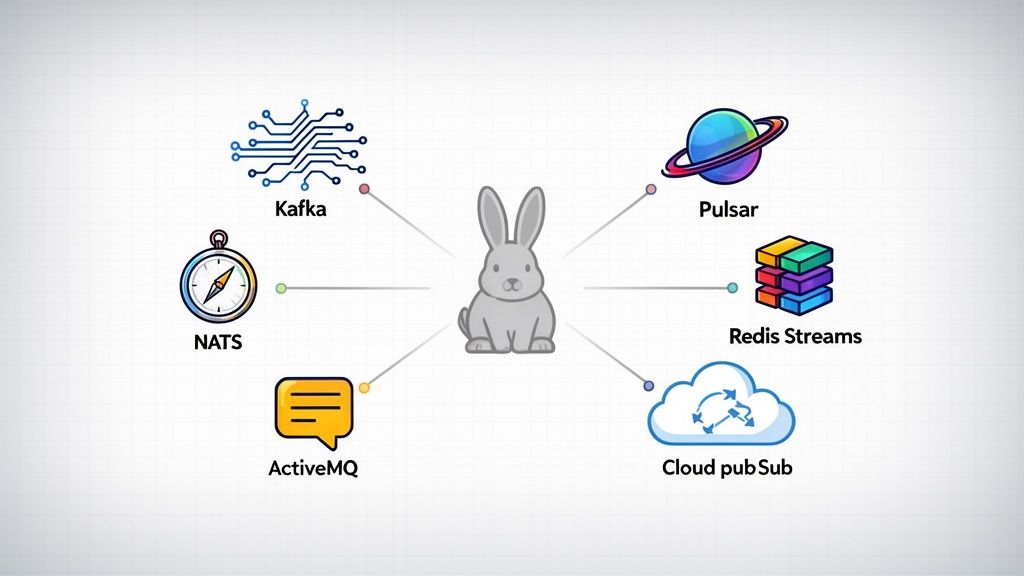
RabbitMQ is a powerful and popular open-source message broker, but its architecture and feature set aren't universally ideal for every use case. Whether you're hitting performance ceilings, struggling with operational complexity, facing scalability challenges in a cloud-native environment, or simply exploring different messaging paradigms like log-based streaming, finding the right alternative to RabbitMQ is crucial for building resilient and efficient distributed systems. This guide is designed to help you navigate the complex landscape of modern messaging and streaming platforms, moving beyond surface-level feature lists to provide a deep, practical analysis.
We will explore a curated list of twelve robust alternatives, each with its own distinct advantages and trade-offs. You'll gain a clear understanding of platforms like Apache Kafka for high-throughput data streaming, Apache Pulsar for its multi-tenancy and tiered storage, and lightweight options like NATS for high-performance edge computing. We'll also cover fully-managed cloud services such as Azure Service Bus, Google Cloud Pub/Sub, and Amazon SQS, which offer simplified operations and seamless integration within their respective ecosystems.
For each option, we'll provide an honest assessment of its strengths and limitations, outline specific use-case scenarios where it excels, and offer key implementation considerations, particularly for developers in .NET and Azure environments. This resource is organised to help you make an informed decision, ensuring the messaging backbone you choose perfectly aligns with your technical requirements, operational capabilities, and long-term strategic goals. We will directly compare features, analyse cost models, and provide actionable insights to streamline your evaluation process and de-risk your migration or new implementation.
1. Confluent Cloud (Managed Apache Kafka)
For teams seeking an enterprise-grade alternative to RabbitMQ, especially those prioritising data streaming over simple task queuing, Confluent Cloud offers a powerful, fully managed Apache Kafka service. It's designed to remove the significant operational overhead of self-managing a Kafka cluster, allowing developers to focus on building event-driven applications rather than infrastructure maintenance. This platform excels in scenarios requiring high-throughput, persistent, and ordered message delivery for use cases like event sourcing, real-time analytics, and log aggregation.
Confluent Cloud stands out with its comprehensive ecosystem built around the Kafka core. It includes a Schema Registry for enforcing data contracts, ksqlDB for building stream processing applications with SQL-like syntax, and a vast marketplace of pre-built connectors for seamless integration with hundreds of data sources and sinks. For organisations operating in Europe, its broad region support, including data residency options in Frankfurt (AWS eu-central-1) and Germany West Central (Azure), is a critical feature for GDPR compliance.
Core Features & Considerations
- Deployment Options: Offers both serverless clusters for elastic scaling and dedicated clusters for predictable performance.
- Governance: Provides robust tools like Schema Registry, data lineage tracking, and Role-Based Access Control (RBAC) to manage data quality and security at scale.
- Ecosystem: The integrated connector library and ksqlDB significantly accelerate development time for data integration and real-time processing tasks.
- Cost Model: While the on-demand, consumption-based pricing provides flexibility, forecasting costs can be complex due to per-feature charges. The total cost of ownership is generally higher than a self-managed solution but is offset by reduced operational burden and SRE coverage.
- User Experience: The user interface is well-organised, simplifying cluster provisioning, topic management, and monitoring.
Website: https://www.confluent.io
2. Redpanda Cloud (Kafka‑API compatible streaming)
For development teams looking for a high-performance alternative to RabbitMQ that retains Kafka API compatibility, Redpanda Cloud is a compelling choice. It positions itself as a simpler, more efficient streaming data platform by re-implementing the Kafka protocol in C++ and eliminating dependencies on the JVM and ZooKeeper. This architecture results in faster start-up times, lower tail latencies, and a reduced operational footprint, making it ideal for latency-sensitive applications and teams wanting Kafka's power without its traditional complexity.
Redpanda Cloud’s primary advantage is its drop-in compatibility, allowing existing Kafka clients, tools, and connectors to work without modification. This significantly eases migration for teams already familiar with the Kafka ecosystem. The platform offers fully managed, dedicated clusters with transparent pricing based on throughput and retention, which simplifies capacity planning. For European organisations, Redpanda provides crucial data residency options with cluster deployments available in regions like Frankfurt (AWS eu-central-1 and GCP europe-west3), ensuring compliance with local data protection regulations.
Core Features & Considerations
- Deployment Options: Offers managed dedicated clusters with clearly defined partition and throughput limits per tier.
- Compatibility: Fully compatible with the Kafka API, enabling the use of the existing vast ecosystem of Kafka client libraries and tools.
- Performance: The JVM-less, ZooKeeper-free architecture is engineered for high throughput and consistently low-latency message processing.
- Cost Model: Provides predictable, tier-based pricing, which can be easier to forecast than pure consumption-based models. However, its connector ecosystem is less mature than Confluent's, and advanced enterprise features may be limited to higher-priced tiers.
- User Experience: The cloud console is straightforward, focusing on simplifying cluster management, monitoring key metrics, and topic configuration.
Website: https://redpanda.com
3. Amazon SQS
For teams deeply integrated within the AWS ecosystem, Amazon Simple Queue Service (SQS) presents a compelling alternative to RabbitMQ by offering a fully managed, serverless message queuing service. It entirely removes the need for infrastructure management, allowing developers to decouple microservices and distributed systems with minimal operational overhead. SQS excels at buffering requests, smoothing out workloads, and reliably handling tasks without the complexity of provisioning and scaling a message broker cluster.
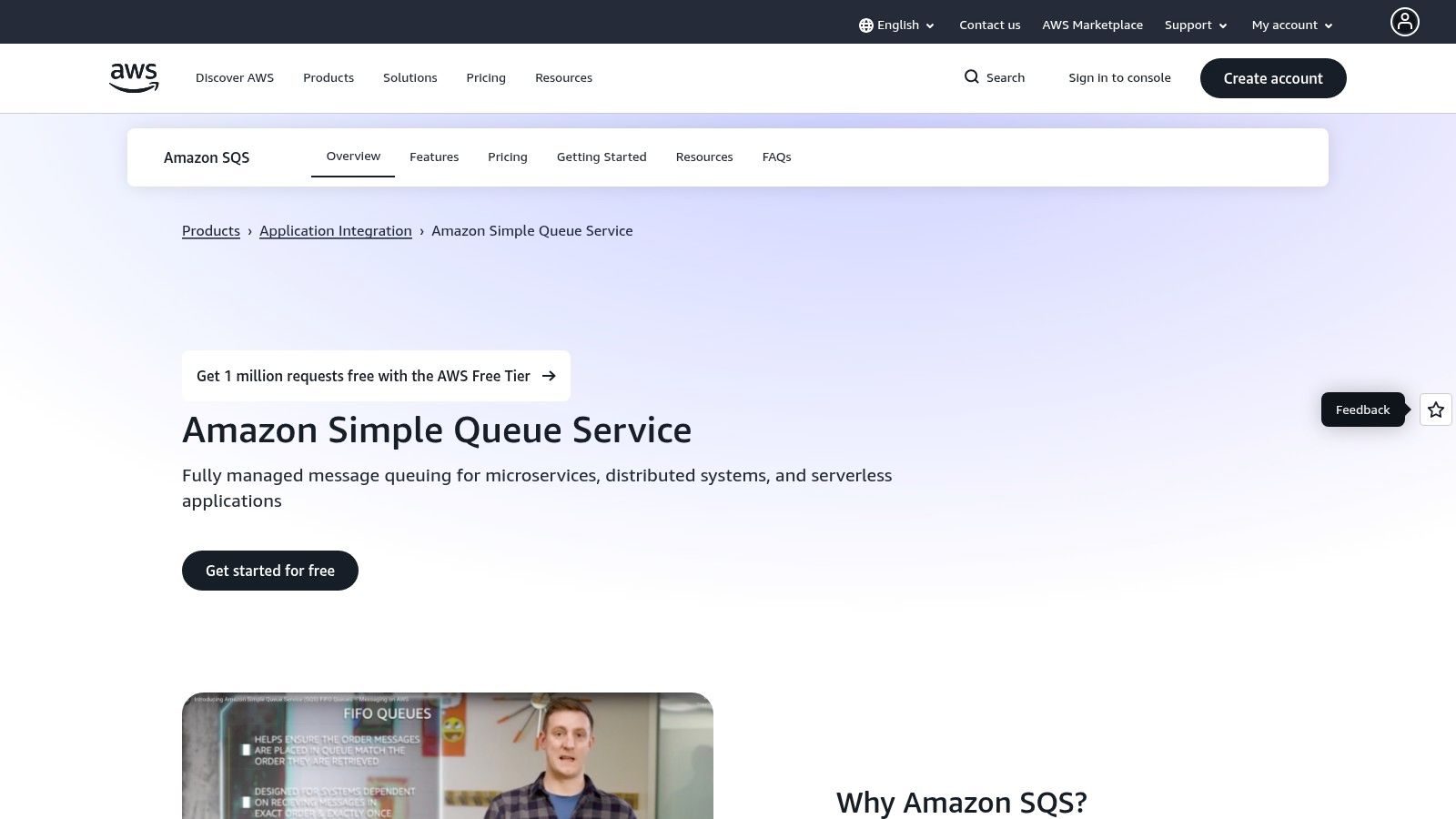
SQS stands out for its simplicity and direct integration with other AWS services like Lambda, SNS, and IAM. It offers two queue types: Standard, which provides best-effort ordering and at-least-once delivery for maximum throughput, and FIFO (First-In, First-Out) queues, which guarantee message order and exactly-once processing. For organisations in Germany and the EU, its availability in the AWS eu-central-1 region (Frankfurt) is crucial for meeting data residency and GDPR compliance requirements, making it a reliable choice for event-driven architectures built on AWS.
Core Features & Considerations
- Deployment Options: Completely serverless, with automatic scaling to handle virtually any message volume without user intervention.
- Queue Types: Supports both Standard queues for high-throughput scenarios and FIFO queues for use cases requiring strict ordering and no duplicates.
- Ecosystem: Native integration with the AWS stack is its primary strength, enabling seamless, event-driven workflows, for example, triggering a Lambda function from an SQS message.
- Cost Model: The pricing is transparent and consumption-based, with a generous free tier. Costs are primarily calculated per million requests, making it very cost-effective for many workloads.
- User Experience: Management is straightforward via the AWS Management Console, CLI, or SDKs. It prioritises operational simplicity over feature complexity.
- Limitations: It is a pure queueing service and lacks the advanced routing, exchange types, and streaming semantics (like message retention) found in brokers like RabbitMQ or Kafka. Cross-cloud portability requires custom adapters.
Website: https://aws.amazon.com/sqs/
4. Google Cloud Pub/Sub
For organisations deeply integrated into the Google Cloud Platform, Pub/Sub presents a compelling serverless alternative to RabbitMQ. It offers a fully managed, no-ops messaging service designed for global scale and high durability. This makes it an excellent choice for decoupling services, ingesting event streams for analytics, and building reliable, event-driven architectures without the burden of managing infrastructure. Its core strength lies in its simplicity and seamless integration with other GCP services like Dataflow, Cloud Functions, and BigQuery.
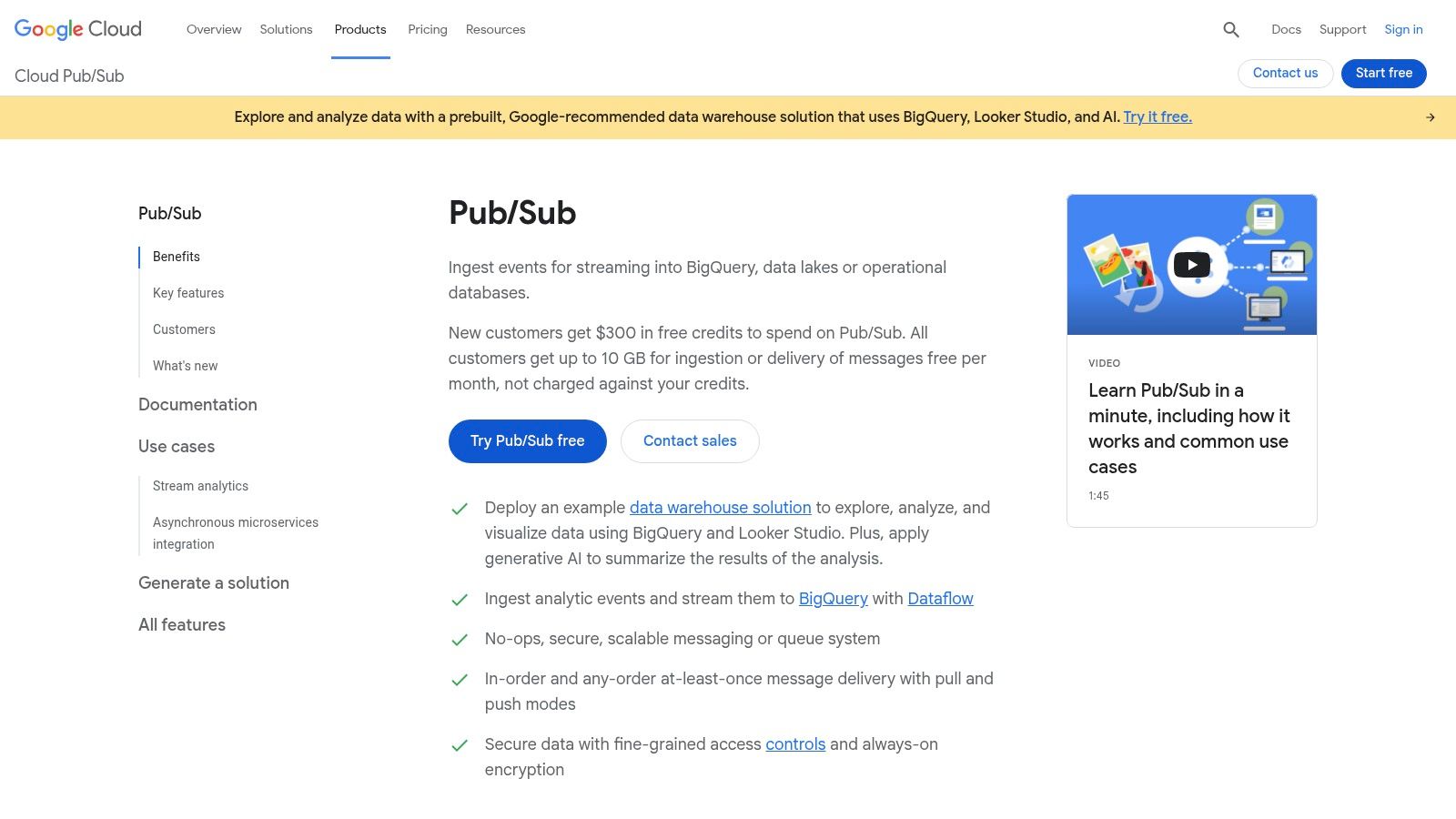
Google Cloud Pub/Sub stands out with its global-by-default architecture, allowing publishers and subscribers to operate across different regions without complex configuration. It guarantees at-least-once message delivery and offers features like message filtering and ordered delivery for specific use cases. For European businesses concerned with data sovereignty, Pub/Sub is available in numerous regions, including europe-west3 in Frankfurt, ensuring data can be processed and stored in compliance with local regulations like GDPR. The throughput-based pricing model is straightforward, making it easier to forecast costs for event-driven workloads.
Core Features & Considerations
- Deployment Options: A fully serverless offering that scales automatically based on usage, eliminating the need for capacity planning or cluster management.
- GCP Integration: Native, first-class integration with the GCP ecosystem, particularly for data analytics pipelines involving services like BigQuery and Dataflow.
- Durability & Scale: Provides durable message storage and can horizontally scale to handle massive throughput, making it suitable for large-scale event ingestion.
- Cost Model: Pricing is based on data volume (throughput), which is generally easy to understand. However, the deprecation of the lower-cost Pub/Sub Lite option may impact highly cost-sensitive users.
- Portability: As a proprietary GCP service, it lacks Kafka-API compatibility and presents a significant vendor lock-in risk. Migrating applications to or from Pub/Sub requires code changes to use its specific client libraries.
Website: https://cloud.google.com/pubsub
5. Azure Service Bus
For organisations deeply integrated into the Microsoft ecosystem, Azure Service Bus presents a compelling, fully managed alternative to RabbitMQ. It is an enterprise-grade message broker that offers both simple message queues and more complex publish/subscribe topics. This service is particularly well-suited for applications that require reliable, asynchronous communication, decoupling services, and load balancing. It natively supports the AMQP 1.0 protocol, making it a familiar environment for teams experienced with RabbitMQ.
Azure Service Bus shines with its robust set of enterprise messaging features, such as message sessions for guaranteed ordering, transactions, and dead-lettering capabilities. For businesses operating within the EU, its strong presence in regions like Germany West Central (Frankfurt) ensures data residency and helps meet GDPR compliance requirements. The seamless integration with other Azure services, including Azure Functions and Logic Apps, allows for the rapid development of serverless, event-driven architectures, making it a highly productive choice for Azure-first development teams.
Core Features & Considerations
- Deployment Options: Offered in three tiers: Basic, Standard, and Premium. The Premium tier provides dedicated resources for predictable performance, VNet integration, and geo-disaster recovery.
- Enterprise Features: Supports mature capabilities like sessions for FIFO processing, duplicate detection, scheduled delivery, and client-side batching.
- Ecosystem: Offers first-class integration with the broader Azure platform, simplifying workflows that connect various cloud services and applications.
- Cost Model: Pricing is tiered. The Standard tier has per-operation charges that can be difficult to forecast under heavy load, while the Premium tier offers a more predictable, resource-based cost structure.
- User Experience: Management is handled through the Azure Portal, CLI, or SDKs, providing a consistent and well-documented experience for Azure developers.
Website: https://azure.microsoft.com/services/service-bus/
6. StreamNative Cloud (Managed Apache Pulsar)
For organisations looking for a modern alternative to RabbitMQ that natively unifies message queuing and log streaming, StreamNative Cloud offers a fully managed Apache Pulsar service. It is designed to handle a wide range of messaging patterns, from simple task queues to high-throughput event streams, all on a single platform. This makes it an ideal choice for complex, multi-tenant environments where operational simplicity and workload consolidation are key priorities. The platform excels at providing strong isolation between tenants and topics, making it suitable for large-scale SaaS applications.
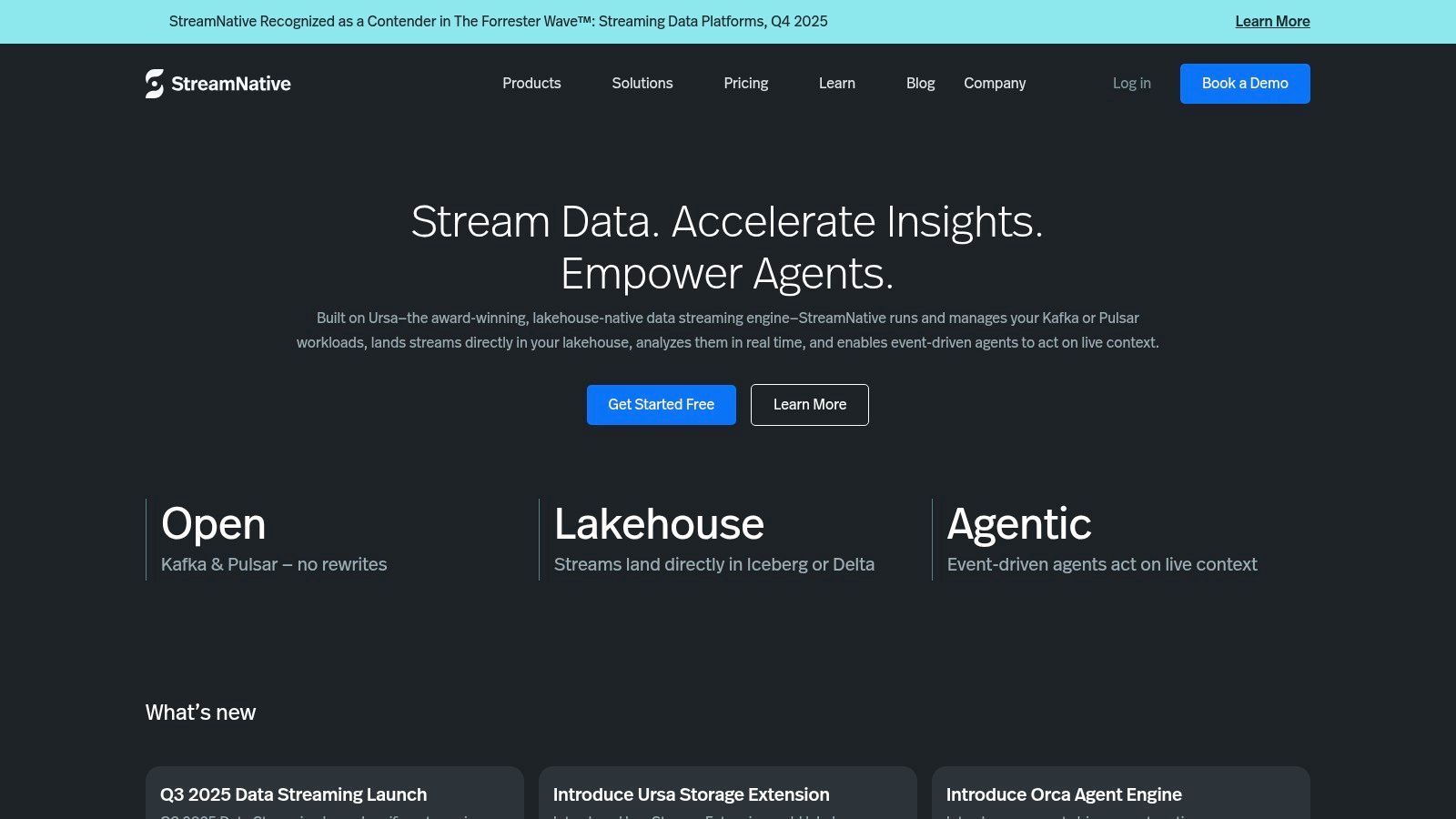
StreamNative Cloud’s architecture is a key differentiator, particularly its use of tiered storage for long-term data retention at a low cost and its built-in geo-replication capabilities for disaster recovery. It offers flexible deployment models, including a "Bring Your Own Cloud" (BYOC) option that allows data to remain within a company's own cloud account, addressing strict data residency and compliance requirements. This combination of features provides a robust foundation for building globally distributed and resilient real-time applications without the typical complexity of managing separate queuing and streaming systems.
Core Features & Considerations
- Deployment Options: Provides Serverless, Dedicated, and BYOC (Bring Your Own Cloud) clusters to suit different performance, cost, and data governance needs.
- Unified Messaging: Natively supports both queuing (competing consumers) and streaming (non-destructive consumption) models on a per-topic basis.
- Scalability & Tenancy: Architected for strong multi-tenancy, enabling secure isolation between different teams or customers on shared infrastructure and scaling to millions of topics.
- Cost Model: Pricing is measured across multiple units (Compute Units, Storage Units, Function Processing Units), which offers granular control but can add complexity to cost forecasting.
- Ecosystem: While growing, the ecosystem of connectors and tooling is less mature than Apache Kafka's, which might require more custom development for certain integrations.
Website: https://streamnative.io
7. Synadia Cloud (NATS as a Service)
For organisations building globally distributed systems where extreme low latency is paramount, Synadia Cloud offers a powerful, managed NATS.io platform. As an alternative to RabbitMQ, it excels in high-performance pub/sub and request/reply messaging patterns common in microservices, IoT, and command-and-control systems. It moves away from traditional broker-centric queueing to a high-speed, fire-and-forget messaging core, with persistence and streaming added via its integrated JetStream component.
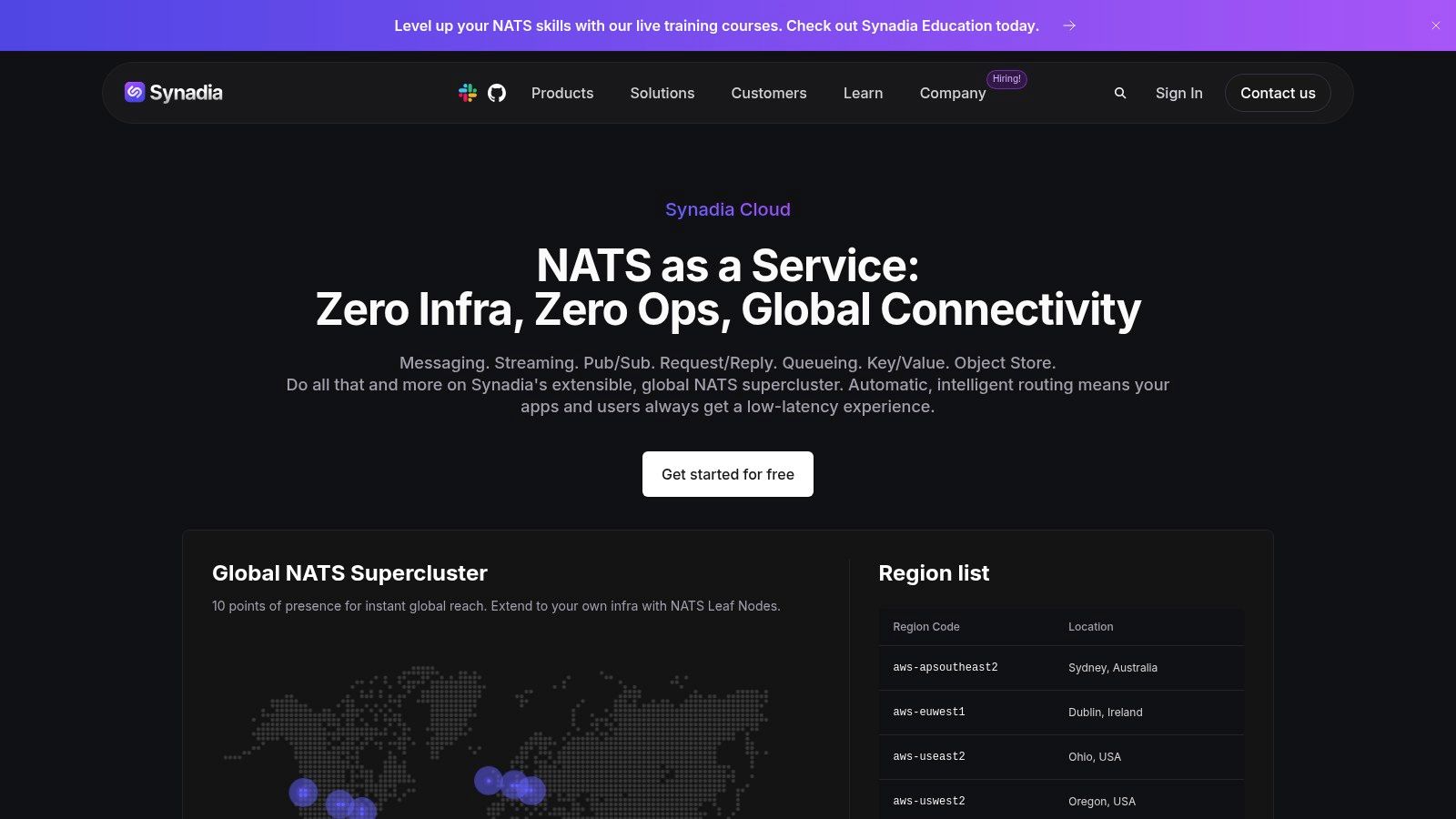
Synadia Cloud’s key differentiator is its global supercluster, which allows seamless and secure communication between services across different cloud providers and regions. This makes it a strong choice for applications requiring a unified, planet-scale messaging fabric. For European teams, its support for regions like Frankfurt (GCP europe-west3) ensures data can be processed locally to meet data residency and GDPR requirements. Its simple, predictable pricing model also contrasts with the more complex, consumption-based billing of larger hyperscale services.
Core Features & Considerations
- Performance: Built for extremely low latency and high throughput, making it ideal for real-time applications and systems requiring rapid response times.
- Deployment Model: Offers a global, multi-cloud, multi-region supercluster. Leaf nodes can extend this secure network directly into your own infrastructure, whether on-premise or in another cloud.
- Persistence & Storage: NATS JetStream provides streaming, at-least-once delivery guarantees, and key-value/object storage directly within the messaging system.
- Cost Model: Features simple, plan-based pricing with predictable limits, which simplifies budget forecasting compared to pay-per-message models. A Bring-Your-Own-Cluster (BYOC) add-on is also available.
- Limitations: While powerful, its ecosystem of connectors is smaller than Kafka's. It also focuses less on the complex enterprise queueing patterns found in platforms like IBM MQ or Azure Service Bus.
Website: https://www.synadia.com/cloud
8. IBM MQ
For organisations where transactional integrity, enterprise-grade security, and guaranteed message delivery are paramount, IBM MQ stands as a long-established and robust alternative to RabbitMQ. It has a proven track record in mission-critical environments, including finance, healthcare, and retail, where data loss is unacceptable. IBM MQ is engineered for scenarios requiring strict reliability, such as financial transactions, order processing, and integrations with legacy mainframe systems, making it a cornerstone of enterprise messaging for decades.
What sets IBM MQ apart is its deep focus on transactional messaging and its strong compliance posture. It provides exactly-once delivery patterns and comprehensive security features, including end-to-end encryption and detailed auditing, which are critical for regulated industries. Offered as both a self-managed software and a fully managed cloud service (MQ on Cloud), it provides deployment flexibility. For companies operating in the DE region, its availability across multiple cloud providers ensures data can be hosted locally to meet data residency and compliance requirements.
Core Features & Considerations
- Deployment Options: Available as traditional software, a containerised image for Kubernetes, and a managed service on major public clouds like AWS and Azure.
- Governance: Offers advanced security features, Role-Based Access Control (RBAC), and extensive auditing capabilities to meet stringent corporate and regulatory compliance standards.
- Ecosystem: Integrates seamlessly with the broader IBM software portfolio and supports standards like JMS, making it a versatile choice for complex enterprise application integration (EAI).
- Cost Model: Licensing for the self-managed version can be complex and is often perceived as having a higher total cost of ownership compared to cloud-native queues for simpler use cases. The cloud offering provides more predictable, consumption-based pricing.
- User Experience: The platform is very mature, with extensive documentation, support, and tooling. However, its complexity can present a steeper learning curve for teams accustomed to more lightweight, modern messaging systems.
Website: https://www.ibm.com/products/mq
9. Redis Enterprise Cloud (Redis Streams)
For developers already using Redis or those needing an ultra-low latency alternative to RabbitMQ that doubles as a multipurpose data platform, Redis Enterprise Cloud is an exceptional choice. It extends the familiar in-memory data store with Redis Streams, a persistent, log-like data structure that provides messaging capabilities. This allows teams to consolidate their caching, database, and message queuing infrastructure into a single, high-performance managed service, simplifying their architecture and reducing operational complexity.
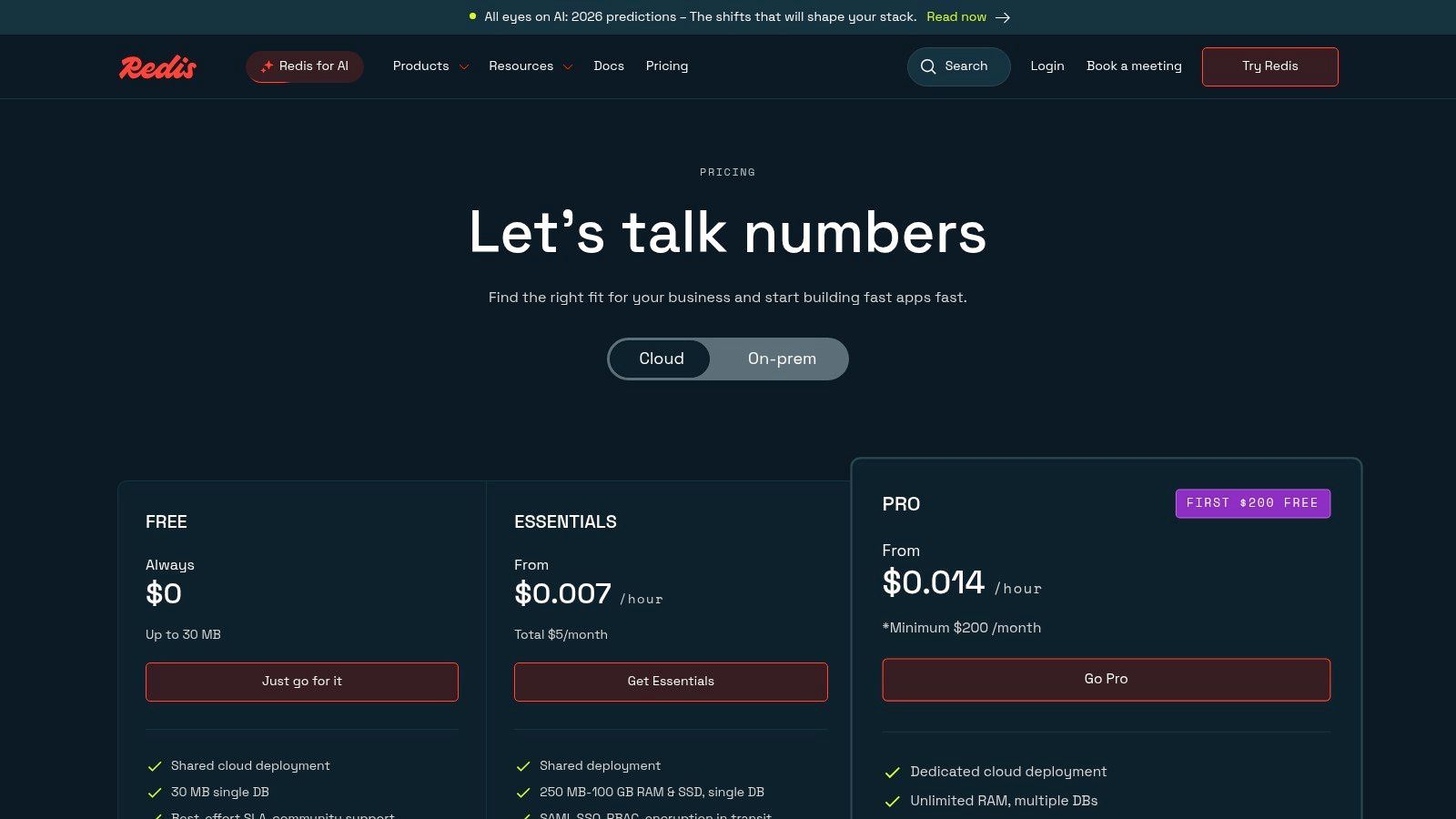
Redis Enterprise Cloud excels in use cases where speed is paramount, such as real-time notifications, session management, and fast job queuing. The platform is available across AWS, Azure, and GCP, offering extensive region selection to meet data residency needs, including multiple locations within the EU. Its fully managed nature means high availability, automated scaling, and robust persistence are handled out-of-the-box, allowing development teams to leverage Redis's power without the burden of infrastructure management.
Core Features & Considerations
- Deployment Options: Offers flexible plans from multi-tenant servers to dedicated Pro tiers with Active-Active replication and a 99.999% uptime SLA.
- Unified Platform: Combines durable messaging via Redis Streams with its core caching, pub/sub, and data structure functionalities in one unified service.
- Performance: Delivers extremely low-latency operations, making it suitable for high-throughput systems that require near-instant message delivery.
- Cost Model: Pricing is primarily based on memory footprint and feature tier. While the entry point is accessible, costs can escalate with increased memory, data persistence, and high-availability requirements.
- Learning Curve: While Redis itself is straightforward, its stream semantics differ from traditional message brokers like RabbitMQ (AMQP), potentially requiring adjustments in application logic and client-side implementation.
Website: https://redis.io/pricing
10. Aiven (Managed Kafka, Pulsar, and more)
For organisations looking for a straightforward, multi-cloud alternative to RabbitMQ, Aiven provides a compelling managed data platform focused on open-source technologies. It simplifies the deployment of complex systems like Apache Kafka and Apache Pulsar, offering them as turnkey services on your preferred cloud provider. Aiven’s core value proposition is its all-inclusive, predictable pricing model, which bundles networking, backups, and maintenance, removing the billing complexity often associated with consumption-based services.
This platform is particularly attractive for teams operating in Europe, with strong support for data residency in regions like Frankfurt (AWS eu-central-1 and Google europe-west3). This makes it easy to provision a high-performance messaging backbone alongside existing EU-based applications while adhering to GDPR requirements. Aiven’s approach abstracts away the underlying infrastructure, allowing developers to spin up a production-ready Kafka cluster in minutes via a clean, organised user interface or a powerful CLI.
Core Features & Considerations
- Multi-Cloud & Multi-Region: Deploy managed services on AWS, Google Cloud, Azure, DigitalOcean, and UpCloud, ensuring you can co-locate your data platform with your applications.
- Predictable Pricing: The all-inclusive pricing model simplifies budget forecasting, covering data transfer, VMs, and storage in a single monthly cost, which contrasts with more complex pay-per-feature models.
- Open-Source Focus: Aiven is committed to open-source, providing managed Kafka with Karapace (an open-source Schema Registry and REST Proxy) and other tools without vendor lock-in.
- Service Limitations: While excellent for core Kafka operations, the platform has less-developed governance and ecosystem features compared to specialised providers like Confluent. Lower-tier and free plans have notable throughput and data retention limits.
- User Experience: The platform is praised for its simplicity and ease of use, making it an excellent choice for teams who need to get started quickly without a dedicated DevOps team.
Website: https://aiven.io
11. Ably
For developers building client-facing realtime features, Ably provides a compelling alternative to RabbitMQ by focusing specifically on globally-distributed, low-latency pub/sub messaging. It's a managed platform designed to power live experiences like chat, data broadcasts, and collaborative applications, abstracting away the complexities of managing WebSocket connections and ensuring reliable message delivery to end-users across any device. Ably excels where the primary concern is delivering messages to and from web and mobile clients at scale, rather than traditional backend service-to-service communication.
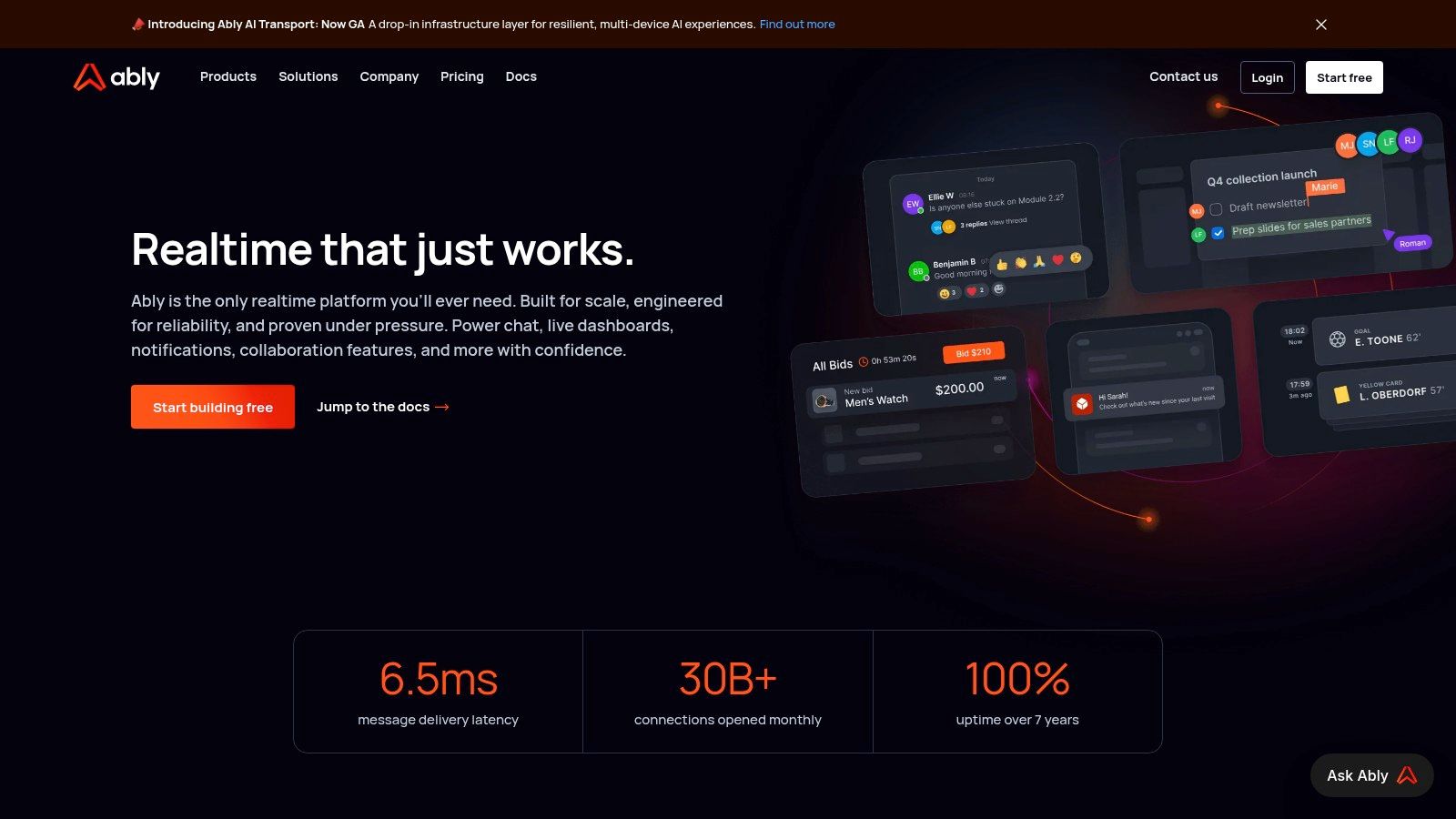
Ably differentiates itself with a rich feature set tailored for frontend applications, including channel presence to see who is online, message history for catching up on missed events, and integrations with backend systems like Kafka or Kinesis. For businesses operating within the EU, Ably offers enterprise plans with guarantees for EU-only data routing and storage, a crucial consideration for GDPR compliance. While it's not a direct replacement for an AMQP broker, it serves as a powerful, specialised tool for the realtime component of an event-driven architecture.
Core Features & Considerations
- Client Focus: Natively supports WebSockets and Server-Sent Events (SSE) with SDKs for a wide range of frontend and backend languages, simplifying client-side integration.
- Realtime Features: Built-in presence, message history, and channel state recovery are included out-of-the-box, saving significant development effort.
- Global Infrastructure: Intelligently routes messages via the lowest-latency datacentre, ensuring a fast and reliable experience for a global user base.
- Use Case Specificity: It is not a drop-in replacement for RabbitMQ's complex routing or queuing patterns; it is purpose-built for client-facing pub/sub.
- Cost Model: Pricing is transparent and usage-based, revolving around monthly message volume, peak connections, and peak channels, which is easy to understand but requires monitoring.
Website: https://ably.com
12. Apache ActiveMQ Artemis
For organisations looking for a modern, high-performance alternative to RabbitMQ that retains familiar enterprise messaging patterns, Apache ActiveMQ Artemis is a compelling choice. As the next-generation broker from the Apache ActiveMQ project, Artemis was re-architected from the ground up for superior performance and a non-blocking architecture. It is an excellent fit for those who need to self-host their messaging infrastructure on-premises or in a private cloud, offering complete control without any licensing costs.
ActiveMQ Artemis stands out due to its extensive protocol support, including JMS, AMQP 1.0, MQTT, and even STOMP, making it a highly versatile hub for integrating diverse applications. Its design prioritises speed and reliability with flexible persistence options (including AIO and JDBC) and robust high-availability (HA) clustering configurations. For teams migrating from traditional message-oriented middleware or those with deep Java expertise, Artemis provides a familiar development experience while delivering the performance expected of modern systems. It's a pragmatic option for replacing legacy systems or when vendor lock-in is a primary concern.
Core Features & Considerations
- Protocol Versatility: Supports a wide range of standard messaging protocols, ensuring broad compatibility with various clients and systems.
- Performance: Built on a fully asynchronous, non-blocking core, enabling very high message throughput and low latency.
- Operational Model: As a self-managed solution, you are responsible for all operational aspects, including deployment, scaling, monitoring, and maintenance. This offers maximum control but requires significant operational expertise.
- Cost Model: The software is completely free and open-source under the Apache 2.0 licence. Costs are limited to the infrastructure it runs on and the engineering time required to manage it.
- User Experience: Comes with a web-based management console for administrative tasks, and official Docker images are available to simplify deployment.
Website: https://activemq.apache.org/components/artemis/
12 Alternatives to RabbitMQ — Feature Comparison
| Service | Core features ✨ | Reliability / UX ★ | Value / Pricing 💰 | Ideal audience 👥 | Key strength 🏆 | |---|---:|:---:|:---:|:---:|:---:| | Confluent Cloud (Managed Apache Kafka) | Managed Kafka, Connectors, ksqlDB, Schema Registry, Governance ✨ | ★★★★★ — mature SRE & tooling | 💰 Higher TCO; enterprise pricing, per‑feature costs | 👥 Enterprises needing governance & EU data residency | 🏆 Best-in-class Kafka ecosystem & governance | | Redpanda Cloud (Kafka‑API compatible) | Kafka‑API compatible, JVM‑less engine, high throughput, clear tier limits ✨ | ★★★★ — low ops, high perf | 💰 Lower ops cost; predictable tier specs | 👥 Teams wanting Kafka compatibility + low latency | 🏆 Kafka compatibility with simpler ops | | Amazon SQS | Serverless queues (Standard & FIFO), DLQs, AWS integrations ✨ | ★★★★★ — serverless scale & reliability | 💰 Per‑request pricing; low cost + free tier | 👥 AWS‑centric teams needing simple queueing | 🏆 Minimal ops with tight AWS ecosystem fit | | Google Cloud Pub/Sub | Global durable pub/sub, ordering, filtering, GCP integrations ✨ | ★★★★★ — global scale & durability | 💰 Throughput‑based, no‑ops pricing | 👥 GCP users building analytics/ingestion pipelines | 🏆 Seamless integration with Dataflow/BigQuery | | Azure Service Bus | Queues & topics, AMQP 1.0, sessions, geo‑DR, VNET ✨ | ★★★★ — enterprise messaging features | 💰 Predictable Premium for advanced features | 👥 Azure‑first enterprises needing JMS/AMQP | 🏆 Enterprise MQ semantics + Azure integration | | StreamNative Cloud (Apache Pulsar) | Pulsar (stream+queue), tiered storage, multi‑tenancy, geo‑replication ✨ | ★★★★ — powerful but different model | 💰 Flexible but multi‑unit pricing (CUs/SUs) | 👥 Teams needing long retention & multi‑tenant scale | 🏆 Unifies queueing & streaming at scale | | Synadia Cloud (NATS as a Service) | NATS core + JetStream, KV store, global routing, leaf nodes ✨ | ★★★★★ — ultra‑low latency & small footprint | 💰 Plan‑based, predictable pricing | 👥 Microservices needing sub-ms pub/sub | 🏆 Extremely low latency + simple pricing | | IBM MQ | Transactional MQ, JMS support, encryption, mainframe integration ✨ | ★★★★ — enterprise‑grade reliability | 💰 Higher cost; complex licensing | 👥 Regulated industries & mainframe users | 🏆 Exactly‑once guarantees & compliance posture | | Redis Enterprise Cloud (Redis Streams) | Redis Streams + caching, HA, Active‑Active, persistence ✨ | ★★★★★ — ultra‑low latency & multipurpose | 💰 Cost grows with memory/HA needs | 👥 Apps needing cache + stream in one platform | 🏆 Low latency + combined cache/data‑store | | Aiven (Managed OSS: Kafka, Pulsar, etc.) | Managed OSS services, Schema Registry, multi‑cloud, backups ✨ | ★★★★ — transparent managed OSS | 💰 All‑inclusive & predictable pricing; free trial | 👥 Teams wanting managed OSS multi‑cloud | 🏆 Predictable pricing + multi‑cloud flexibility | | Ably | Realtime pub/sub, presence, history, WebSockets/SSE ✨ | ★★★★★ — fast front‑end integration | 💰 Usage‑based pricing (messages/connections) | 👥 Realtime apps, mobile & web front‑ends | 🏆 Rich realtime primitives (presence, history) | | Apache ActiveMQ Artemis | JMS, AMQP, MQTT, flexible persistence, clustering ✨ | ★★★★ — high performance (self‑managed) | 💰 Open‑source — no license cost (ops cost applies) | 👥 On‑prem / self‑hosted teams needing MQ semantics | 🏆 Familiar enterprise MQ semantics without licensing |
Final Thoughts
The journey to find the perfect messaging system is often less about finding a single "best" tool and more about discovering the right fit for your specific architectural needs, operational capacity, and business objectives. While RabbitMQ has long been a reliable and feature-rich choice, the modern distributed systems landscape demands a more nuanced approach. The need for a robust alternative to RabbitMQ often arises from evolving requirements around data volume, throughput, persistence, and cloud-native integration.
Throughout this guide, we've explored a diverse array of powerful contenders. We have seen how systems like Apache Kafka, Redpanda, and Apache Pulsar have redefined high-throughput stream processing, making them ideal for event-sourcing, real-time analytics, and large-scale data ingestion pipelines. Their log-based architecture offers unparalleled durability and the ability to replay messages, a paradigm shift from traditional queue-based brokers.
Conversely, we examined cloud-native managed services like Azure Service Bus, Amazon SQS, and Google Cloud Pub/Sub. These platforms excel in providing immense scalability and reliability with minimal operational overhead. For development teams, particularly those in .NET and Azure environments, the deep integration and pay-as-you-go pricing models of these services present a compelling case for offloading infrastructure management and focusing purely on application logic.
Synthesising Your Decision: Key Takeaways
Choosing your messaging backbone is a critical architectural decision with long-term consequences. As you deliberate on the ideal alternative to RabbitMQ for your project, synthesise your findings by focusing on these core principles:
- Message Delivery Semantics: Do you need at-least-once, at-most-once, or exactly-once delivery guarantees? Tools like Kafka and Pulsar offer stronger guarantees that are critical for financial transactions or data integrity, whereas a simple queue like SQS might be sufficient for less critical, idempotent tasks.
- Architectural Paradigm: Are you building a traditional task queue system or a modern event-driven, stream-processing architecture? Your choice here is the most significant fork in the road. AMQP-based systems like ActiveMQ Artemis align with the former, while log-based platforms are built for the latter.
- Operational Burden vs. Control: Evaluate your team's expertise and willingness to manage complex infrastructure. Self-hosting Kafka or Pulsar offers maximum control and customisation but demands significant operational investment. Managed services like Confluent Cloud, Aiven, or native cloud pub/sub offerings abstract this complexity away at a premium.
- Ecosystem and Integration: Consider the tooling and client library support for your primary technology stack. For .NET developers, the seamless integration of Azure Service Bus can accelerate development. Similarly, the vast ecosystem surrounding Kafka provides a rich set of connectors and tools for almost any use case imaginable.
- Performance and Scale Profile: Be realistic about your current and future needs. While the multi-million messages per second benchmarks of systems like Redpanda and NATS are impressive, they may be overkill for your application. Conversely, choosing a system that cannot scale with your growth will lead to costly re-architecture down the line.
Your Next Steps
The path forward involves moving from theoretical analysis to practical evaluation. We recommend a phased approach:
- Shortlist: Based on the criteria above, select your top two or three candidates.
- Prototype: Develop a small-scale proof-of-concept for each shortlisted tool. Simulate a core business process, focusing on publisher and consumer logic, error handling, and monitoring.
- Benchmark: Conduct performance tests that reflect your expected production load. Measure latency, throughput, and resource consumption under various conditions.
- Evaluate: Assess the developer experience, documentation quality, and community support for each option. A tool is only as good as your team's ability to use it effectively.
Ultimately, the best alternative to RabbitMQ is not a one-size-fits-all answer but a strategic choice that aligns with your technical vision and empowers your team to build resilient, scalable, and maintainable systems.
Navigating the complexities of architectural decisions and technical recruitment can be challenging. Acquispect provides specialised talent acquisition and consulting to help you build the elite engineering team needed to implement and manage sophisticated systems like the ones discussed. Find the expert developers and architects who can master any messaging platform by visiting Acquispect.