Remote call centre jobs are a fantastic way to build a career from home, whether you're helping customers solve problems or making sales calls. At its heart, the job requires solid communication skills, a decent internet connection, and a quiet corner to work from. For many, it's the perfect entry point into the world of remote work.
Getting to Grips with the Remote Call Centre Scene
Jumping into the world of remote call centre jobs means getting to know a field that's bigger and more varied than you might think. The old picture of a noisy office packed with cubicles is fading fast. Today, it’s all about a network of skilled agents working from their own homes all across Germany. This move brings a ton of flexibility, but it also means there are different kinds of roles and expectations to understand before you start applying.
And this industry isn't just getting by—it's booming. Germany's call centre sector has been growing steadily, hitting a market value of around €7.6 billion after expanding by 2.8% each year for the past five years. With over 1,025 businesses in this space, the need for good remote agents is stronger than ever. If you're curious, you can explore more data on Germany's call centre industry to see the full picture.
Inbound vs. Outbound: The Two Sides of the Headset
Every call centre job boils down to one of two things: inbound or outbound. Figuring out which one suits your personality is the first real step in your job search.
Inbound Roles: This is all about customer service. You're the one people call when they have questions, need help with a product, or have a problem that needs fixing. To do well here, you need to be a great listener, show empathy, and enjoy finding solutions.
Outbound Roles: This is the proactive side of things, usually focused on sales, finding new leads, or doing market research. You’ll be the one making the calls to offer a new service, follow up on a query, or get feedback. It's a great fit if you're persuasive, love hitting targets, and don't get discouraged easily.
The real secret is matching your personality to the job. If you genuinely get a kick out of helping people, you'll thrive in an inbound role. But if you're driven by goals and enjoy the challenge of persuasion, you'll feel right at home in an outbound position.
A Snapshot of Common Remote Call Center Roles
To make it even clearer, let's break down some of the most common roles you'll come across. This table gives you a quick look at what each job involves, the skills you'll need, and the kind of hours you can expect.
| Role Type | Primary Responsibilities | Key Skills | Common Schedules | | :--- | :--- | :--- | :--- | | Customer Service Representative | Answering questions, resolving complaints, processing orders, and providing product information. | Patience, empathy, problem-solving, active listening, clear communication. | Full-time, part-time, and flexible shifts, often including weekends/evenings for 24/7 support. | | Technical Support Specialist | Troubleshooting technical issues with products or services, guiding users through fixes. | Technical knowledge, patience, step-by-step instruction, problem-solving. | Often requires 24/7 availability, so overnight and weekend shifts are common. | | Sales Development Representative (SDR) | Making outbound calls to generate leads, qualify prospects, and set appointments for sales teams. | Persuasion, resilience, goal-orientation, excellent communication skills. | Typically standard business hours (Mon-Fri, 9-5) to reach business clients. | | Telemarketer | Contacting potential customers from a list to sell products or services directly over the phone. | High energy, persistence, ability to handle rejection, persuasive speaking. | Can be full-time or part-time, often with flexible evening and weekend hours. |
Looking at these roles side-by-side helps you see exactly where your skills might fit best. Think about whether you prefer solving problems or closing deals, as that will guide you to the right job listings.
Finding a Schedule That Actually Fits Your Life
One of the biggest perks of working in a remote call centre is the scheduling flexibility. Forget the rigid 9-to-5 grind; these roles are often designed to work for different kinds of people.
What do you actually need? Are you after a stable, full-time gig? Or do you need something that can fit around your university timetable or family duties?
- Full-Time: This usually means a 35-40 hour week. It’s the way to go if you want a steady salary and, in many cases, company benefits.
- Part-Time: Perfect for students or anyone juggling other big commitments. You’re looking at around 15-25 hours a week with a lot more flexibility.
- Flexible Shifts: Many companies need people round-the-clock, which opens up evening, overnight, and weekend shifts. This is ideal for night owls or anyone who needs to work outside of the typical workday.
The right schedule can make all the difference. Be honest with yourself about when you're most productive and what you can realistically commit to. Nailing this down from the start helps you filter out the noise and focus on the jobs that are a genuine match for your life.
Finding and Vetting Quality Job Listings
Knowing where to look for high-quality remote call centre jobs is the first real hurdle in landing a role you'll actually enjoy. A quick online search can throw a tidal wave of listings at you, but a more focused approach will make all the difference. By zeroing in on the right platforms, you can cut through the noise and connect directly with reputable employers who are actively hiring in Germany.
The good news is that the market for these roles is getting bigger. Germany's call and contact centre outsourcing sector is on track to grow at a compound annual rate of 6.6%, which translates to a steady stream of new opportunities. Some platforms are already showing over 440 remote call centre positions in Germany, highlighting the strong demand. Just keep in mind that for most of these roles, being proficient in German is non-negotiable. You can dive deeper into the numbers by reading the full research on Germany's call centre market growth.
Where to Focus Your Search
Instead of spreading yourself thin across dozens of generic sites, concentrate your energy where it counts. This strategy not only saves you time but also dramatically improves your chances of finding legitimate, well-paying work.
- Niche Job Boards: Websites that live and breathe remote work, like Remote.co, or industry-specific portals are goldmines. They often have vetted listings because they cater specifically to a remote workforce, so the quality is usually a cut above the rest.
- Major Job Aggregators: Giants like Indeed.de and StepStone.de are powerful, but you have to master their search filters. Get specific with keywords like "home office call centre," "remote kundenberater," or "virtual customer service" to filter out the irrelevant noise.
- Company Careers Pages: Got your eye on a few dream companies? Head straight to their websites. Many large organisations, such as Sutherland or Teleperformance, post new remote openings on their own careers pages before anywhere else. It also shows genuine initiative on your part.
- Professional Networks: LinkedIn is more than just a place to post your CV; it's a powerful networking tool. Follow companies you admire, connect with recruiters in the customer service sector, and join groups dedicated to remote work in Germany. Recruiters often share exclusive openings there first.
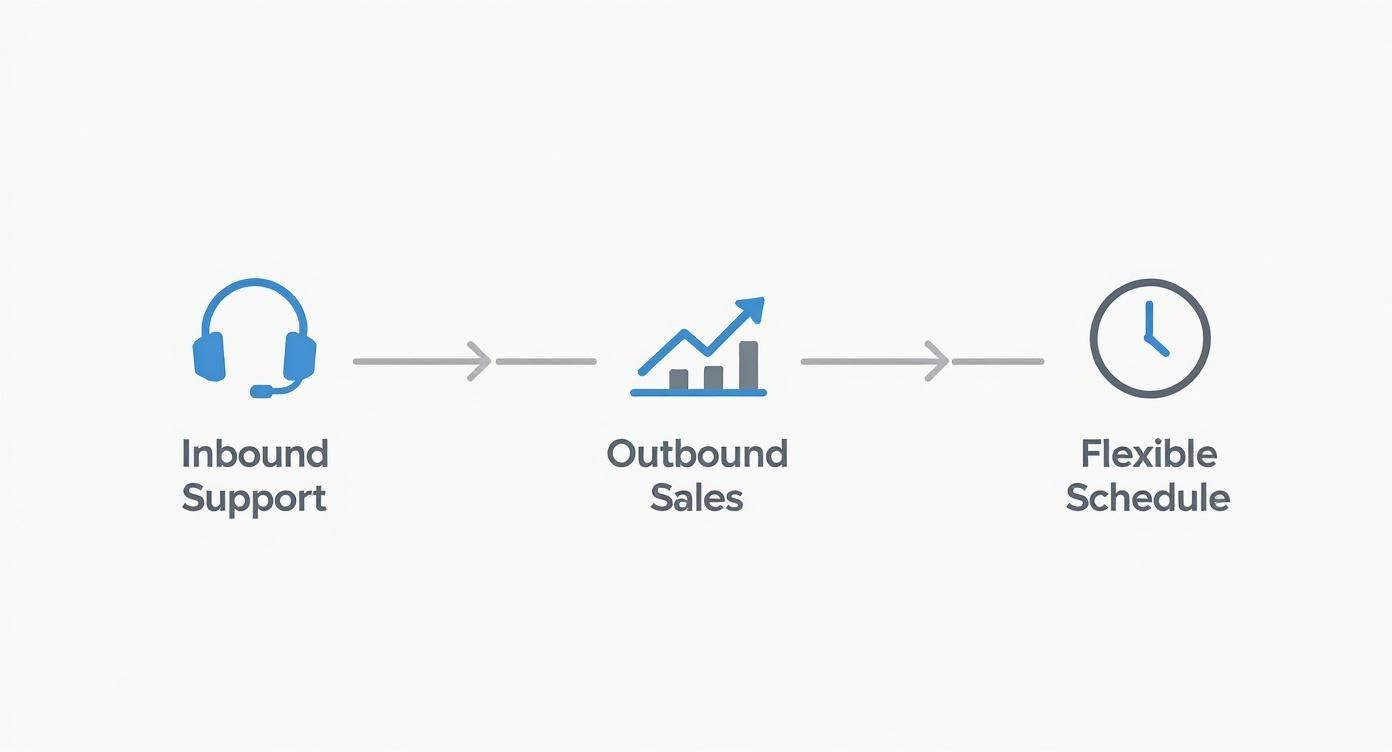
Getting a feel for these different paths—whether it's inbound support, outbound sales, or something with a more flexible schedule—helps you narrow your search and tailor your applications to the jobs that truly fit your skills and lifestyle.
How to Analyse a Job Description
Okay, so you've found a listing that looks promising. Now it's time to put on your detective hat and scrutinise the details. A well-written job description is a great sign; a vague or sloppy one is an immediate red flag. Paying close attention here can save you from applying to a role that's a poor fit.
A great job description tells a story. It doesn't just list tasks; it explains the impact the role has, describes the team culture, and clearly outlines what success looks like. If it feels generic or rushed, the company might view the role the same way.
As you read through a listing, look for specific clues that point to a quality opportunity. Are the duties clearly laid out? Does the company talk about its values or what it's like to work there?
Here are the key things to look for:
- Clear Responsibilities: The description should go beyond just "answering calls." You want to see specifics like "troubleshooting technical issues via phone and chat" or "managing customer accounts in Salesforce."
- Specific Skill Requirements: Vague phrases like "good communication skills" are a given. Better listings will ask for concrete experience with certain software (e.g., Zendesk, SAP), specific language proficiency levels (e.g., C1 German), or familiarity with performance metrics (e.g., average handling time).
- Information on Training: Reputable companies invest in their people. The job ad should mention a structured onboarding or training programme to get you set up for success.
- Details on Equipment: Does the company provide a laptop and headset, or are you expected to supply your own? A clear policy on equipment is the mark of an organised, professional operation.
Trying to keep track of multiple applications and tailoring each one can feel like a full-time job in itself. Using certain features for job search automation can really help you stay organised, manage different listings, and customise your materials without losing your mind. This focused approach ensures you’re spending your valuable time on the opportunities that truly matter.
Crafting an Application That Gets Noticed
Firing off a generic application is the quickest way to end up in the 'no' pile. In the busy market for remote call centre jobs, hiring managers can spot a copy-and-paste CV from a mile away. To actually get noticed, your application needs to tell a story—one that clicks perfectly with what the company is looking for.
This means you need to go beyond a simple laundry list of past duties. Instead, you have to showcase your specific talents in communication, problem-solving, and tech. A tailored application doesn’t just show what you've done; it shows what you can do for them. It’s your very first chance to prove you’re a resourceful and detail-oriented person, which are non-negotiable traits for any remote role.

Decoding the Job Description for Keywords
Before you type a single word, your first job is to become a detective and analyse the job description. Think of it as a cheat sheet. It’s packed with all the keywords and skills the company really cares about. I always recommend printing it out or copying it into a document and literally highlighting every skill, piece of software, and responsibility they mention.
You'll start to see patterns. Look for things like:
- Hard Skills: These are the specifics, like experience with Zendesk or Salesforce, a certain typing speed (WPM), or language fluency (e.g., German C1).
- Soft Skills: You’ll see phrases pop up again and again, like "active listening," "empathy," "conflict resolution," and "time management."
- Company Values: Pay attention to words that describe their culture. Are they "customer-obsessed," "collaborative," or "proactive"?
Once you have this list of keywords, your mission is to weave them naturally throughout your CV and cover letter. This simple technique does two things: it helps your application get past the automated Applicant Tracking Systems (ATS), and it immediately tells the human recruiter, "This person gets it."
Structuring Your CV for Impact
Your CV isn’t just a history lesson of your career; it’s a marketing document, and you're the product. For remote call centre positions, you need to laser-focus on quantifiable achievements and skills that matter for the role.
The Professional Summary
Ditch the old-fashioned "Objective" section. It's outdated. Replace it with a punchy Professional Summary right at the top. This is your 2-3 sentence elevator pitch designed to hook the reader immediately.
- Here's a simple formula:
- "Dedicated Customer Service Professional with 5+ years of experience in high-volume inbound call centres. Proven ability in resolving complex customer issues and exceeding sales targets by up to 20%. Proficient in Salesforce and eager to bring strong problem-solving skills to a remote setting at [Company Name]."
See how that works? It's concise, loaded with relevant keywords, and customised for the specific job.
Showcasing Achievements with the STAR Method
To make your experience feel real and impactful, use the STAR method to describe what you’ve accomplished. This framework moves you away from just listing duties and forces you to show the results of your work.
- Situation: What was the context?
- Task: What was your specific goal or responsibility?
- Action: What, exactly, did you do?
- Result: What was the outcome? Use numbers!
STAR Method in Action: Instead of writing a boring line like, "Handled customer complaints," bring it to life:
"In a previous role handling escalations, I was tasked with de-escalating calls from customers upset about delivery times and retaining their business. I actively listened to their concerns, tracked their packages in real-time, and offered a goodwill discount on a future purchase. This personal approach led to a 15% increase in customer retention for my accounts and consistently high satisfaction scores."
This turns a generic duty into a powerful story of success.
Writing a Cover Letter That Connects
The cover letter is where you get to show some personality. It’s your chance to connect the dots for the hiring manager and explain why you're genuinely excited about this specific remote call centre job. My advice is to keep it brief, focused, and full of enthusiasm.
- Opening Paragraph: Name the position you're applying for and show real excitement. Mention something specific you admire about the company—maybe its mission, a product you love, or a recent achievement you read about.
- Body Paragraphs: Don't just rehash your CV. Pick one or two of your proudest achievements and expand on them, maybe using the STAR method again. Explicitly connect your skills to the requirements they listed in the job description.
- Closing Paragraph: Reiterate your strong interest and end with a clear call to action. Say you're available for an interview and end on a confident note about how you can contribute to their team.
For more deep-dives and fresh ideas on crafting winning applications, the resources on our JobCoPilot blog are a great place to continue learning. Staying on top of the latest best practices can give you a real advantage. Remember, a thoughtful, well-crafted application is the most important tool you have for landing the remote job you want.
Navigating the Remote Interview with Confidence
https://www.youtube.com/embed/PpbhaVjV2QI
Getting the interview for a remote call centre role is a big step, but the interview itself brings a unique set of hurdles. Unlike meeting in person, every detail of your digital setup is under scrutiny—from the stability of your internet to the professionalism of your background. To really nail it, you need to master both your tech setup and the specific questions designed to test if you've got what it takes to work from home.
It all begins with a flawless technical foundation. Honestly, nothing tanks an interview quicker than a choppy video or crackling audio. A few days before the call, do a full tech rehearsal. You’ll thank yourself later when you're not scrambling to fix something at the last minute.
Perfecting Your Pre-Interview Checklist
Think of your interview space as a temporary film set where you're the star. The aim is to create a professional, quiet environment that lets your skills and personality take centre stage.
- Test Your Connection: Run a speed test. If you can, plug directly into your router with an Ethernet cable instead of relying on Wi-Fi. It’s far more stable.
- Check Your Hardware: Give your webcam and headset a trial run. Is the picture clear? Can you be heard without any annoying background static? A quick call with a friend is an easy way to check.
- Set the Scene: Choose a simple and tidy background. A neutral-coloured wall or a neat bookshelf works perfectly. Try to avoid sitting in front of a busy room, an open door, or a window that will silhouette you.
- Lighting is Key: Make sure the main light source is in front of you, not behind. This lights up your face and gets rid of any weird shadows. Natural light from a window is usually best if you have one.
The goal of your setup is to make the technology invisible. When the interviewer isn't distracted by poor audio or a busy background, they can focus entirely on you and what you have to say.
Once your tech is sorted, it’s time to prep for the questions. Remote interviews often dig deeper than the standard job queries. The hiring manager needs to feel confident that you have the self-discipline, communication skills, and problem-solving grit to excel without a manager watching over you.
Answering Common Remote Work Questions
You should definitely expect questions that gauge your independence and readiness for remote work. They want to know how you operate when you're on your own. Be ready with concrete examples that show, not just tell, them you're the right person for the job.
Here are a few common ones and how you might tackle them:
"How do you stay motivated and productive when working alone?"
- What they're really asking: Can you manage your own time and stay on task without direct supervision?
- How to answer: Talk about your routine. Mention how you structure your day, the tools you use (like calendars or to-do lists), and how you set personal goals. For example, "I'm someone who thrives on structure, so I start each day by outlining my key priorities. I use a time-blocking technique to dedicate specific periods to tasks, which keeps me focused and minimises distractions."
"Describe a time you handled a difficult customer without face-to-face interaction."
- What they're really asking: Can you show empathy and solve problems effectively over the phone or through a screen?
- How to answer: This is the perfect time to use the STAR method (Situation, Task, Action, Result) to tell a short, powerful story. Set the scene with a specific customer issue, explain what you needed to achieve, detail the steps you took to de-escalate things, and wrap up with the positive outcome.
"What is your experience with [specific software, e.g., Zendesk, Salesforce]?"
- What they're really asking: How quickly can you learn our tools and start contributing?
- How to answer: Be honest. If you know the software, great! If not, talk about similar platforms you've used and highlight how quickly you pick up new technology. You could say something like, "While my primary experience is with HubSpot, I've reviewed tutorials for Zendesk and noticed many parallels in ticketing and customer management. I'm confident I could become proficient very quickly."
Putting in the effort to prepare thoughtful, evidence-based answers shows you’ve seriously considered the reality of the role. It proves you're not just looking for any job, but that you are specifically equipped for the unique demands of a remote call centre job.
Creating a Productive Home Office Environment
Landing a remote call centre job is a huge win, but your long-term success really depends on what happens next. Thriving as a work-from-home professional means you have to deliberately create an environment built for focus and productivity. It’s about so much more than just having a laptop on your kitchen table; it’s about setting up the physical and mental space to truly do your best work.
The shift to home-based roles is a massive part of the modern German job market. Right now, there are over 770,000 open positions across the country, with cities like Berlin and Frankfurt emerging as major hubs for remote work. Because this model is now so common, companies expect a high degree of professionalism and self-discipline from their remote teams. You can get more insights on Germany's strong job market over at AccessFuture.net.
Building Your Technical Foundation
First things first: you need the right gear. For any remote call centre jobs, a stable and reliable tech setup is completely non-negotiable. It's your direct link to customers and colleagues. Dropped calls or a lagging system aren't just minor annoyances—they directly hit your performance metrics.
Most employers will give you a list of minimum requirements, but here’s a solid checklist of what you'll almost certainly need:
- A High-Speed, Wired Internet Connection: Wi-Fi is fine for browsing, but for the crystal-clear audio needed for VoIP (Voice over Internet Protocol) systems, nothing beats an Ethernet cable plugged directly into your router. It’s all about stability.
- A Capable Computer: You'll need a modern laptop or desktop with enough RAM and processing power to juggle multiple apps at once—think CRM software, team chat, and your phone system—without everything grinding to a halt.
- A Noise-Cancelling Headset: This is probably your most important piece of kit. A high-quality, comfortable headset with a noise-cancelling mic ensures the customer hears you perfectly, not the delivery driver at your door.
Think of these items as your professional toolkit. Investing in them (or making sure your employer provides them) is the foundational step for a smooth workday.

Designing a Distraction-Free Workspace
Once your tech is sorted, it's time to carve out a physical space dedicated solely to work. The kitchen table might seem like a good idea for a day or two, but it quickly blurs the line between your personal and professional life, which is a fast track to burnout.
A dedicated workspace helps your brain click into "work mode" when you sit down and, just as importantly, helps it switch off when you leave. It doesn't have to be a whole separate room (though that's the dream!). A specific corner of a room works perfectly well, as long as it's organised for focus.
The real power of a dedicated workspace is psychological. It creates a boundary that tells you—and everyone else in your home—that when you're in this spot, you're on the clock and focused on your job.
This separation is the key to maintaining a healthy work-life balance, which is often the biggest hurdle for new remote workers.
Establishing a Consistent Daily Routine
The freedom of working from home can be a bit of a double-edged sword. Without the built-in structure of a commute or office life, it's incredibly easy for your schedule to fall into chaos. That's why building a consistent daily routine is your secret weapon for productivity.
A structured day keeps you disciplined and helps ensure you're actually logging off at a reasonable time. Try to build these habits into your life:
- Stick to set hours. Treat your remote job like any other. Waking up, getting dressed, and starting work at a consistent time signals to your brain that the workday has officially begun.
- Schedule your breaks. Don't just take breaks whenever you feel tired. Block out proper time in your calendar for lunch (away from your desk!) and a couple of short 10-15 minute breathers to stretch and reset.
- Create a "shutdown" ritual. When your shift ends, do something that marks the transition from work to personal time. It could be as simple as closing all your work tabs, putting your headset away, or going for a quick walk around the block.
This kind of structure helps you avoid that dreaded feeling of being "always on." It puts you back in control of your day, helping you not just land one of the many remote call centre jobs out there, but truly excel in it.
Answering Your Top Questions About Remote Call Centre Jobs
Diving into the world of remote call centre work often brings up a few key questions. It's completely normal to want clarity before you start applying. Let's walk through some of the most common things people ask, so you can move forward with confidence.
What Kind of Tech and Equipment Will I Need?
This is usually one of the first things people wonder about, and for good reason! Your home office setup is your new workplace.
Most companies will give you a specific list, but you can generally expect to need a reliable, high-speed internet connection—and they almost always prefer a stable, wired connection over Wi-Fi. You'll also need a decent computer or laptop that's powerful enough to run their software without a hitch.
A good-quality, noise-cancelling headset with a microphone is non-negotiable. Some employers will ship you all the necessary gear, while others provide a stipend to buy it yourself. Don't be shy about asking which it is during the interview process; it's a standard question.
Is This Just a Job, or Can It Be a Career?
Absolutely, it can be a career. Many people start in a customer service role and use it as a stepping stone to something bigger. Think of it as your entry point into a company.
If you perform well, show you're reliable, and develop your skills, you can find yourself moving up. Paths often open up to positions like:
- Team Leader
- Quality Assurance Specialist
- Corporate Trainer
- Workforce Management Analyst
Companies love to promote from within. It’s a smart way for them to keep great people and their experience, even when everyone is working remotely.
Do I Absolutely Have to Speak German?
For the German market, fluency in German is a huge advantage and, frankly, a requirement for most jobs you'll find.
However, there are exceptions. Big, multinational players like Sutherland or Teleperformance often hire for English-speaking or other language-specific teams to serve their global customers. So, if German isn't your strong suit, focus your search on those larger international companies. But to have the widest array of options in Germany, German proficiency is key.
How Does Remote Training Actually Work?
You won't just be thrown in at the deep end. Companies have gotten very good at virtual training. It's usually a well-structured mix of different methods to get you up to speed.
You can expect self-paced online courses, live training sessions over video with instructors, and even practice simulations. A lot of training programmes also involve "shadowing" where you listen in on calls with seasoned agents to get a feel for the real thing.
A solid onboarding process should include regular one-on-ones with your trainer or manager. The entire point is to make you feel supported and ready before you ever speak to a live customer.
This approach ensures you’re comfortable with the company’s products, software, and procedures, all from your own home office. For more in-depth answers, you can always find more information in our JobCoPilot help centre.
Ready to stop scrolling and start applying smarter? JobCoPilot uses AI to automate your job search, find the perfect roles, and create tailored applications in minutes, significantly increasing your chances of landing an interview. Discover how Acquispect can accelerate your job search today.