It seems like every other day there's a new headline about automation, and honestly, most of them miss the point. The real story isn't about jobs disappearing; it's about jobs changing for the better. We're moving away from the grunt work and toward roles that require real brainpower.
This shift opens up a massive range of opportunities, from programming the robots that build our cars to designing the smart software that keeps businesses running smoothly. It's a field where your ability to think strategically and solve tricky problems is what truly matters.
The Real Story Behind Automation and Your Career
Let's get one thing straight: the whole "robots are taking our jobs" narrative is tired and, frankly, wrong. What's actually happening is a fundamental shift in what "work" even means. It’s less about job loss and more about career evolution.
Think of automation as the ultimate assistant. It’s brilliant at the mind-numbing, repetitive, and even dangerous tasks that nobody enjoys anyway. This frees us up to focus on the things humans are uniquely good at:
- Strategic thinking: Seeing the big picture and making complex judgement calls.
- Creativity and innovation: Coming up with fresh ideas and better ways of doing things.
- Complex problem-solving: Untangling the knotty, unexpected issues that no machine can figure out.
It’s not a hostile takeover. It’s a partnership where technology handles the heavy lifting, allowing our own skills to shine.
From Job Replacement to Job Creation
The fear of automation leading to mass unemployment just doesn't hold up when you look at the evidence. History has shown us time and again that new technology creates entirely new industries and roles we couldn't have imagined before. It doesn't shrink the job market; it reorganises it.
A perfect real-world example is Germany's manufacturing powerhouse. Between 2011 and 2019, they installed over 60,000 industrial robots. According to the "robots took our jobs" theory, that should have been devastating for workers. Instead, they added more than 500,000 new jobs in the industrial sector during that same period.
The car industry, one of the biggest users of this tech, made up 38% of all new robot installations in 2021 and continues to be a massive employer. This flies in the face of old fears and shows automation for what it is: a catalyst for growth. You can find more insights on how automation fuels job growth.
This shift means the most valuable jobs in automation aren't just for coders. They are roles for people who can bridge the gap between machine efficiency and human ingenuity, requiring a mix of technical skill and sharp analytical thinking.
Turning Anxiety into Opportunity
So, how do you get in on this? The key is to stop worrying and start seeing where the real opportunities are. The world of automation is huge, covering everything from physical robots on a factory floor to clever software bots running an entire company's data.
Consider this guide your roadmap. We’ll break down the major job categories and the skills you need, turning any anxiety you have about the future into a clear, actionable career plan. This is your chance to build a stable and genuinely exciting future in a field that's only going to get bigger.
Charting Your Course in the Automation World
The world of automation isn’t a single, monolithic career path. Think of it more like a vast territory with distinct regions, each with its own landscape, language, and opportunities. Getting a handle on these core domains is your first step to finding where you fit in.
Whether you're more interested in the physical machinery that builds our world or the intelligent software that powers our decisions, there's a place for you. Let's break down the major job categories to help you map out your journey.
Robotic Process Automation: The Digital Workforce Architect
Robotic Process Automation (RPA) is all about building a digital workforce. Forget physical robots; we're talking about software "bots" that are trained to mimic human actions on a computer. These bots can log into applications, fill out forms, move files, and handle all sorts of repetitive administrative tasks—only they do it faster and with perfect accuracy.
Your entry point here is often as an RPA Developer. Using platforms like UiPath or Automation Anywhere, you'll be the one building the bots. One day you might be automating an invoicing process—teaching a bot to read PDF invoices, pull out the key data, and plug it into the company's accounting software.
As you gain experience, you could move into a Senior RPA Developer or RPA Analyst role, where the focus shifts from just building to identifying and designing the best automation opportunities. The top of this ladder is often the Automation Solution Architect, a strategic role responsible for a company's entire automation roadmap.
Industrial Automation: The Engine Room of Modern Production
This is the classic, tangible side of automation. Industrial Automation is the bedrock of manufacturing, logistics, and energy sectors. It’s all about the physical machinery—the assembly lines, the warehouse conveyor systems, and the control systems in power plants. This is a world of sensors, motors, and Programmable Logic Controllers (PLCs), the rugged computers that act as the brains for industrial equipment.
A common starting point is a Controls Engineer or PLC Programmer. You’ll be writing the low-level code that tells machines precisely what to do. That could mean programming a robotic arm to weld a car door or configuring a sorting system in an Amazon warehouse. It's hands-on, problem-solving work.
From there, the path often leads to an Automation Engineer position, where you'd be designing entire automated systems from scratch. Eventually, you could become an Automation Manager, leading teams and overseeing the automation strategy for a whole facility.
The real power of automation isn't just about replacing tasks; it's about elevating human talent. When machines handle the repetitive grunt work, people are freed up to focus on the things we do best: strategy, creativity, and complex problem-solving.
This idea is at the heart of the entire field. The technology is a tool, and human ingenuity is what makes it valuable.
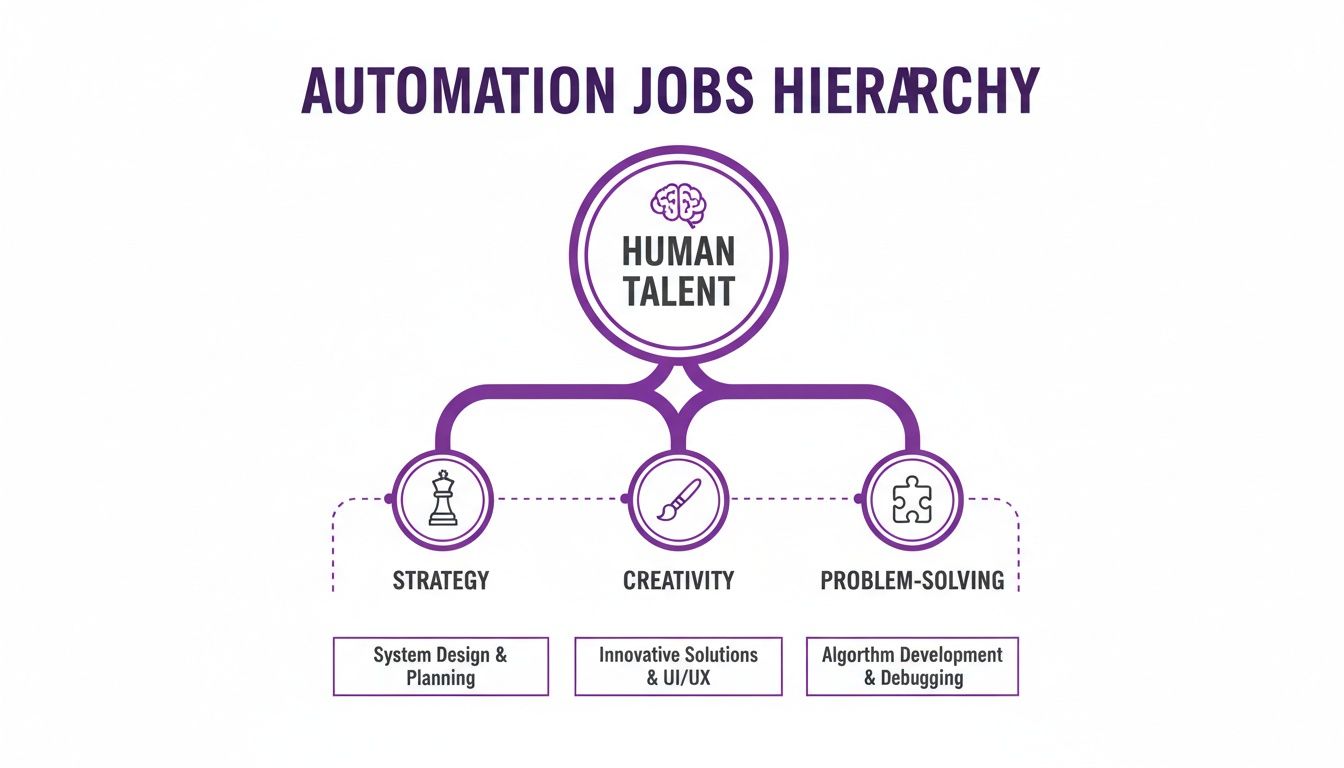
As you can see, human skill is the guiding force, directing the technology to solve meaningful problems.
AI and Machine Learning: The Brains of the Operation
If industrial automation is the brawn, Artificial Intelligence (AI) and Machine Learning (ML) are the brains. Professionals here build the intelligent systems that can learn from data, recognise patterns, and make predictions. This is the magic behind everything from Netflix’s recommendation engine to the predictive maintenance that flags a jet engine for service before it ever fails.
An AI/ML Engineer is the one who builds and deploys these learning models. They dive deep into massive datasets to train algorithms for specific tasks, like building a model that can detect fraudulent credit card transactions in real-time.
This field has several exciting offshoots:
- A Data Scientist leans more towards analysis, using statistics and ML to uncover business insights from data.
- A Machine Learning Researcher is on the front lines, creating entirely new algorithms and pushing the boundaries of what AI can do.
- A Computer Vision Engineer specialises in building systems that can interpret images and video—a critical skill for self-driving cars and medical diagnostics.
Robotics Engineering: Where Hardware and Software Collide
Robotics Engineering is where it all comes together. It’s a fascinating blend of mechanical engineering, electrical engineering, and computer science that brings intelligent software into the physical world. Robotics Engineers are the people designing everything from precise surgical assistants to the rovers exploring other planets.
As an entry-level Robotics Engineer, you might specialise in one area, like designing the gripper for a warehouse bot or writing the navigation code for an autonomous drone. Your days would be a mix of computer-aided design (CAD), soldering circuit boards, and coding in languages like Python or C++.
With more experience, you could become a Senior Robotics Engineer, taking charge of designing a complete robotic system from top to bottom. It demands a holistic understanding of how motors, sensors, power, and software must work in perfect harmony. Further on, you could become a Robotics Team Lead or Director of Robotics, managing huge projects that define the future of what's possible.
To give you a clearer picture, here’s a table summarising these key automation fields and the types of roles you can find within them.
Overview of Major Automation Job Categories
| Automation Category | Example Job Titles | Core Responsibilities | Key Industries | | :--- | :--- | :--- | :--- | | Robotic Process Automation (RPA) | RPA Developer, Automation Analyst, Solution Architect | Designing and deploying software bots to automate business processes; process analysis and optimisation. | Finance, Insurance, Healthcare, IT Services | | Industrial Automation | Controls Engineer, PLC Programmer, Automation Engineer | Designing, programming, and maintaining physical automated systems and machinery. | Manufacturing, Automotive, Logistics, Energy | | AI & Machine Learning | ML Engineer, Data Scientist, Computer Vision Engineer | Building, training, and deploying intelligent models; data analysis and predictive analytics. | Tech, Finance, E-commerce, Healthcare | | Robotics Engineering | Robotics Engineer, Mechatronics Engineer, Robotics Technician | Designing, building, and testing physical robots that integrate hardware and software. | Manufacturing, Aerospace, Medical, Defence |
As you can see, while each category is distinct, they all share the common goal of using technology to create more intelligent and efficient systems. The key is finding the area where your skills and interests align best.
The Essential Skills That Power Automation Careers
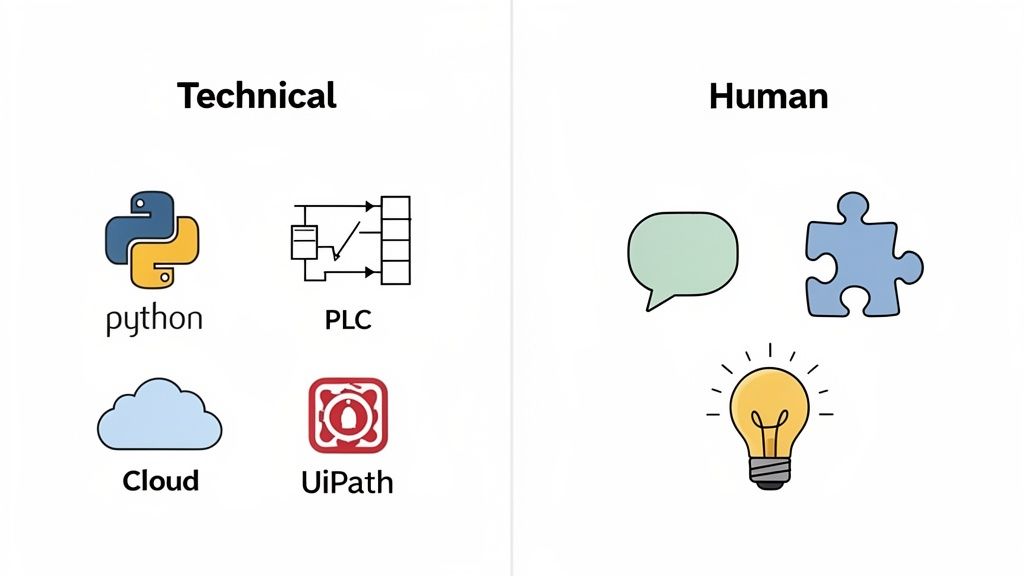
Success in automation isn't just about mastering code or machines. It's a blend of raw technical know-how and uniquely human ingenuity.
Think of it like building a high-performance race car. You absolutely need the powerful engine and a solid chassis—those are your technical skills. But without a skilled driver who can read the track, adapt to changing conditions, and make split-second decisions, that car is just a piece of metal. Those are your soft skills.
In jobs in automation, neither set of skills is optional. The most brilliant technical solution is useless if it doesn't solve a real business problem or if you can't explain it to the people who need to use it. To truly succeed, you have to be a translator, turning complex technical possibilities into tangible business value.
Mastering the Technical Toolkit
While the specific tools change depending on your specialisation, a core set of hard skills forms the bedrock of most automation careers. These are the hands-on abilities you need to build, deploy, and manage automated systems.
A strong grasp of programming is usually the jumping-off point. Python has become the Swiss Army knife for automation, perfect for everything from data science and machine learning to scripting simple tasks. Other languages like C++ and Java are also vital, especially in robotics and more intricate software development.
Beyond general programming, you'll need platform-specific knowledge:
- Robotic Process Automation (RPA): If you want to build software bots, you need to be proficient in tools like UiPath, Automation Anywhere, or Blue Prism. It's non-negotiable.
- Industrial Automation: Here, it's all about Programmable Logic Controllers (PLCs). Understanding how to programme and troubleshoot systems from major players like Siemens or Rockwell Automation is a core requirement.
- Cloud Computing: Modern automation leans heavily on the cloud. Skills in platforms like Amazon Web Services (AWS) or Microsoft Azure are crucial for deploying and scaling your solutions.
An automation professional is an architect. You need to understand the properties of steel and concrete (the hard skills), but you also have to grasp the client's vision and needs (the soft skills) to create something that not only stands up but is celebrated.
The Irreplaceable Human Element
No matter how powerful technology gets, it can't replicate the nuanced skills that drive real innovation. These soft skills are what separate a good technician from a true automation leader. They are what allow you to identify the right problems to solve and to make sure the solutions actually work for people.
Problem-solving is at the heart of it all. It’s not just about fixing broken code. It’s about looking at a messy, inefficient manual process and seeing a clear path to an elegant, automated workflow. This takes real curiosity and sharp analytical thinking.
On top of that, clear communication is everything. You'll need to explain highly technical concepts to people who aren't technical, from managers to frontline workers. Articulating the "why" behind an automation project—how it will save time, reduce errors, or improve safety—is just as important as building the system itself.
This blend of skills is exactly what employers are looking for. For instance, recent studies in Germany show that when companies introduce industrial robots, it actually creates a surge in hiring for roles machines can't fill. Facilities adopting robots see an average employment increase of 5%, with new hires for technicians, engineers, and managers jumping by 24% during the adoption year. These roles all demand the very human skills we've discussed, proving that automation elevates the need for human expertise, rather than eliminating it. You can read more about the positive link between robot adoption and employment.
Ultimately, the people who thrive in automation jobs are the ones who cultivate both sides of this skill equation. They become indispensable, no matter how much the technology evolves.
How to Prove Your Automation Skills and Stand Out
In a crowded job market, your CV makes a promise, but it’s your portfolio that provides the proof. Simply listing skills under bullet points just doesn't cut it anymore. What you really need is a compelling collection of your work—tangible evidence that shows you know your stuff.
This is all about showing, not just telling. A well-put-together portfolio instantly builds trust with recruiters and hiring managers. It proves you can deliver real-world results before you even walk into the interview room.
Building Your Evidence Locker
Think of your portfolio less like a scrapbook and more like an evidence locker. Every project inside is a verifiable piece of proof that backs up your claims. This isn't a numbers game; it's about showcasing high-quality work that demonstrates specific, relevant skills. Your goal is to draw a straight line from what a company needs to what you can deliver.
For anyone working in software-focused automation roles, this is pretty straightforward. A clean, active GitHub repository is the gold standard. It’s a living, breathing showcase of your coding style, how you tackle problems, and your ability to work with others.
But what if your work is more hands-on, dealing with industrial machinery or hardware? You can still create powerful proof. Set up a home-lab project with a PLC or a microcontroller like an Arduino. Document the entire process with a detailed write-up, clear photos, circuit diagrams, and, of course, your code. This shows not just your technical chops but also your passion and self-starting attitude.
Your portfolio needs to answer the one question every hiring manager is thinking: "Can this person actually do the job?" By presenting verifiable projects, you’re giving them a confident "yes" before they even have to ask. It shifts the entire conversation from what you claim you can do to what you can prove you've already done.
Curating Projects That Get Noticed
A truly great portfolio is more than just a random collection of your work; it tells a story about your expertise and where you want to go in your career. To make a real impact, you should focus on projects that directly align with the kinds of automation jobs you're applying for.
Here are three types of projects you should prioritise:
- The Problem-Solver Project: Showcase a project where you automated a tedious, complex, or error-prone task. For an RPA developer, this might be a bot that scrapes data from several websites to auto-generate a daily report. Make sure to explain the original problem, how you solved it, and the measurable outcome (e.g., "cut manual data entry time by 95%").
- The Technical Showcase Project: Pick a project that puts your mastery of a specific technology on full display. If you're a controls engineer, maybe it's a sophisticated PLC program you wrote to control a multi-stage manufacturing process. You could provide the commented code and even a short video of the system running.
- The Collaborative Contributor Project: Contributing to an open-source automation tool is a massive plus. It proves you can navigate an existing codebase, collaborate effectively with other developers, and adhere to established coding standards—all skills that are hugely valuable to employers.
Each project in your portfolio should be properly documented. Give it a short, clear description covering the project's goal, the tech you used, what your specific role was, and a link to the code, the final product, or a detailed write-up. This curated collection of evidence is your single most powerful tool for standing out and landing the best jobs in automation.
Where to Find the Top Automation Opportunities
Knowing your value is one thing; finding the right arena to prove it is a whole other ball game. To land the best jobs in automation, you need to think beyond the usual suspects like LinkedIn and Indeed. Of course, those platforms have their place, but a smarter, multi-channel strategy will help you unearth the hidden gems that everyone else misses.
The trick is to shift from broad, hopeful searches to precise, targeted efforts. This means getting clever with advanced filters, mastering keywords specific to your niche, and exploring corners of the internet where top employers are actively scouting for talent.
Optimising Your Search on Major Job Boards
The big job boards are still incredibly useful, but only if you know how to wield them properly. Simply typing “automation job” into the search bar is a recipe for scrolling through hundreds of irrelevant listings. You have to get specific to cut through the noise.
Here are a few keyword strategies that work wonders:
- Platform-Specific Searches: Instead of being vague, search for the tools you know. Think "UiPath Developer," "Siemens PLC Programmer," or "AWS Automation."
- Skill-Based Queries: Focus on your core competencies. Try searching for "Robotics Process Automation," "Industrial Control Systems," or "Machine Learning Engineer."
- Combine with an Industry: Pair your technical skills with a sector that excites you, like "RPA in finance" or "automation in logistics."
This level of precision is what helps you zero in on roles that are a genuine match for your skills. It saves a ton of time and connects you with employers who are actually looking for someone like you.
Exploring Niche and Community-Driven Platforms
Your real competitive edge comes from looking where others don't. Niche job boards and community platforms are often where the most exciting and specialised automation opportunities are hiding. These are the places employers go when they need to find true specialists.
Look for platforms dedicated to technology and engineering, where the signal-to-noise ratio is much higher. Even better, get active in professional communities. A well-maintained GitHub profile, for instance, is more than just a portfolio; it’s a direct signal to recruiters who are hunting for proven skills.
Getting involved in industry forums or contributing to open-source projects isn't just about networking. It's a way to publicly demonstrate your passion and expertise. This alone can lead to unsolicited job offers from hiring managers who value tangible proof of skill far more than a polished CV.
Targeting Industries with the Highest Demand
Your job search becomes exponentially more effective when you focus your energy on the sectors that are crying out for automation expertise. While almost every industry is dipping its toes in automation, a few are diving in headfirst and have a massive appetite for skilled professionals.
- Manufacturing and Logistics: This is the traditional heartland of automation. The demand for PLC Programmers, Robotics Engineers, and Controls Engineers is relentless as companies push towards fully integrated "smart factories" and automated warehouses.
- Finance and Insurance: These industries are pouring money into RPA to automate tedious back-office work like claims processing, data entry, and compliance checks. This has created a huge need for RPA Developers and Automation Analysts.
- Healthcare: From automating patient records to leveraging AI for diagnostics, healthcare is a booming field for automation experts. Roles here often focus on data security, process efficiency, and RPA implementation.
This demand is often matched by a workforce that sees the upside. Take German workers, for example, where a staggering 77% of employees approve of using robots in factories. This positive sentiment comes from a belief that automation secures the country's economic edge and takes over dangerous or mind-numbing tasks, ultimately enhancing jobs rather than replacing them. You can read more about the German workers' positive outlook on workplace automation to see how this cultural acceptance fuels opportunity.
By weaving together these different channels, you position yourself perfectly to find—and land—the very best jobs in the automation field.
Building Your Future in an Automated World
An automation career isn't a destination you arrive at; it's a constant process of growth and reinvention. The roles we see today are just the starting point for what's coming next. In this field, success is all about committing to being a lifelong learner and staying adaptable.
Stop thinking of yourself as a passenger just watching technology evolve. You're an architect, actively building this new world. Every process you streamline, every bot you create, and every system you design is another brick laid in the foundation of our automated future. That mindset is your single most powerful career asset.
Owning Your Career Trajectory
The very principles that define great automation—efficiency, precision, and proven results—are the same ones that will shape your career. We're rapidly leaving behind the era where a degree was the only ticket to the game. Now, we're in a merit-based world where your verifiable skills and tangible accomplishments are what truly matter.
This is a world where what you can do is infinitely more valuable than what you claim you know. A well-documented project that solves a real-world problem speaks volumes more than any line item on a CV. This shift is a massive advantage for anyone who focuses on building concrete proof of their abilities.
In the world of automation, your career isn't something you just apply for; it's something you actively build. Your portfolio of proven work is your new CV, and your demonstrated skills are your interview. It's a fundamental move towards a true meritocracy.
Your journey begins right now. It doesn't start with a job application, but with that first line of code on a personal project or the first component you set up in your home lab. The path is clear: master new skills, build a portfolio that proves your talent, and step confidently into a future you're helping create.
The Opportunity Is Yours to Build
The need for skilled automation professionals isn't just steady—it's accelerating. Studies predict that by 2030, while 30% of current U.S. jobs could be automated, the demand for technology skills will outpace every other category. This is creating a huge opportunity for those who are ready for it.
The future doesn't belong to those who wait around for it to happen; it belongs to the people who build it. Start building yours today.
Your Questions About Automation Jobs, Answered
Jumping into a new career path always brings up a lot of questions. And when that path is in a field as fast-moving as automation, it's easy to feel a bit overwhelmed. Let's clear up some of the most common queries people have when they’re looking to get into automation.
Do I Really Need a University Degree for an Automation Job?
This is a big one. While a formal degree in engineering or computer science definitely helps and opens certain doors, it’s far from the only way in. The automation world values what you can do far more than what a piece of paper says you’ve studied.
In many areas, especially Robotic Process Automation (RPA), practical skills are king. Earning certifications from major players like UiPath or Automation Anywhere can be incredibly powerful. When it comes down to it, a portfolio showcasing a project you built yourself on GitHub often carries more weight with a hiring manager than a traditional degree. It's tangible proof of your abilities.
Where Are the Most Job Openings in Automation Right Now?
If you're looking for where the action is, two areas are absolutely booming: Robotic Process Automation (RPA) and industrial automation.
RPA is seeing huge growth in sectors like finance, healthcare, and insurance. These industries are scrambling to automate their repetitive back-office tasks, which has created a massive demand for skilled RPA Developers.
At the same time, the push towards "Industry 4.0" in manufacturing and logistics is relentless. This means there's a constant need for industrial automation specialists. Roles like PLC Programmers and Controls Engineers are the backbone of the smart factories and automated warehouses that are becoming standard.
The bottom line? The opportunities are everywhere. Whether you're drawn to the software side with RPA or prefer the hands-on world of industrial machinery, there's a role out there for you.
How Do I Build a Portfolio If I Have Zero Experience?
Starting from a blank slate is daunting, but it's more straightforward than you might think. The trick is to start small. Tackle personal projects that solve a real, even minor, problem. This is how you show initiative, problem-solving skills, and a genuine interest in the field—exactly what employers want to see.
Here are a few ideas to get you started:
- For aspiring RPA pros: Build a simple software bot to automate a task in your own life. Maybe it could organise your digital receipts or pull data from a website to update a personal spreadsheet.
- For the industrial-minded: Grab an affordable microcontroller kit like an Arduino or a starter PLC. You could build something like a small automated plant watering system and document the entire journey—code, diagrams, and a blog post explaining your process.
- For coders: Dive into GitHub and find an open-source automation project. You don't have to rewrite the whole thing. Just fixing a small bug or improving the documentation shows you can collaborate and navigate an existing codebase.
The point isn't to create something groundbreaking from day one. It’s to build tangible, verifiable proof of your skills and how you think.
At Acquispect, we believe your work should be the only proof you need. We are building the foundation for a true meritocracy where your verified skills and proven projects speak directly to opportunities, making the traditional CV obsolete. Discover how your talent can get the recognition it deserves.