Data science has become one of the most exciting and rewarding career paths out there. Think of data professionals as modern-day storytellers; they take a complex world of numbers and translate it into clear, compelling narratives that drive real business decisions. With demand for these skills at an all-time high, there's never been a better time to dive in.
Your Roadmap to a Career in Data Science
Welcome to the intersection of technology, analytics, and business strategy. A career in data science is a unique mix of rigorous analysis, technical skill, and creative problem-solving. It’s a field where genuine curiosity isn't just a bonus—it's a core requirement. The real magic happens when you can find the hidden patterns in massive datasets and use them to create value for an organisation.
This guide is your complete roadmap. Whether you're just starting to explore the field or you're a seasoned pro looking for your next move, we’ve got you covered.
Right now, Germany's tech scene is booming. There are over 137,000 openings in high-demand areas like AI and cloud computing, which has created a massive opportunity for data professionals. Data scientists are at the heart of this growth, and it shows in their paycheques. The average annual salary is around €70,492, which really underlines how much companies value these skills and makes it one of the most attractive entry points into tech. For a deeper look into this trend, you can explore more about the thriving tech job market in Germany.
What to Expect in This Guide
To help you get your bearings, we've broken down everything you need to know about landing a great data science job. We’ll start with the basics and build up to more advanced strategies you can use in your search.
Here’s a quick look at what we’ll cover:
- Defining the Roles: We’ll untangle the differences between a Data Analyst, a Data Scientist, and a Machine Learning Engineer.
- Essential Skills: A practical breakdown of the must-have technical and soft skills you'll need to succeed.
- Industry and Salary Insights: We’ll explore which industries are hiring the most in Germany and what kind of salary you can realistically expect.
- Application and Interview Strategies: Real-world advice on how to build a standout application and nail your interviews.
Think of this guide as your personal career coach, here to give you the insights and tools you need to chase down a fulfilling and well-paid career.
A data scientist is someone who can obtain, scrub, explore, model, and interpret data, blending hacking, statistics, and machine learning. They are the detectives of the digital age, finding the story buried in the data.
Before we dive deep, let's start with a high-level overview. The table below summarises the key things you need to know about a career in data science in Germany today.
Data Science Careers at a Glance
| Aspect | Description | | :--- | :--- | | Common Roles | Data Analyst, Data Scientist, Machine Learning Engineer, Data Engineer, Business Intelligence Analyst. | | Average Salary (Germany) | Approximately €70,492 per year, with significant variation based on experience and specialisation. | | Core Technical Skills | Python or R, SQL, statistics, machine learning, data visualisation (e.g., Tableau, Power BI), and cloud platforms (AWS, Azure, GCP). | | Key Soft Skills | Problem-solving, communication, business acumen, storytelling, and curiosity. | | Top Industries | Tech, E-commerce, Finance, Automotive, Healthcare, and Consulting. | | Job Market Outlook | Extremely strong, with over 137,000 related tech openings and continued high demand. |
This table gives you a snapshot, but there's a lot more to unpack. Our goal is to equip you with a practical understanding of what it really takes to land top-tier data science jobs. By the time you finish this guide, you’ll have a clear picture of the opportunities out there and a solid plan to make them yours.
Understanding the Different Data Science Roles
Trying to get a handle on data science jobs can sometimes feel like you've been handed a complex organisational chart with no context. You've got titles like Data Analyst, Data Scientist, and Machine Learning Engineer floating around, and it's easy to get lost. The truth is, each role plays a very distinct and vital part in the process of turning raw data into something a business can actually use.
Let's try a simple analogy to clear things up. Think of it like an expert investigative team solving a major case. Every member has their own specialisation, but they all need to work together to crack it. This mental model makes it much easier to see how responsibilities change and build on each other as you move between roles.
The Data Analyst: The Detective on the Ground
First up is the Data Analyst. Picture them as the detective meticulously combing through the crime scene. Their job is all about looking at what has already happened. They are the ones who gather, clean, and organise all the evidence—in this case, data—to find patterns and clues from past events.
Their focus is squarely on retrospective analysis. They’re answering questions like, "What were our sales figures in Berlin last quarter?" or "Which marketing channel brought in the most new customers?" To do this, they lean heavily on tools like SQL for pulling data from databases and visualisation software like Tableau or Power BI to build reports and dashboards that make sense to everyone else.
A Data Analyst’s work is the bedrock for every other data role. Without their clean, structured data and clear reporting, the rest of the team is just guessing. They are the masters of descriptive analytics, telling the story of the past with precision.
This diagram shows how a background in tech often serves as a launchpad into these specialised, high-paying data science positions.
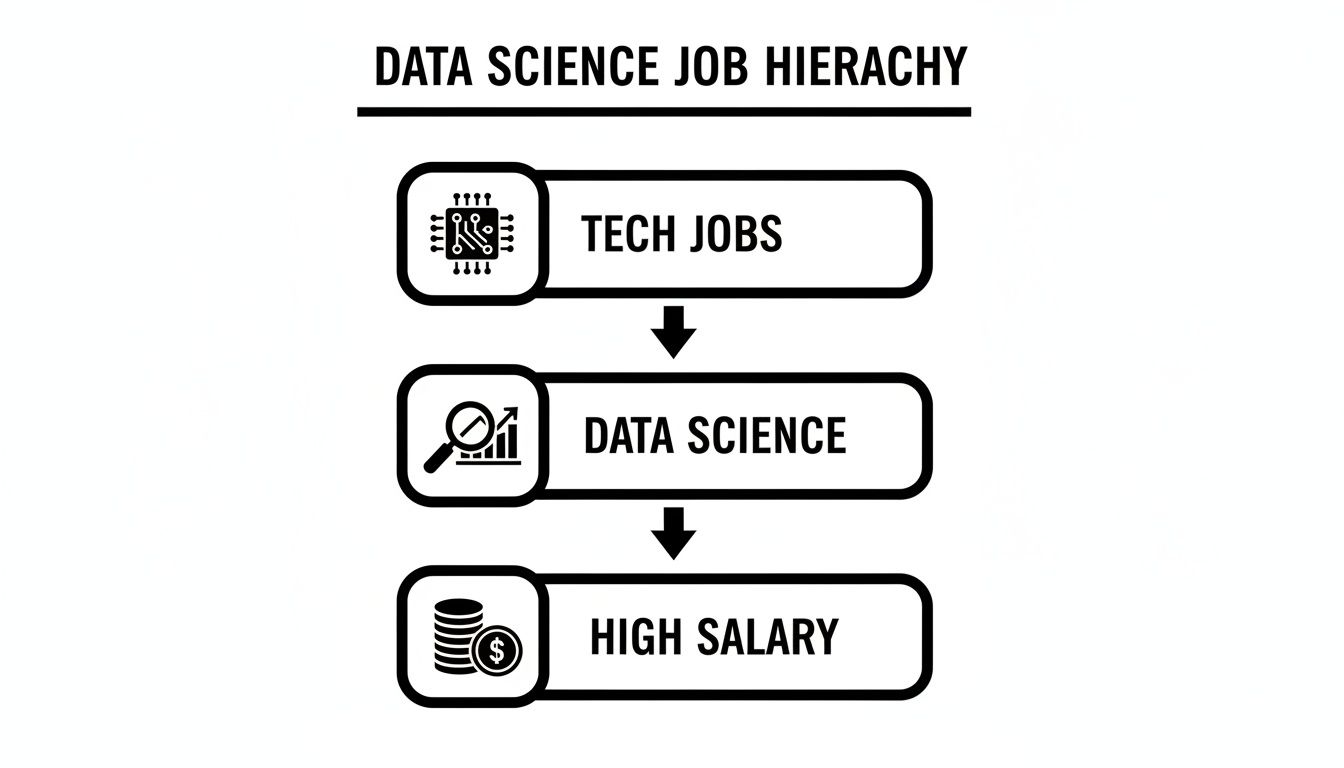
As you can see, a solid foundation in technology is a common pathway into the data science field, which can then lead to some serious salary potential.
The Data Scientist: The Criminal Profiler
Once the detective has gathered all the evidence, the Data Scientist steps in. Think of this role as the criminal profiler. They take the clues and evidence collected by the analyst to understand the 'why' behind it all and, crucially, to predict what might happen next. They move beyond simply describing the past and start building models that forecast the future.
Data Scientists use more advanced statistical techniques and machine learning algorithms to tackle predictive questions. For instance, "Which of our customers are most likely to cancel their subscription next month?" or "What's the likely demand for our new product line?" They're typically writing code in languages like Python or R to build, train, and test these predictive models.
While an analyst reports on what happened, a scientist builds systems to predict what will happen. This shift from descriptive to predictive analytics is the key difference and represents a significant step up in complexity and business impact.
They can do everything an analyst can, but they add that powerful layer of foresight. Their work has a direct line to a company's strategy, helping the business get ahead of trends instead of just reacting to them.
The Machine Learning Engineer: The Tech Specialist
Finally, we have the Machine Learning Engineer (ML Engineer). This is the team’s high-tech specialist—the one who designs and builds the advanced surveillance tools and operational systems. They take the predictive models prototyped by the Data Scientist and turn them into robust, scalable software that can run in a live business environment.
An ML Engineer’s world revolves around implementation and hardcore engineering. Their main concern is making sure a model doesn't just work on a scientist's laptop but can handle real-world data streams, 24/7, without falling over. This requires a deep knowledge of software engineering best practices, cloud platforms, and MLOps (Machine Learning Operations).
They are the ones who make sure the insights from the data team become part of the company's DNA, not just a one-off report. Whether it's a recommendation engine on an e-commerce site or a real-time fraud detection system for a bank, the ML Engineer is the one who brings it to life. They form the critical bridge between data science and software engineering, making them absolutely indispensable today.
Mastering the Essential Skills for Success
To land a great data science job, you need more than a casual acquaintance with a few algorithms. Real success in this field stands on three core pillars: deep technical know-how, sharp business sense, and polished soft skills. Picture it like a three-legged stool—if one leg is wobbly, the whole thing comes crashing down.
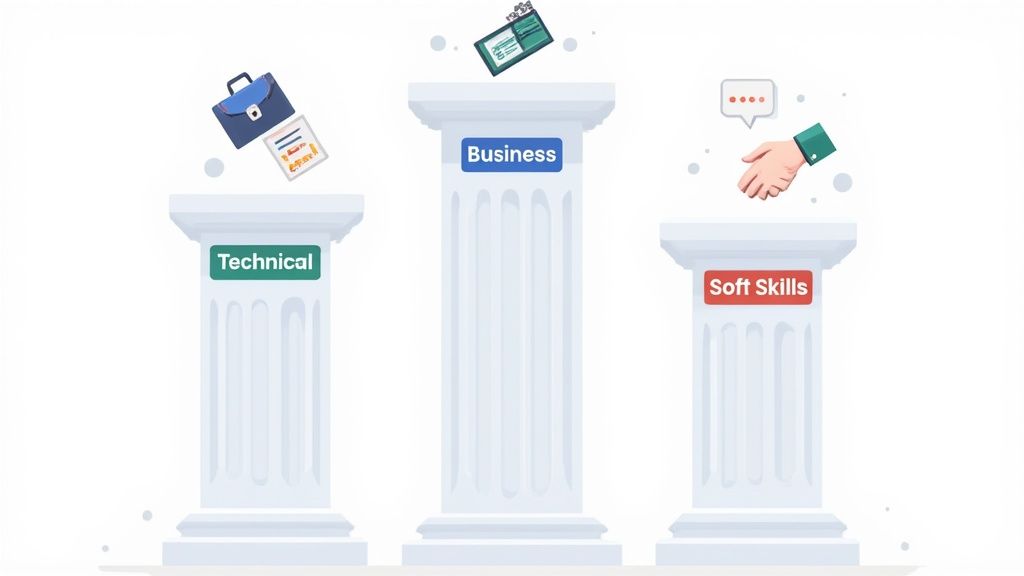
Too many aspiring data scientists get tunnel vision, focusing only on the technical stuff as if mastering code is the only thing that matters. While your technical chops are non-negotiable, it's the fusion of all three pillars that truly separates a good data scientist from a great one.
Let's break down what each of these really means.
The Technical Toolkit
This is the bedrock, the hands-on part of the job. It's your ability to actually get in there, wrangle data, build models, and pull out insights using specific technologies. Without this foundation, you can't even begin to do the work.
At a minimum, your toolkit needs a few key things:
- Programming Languages: Python is the undisputed king of the data science world, thanks to its powerful libraries like Pandas, NumPy, and Scikit-learn. R still holds its ground, especially in academic circles and for specialised statistical work.
- Database Management: Knowing SQL is absolutely critical. You have to be able to pull, join, and summarise data from relational databases efficiently. It's a daily task.
- Machine Learning Frameworks: Getting familiar with frameworks like TensorFlow or PyTorch is a must for building and deploying predictive models, especially as you move into more senior roles.
- Big Data Technologies: Datasets are only getting bigger. Experience with tools like Apache Spark is becoming essential for processing massive amounts of information without your laptop catching fire.
A quick look at job platforms shows just how in-demand these skills are. On Indeed, for example, there are 463 active data science positions in Germany right now, ranging from junior analysts to senior machine learning engineers. These roles consistently ask for expertise in tools like Python, Spark, TensorFlow, and PyTorch, underscoring just how important hands-on experience has become. You can check out the current openings for yourself by exploring data scientist positions in Germany on indeed.com.
Navigating the vast landscape of data science technologies can feel overwhelming. To help clarify, here’s a breakdown of the essential tools and where they fit into your workflow.
Essential Data Science Tools and Their Applications
| Technology Category | Examples | Primary Use Case | | :--- | :--- | :--- | | Programming | Python, R | General-purpose data manipulation, analysis, and model building. | | Databases | SQL (PostgreSQL, MySQL) | Querying and managing data stored in relational databases. | | ML Frameworks | Scikit-learn, TensorFlow, PyTorch | Building, training, and deploying machine learning models. | | Big Data Processing | Apache Spark, Dask | Handling and analysing datasets too large to fit into memory. | | Data Visualisation | Matplotlib, Seaborn, Tableau | Creating charts and dashboards to communicate findings. | | Cloud Platforms | AWS, Azure, Google Cloud | Accessing scalable computing power and managed data services. |
Each tool has its place, and a well-rounded data scientist knows which one to reach for to solve a specific problem efficiently.
Business Acumen and Strategic Thinking
All the technical wizardry in the world is useless without context. Business acumen is your ability to see the bigger picture—to understand how the company makes money and how your work can help it do better. It’s about learning to ask the right questions, not just crunching numbers to get an answer.
This means you have to connect your analysis to real-world business results. A model that predicts customer churn with 99% accuracy is just an academic exercise if those insights aren't turned into a retention campaign that actually saves the company money.
Business acumen transforms a data scientist from a technical expert into a strategic partner. It’s the difference between saying "the data shows a 15% drop in engagement" and saying "we're losing high-value users in this segment, and here’s a data-backed plan to win them back."
You develop this skill by being relentlessly curious about your company’s industry, its customers, and its competitors. Always push yourself to answer the "so what?" behind every analysis you run.
Soft Skills: Communication and Collaboration
Finally, we have the soft skills—the glue that holds everything together. You can build the most elegant, powerful model imaginable, but if you can’t explain what it does and why it matters to a non-technical manager, it will never see the light of day. This is probably the most underrated, yet most important, pillar for a long-term data science career.
A few soft skills are absolutely essential:
- Storytelling: You need to frame your findings in a clear, compelling narrative that connects with your audience and convinces them to act.
- Critical Thinking: This is about approaching problems with a structured, logical mindset, questioning assumptions, and thinking through edge cases.
- Collaboration: Data science is a team sport. You’ll be working closely with engineers, product managers, and business leaders every single day.
Ultimately, your success in finding the best data science jobs will hinge on how well you can build and balance all three of these areas. The candidates who can code, grasp the business context, and communicate their ideas clearly are the ones every organisation wants to hire.
Exploring Industries and Salary Expectations
Once you have a good handle on the different roles and the skills they require, the next logical questions are always: "Where are the best jobs?" and "What can I actually earn?" In Germany, the answers really depend on which industry you're aiming for and where you're located. Different sectors use data science in completely unique ways, which naturally leads to a wide range of salaries.
Think of it like being a specialist doctor. A brilliant surgeon is valuable anywhere, but their salary and daily routine will be worlds apart working in a private cosmetic clinic in Munich versus a public research hospital in Leipzig. It's the same for a data scientist—the industry you pick will fundamentally shape your career.
Top Industries Hiring Data Scientists in Germany
Germany's powerful economy is a fantastic place for data professionals. While the tech industry is the obvious starting point, you'll find that many traditional sectors are also hiring aggressively to gain a competitive edge.
Here are some of the key industries where demand is booming:
- Automotive: Industry titans like BMW, Volkswagen, and Siemens are putting data at the core of everything. They use it to fine-tune manufacturing supply chains, predict when factory robots need maintenance, and, of course, develop self-driving cars.
- E-commerce and Retail: For these companies, data is everything. They rely on data scientists to build the recommendation engines we all use, create personalised shopping experiences, and accurately forecast what products they'll need in stock.
- Fintech and Banking: The financial world runs on data science. From algorithmic trading and modelling credit risk to spotting fraud in real-time, data is essential for managing risk and launching new digital banking products.
- Healthcare and Pharmaceuticals: This is a field where data has a massive impact. It’s used to speed up the discovery of new drugs, create personalised treatment plans based on a patient's genetic makeup, and make clinical trials more efficient.
The growth in these areas is just explosive. The data science scene in Germany is expanding fast, with job boards filled with hundreds of specialised roles at both startups and massive corporations. For instance, a quick look at portals like datacareer.de shows over 500 positions in big data and statistics. You'll see roles at places like trivago in Düsseldorf, where marketing teams blend deep data expertise with business savvy to drive major decisions. To get a real feel for the market right now, check out this curated list of German data analytics and science jobs on builtin.com.
Decoding Salary Expectations
What you can expect to earn isn't just tied to your job title. A whole mix of factors comes into play, with your experience, location, and the size of the company all having a major impact on your final paycheque.
A common mistake is to just look at the national average salary. You'll get a much clearer picture by researching salary benchmarks for your target city, specific industry, and experience level. That's how you can set financial goals that are both realistic and ambitious.
Let's break down the key things that will influence how much you can make.
- Experience Level: This is the big one. An entry-level data analyst might start out around €50,000. A mid-level data scientist, on the other hand, can expect to pull in somewhere between €65,000 and €85,000. Once you reach a senior or lead position with specialised skills, you could be looking at a salary well over €100,000.
- Location: As you'd expect, major tech hubs pay more to compensate for the higher cost of living. Munich and Frankfurt often lead the way in terms of salary, with Berlin and Hamburg not far behind.
- Company Size and Type: Big multinational corporations and well-funded tech startups usually have deeper pockets. They tend to offer more competitive salaries and better benefits than smaller, local businesses.
- Specialisation: If you have hot, in-demand skills in areas like deep learning, natural language processing (NLP), or MLOps, your market value goes way up. This can give your earning potential a significant boost.
Getting your head around these factors gives you a much better financial roadmap for your career. For more tips on building a winning career strategy, feel free to explore the resources on our JobCoPilot blog. With the right plan, you can put yourself in the running for the most rewarding data science jobs out there.
Crafting an Application That Gets Noticed
In a market buzzing with talent, just having the right skills isn't going to cut it. Your application is the first thing a recruiter sees, and frankly, it might be the only thing. It has to do more than just list what you know; it needs to tell a story that makes them stop scrolling and see you as the answer to their problems.
Think of your application less like a historical record and more like a targeted marketing campaign. Every single piece—your CV, your cover letter, your portfolio—needs to be carefully shaped to show your value and fit the exact job you're after. That means ditching the one-size-fits-all approach and focusing on projects and results.
Tailor Your CV for Maximum Impact
Your CV is the foundation of your application, but so many people make the mistake of treating it like a checklist of every tool they’ve ever used. Here’s a secret: hiring managers care a lot more about what you achieved than what your job description said you did.
A better way is to structure your experience around projects, not just job titles. For every project, use this simple but powerful framework:
- Problem: What was the business challenge? (e.g., "Customer churn for our premium subscription was getting out of hand.")
- Action: What did you do about it? Mention the key skills and tools you used. (e.g., "I built a predictive churn model using Python, Scikit-learn, and XGBoost.")
- Result: What was the outcome? Use hard numbers. (e.g., "The model flagged at-risk customers with 85% accuracy, which let us run a retention campaign that cut churn by 15% in one quarter.")
This structure instantly shows that you know how to connect your technical skills to real business results—a massive plus for any data science jobs.
Write a Cover Letter That Tells Your Story
If your CV lays out the facts, your cover letter gives them meaning. This is your chance to connect the dots for the hiring manager and show them why your specific background makes you the perfect person to tackle their specific problems. Sending a generic cover letter is like showing up to a party you weren't invited to; it just doesn't work.
Instead of just repeating your CV, use your cover letter to:
- Speak to their needs: Show you’ve done your homework. Mention a recent company win or a problem from the job description and explain how you can contribute.
- Spotlight a key project: Choose one killer project from your CV and tell the story behind it.
- Show you're genuinely interested: Talk about why you’re excited about the company's mission or the challenges they're tackling.
A great cover letter doesn't just say, "I have the skills." It says, "I understand your problem, and I am excited to help you solve it." It bridges the gap between your qualifications and the company's goals.
Getting the first draft of these personalised documents done automatically can be a huge help. You can check out a range of features for optimising job applications that handle the heavy lifting, giving you more time to add those crucial final touches for each role.
Build a Portfolio That Demonstrates Your Skills
Last but not least, your GitHub portfolio is where the rubber meets the road. It’s your proof that you can actually do what you say you can do. A strong portfolio isn’t about having hundreds of repositories; it's all about quality over quantity.
Aim for 2-3 well-documented, end-to-end projects that show off a variety of skills. Each project needs a crystal-clear README file explaining the problem, the data, your methods, and what you found. Your code should be clean, commented, and easy for someone else to run. This doesn't just show you're a skilled technician; it proves you're a great communicator and problem-solver, completing a powerful application package that is sure to get noticed.
Acing the Data Science Interview Process
Getting through a data science interview process can feel like a marathon. It’s a multi-stage affair designed to test your technical chops, your business acumen, and how well you can communicate complex ideas. Knowing what’s coming at each stage is half the battle won.
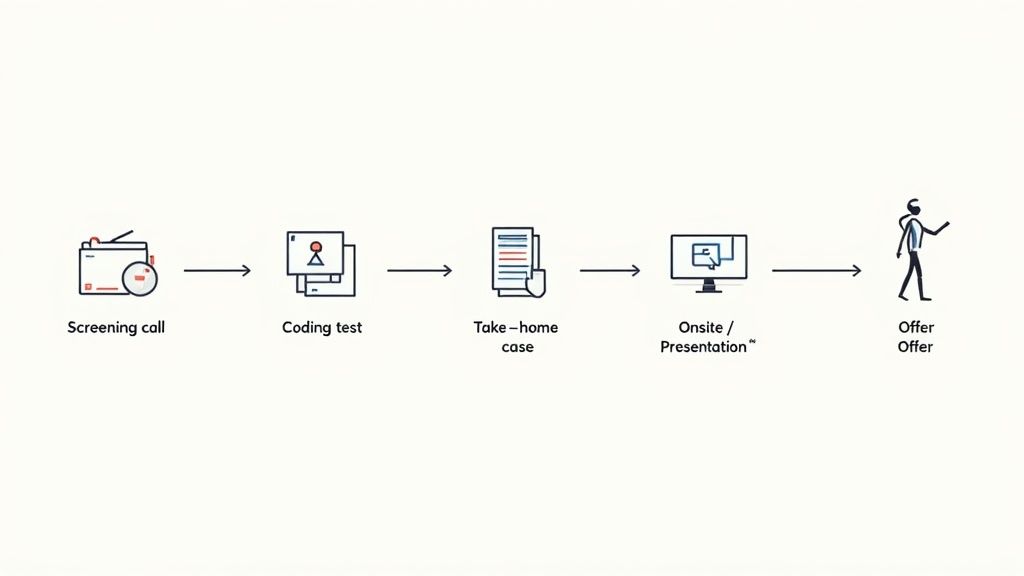
It almost always starts with a screening call from a recruiter or the hiring manager. This isn't a deep technical dive; it’s more of a gut check. They want to hear about your background, what motivates you, and whether you'd be a good fit for the team. Have your elevator pitch ready and be prepared to explain exactly why you want this job at this company.
Conquering the Technical Assessments
Once you’re past the initial screen, the real tests begin. This is where they verify that the skills on your CV are legit, usually through a mix of coding and analytical problems.
You’ll likely encounter one or more of these hurdles:
- Live Coding Challenge: Get ready to share your screen. You'll be asked to solve problems on the fly, typically involving Python algorithms, some data wrangling with Pandas, or a few SQL queries.
- SQL and Database Questions: Be prepared to write queries that join tables, filter data, and run aggregations to pull out specific business insights.
- Probability and Statistics: You might get quizzed on anything from A/B testing concepts and confidence intervals to classic probability brain teasers. They want to see if your theoretical foundations are solid.
Remember, they're not just looking for the right answer. They want to see how you think. Talk them through your approach, state your assumptions out loud, and explain why you chose a particular method over another. That’s what a real problem-solver does.
The Take-Home Case Study
The take-home assignment is your moment to really stand out. You'll get a dataset and a business problem and be asked to conduct a full analysis, usually culminating in a presentation of your findings. This is where they test everything—from data cleaning and modelling to, most importantly, your ability to tell a compelling story with data.
Your presentation is just as important as your code. The key is to translate your complex analysis into a clear, actionable story that solves the business problem. Stakeholders want to know the "so what?"—not just the technical nitty-gritty.
When you present your work, structure it logically. Start with the problem, walk them through your method, showcase your key findings with clean visualisations, and wrap up with firm recommendations. This shows you can tie your technical work directly to business value.
This part of the interview often mimics the kind of project you'd actually be doing on the job. If you want to sharpen that strategic communication skill, it's a great area to focus on. For more guidance on framing your insights effectively, check out our expert consulting services. Nailing this stage shows you're not just a technician; you're the strategic partner they're looking for.
Common Questions About Data Science Jobs
Stepping into the world of data science brings up a lot of practical questions that go way beyond simple job descriptions. Let's tackle some of the most common things people ask, so you can map out your next move with a bit more clarity.
Do I Need a PhD to Get a Data Science Job?
This is a classic. The short answer? No, a PhD isn't the golden ticket anymore. While it's definitely a huge plus for very specific R&D roles, most companies today are far more interested in what you can do, not just what you've studied.
A Master’s degree in a quantitative field (think stats, computer science, or maths) is a great foundation and pretty common to see. But honestly, a lot of incredible data scientists have come out of intensive bootcamps or are completely self-taught.
At the end of the day, your ability to show a hiring manager how you can create value with data is what really counts. A solid GitHub portfolio filled with start-to-finish projects often shouts louder than any academic title.
What really moves the needle is your hands-on experience with core tools like Python and SQL, and a genuine talent for solving tricky problems. That’s what gets you hired for most data science jobs.
How Important Is Speaking German for Tech Jobs in Germany?
This really depends on where you land and who you work for, but knowing the language is always a smart move. In the big international tech cities like Berlin, you’ll find tons of startups and global companies where English is the main language of business. You can absolutely get a great job there without being fluent in German.
But once you step outside those international hubs, especially into more traditional German sectors like automotive or manufacturing, speaking German often becomes a must-have. Knowing the language doesn't just open up way more job opportunities; it makes a huge difference in fitting into the workplace culture and just navigating everyday life. Even a basic grasp shows you're committed to being there, and employers really value that.
What Is the Real Difference Between a Data Analyst and a Data Scientist?
Think of it like this: a Data Analyst is a historian, while a Data Scientist is a forecaster.
The analyst is laser-focused on the past, digging into data to figure out what happened. Their job is to clean, analyse, and visualise information to build reports and dashboards that tell the story of past performance.
The scientist takes that story and tries to predict the next chapter. They use the insights from the analyst but layer on advanced statistics and machine learning to build models that forecast what will happen next. So, while the analyst's work looks backward, the scientist’s work is all about building tools to shape what comes next.
Stop wasting hours on applications and start getting more interviews. Acquispect uses AI to find your ideal jobs, craft personalised cover letters, and track your success automatically. Take control of your job search and see the difference data-driven automation can make. Try it free by visiting acquispect.com.