Certain parts of the world are buzzing with demand for skilled medical writers, and Germany is right at the top of that list. It's become a major European hub, not by accident, but because of a perfect storm: a massive pharmaceutical industry, a world-class clinical research scene, and some of the strictest regulatory standards you'll find anywhere.
Why Germany Is a Hotspot for Medical Writers
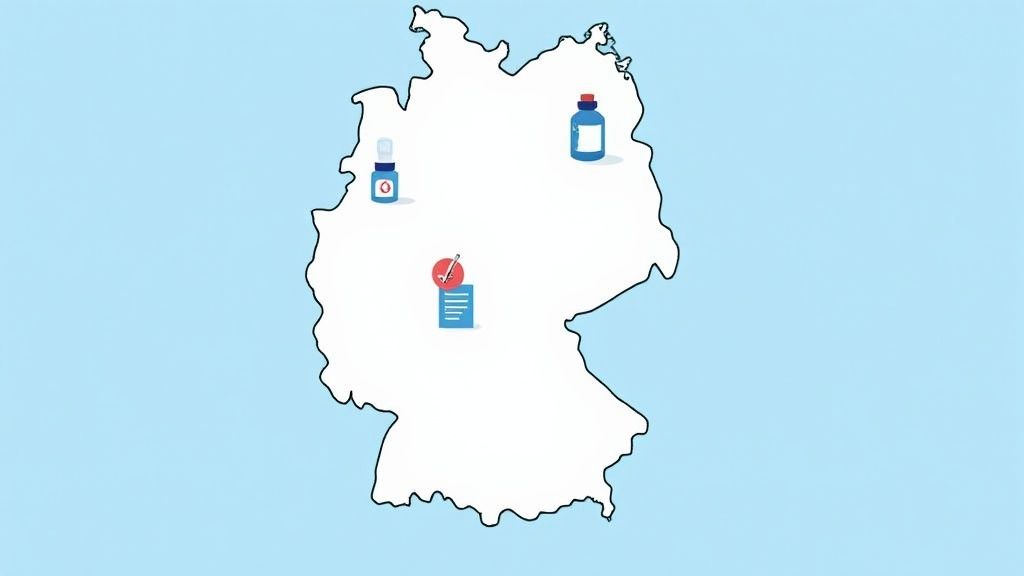
Germany's reputation as a life sciences powerhouse makes it incredibly fertile ground for anyone in medical writing. We're not just talking about a big market for medicines; this is a place where research, development, and regulatory affairs all converge. Once you understand how these pieces fit together, it's easy to see why your skills are in such high demand here.
At its heart, this demand is built on Germany's world-leading pharmaceutical and biotech industry. Think of the global players headquartered here—Bayer, Boehringer Ingelheim, Merck KGaA. These companies are constantly innovating, and that relentless push for new treatments creates a constant, non-negotiable need for top-tier documentation. Everything from the very first research proposal to the final marketing brochure needs to be written with precision.
Here is a breakdown of typical medical writing jobs you will find, their core responsibilities, and where you're likely to be employed in Germany.
Common Medical Writing Roles in Germany
| Role Type | Primary Responsibilities | Common Employers | | :--- | :--- | :--- | | Regulatory Writer | Prepares documents for regulatory submissions, like CSRs, CTD modules, and IBs. | Pharmaceutical companies, biotech firms, Contract Research Organisations (CROs). | | Medical Communications Writer | Creates content for healthcare professionals, such as manuscripts, conference materials, and educational content. | Medical communications agencies, pharmaceutical companies. | | Medical Marketing Writer | Develops promotional materials for new drugs and devices, including brochures, websites, and sales aids. | Advertising agencies with a healthcare focus, pharmaceutical marketing departments. | | Health Economics & Outcomes Research (HEOR) Writer | Communicates the economic value of a drug or therapy to payers and policymakers. | HEOR consultancies, large pharmaceutical companies. |
This table just scratches the surface, but it gives you a good sense of the diversity of roles available across the German market.
The Engine of Clinical Research
One of the biggest reasons for the abundance of jobs for medical writer professionals is Germany’s leading role in clinical trials. The country is consistently a top global destination for this kind of research, and for good reason. It has fantastic infrastructure, highly skilled doctors and researchers, and access to large patient groups.
Every single clinical trial generates a mountain of paperwork that needs to be perfectly written, managed, and submitted. We’re talking about documents like:
- Clinical Study Protocols (CSPs): The complete blueprint for a trial.
- Investigator's Brochures (IBs): A comprehensive summary of all data on the product being tested.
- Clinical Study Reports (CSRs): The detailed final report on a trial's methods and results.
- Informed Consent Forms (ICFs): Critical documents ensuring patients understand what they're signing up for.
Each one of these requires a writer who not only gets the science but can also communicate with absolute clarity. It creates a steady stream of work for specialists.
Strict Regulatory Standards Create Opportunity
Germany's regulatory environment, shaped by authorities like the Federal Institute for Drugs and Medical Devices (BfArM) and the European Medicines Agency (EMA), sets an incredibly high standard for all documentation. There's no room for error. The complexity of submissions, such as the Common Technical Document (CTD), demands true expertise.
Medical writers are the essential bridge between complex scientific data and stringent regulatory requirements. In Germany, this role is not just supportive; it is critical to bringing new medicines to patients safely and efficiently.
This tough environment means that companies simply can't afford to cut corners on their written materials. They actively hunt for writers who can navigate these complex rules, translate complicated trial data into compliant reports, and guarantee every document will pass review. What sounds like a challenge is actually a massive career opportunity for those with the right skills.
The numbers back this up. The German medical writing market is doing more than just holding steady—it's growing fast. Valued at roughly US$228.81 million, it’s projected to more than double to US$490.01 million by 2033. That’s a compound annual growth rate (CAGR) of 8.83% from 2025 to 2033. If you want a deeper dive, you can explore the full analysis of the Germany medical writing market. For anyone looking at jobs for medical writer positions, those figures should tell you everything you need to know about the potential waiting for you in Germany.
Nailing Your CV for the German Medical Writing Scene
In Germany's competitive job market, your CV isn't just a document; it’s your number one marketing tool. Sending out a generic, one-size-fits-all application is the fastest way to get ignored. If you want to land one of the top jobs for medical writer professionals, you have to meticulously tailor your application to what German life sciences employers are actually looking for.
This goes way beyond just listing your past jobs. The real goal is to tell a compelling story about your scientific know-how, regulatory fluency, and writing talent in a way that not only catches a hiring manager's eye but also sails through their Applicant Tracking Systems (ATS).
Structuring Your CV for German Recruiters
German CVs, known as a Lebenslauf, have their own set of rules. While your writing needs to be sharp and engaging, your CV itself should be conservative, professional, and perfectly organised. Think of it as a clear, chronological history of your career, with a major emphasis on detail and completeness.
Here’s what you absolutely need to include:
- Personal Details: Your name, address, phone number, and a professional email. A polished, professional headshot is still very common and often expected.
- Professional Summary (Kurzprofil): This is a short, punchy paragraph right at the top. It's your elevator pitch to immediately flag your specialty (like regulatory writing in oncology) and years of experience.
- Work Experience (Berufserfahrung): List your roles with the most recent one first. Under each job, use bullet points to outline not just what you did, but what you achieved.
- Education (Ausbildung): List your degrees, universities, and dates. If your thesis topic is relevant to the medical field, definitely mention it.
- Skills (Kenntnisse und Fähigkeiten): Create a specific section for languages, software skills (like EndNote or Veeva Vault), and any other technical writing abilities.
Stick to a two-page maximum. German employers value someone who can get to the point. Your CV is the first test of your ability to synthesise complex information—a skill at the very heart of medical writing.
When you're describing your experience, use numbers to back up your claims. Don't just say you "wrote clinical study reports." Instead, say you "authored 15+ Phase III CSRs for novel oncology treatments, contributing to successful EMA submissions." That turns a vague duty into a concrete, impressive achievement.
Building a Strong Portfolio When You're Starting Out
A great portfolio is a must-have, but what if you're new to the field? This is a common hurdle. You might feel like you have nothing to show, but it’s all about being creative and demonstrating your potential.
If you can't share professional work because of confidentiality agreements or you're just starting, you can still build a fantastic portfolio. Try this:
- Leverage Your Academic Work: Pull out excerpts from your master's thesis or PhD dissertation. The introduction and discussion sections are perfect for showing you know how to build a solid scientific argument.
- Create Your Own Samples: Find a recently published clinical trial and create a sample document from the public data. You could write a mock press release, a plain language summary, or a slide deck. This is a proactive way to show what you can do.
- Write a Review Article: Pick a niche topic you're genuinely interested in and write a short literature review. It’s a great way to showcase your research, analysis, and writing skills in a format that science-focused employers instantly recognise.
These pieces prove you've got the core skills, even if your professional work history is short. For more deep dives into career strategies and building your application, the JobCopilot blog has some excellent resources.
Getting Past the Robots: Optimising for Applicant Tracking Systems
Let's be real: most large pharma companies and CROs in Germany use Applicant Tracking Systems (ATS) to do the first round of screening. These systems are programmed to scan your CV for keywords from the job description. If you want a human to ever see your application, you have to play the game.
First, dissect the job ad. Pull out the key terms and phrases they use, like:
- "Regulatory documents"
- "Clinical Study Reports (CSRs)"
- "Common Technical Document (CTD)"
- "ICH-GCP guidelines"
- "Medical communications"
- "AMWA" or "EMWA"
Now, sprinkle these keywords naturally through your CV. They fit perfectly in your professional summary and in the bullet points describing your work experience. Use standard headings like "Work Experience" and "Education" so the ATS can read your document easily. A quick tip: avoid fancy tables, columns, or graphics in your CV—they can throw the software for a loop. Sending your CV as a PDF is usually the safest bet to keep your formatting intact.
By thinking like a machine first, you give yourself a much better chance of impressing a person later on.
How to Find Medical Writing Jobs in Germany
Alright, you’ve polished your CV and your portfolio is looking sharp. Now for the real work: finding that perfect medical writing job. In Germany, it’s all about strategy. Simply blasting your application across massive, generic job sites is a fast track to getting ignored. You need to be surgical, focusing on the platforms where pharmaceutical companies, CROs, and medical communications agencies are actively hunting for specialised talent like yours.
Think of it less as a wide-net fishing expedition and more as targeted spearfishing. You need to know where the best opportunities are hiding. This means looking beyond the usual suspects and digging into niche job boards and professional networks. It’s not just about finding job ads; it’s about connecting with the people who do the hiring.
Tapping Into Specialised Job Boards
While big names like Indeed certainly have their place, the real gems for medical writing roles are often tucked away on specialised life science and pharma job boards. These are the corners of the internet where recruiters go when they need candidates with a solid scientific background.
Here’s where you should be focusing your energy:
- StepStone.de: As a major player in the German job market, StepStone has a surprisingly robust life sciences section. Get familiar with its advanced filters. You can slice and dice your search by industry, experience level, and specific German keywords like "Medizinischer Redakteur" or "regulatory writing."
- Pharma-Zeitung.de: This is a goldmine. It's a highly focused portal dedicated entirely to Germany’s pharmaceutical industry. The listings here are incredibly relevant because companies often post them directly, cutting out the middleman.
- Specialist Recruiters: Don't overlook the websites of recruitment agencies that live and breathe life sciences. Firms like ProClinical or Hays often handle exclusive roles that you won't see advertised anywhere else.
Before you even start clicking "apply," though, remember that your application materials need to be spot on.
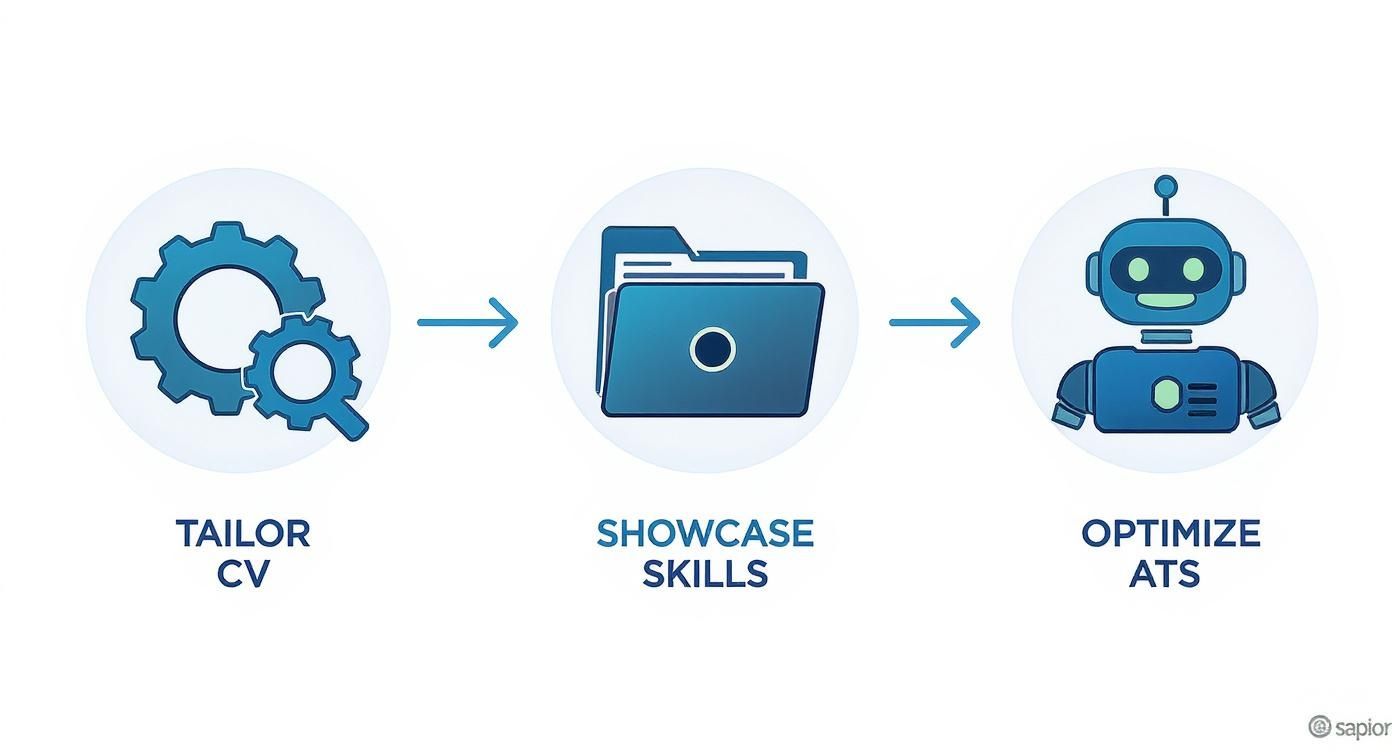
As you can see, a successful application is about more than just listing your experience. It’s a process that requires careful customisation for both the human eye and the automated systems that screen your CV first.
Mastering Professional Networks
In Germany, who you know can be just as important as what you know. Professional networking platforms are often more powerful than job boards because they offer a direct line to recruiters and hiring managers. This is your chance to build a relationship before a job is even officially posted.
LinkedIn is, of course, the global king. It’s essential for connecting with the big international pharma companies and CROs that have a presence in Germany. But just having a profile isn't enough. You need to be active. Start by peppering your profile with keywords like "medical writer," "regulatory affairs," and specific document types you've worked on, like "CSRs" or "CTDs." Then, get involved. A thoughtful comment on a post from a hiring manager at Bayer or Boehringer Ingelheim can do more for your visibility than ten cold applications.
Your network is your most valuable career asset. Don’t wait until you need a job to start building it. Consistently connect with peers, recruiters, and managers in your target field.
XING is the German-speaking world's answer to LinkedIn, and you ignore it at your peril. It remains incredibly influential, especially with Germany’s famous small to medium-sized companies (Mittelstand) and more traditional organisations. If you're serious about the German market, having a polished XING profile is non-negotiable. Many local recruiters and HR managers still use it as their primary tool for sourcing candidates.
Activating Your Job Search Strategy
Okay, so you’ve set up your profiles. Now what? A passive presence won’t get you very far. You need a proactive system to make sure you never miss a relevant opening. This comes down to setting up smart alerts and making direct connections.
Here’s a simple action plan to get you started:
- Set Up Smart Alerts: On both the job boards and your networking profiles, create saved searches with very specific criteria. Use boolean search terms to narrow the field, like
"medical writer" AND "oncology"or"Medizinischer Redakteur" AND "home office". This will filter out the noise and deliver only the good stuff straight to your inbox. - Join Industry Groups: Both LinkedIn and XING are full of groups dedicated to medical writing, regulatory affairs, and the German pharmaceutical scene. Jump in, participate in discussions, and keep an eye out for jobs shared directly by members.
- Connect with Recruiters: Find recruiters who specialise in life sciences in Germany and send them a personalised connection request. A quick message explaining your interest in jobs for medical writer roles can put you on their radar for the next great opportunity they get.
By blending targeted job board searches with active networking, you create a powerful, two-pronged attack on your job hunt. This approach ensures you not only see the best opportunities but also build the connections you need to land them. You can also look into platforms that help make this entire process easier; for example, you can find a suite of helpful tools for job seekers at JobCopilot, designed to make your search more efficient. This turns your search from a passive waiting game into an active, strategic pursuit.
Navigating Interviews and Salary Negotiations
Getting the interview is a massive win, but in the German life sciences world, it's really just the start of the race. When you’re going for jobs for a medical writer, you’ll find the interview process is often a multi-stage affair. It’s designed to do more than just check your personality and CV; it’s a rigorous test of your actual, practical skills. Knowing what’s coming is half the battle.
Don't expect a simple chat. German employers place a huge emphasis on tangible proof of your abilities, which usually means getting ready for a skills-based assessment. Think of it less as a formality and more as a core part of their evaluation.
Acing the Medical Writing Test
One of the first hurdles you’ll likely face is a writing test. It’s the company’s way of seeing how you handle pressure and getting a genuine feel for your writing style, scientific accuracy, and eagle-eyed attention to detail.
While these tests vary from company to company, they generally fall into a few familiar categories:
- Summarising Data: You might get a stack of clinical trial data tables or a dense research paper and be asked to draft a concise summary or abstract. They’re looking to see if you can quickly pinpoint the most critical information and communicate it clearly.
- Editing Exercise: Sometimes, you’ll be handed a document that’s a mess—full of grammatical errors, stylistic blunders, and scientific inaccuracies. Your job is to whip it into shape, proving you have the sharp editorial skills they need.
- Creating a Document: Some employers might ask you to create a small document from scratch based on a specific brief. This could be anything from a single presentation slide to a small section of a Clinical Study Report (CSR).
My best advice? Stay calm and be methodical. Read the instructions twice, manage your time carefully, and always, always proofread your work for clarity and accuracy before you hit send. This is your moment to show them what you can do, not just tell them.
Preparing for Common Interview Questions
Beyond the practical test, you’ll of course have the more traditional interview. German interviewers tend to be direct and appreciate straightforward, evidence-backed answers. Be prepared to talk about your experience in detail, drawing on specific examples from your past projects.
You can expect questions that dig into both your technical know-how and your softer skills. Be ready for things like:
- "Can you describe your experience with regulatory documents like CSRs or CTDs?"
- "How do you ensure the scientific information in your writing is completely accurate?"
- "Tell us about a time you had to work with a tricky Subject Matter Expert (SME). How did you manage that relationship?"
- "Which therapeutic areas do you know best?"
Your answers need to be concrete. Instead of just saying you have 'good project management skills,' talk about a specific project you managed. Mention the timeline, the challenges, and how you ensured it was delivered on time and to a high standard. Real examples speak volumes.
Talking About Salary with Confidence
The salary chat can feel awkward, but walking in with solid market knowledge gives you a massive advantage. In Germany, it’s quite common to discuss salary expectations right at the beginning, so you need to have your numbers ready from the very first call.
Do your homework. Research the typical salary bands for jobs for a medical writer in Germany. Things like your experience level, the type of company (big pharma versus a CRO or agency), and even the city will influence the final number. For context, a senior medical writer in Germany can command an average salary of around €63,066 per year. While entry-level roles will start lower, there's a clear and promising path for financial growth, which shows just how strong Germany's pharmaceutical sector is. To see how these figures stack up across the continent, you can explore detailed medical writer job profiles.
When the recruiter or hiring manager asks for your Gehaltsvorstellung (salary expectation), be direct. Give them a clear number or a tight, well-researched range. For instance, saying "I am looking for a salary in the range of €58,000 to €62,000" demonstrates that you've done your research and you know your worth. Be ready to explain your number based on your experience, skills, and the market data you’ve found. This confident, straightforward approach is respected and sets a professional tone for the entire process.
The Core Skills You Need to Succeed
When German employers are looking to fill jobs for medical writer positions, they aren't just looking for a good writer. They're looking for a very specific blend of skills: someone who is precise, deeply knowledgeable, and can communicate flawlessly within a tightly regulated scientific world. To really excel here, you need a solid foundation of technical expertise balanced with some crucial soft skills.
Think of it like this: your scientific knowledge is the engine, but it's your writing and communication that actually put that power on the road. One without the other just won't cut it. Hiring managers in Germany will always favour candidates who show they've mastered the full set of competencies.
Mastering the Technical Hard Skills
Let's start with the non-negotiables—the skills directly tied to science and regulation. These are the qualifications that get your CV noticed and prove you can handle the work from day one. Without these, even the most gifted writer will find it tough to get a foot in the door.
Your checklist of essential hard skills should look something like this:
- Deep Medical and Scientific Fluency: You need a rock-solid command of medical terminology, human anatomy, and disease processes. This isn't just about memorising definitions; it’s about understanding the science so well you can explain it with absolute clarity and accuracy.
- Knowledge of Clinical Trial Processes: A thorough grasp of the clinical trial lifecycle, from Phase I right through to Phase IV, is vital. Employers will expect you to know what’s happening at each stage and the purpose of the documentation created along the way.
- Regulatory Document Expertise: You've got to be familiar with the key regulatory documents. That means knowing what goes into a Clinical Study Report (CSR), understanding the structure of the Common Technical Document (CTD), and recognising the role of an Investigator's Brochure (IB).
- Data Interpretation Skills: A huge part of the job is turning complex statistical outputs and dense data tables into clear, readable text. The ability to look at raw data and accurately pull out the key findings is a massively valued skill.
A common mistake I see is people simply listing these skills on a CV. Don't do that. Instead, give concrete examples. Mentioning that you drafted specific sections of a CSR for a Phase III trial in oncology, for instance, makes your expertise tangible and real.
Cultivating Essential Soft Skills
While your technical knowledge gets you the interview, it’s your soft skills that will determine how successful you are once you're on the team. Medical writing is a deeply collaborative field. Your ability to work with others, manage your time, and sweat the small stuff is just as important as your scientific background.
Honestly, these skills are often what separate a good medical writer from a great one.
Here are the key soft skills to focus on:
- Exceptional Attention to Detail: In medical writing, there is zero room for error. A misplaced decimal point or a misunderstood term can have serious consequences. Meticulous proofreading and an obsession with accuracy are non-negotiable.
- Strong Project Management Abilities: You'll often be juggling multiple documents at once, each with its own tight deadline and group of stakeholders. Being organised and able to manage your time effectively is absolutely essential.
- Excellent Communication and Interpersonal Skills: You will be talking to a diverse team every day—scientists, statisticians, clinicians, and regulatory experts. The ability to ask smart questions, clarify complex points, and handle feedback gracefully is critical to keeping projects moving forward.
The Role of Professional Certifications
A question I get asked a lot is whether certifications are really necessary for finding jobs for a medical writer. Organisations like the American Medical Writers Association (AMWA) and the European Medical Writers Association (EMWA) offer various certificates and professional development programmes.
Here’s the deal in the German market: while a specific certification is rarely a mandatory tick-box on an application, it is looked upon very favourably. It shows a genuine commitment to the profession and a dedication to upholding the highest standards.
For anyone moving into medical writing from academia or another field, a certificate from EMWA or AMWA can be a powerful way to bridge any perceived experience gaps on your CV. It proves you've proactively sought out specialised training in the craft, and that speaks volumes.
Got Questions? Let's Get You Some Answers
When you're trying to land a medical writing job in Germany, a lot of questions can pop up. It's completely normal. Whether you're a seasoned pro or just breaking into the field, navigating a new job market can feel tricky.
Let's clear up some of the most common uncertainties I hear about, from language hurdles to visa paperwork. Getting these details straight from the start will make your job search a whole lot smoother.
So, Do I Really Need to Speak German?
This is the big one, and the honest answer is: it depends, but it helps. A lot.
Plenty of the big international pharma companies and CROs use English as their working language, so you can definitely find roles where you don't need German. But if you want to unlock the full potential of the German job market, including the famous Mittelstand (those innovative small and medium-sized companies), then German fluency is a massive advantage.
Think of it this way: for a pure regulatory writing job focused on EMA submissions, top-notch English is usually all you need. But if you're interested in medical communications or marketing aimed at the German-speaking market, German becomes essential.
My Advice: You can certainly start your search focusing on English-only roles. But if you're serious about building a long-term career in Germany, start learning the language. A B2 level is a great target—it shows employers you're functional in a professional setting and serious about integrating.
Which Specialisations Are in High Demand?
Germany’s life sciences sector is a powerhouse, but a few areas are particularly hot right now. If your experience aligns with these, you're in a great position.
- Oncology: This field is constantly evolving. Companies are always looking for skilled writers who can make sense of complex clinical trial data for publications and regulatory documents.
- Immunology: Much like oncology, the pace of discovery in immunology means there's a steady demand for writers who understand the science.
- Rare Diseases: There's a growing focus on orphan drugs, and expertise in this niche is a highly sought-after skill.
- Medical Devices: Germany is a world leader in medical technology. This creates a strong need for writers who can handle highly specific documents like Clinical Evaluation Reports (CERs).
Is It Possible to Work Remotely from Outside Germany?
While "home office" has become standard, working remotely from another country is a different story. It’s tricky.
Most German employers, even for fully remote roles, require you to be a resident in Germany. This isn't just a preference; it's tied to complex tax laws, social security contributions, and strict data protection (GDPR) rules.
You might find more flexibility with freelance contracts, but for permanent, full-time positions, a German address is almost always a prerequisite. Don't just assume it's okay—make sure you clarify the company's policy on international remote work early in the interview process.
What's the Deal with Visas?
If you're a non-EU/EEA citizen, getting the right visa is your first major hurdle. For most qualified professionals, the go-to option is the EU Blue Card. It’s a residence permit specifically designed for highly skilled workers.
To be eligible, you generally need to check three boxes:
- A university degree that’s recognised in Germany (or equivalent to a German degree).
- A firm job offer with a signed contract in hand.
- A job that pays a minimum gross annual salary (the threshold changes each year, so check the latest figures).
The key here is to be prepared. Start the application process at the German embassy or consulate in your home country well before your planned start date. Having all your documents perfectly in order is non-negotiable if you want to avoid frustrating delays.
Tired of spending hours searching and applying manually? Acquispect finds your ideal jobs with AI, writes personalised cover letters for you, and automatically sends your applications. You can set up your profile in five minutes and let our tech do the heavy lifting. Focus on acing the interviews, not the paperwork. Try it free for 30 days and find your next job faster.