So, what exactly is a freelance IT recruiter? Think of them as a specialist talent scout, an independent professional you bring in to find and hire tech talent on a project or contract basis. They're your on-demand expert, plugging directly into the tech market without the long-term commitment and overhead of a full-time employee.
Why a Freelance IT Recruiter Is Your Secret Weapon

In today's fast-paced tech world, the old ways of hiring just don't cut it. The best people are often off the market in a matter of days. This is where a freelance IT recruiter stops being just another vendor and becomes a genuine strategic partner.
Imagine you're trying to find a world-class athlete. Would you use a general sports agent, or one who lives and breathes that specific sport? It’s the same with tech. While your in-house HR team is juggling everything from sales to marketing hires, a freelance IT recruiter is completely immersed in the tech ecosystem. They know the players, the trends, and the hidden corners of the talent market that generalists can't see.
Bridging the Critical Talent Gap
A modern freelance IT recruiter does far more than just flick through CVs. They are the essential link between your company's highly specific technical needs and the brilliant minds who can meet them. Their value becomes crystal clear when you look at markets with major talent shortages.
Take Germany's IT sector, for example. In 2022, a mind-boggling 137,000 specialist jobs were sitting empty, a gap that has only grown since. If you want to dig deeper, you can explore more on the German freelance market to grasp the scale of the problem.
This is exactly the kind of environment where a freelance specialist shines. They give you a direct line to talent you wouldn't otherwise find.
To give you a clearer picture, let's compare a freelance IT specialist with an in-house HR generalist.
Freelance IT Recruiter vs In-House HR Generalist
| Attribute | Freelance IT Recruiter | In-House HR Generalist | | :--- | :--- | :--- | | Focus | Deep specialisation in tech roles and talent pools. | Broad focus across all company departments and roles. | | Speed | Extremely fast; can start sourcing immediately with no internal delays. | Slower; must navigate internal processes and competing priorities. | | Network | Extensive, niche network of passive candidates (not actively looking). | Primarily relies on active job seekers and company career pages. | | Cost | Flexible, pay-for-performance models (e.g., contingency fee). | Fixed cost (salary and benefits) regardless of hiring output. | | Technical Vetting| Can conduct initial technical screening and understands the jargon. | Limited technical knowledge; relies on hiring managers for vetting. |
As you can see, each has its place, but for filling critical tech roles quickly, the specialist often has a clear edge. They bring a unique set of advantages to the table:
- Agility and Speed: They can jump on a role instantly, cutting through the usual red tape to get qualified people in front of you much faster.
- Deep Niche Networks: The best freelancers have a black book of contacts filled with passive candidates—those amazing professionals who aren't even looking for a job but will listen when the right person calls.
- Specialised Expertise: They genuinely get the difference between Java and JavaScript, or Kubernetes and Docker. This means they can vet candidates on a technical level your HR team probably can't.
- Cost-Effectiveness: You pay for results. Whether it's a fee upon hiring or a project-based rate, you're not locked into the fixed costs of a full-time salary.
The real game-changer today is moving past what a CV says and focusing on what a candidate can prove. It's not about finding someone who claims they can code; it's about finding someone whose work speaks for itself.
This shift towards evidence-based hiring is where the best recruiters are heading. By working with a freelancer who prioritises verifiable proof—like code on GitHub or contributions to open-source projects—you’re buying certainty. You’re not just hiring a piece of paper; you’re investing in proven skills, making sure your next tech hire is ready to contribute from day one.
How Freelance Recruiters Charge for Their Services
Figuring out how a freelance IT recruiter charges can feel a bit like decoding a secret language. But getting a handle on their pricing models is the key to matching your budget with your hiring goals. It's not about just finding the cheapest person; it's about finding the model that offers the best value for what you actually need.
You'll generally run into three main pricing structures in the recruiting world. Each one is built for a different kind of hiring situation, depending on how urgent the role is, how hard it is to fill, and how much of a commitment you're ready to make. Think of it like picking a delivery service: sometimes standard post is fine, but for something irreplaceable, you’d want a dedicated courier with tracking and insurance.
The Contingency Model: Pay for Success
The contingency model is probably the most common setup you'll see. It’s wonderfully simple: you only pay the recruiter a fee if you end up hiring a candidate they brought to you. That fee is almost always a percentage of the candidate's first-year salary, typically landing somewhere between 15% and 25%.
This is a pretty low-risk way for a company to engage a recruiter. You don't spend a thing until the role is filled, which is great for positions that are important but not necessarily five-alarm-fire urgent or incredibly obscure.
- Best For: Mainstream tech roles like Senior Software Developers, UI/UX Designers, or Product Managers where a good number of qualified people are out there.
- Analogy: It’s like a "no win, no fee" agreement. The recruiter is betting on their ability to find your perfect match, and they only get paid when they succeed.
The trade-off, however, is that a recruiter working on contingency is likely juggling multiple roles for different clients. Your search might not always be their number one priority, especially if another client's role is easier to fill or comes with a bigger payday.
The Retained Model: Securing Dedicated Effort
When you’re trying to fill a critical, senior-level, or extremely specialised role, the retained model is almost always the way to go. With this setup, you pay an exclusive fee to have a recruiter dedicate their focus and resources entirely to your search. The total fee is still based on a percentage of the salary, but it's paid out in stages.
A typical retained agreement is split into three parts: one-third of the fee is paid upfront to kick off the search, another third is paid when they present a shortlist of qualified candidates, and the final third is paid once the candidate is hired.
This model turns the relationship into a true partnership. Because the recruiter is financially committed from day one, your search gets their full, undivided attention. It's perfect for confidential searches (like replacing a key team member) or for leadership positions where the talent pool is tiny and requires a very careful, targeted approach.
- Best For: Niche or executive roles like a Head of AI, a Principal Site Reliability Engineer with specific security clearance, or a confidential leadership hire.
- Analogy: A retained search is like commissioning a bespoke suit. You’re paying for a dedicated artisan to source the finest materials and craft something that fits perfectly, with their focused attention at every single step.
The Hourly or Project-Based Model: Flexible Support
Sometimes you don't need someone to handle the entire hiring process from start to finish. You might just need a hand with a specific piece of it, like sourcing a list of potential candidates or running the initial screening calls. That’s where an hourly or project-based model shines.
You simply pay the freelance IT recruiter for their time, with rates typically ranging from €75 to over €200 per hour, depending on their experience and the market. This gives you maximum flexibility and is ideal for beefing up your internal HR team during a hiring spike or for tackling specific, short-term recruitment tasks. To get a better feel for how different service levels affect cost, it's helpful to explore various recruitment service pricing models and see what's included in each package.
By understanding these core structures, you can confidently choose and negotiate the right arrangement. This ensures you and your freelance IT recruiter are perfectly aligned for a successful hire right from the start.
How to Find and Vet the Best Freelance IT Recruiters
Finding a top-tier freelance IT recruiter isn't as simple as running a quick search on LinkedIn. The really good ones—the true talent partners—are often discovered through more specific channels, and you need a vetting process that values tangible proof over a slick sales pitch. It’s all about finding a specialist who can actually deliver results, not just talk about them.
While general freelance platforms can be a starting point, your search should really extend beyond them. The most effective recruiters tend to operate in more focused environments. This is where you'll find the people with deep, verified expertise in your specific technology stack or industry.
Where to Source Top Freelance Talent
To find a quality freelance IT recruiter, you've got to look where they build their reputation and connect with their peers. Think of it as fishing in the right pond—you wouldn't look for deep-sea fish in a shallow stream.
Here are the best channels to start exploring:
- Specialised Recruiter Marketplaces: Platforms like BountyJobs or Relancer are built specifically to connect companies with independent recruiters. They often give you access to a pool of vetted professionals who are actively looking for their next project.
- Niche Industry Communities: Check out Slack channels, private forums, or professional groups dedicated to tech recruitment, especially those focused on your local area. Engaging in these communities can lead you straight to highly recommended freelancers who are respected by other recruiters.
- Targeted LinkedIn Searches: Don't just type in "freelance recruiter." Get specific. Use advanced filters to find individuals who have previously worked with companies similar to yours or who specialise in the exact roles you need to fill, like "freelance Golang recruiter Berlin."
As you begin your search, you'll come across a few common ways these recruiters charge for their services.
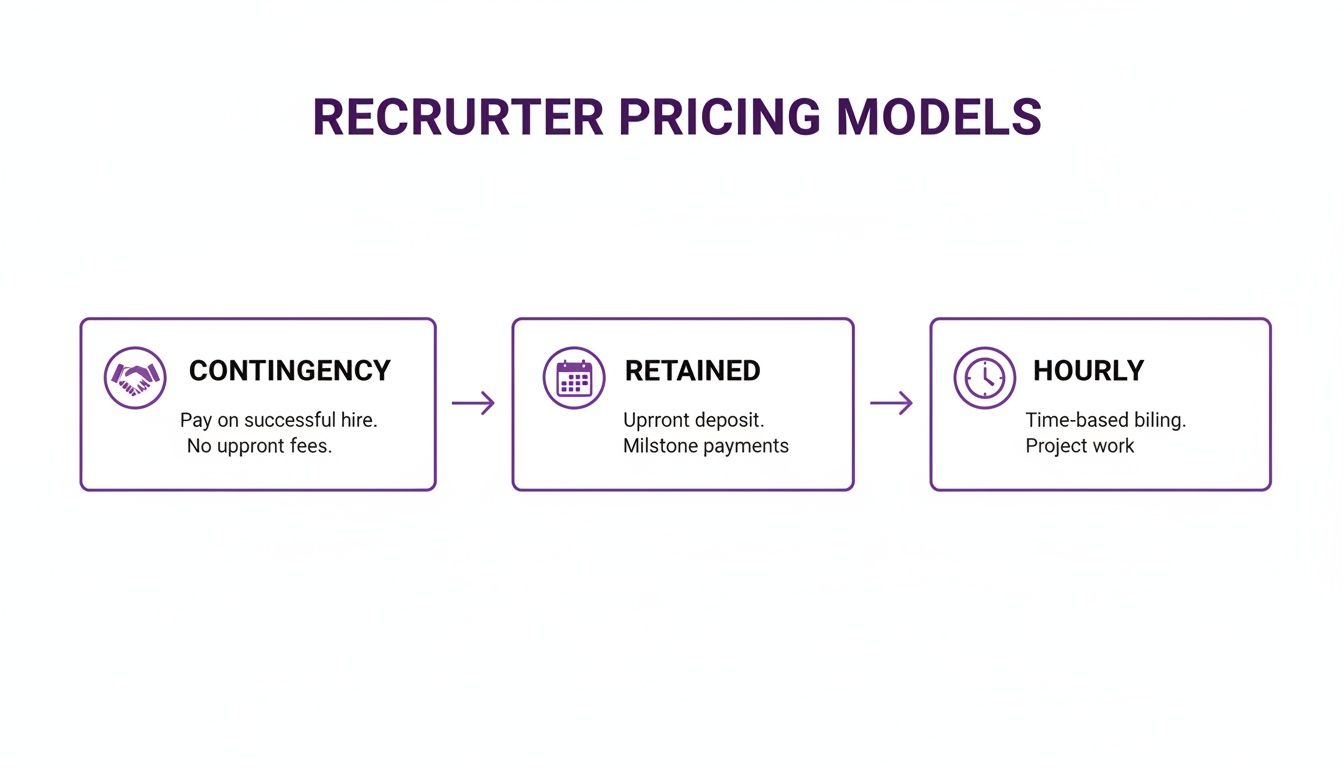
Getting your head around these models early on helps you align your budget and expectations before you even start talking to people, which makes for a much smoother first conversation.
Vetting Recruiters With a Modern Approach
Once you've got a shortlist, the real work begins. A traditional interview just won't cut it; you need to treat the recruiter’s past work as the real interview. This means getting away from hypothetical questions and focusing on cold, hard evidence of their past performance and methods.
The whole point is to separate the genuine talent partners from the people who just forward résumés. In a competitive landscape like the German IT market, this is critical. Recruiters here average about 25 hires per month, which is quite a bit below the global peer average of 30. With IT vacancies on the rise and a need for an estimated 400,000 skilled foreign workers each year, you need a recruiter who is precise and deeply specialised.
Here’s a simple, structured way to vet them:
- Request Specific Case Studies: Ask for detailed examples of recent, relevant placements. A great recruiter should be able to walk you through how they filled a role similar to yours, explaining the challenges they faced, their sourcing strategy, and the final outcome.
- Analyse Placement Metrics: Don't be shy about asking for their numbers. Key metrics like time-to-fill, interview-to-hire ratio, and—most importantly—the retention rate of their placements at the 12-month mark are powerful indicators of how effective they really are.
- Verify With Client Testimonials: Ask for references from past clients, especially from hiring managers or founders at companies of a similar size and stage. A quick phone call can give you invaluable insight into their communication style and overall reliability.
The single most important question you can ask a potential freelance IT recruiter is this: 'How do you verify a candidate's technical skills?'
This question cuts right to the heart of their value. An average recruiter might mumble something about technical interviews or matching keywords on a CV. An elite recruiter, on the other hand, will talk about analysing GitHub repositories for code quality, reviewing Figma contributions for design system knowledge, or using platforms that offer verifiable proof of a candidate's work, like Acquispect.
Their answer will immediately tell you whether they rely on claims or on tangible evidence. That distinction is what separates old-school recruiting from modern, effective talent acquisition.
Moving Beyond Resumes to Verifiable Proof of Skill
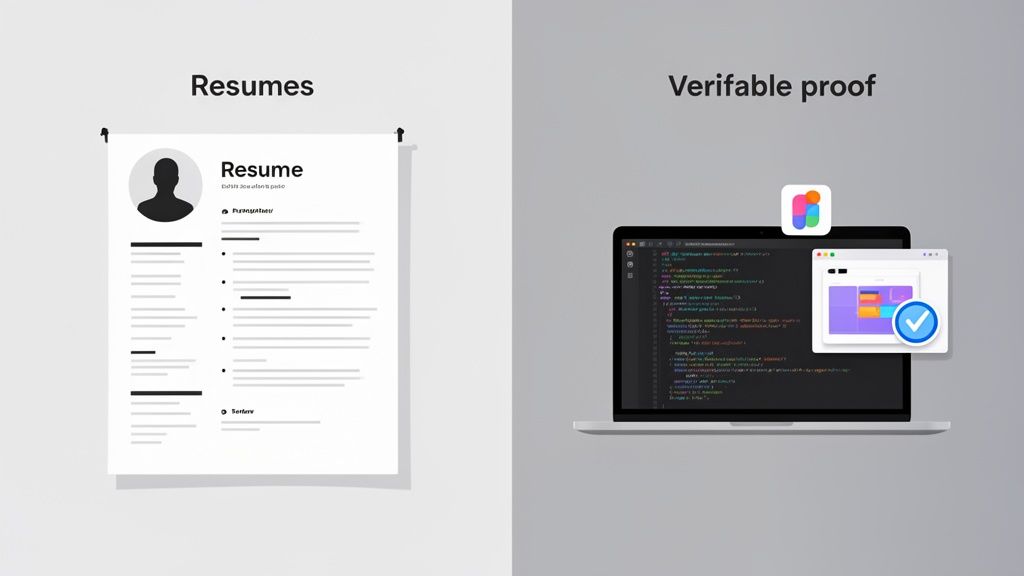
For decades, the resume has been the centrepiece of hiring. We all know it: a document filled with self-reported skills, experiences, and accomplishments. But in the incredibly nuanced world of IT, this old-school approach isn't just showing its age—it's fundamentally broken.
Think of a resume as a movie poster. It’s slick, impressive, and uses all the right words to promise an amazing experience. But let's be honest, we've all been let down by a film with a fantastic poster.
That's the core issue with relying on resumes alone. They’re built on trust and unverified claims. A candidate can easily write "Expert in Python" or "Led a team of five developers," but the paper itself offers zero tangible proof. It’s an honour system in a field where proven ability is everything.
The Shift to Tangible Evidence
An experienced freelance IT recruiter knows this all too well and champions a much smarter alternative: focusing on verifiable proof of work. Instead of just reading the movie poster, they insist on seeing the film. This means getting past the claims and digging into real evidence of what a candidate can actually do.
This proof-based approach fosters a genuine meritocracy. It means you hire people based on what they can demonstrably do, not just what they say they can do. It’s about swapping uncertainty for confidence.
So, what does this look like in the real world?
- For a Backend Developer: Instead of taking "Proficient in Go" at face value, the recruiter dives into the candidate's GitHub repository. They’re looking at the quality of the code, the thought process behind their solutions, and how they collaborate on projects.
- For a UI/UX Designer: "Experienced with design systems" is a nice phrase, but a savvy recruiter will ask to see their contributions in Figma. They'll assess component libraries, the clarity of their documentation, and how they solve actual design challenges.
- For a DevOps Engineer: The claim "Skilled in CI/CD" is validated by examining their public infrastructure-as-code configurations or contributions that showcase their ability to build and maintain automated pipelines.
Verifiable proof is the single most reliable indicator of future performance. It’s the difference between a candidate telling you they can build a bridge and showing you the bridges they’ve already built.
This method transforms hiring from a high-stakes guessing game into a data-driven decision. It’s the modern way to build trust and certainty before you bring someone critical onto your team.
Why This Matters More Than Ever
The traditional hiring model is simply failing to keep up. It's slow, inefficient, and often leads to bad hires—a huge source of frustration for companies trying to grow. In fact, the problem is so widespread that 65% of startups cited talent acquisition as their number one headache in the 2025 EY Startup Barometer.
A sharp freelance IT recruiter who prioritises verifiable proof—like code commits or project audits from platforms like Acquispect—cuts straight through the noise. They find and place top talent faster and with far greater accuracy. For more on the market dynamics, you can find great insights on the state of the freelance market on freelancermap.com.
Implementing a Proof-Based Vetting Process
Adopting this mindset means changing how you work with your freelance recruiter. You need to empower them to go much deeper than a quick CV scan.
Here’s a practical way to make it happen together:
- Define What Proof Looks Like: For every role, get specific about what constitutes compelling evidence. Is it a live portfolio, a specific type of code repository, or a detailed case study?
- Equip Your Recruiter: Give them the tools and context they need. This might mean arranging for a technical lead to review work samples or using platforms designed to audit code quality.
- Prioritise Proof Over Pedigree: Encourage your recruiter to focus on candidates with strong, verifiable work, even if they don't have a specific university degree or a FAANG company on their resume. Real skill trumps a fancy logo.
- Make "Work the Interview": For high-stakes roles, consider using small, paid, real-world tasks. A great recruiter can help you design assignments that effectively test the skills you need most, giving you a real preview of their capabilities.
When you partner with a freelance IT recruiter who speaks the language of proof, you aren’t just filling a vacancy. You’re building a more resilient and talented team on a solid foundation of verified skill.
Crafting Your Recruiter Contract and SLA
Before a single CV lands in your inbox, the most important thing you'll create with your freelance IT recruiter is the contract. Don't just see it as a legal formality; think of it as the blueprint for a successful partnership. A solid agreement, complete with a clear Service Level Agreement (SLA), is your best defence against misunderstandings and ensures everyone is on the same page from day one.
Without that clarity, you’re opening the door to scope creep, arguments over fees, and a whole lot of frustration. A well-written contract simply makes sure everyone knows the rules of the game, creating a transparent and professional relationship. It's the foundation for trust and, ultimately, great results.
Essential Components of Your Agreement
Your contract needs to be more than just a fee percentage and a signature line. It should map out every crucial aspect of the working relationship. This isn't just about protecting your business—it's about giving your recruiter the clarity they need to do their best work.
A truly comprehensive agreement will always cover:
- Scope of Work: Spell out exactly what the recruiter is responsible for. Are they handling everything from sourcing to negotiating the final offer, or just finding potential candidates? Get specific about the roles they’ll be working on.
- Fee Structure and Payment Terms: Detail the pricing model you’ve agreed upon (contingency, retained, etc.). State the precise fee percentage, what triggers the payment (like the candidate’s first day), and your payment terms (e.g., net 30 days).
- Exclusivity Clause: Clearly state if the arrangement is exclusive. Giving a recruiter an exclusive on a role for a set period is a powerful motivator for them to prioritise your search over others.
- Guarantee Period: Make sure there's a replacement guarantee. It’s standard practice for a recruiter to find a replacement at no extra cost if a candidate they placed leaves within a certain window, usually 90 days.
Defining Success with a Service Level Agreement
The SLA is where your contract gets teeth. It’s the part that turns vague goals into hard numbers and timelines, defining what "a great job" actually looks like. This shifts your partnership from being based on feelings to being tracked by objective performance, which is essential for knowing if you're getting a good return on your investment. For companies that need a hand structuring these kinds of complex partnerships, exploring expert talent acquisition consulting can offer some incredibly useful frameworks.
A strong SLA is your early warning system. It helps you see if a search is going off the rails long before a deadline is missed, letting you fix problems proactively instead of reacting to them.
Your SLA should be built around specific, measurable, achievable, relevant, and time-bound (SMART) goals. Think about including metrics that really matter for your hiring speed and the quality of candidates you want to see.
To make sure everything is measurable and everyone is accountable, your SLA needs to include some key performance indicators (KPIs). These metrics give you a clear, data-driven picture of how the recruiter is performing.
The table below outlines the must-have components for a robust SLA, turning vague expectations into concrete, measurable commitments.
| Essential SLA Components for Your Recruiter Contract | | :--- | :--- | :--- | | SLA Component | Description | Example Metric/Term | | Time-to-Shortlist | The time from search kickoff to receiving the first batch of qualified candidates. This measures the recruiter's urgency and sourcing efficiency. | 7-14 business days to present 3-5 vetted candidates. | | Candidate Submission Quality | The percentage of submitted candidates you decide to interview. A high rate shows the recruiter truly gets your requirements. | At least 75% of submitted profiles move to a first-stage interview. | | Interview-to-Hire Ratio | The number of interviews conducted to make one hire. A lower ratio (e.g., 5:1) signals high-quality, well-matched candidates. | Target a ratio of 6:1 or lower. | | Candidate Ownership Policy | A clause defining who gets credit for a candidate submission to avoid paying duplicate fees if you're working with multiple sources. | The first recruiter to submit a candidate's profile "owns" them for 6-12 months. | | Communication & Reporting | The expected frequency and format of updates on the search progress. This ensures transparency and keeps everyone aligned. | A weekly progress report email and a bi-weekly 30-minute check-in call. |
By including these elements, you’re not just signing a contract; you’re creating a shared roadmap for success. It keeps things transparent, sets crystal-clear expectations, and lays the groundwork for a highly effective partnership with your freelance IT recruiter.
Forging a True Partnership with Your Recruiter
Bringing a freelance IT recruiter on board is just the starting line. The real magic happens when you move beyond a simple vendor relationship and build a genuine, collaborative partnership. Think of them less as an outsider and more as a strategic extension of your own team. Success hinges on clear communication, mutual respect, and a shared vision for what a great hire looks like.
It all starts with the job brief. A single, vague paragraph just won't do the job. Your recruiter needs to get inside the role, understand your team's culture, and grasp the specific technical problems this new person will be hired to solve. The more context you give them, the sharper their search will be, which saves everyone a ton of time and effort down the line.
Setting the Right Communication Cadence
Consistent, honest feedback is the fuel that keeps a successful talent search moving. When your recruiter sends over candidate profiles, a quick response is crucial. In this market, the best people are often snapped up in a matter of days, so any delay could mean you miss out.
Even more important is the quality of your feedback. Simply saying "not a fit" doesn't help anyone. Give them the "why." For instance, instead of a flat no, try: "Their backend experience is solid, but we really need someone who has hands-on experience building scalable payment gateways from the ground up." This kind of specific, actionable feedback helps the recruiter fine-tune their search and bring you closer to the perfect candidate.
Treat your freelance recruiter as a true partner. They're your eyes and ears in a fast-moving talent market, and their insights can be gold.
Find a communication rhythm that works for both of you. A quick weekly check-in call or a shared tracker can keep everything on track and prevent that frustrating feeling of radio silence where no one knows what's happening.
Common Pitfalls to Sidestep
Even the most promising partnerships can hit a rough patch. One of the fastest ways to derail the process is to keep changing the goalposts. Constantly shifting the job requirements mid-search forces your recruiter back to square one, which is a surefire way to kill their momentum and enthusiasm.
Another major misstep is simply disappearing. Ghosting your recruiter after they've poured hours into sourcing candidates isn't just unprofessional—it can seriously tarnish your company's reputation. In Germany’s bustling market, which is home to 1.5 million freelancers and a tech sector expanding by 8% each year, your reputation is everything. Great recruiters are well-connected, and you can be sure that word gets around. You can get a better sense of Germany's vibrant recruitment scene and its challenges on ginitallent.com.
Ultimately, when you invest in building a strong partnership, you're doing more than just filling a single vacancy. You're developing a long-term asset that will strengthen your company's hiring strategy for years to come.
Frequently Asked Questions
Hiring a freelance IT recruiter for the first time? It's natural to have a few questions. Let's walk through some of the most common ones we hear from hiring managers, so you can feel confident making the right move.
What Is a Reasonable Fee for a Freelance IT Recruiter?
There's no single price tag, as fees really depend on the pricing model you agree on. The most common setup is a contingency search, where you only pay when a candidate is successfully hired. For that, you can expect to pay anywhere from 15-25% of the candidate’s first-year guaranteed salary. It’s a great low-risk option for most standard tech roles.
For trickier senior or highly specialised roles, you might see a retained search model. The fee is often in the same ballpark, but you pay it in stages throughout the process. This secures the recruiter's dedicated time and focus on your search. Some freelancers also work on an hourly rate, which could be anything from €75 to over €200, depending on their experience and what you need them to do.
How Long Does It Take to Receive a Candidate Shortlist?
The timeline really hinges on how complex the role is. If you're looking for a Senior Frontend Developer—a role with a relatively large talent pool—a good freelance recruiter can often get you a solid, well-vetted shortlist within 7 to 14 business days.
But if you're chasing a unicorn, like a Principal AI Engineer with a very specific skill set, the search naturally takes more time. It could easily be 4 to 6 weeks of deep-diving and careful vetting. The key is to get these timelines agreed upon in your Service Level Agreement (SLA) from the get-go.
The biggest factor influencing speed? It’s a two-way street. A crystal-clear job brief from you, paired with quick, honest feedback on the first few profiles, helps your recruiter narrow down the search incredibly fast.
What Is the Difference Between a Freelance Recruiter and an Agency?
Think of it like hiring a specialised artisan versus going to a big department store. A freelance IT recruiter is an independent pro who gives you a very personal, focused service. They usually have an incredibly deep network in a specific niche, whether that's a certain tech stack, industry, or location.
A traditional staffing agency is a much bigger operation. They have broader reach, but their consultants often juggle more roles and might not have that same specialised depth.
- Go with a freelancer when you need a targeted, high-touch approach for a critical or hard-to-fill role.
- Consider an agency when you’re hiring at scale across many different departments and need sheer volume.
How Do We Handle Candidate Ownership with Multiple Recruiters?
This is a big one, and you absolutely need to nail it down in your contract to avoid headaches later. The industry standard is pretty simple: the first recruiter who officially submits a candidate's profile for a role "owns" that candidate for a set period, usually 6 to 12 months. This protects you from paying two fees for the same hire.
The best way to keep track of this is with an Applicant Tracking System (ATS). Every submission gets a timestamp, creating a clear, undeniable record of who sent you who, and when.
Ready to hire based on proven skills, not just promises? Acquispect replaces the outdated resume with verifiable proof of work, ensuring you connect with elite talent who have demonstrated their expertise. Build your team with confidence. Discover how on acquispect.com.