Before you even start browsing job boards, it’s worth taking a moment to understand what a "remote data entry job" actually looks like these days. The role has changed. It's not just about typing fast anymore; it’s a mix of tech-savviness, a keen eye for detail, and a serious respect for data privacy. Nailing this understanding is your first real step to a successful job hunt.
What Modern Data Entry Jobs Really Involve

If the term 'data entry' makes you picture someone endlessly typing numbers into a basic spreadsheet, it's time for an update. While that core task still exists, the modern role is much broader and carries more responsibility. Think of today's data entry professionals as the guardians of a company's information, making sure everything is accurate and sound across all sorts of digital platforms.
So, what does that look like in practice? Instead of just mindless input, you could find yourself:
- Updating customer accounts in a CRM (Customer Relationship Management) system, maybe something like Salesforce.
- Transcribing audio from medical consultations or legal meetings, which requires getting specialised terminology spot-on.
- Categorising thousands of products for an online shop's inventory system.
- Processing invoices and purchase orders directly into accounting software.
Key Skills That Employers Actually Want
That "detail-oriented" line on your CV isn't going to cut it. Hiring managers have seen it a thousand times. They're looking for concrete skills that solve their problems and protect their data. Showing you have these can instantly move your application to the top of the pile.
Most successful applicants I've seen can demonstrate:
- Advanced Spreadsheet Knowledge: You need to be comfortable in Microsoft Excel or Google Sheets far beyond just typing in cells. We're talking about being able to use VLOOKUPs, build pivot tables, and apply conditional formatting to make sense of the data.
- High Accuracy and Speed: The industry benchmark is pretty clear here. A typing speed of at least 60 WPM (Words Per Minute) combined with over 99% accuracy is what most companies expect.
- Understanding Data Confidentiality: You’ll often be working with sensitive customer or financial information. A solid grasp of data privacy isn't just a bonus; it's a fundamental requirement.
The Growing but Competitive Market
The boom in remote work has completely changed the game. Recent data points to a massive increase in remote job listings across Europe, and Germany is no exception. While the initial surge of remote postings in early 2025 has started to level off, the overall number of opportunities remains high.
Sectors like healthcare and finance, where accurate data is non-negotiable, have led the charge in creating these remote roles. This is great news—more data entry remote jobs are out there. But it also means the competition is fierce. You can find more detailed analysis on these remote hiring trends on getaura.ai.
The job has fundamentally shifted from pure data input to active data management. A modern data entry specialist is expected to verify information, spot and fix errors, and guarantee the quality of data before it ever gets into a company's core system.
Building a CV That Gets You Noticed
When you're applying for remote data entry jobs, your CV is your foot in the door. In such a competitive field, a generic, one-size-fits-all document is a fast track to the "no" pile. You need to create a CV that speaks directly to what hiring managers actually care about: speed, accuracy, and reliability.
This means you have to get specific. Don't just list the software you know; show what you can do with it. Frame your skills in a way that solves the problems a business is facing.
Show, Don’t Tell, With Numbers
Anyone can say they're "hard-working" or "detail-oriented," but these are just empty words on a page. Numbers, however, offer solid proof of what you're capable of. They turn your CV from a simple list of past duties into a showcase of your actual results.
Think about your past roles, even if they weren't officially "data entry." Did you handle customer records? Manage stock? Process sales orders? All of that is valuable experience.
Here’s how you can translate those tasks into powerful, data-driven bullet points:
Instead of: "Responsible for processing invoices."
Try this: "Processed an average of 500+ invoices daily with a documented 99.8% accuracy rate."
Instead of: "Good typing skills."
Try this: "Consistently maintain a typing speed of 85 WPM with 99% accuracy, verified through regular testing."
This simple tweak makes all the difference. It shows a recruiter exactly what you bring to the table. If you want more tips on fine-tuning your application documents, you might find some useful advice over on the JobcoPilot blog.
Tailor Your Skills and Summary
The professional summary at the top of your CV is prime real estate—don't waste it. It should be a short, powerful pitch that instantly flags you as a strong candidate for a data entry role. Make sure you tailor it for every single application, weaving in keywords from the job description.
Think of your summary as a headline. Its only job is to convince the recruiter to keep reading. It needs to immediately answer their main question: "Why should I hire you for this specific remote data entry job?"
Here’s a solid example for someone just starting out:
"Highly accurate and efficient data entry professional with a proven typing speed of 75 WPM. Proficient in Microsoft Excel, including VLOOKUPs and pivot tables, with a strong commitment to maintaining data integrity and confidentiality. Eager to apply meticulous attention to detail to support the team’s data management goals."
This works because it's packed with relevant keywords like "accuracy," "WPM," "Excel," and "data integrity."
The competition out there is getting tougher. A European survey revealed that 59% of German job seekers saw fewer remote openings in 2025 than in previous years. With nearly a quarter of applicants searching for over a year, a specialised and brilliantly crafted CV isn't just an advantage anymore—it's essential. You can read more about these trends in the 2025 remote job market. This level of competition means employers can afford to be extremely picky, and they’ll always prioritise candidates who can prove their value right from the start.
Finding Legitimate Data Entry Opportunities
Knowing where to look for data entry remote jobs is half the battle. If you just dive into the huge, generic job boards, you're going to get overwhelmed. They're often flooded with thousands of applicants, not to mention a frustrating number of low-quality or even outright fake listings.
To find real opportunities that pay fairly, you need to get a bit more strategic. It's about quality, not quantity. From my experience, the most successful job seekers focus on a few key areas: specialised freelance platforms, direct company career pages, and niche job boards. This approach helps you cut through the noise and get in front of employers who are genuinely looking for skilled people.
Where to Focus Your Search
Freelance platforms are a fantastic starting point, especially if you're looking for project-based work that can blossom into long-term relationships. Sites like Upwork and Freelancer let you build a portfolio and a solid reputation, which makes landing those higher-paying gigs much easier down the line. You'll often find more specialised tasks here, too—everything from cleaning up messy customer databases to transcribing complex industry documents.
Another goldmine that people often forget about is the careers section on company websites. Many organisations, especially bigger players in finance, healthcare, and e-commerce, post their remote roles directly on their own sites. Going direct cuts out the middleman and instantly shows the company you're genuinely interested in them, not just any job.
The most successful job searches are targeted. Instead of blindly applying to 100 random listings on a generic site, focus your energy on 10 well-researched opportunities on platforms known for quality. The return on your time will be significantly higher.
This infographic really breaks down the differences between these sources, showing how pay and the number of listings can vary.
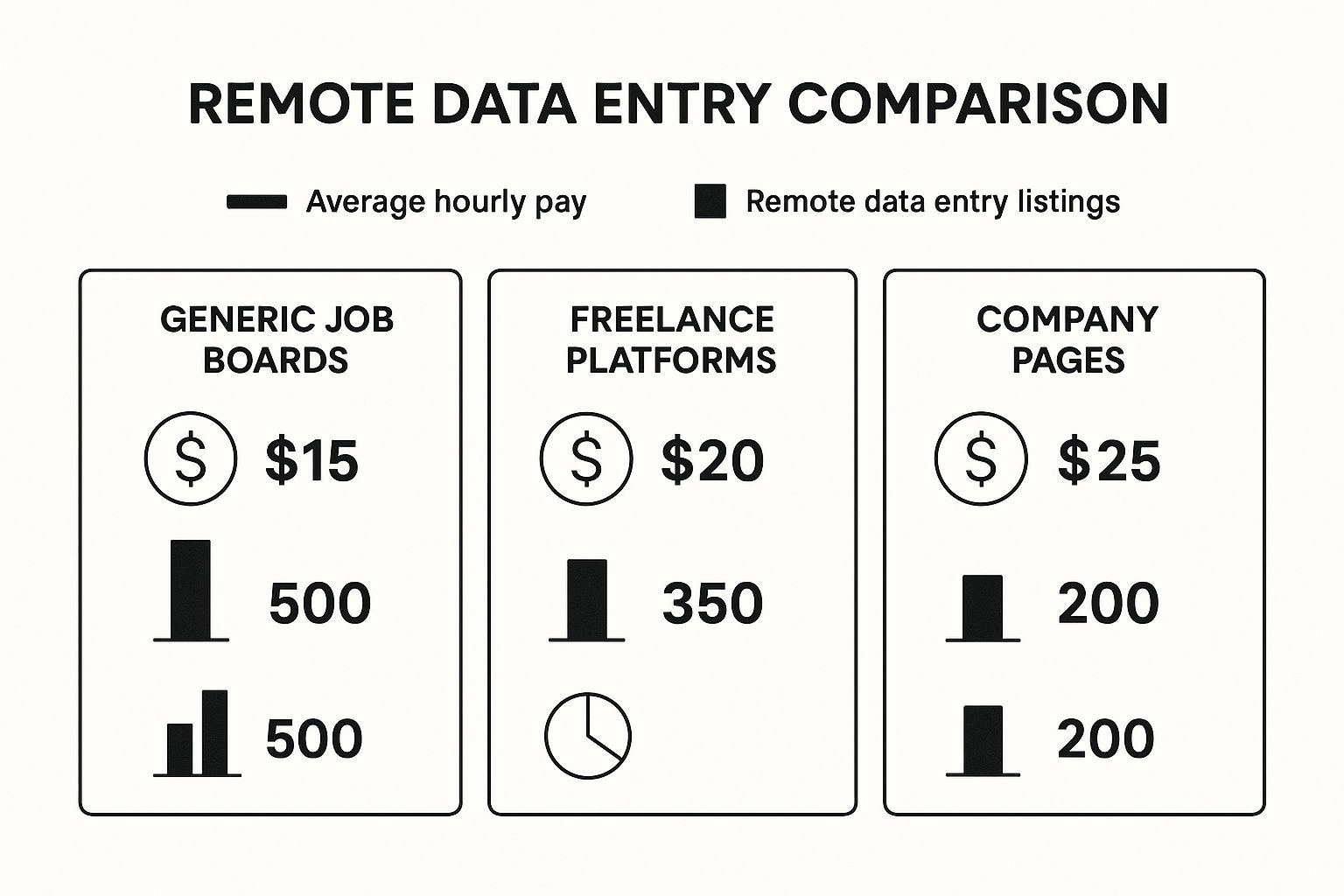
As you can see, applying directly on company pages often leads to higher pay, while freelance platforms offer a great balance of decent pay and a steady stream of opportunities.
To help you decide where to start, here's a quick comparison of the top platforms that data entry professionals are using right now.
Top Platforms for Finding Remote Data Entry Roles
| Platform Name | Best For | Typical Pay Structure | Key Feature | | :--- | :--- | :--- | :--- | | Upwork | Freelance projects & building a portfolio | Hourly or fixed-price | Strong client review and payment protection system | | Freelancer | Short-term gigs and entry-level projects | Fixed-price or hourly | Large volume of global projects posted daily | | LinkedIn | Networking and finding full-time remote roles | Salary or hourly | "Easy Apply" feature and direct connections to recruiters | | Indeed | A wide variety of full-time and part-time roles | Salary or hourly | Extensive filtering options and company reviews | | Direct Company Websites | High-paying, stable, long-term positions | Salaried | Direct application process without third-party competition |
Ultimately, a mix of these platforms will give you the best chance of landing a great role.
Using Search Filters Like a Pro
Whichever platform you're on, you have to master its search filters. Simply typing "data entry" and scrolling is a recipe for frustration. Get into the habit of using the advanced search options to zero in on roles that are a perfect match for you.
- Filter by Date Posted: This is my number one tip. Always look for the newest listings first. Roles posted within the last 24 hours to 7 days are far more likely to have active hiring managers.
- Use Specific Keywords: Think beyond the obvious. Instead of just "data entry," try searching for terms like "CRM data entry," "Excel data clerk," "medical records clerk," or "invoice processing."
- Set Pay Rate Filters: Don't waste a second on roles that don't meet your needs. Filter out low-paying jobs immediately so you're only seeing opportunities worth your time.
This targeted approach will save you from getting bogged down in irrelevant or outdated postings. To take it a step further, using a tool that automates this process can be a real game-changer. For those looking to streamline their job hunt in the German market, you can find powerful tools to automate your job search and application process. This kind of tool helps you stay organised and be one of the first to apply to the best opportunities.
How to Spot and Avoid Job Scams
The world of data entry remote jobs is packed with genuine opportunities, but its popularity has also made it a prime target for scammers. To protect yourself, you need to develop a sharp eye for what’s real and what isn't. It really comes down to this: legitimate employers have professional, structured hiring processes, while scammers often create a sense of urgency to trick you into making a mistake.
Let's start with the most obvious tell-tale sign: a job offer that seems way too good to be true. If you see a post advertising an incredibly high salary for simple tasks that require zero experience, your alarm bells should be ringing. A real company will offer a pay rate that makes sense for the industry and the work involved.
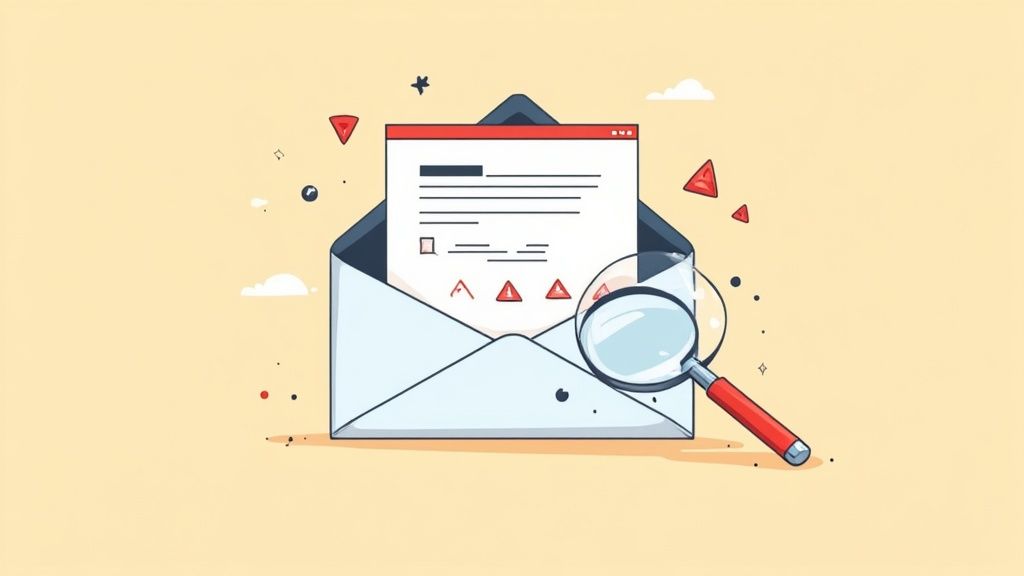
Here's another non-negotiable red flag: any request for you to pay them. A legitimate employer will never ask you for money to cover training, background checks, or software. Those are their business costs, not yours. If anyone tells you to wire funds or purchase gift cards to pay for your "work equipment," you’ve found a scam. End communication immediately.
Vetting a Company’s Credibility
Before you even click "apply," take a few minutes to do some basic detective work. It’s a simple step that can save you a huge headache later. Start by looking for a professional website. Does it have clear contact information, a physical address, and detailed information about what the company actually does? Scammers often hide behind shoddy, generic websites or have no real digital footprint at all.
Next, head over to professional networks like LinkedIn or Xing. A legitimate business will almost always have a company page, often with a list of current employees and recent activity. A bare-bones page with just a handful of followers, or no page at all, is a definite warning sign. It’s also wise to search for the company’s name plus words like "scam," "fraud," or "review" to see if others have already flagged them.
A professional hiring process is clear and structured. It involves interviews, skill assessments, and formal offers. Any company that tries to hire you solely through text messages or instant messaging apps is highly suspect.
Common Scam Tactics to Watch For
Scammers might get creative, but they tend to use the same playbook over and over. Once you learn their common tactics, they become much easier to spot. This keeps you safe while you hunt for legitimate data entry remote jobs.
To make it even clearer, here’s a quick reference table outlining the differences between a scam and a real opportunity.
Red Flags of a Data Entry Job Scam
| Red Flag (Scam) | Green Flag (Legitimate) | | :--- | :--- | | Vague job description with spelling/grammar errors | Detailed role description with clear responsibilities | | Uses a personal email address (e.g., @gmail.com) | Uses a professional company email address | | Asks for personal bank details upfront | Requests bank information only after a formal contract is signed | | Offers a job without a formal interview | Conducts one or more interviews (video or phone) | | Pressures you to make an immediate decision | Gives you reasonable time to review a formal offer |
Looking at this table, you can see how scammers try to cut corners, while real employers follow established, professional steps.
Watch out for the fake cheque scam, too—it's a classic for a reason. In this scenario, the "employer" sends you a cheque for more than your agreed-upon pay. They’ll ask you to deposit it and then wire the "extra" money back to them or a third-party "vendor." The problem is, the original cheque is fake. By the time your bank figures that out, you've already sent your own real money to the scammer, and you're on the hook for the bounced cheque. The golden rule is simple: never, ever agree to handle company funds through your personal bank account.
Specialising to Increase Your Earnings
While general data entry remote jobs are a fantastic way to get your foot in the door of working from home, the real money is in specialisation. Let’s be honest, basic data entry tasks usually come with a standard hourly rate. But if you can carve out a niche for yourself, you can start charging a premium for skills that are harder to come by and much more valuable to certain industries.
Think of it this way: a generalist is like a handyman, great for all sorts of small jobs. But a specialist—say, a certified electrician—is who you call for the critical, complex work, and you pay them accordingly. By shifting from a general data entry clerk to a specialist, you’re not just getting a pay rise; you're changing your entire career path.
High-Demand Niches to Consider
Some industries are swimming in sensitive, highly regulated data. They simply can't afford mistakes, so they're more than willing to pay top dollar for professionals who get their specific needs and compliance rules.
Here are a few of the most rewarding fields to look into:
- Medical Billing and Coding: This is all about translating medical diagnoses, procedures, and services into universal alphanumeric codes. It demands incredible precision and a solid grasp of medical terminology, but it’s a field that’s always hiring.
- Financial Data Entry: This niche covers everything from bookkeeping and invoice processing to managing expense reports. Accuracy is absolutely non-negotiable here. Knowing your way around accounting software like QuickBooks or Xero can make you an indispensable part of a financial team.
- Legal Document Management: Law firms and in-house legal teams need sharp assistants to manage, code, and input data from case files, contracts, and transcripts. Confidentiality is key, as is an understanding of legal document formats.
The Power of Certifications
If you really want to stand out and justify a higher rate, certifications are your secret weapon. They’re concrete proof of your expertise and dedication, and they build immediate trust with potential clients or employers. A relevant certification on your CV can be the one thing that pushes your application to the top of the pile.
For instance, if you're aiming for healthcare data entry, getting a Certified Medical Reimbursement Specialist (CMRS) credential is a game-changer. It tells employers you have a deep understanding of the medical billing cycle and compliance, making you a first-class candidate.
A niche specialisation combined with a recognised certification is the fastest way to double or even triple your potential earnings in the remote data entry field. It shifts the conversation from "how fast can you type?" to "how much value can you provide?"
And the demand for these roles is only getting stronger. Forecasts point to a 12% increase in demand for specialised data entry positions by 2026, particularly in healthcare and finance. This is being driven by companies that need pinpoint data accuracy, especially as remote work becomes a permanent part of the business world. Even though the number of remote jobs has levelled off, the competition for the best ones is intense, making certifications a crucial advantage. You can find more data entry statistics and insights on this trend.
Ready to get started? Check out online learning platforms for courses in your chosen niche. Many of them offer excellent certification prep programmes that will give you exactly the knowledge you need to pass the exams and thrive in a new, specialised career.
Frequently Asked Questions
When you're first looking into remote data entry work, a ton of questions probably pop into your head. That's completely normal. Let's cut through the noise and get you some straight answers to the most common queries I hear.
We'll cover everything from what you can actually expect to make, to the gear you'll need, and how to get your foot in the door even if you're starting from scratch.
How Much Can I Realistically Earn From Home?
Let's talk numbers. Your earning potential really boils down to your speed, accuracy, and the kind of data you're handling. For most entry-level gigs in Germany, you're looking at a starting point of somewhere between €12 and €15 per hour. This is typical for basic tasks like typing up notes or entering numbers into a spreadsheet.
The real money, however, is in finding a niche. Once you build up specialised skills, your pay can jump significantly.
- Specialised Roles: If you get into something like medical coding or legal transcription, you're dealing with complex information that requires specific training. For that, rates often climb to €20 to €28 per hour, sometimes even higher.
- Freelance Platforms: On sites like Upwork, many jobs are paid by the project, not the hour. This is where your efficiency really pays off. The faster you can accurately complete a project, the better your effective hourly rate.
Before you start applying, do a little digging to see what the going rates are for the specific type of data entry you're eyeing. It’ll help you set realistic goals and make sure you're not selling yourself short.
What Equipment Do I Actually Need?
You don't need to build a NASA-style command centre in your spare room, but a few key pieces of gear are non-negotiable for doing this work well.
The absolute basics are a decent computer and a stable, fast internet connection. Since you’ll be sitting for long stretches, an ergonomic setup isn't a luxury—it's essential. A good chair and a comfortable keyboard will save you a world of hurt in your back and wrists later on.
If I could give one piece of advice, it's this: get a second monitor. It is the single best productivity booster you can buy. Having your source document open on one screen and your work on the other eliminates that constant, frustrating tab-switching. It’s a genuine game-changer.
And while many companies have their own software, a solid grasp of Microsoft Excel is pretty much a universal expectation.
Can I Get Hired with No Experience?
Yes, you absolutely can, but you have to be clever about it. Plenty of companies are happy to take on beginners for remote data entry work, but they need to see that you've got the right stuff. Your job is to prove you have the core skills, even if you don't have a formal job title to back it up.
You need to focus on showing, not just telling. Here’s how:
- Prove Your Typing Skills: Don't just say you're a fast typist. Go to a free online typing test site, get a certified result, and put that number on your CV. Seeing "75 WPM with 99% accuracy" is far more convincing than a vague claim.
- Show You Know the Software: Take a free introductory course on Excel or Google Sheets. Being able to mention that you're comfortable with functions like VLOOKUPs tells an employer you’ve already taken the initiative to learn.
- Create a Small Portfolio: Find a messy public dataset online, clean it up, and organise it neatly in a spreadsheet. This simple project can serve as a powerful example of your attention to detail and ability to follow instructions.
When you're searching on job boards, use keywords like "entry-level," "trainee," or "junior data clerk." These postings are specifically for people who are ready to learn on the job. For these roles, a can-do attitude and a sharp eye for detail often count for more than years of prior experience.
Ready to stop scrolling and start applying smarter? Acquispect uses AI to find the perfect jobs for you, crafts personalised application letters in minutes, and tracks your success so you can land more interviews, faster. Take control of your job search and see the difference.
Start your free 30-day trial with Acquispect today!