If you're hunting for a data scientist job in Germany, you’ve picked one of the most exciting and opportunity-packed markets in Europe. Germany's economic powerhouse is undergoing a massive digital overhaul, creating a huge appetite for skilled data professionals. It’s a fantastic place to build a career.
Why Germany Is a Top Destination for Data Scientists
Germany’s economy is in the middle of a massive pivot. Long known for its world-class engineering and manufacturing titans, the country is now weaving data-driven thinking into the very fabric of its industries. This shift, often dubbed Industry 4.0, is like bolting a data-fuelled supercharger onto an already high-performance engine.
This transformation has created a powerful, sustained demand for data expertise. It’s a fantastic environment for professionals like you, with opportunities cropping up everywhere, not just in one or two major cities.
A Unique Blend of Stability and Innovation
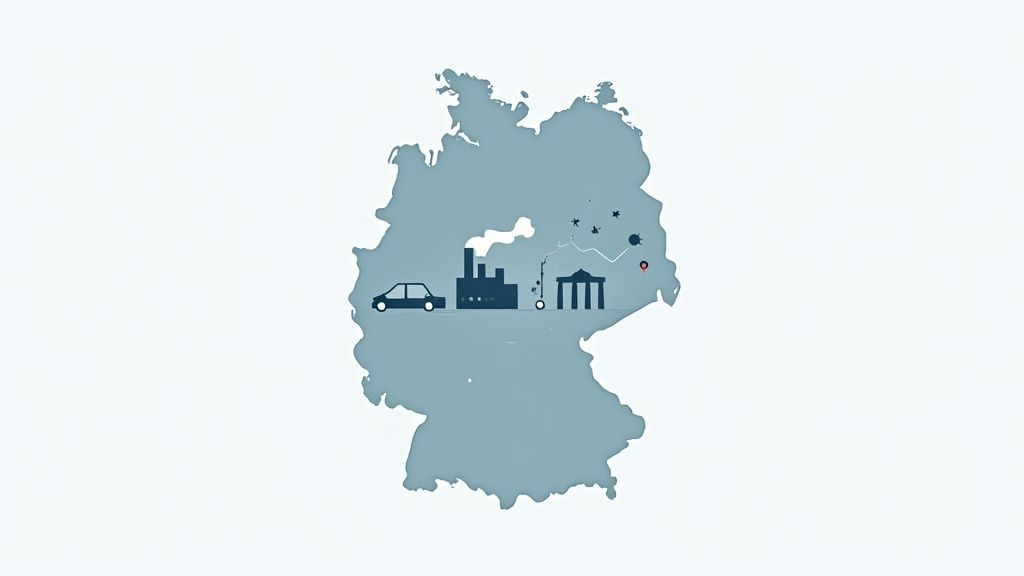
What really sets Germany apart is its blend of rock-solid economic stability and forward-thinking innovation. You could be working on the next big thing in Berlin's vibrant start-up scene or shaping legacy-defining projects at an automotive giant in Bavaria. This dual landscape offers the security of established industries alongside the thrill of real innovation.
For international talent, this environment brings some fantastic perks:
- Strong Job Security: Germany's powerful economy offers a reliable foundation for building a long-term career.
- Diverse Opportunities: Data scientists are in demand everywhere, from e-commerce and fintech to automotive and healthcare.
- High Quality of Life: The country is famous for its great infrastructure, focus on work-life balance, and excellent social benefits.
- Competitive Compensation: The high demand for your skills means salaries are very competitive.
The Talent Gap You Can Fill
Here's the real kicker: Germany has a significant shortage of talent in data science and AI. This isn't just a minor issue; it's a major challenge for businesses, and it puts skilled candidates like you in a very strong position.
A recent survey found that 75% of German employers are struggling to hire data and AI specialists. This often leads to recruitment delays of around six months. This scarcity means companies are more motivated than ever to invest in attracting and keeping top professionals from all over the world.
This talent crunch directly shapes the job market. About 42% of companies are now using a mix of in-house staff and external teams just to keep up, which shows just how much pressure they're under to find experts. For anyone seeking a data scientist job in Germany, this shortage gives you more negotiating power, better salary potential, and a clearer runway for career growth. You can explore more on these data science hiring statistics and understand what they mean for the market.
Mapping Your Career in the German Data Science Market
Think of the German job market as a complex terrain; you need a good map to find the best path. The landscape for a data scientist job in Germany is always shifting, shaped by powerful economic centres and a whole spectrum of specialised roles. Getting a handle on this map—knowing the key cities, what the different job titles really mean, and the current hiring climate—is the first crucial step to landing the right position.
Unlike some countries where tech is clustered in one or two places, Germany's data science scene is spread out. Opportunities are dotted across several major hubs, each with its own unique flavour and industry focus. This regional variety is a huge plus, as it lets you match your job search to the kind of life you want to live and the professional challenges you want to tackle.
Germany's Top Data Science Hubs
A few key cities act as magnets for data talent, pulling in professionals with a high density of jobs and lively tech communities.
Berlin: Without a doubt, the start-up capital. Berlin's ecosystem is buzzing with tech companies, from nimble e-commerce platforms to disruptive fintech firms. The vibe here is fast, international, and perfect for anyone who loves building things from the ground up.
Munich: The heart of German industry. Here, you'll find corporate giants like BMW and Siemens sharing the stage with a powerful insurance, aerospace, and B2B tech scene. A data scientist job in Munich often means working on massive, high-impact projects inside a well-oiled corporate machine.
Hamburg: A powerhouse in media and logistics. As Germany's biggest port, Hamburg’s logistics and trade sectors are pouring money into data-driven optimisation. It also has a vibrant media and gaming industry, which opens up some really unique roles for data professionals.
While these are the big three, don't overlook other cities. Frankfurt is the undisputed king of finance, Stuttgart is all about automotive, and Cologne has a strong media presence. They all offer fantastic, if more specialised, opportunities.
Understanding Current Market Dynamics
The demand for data scientists in Germany is still high, but it's not a free-for-all. Like any market, it has its ups and downs. A recent look at the numbers shows a dynamic but increasingly competitive field. While there are currently around 150 data scientist job openings across Germany, we've also seen a sharp 75% decline in active job postings over the last three months. This might just be a temporary hiring slowdown, or it could mean the market is getting more crowded. Either way, it makes a killer application more critical than ever. For a closer look, you can dig into these German data scientist job statistics.
This competitive climate drives home a critical point: a broad, solid skill set isn't just a "nice-to-have" anymore. It's the price of entry. Companies want people who can walk in and start creating tangible value right away.
So, while Germany's push towards digitalisation keeps the fundamental demand strong, the bar for getting hired is high. Employers aren't just looking for someone who knows the theory; they need specialists who can tackle complex problems with a versatile toolkit.
Distinguishing Key Data Roles
The title "Data Scientist" gets thrown around a lot, often as a catch-all for several very different jobs. Knowing the distinction is vital for finding a role that actually matches your skills and ambitions. It’s a bit like the title "doctor"—a cardiologist and a neurologist are both doctors, but their day-to-day work is worlds apart.
Let's break down the three most common roles you'll encounter:
Data Scientist: The generalist and strategist. These are the problem-solvers who use stats and machine learning to wring insights from data. Their work can span the entire project lifecycle, from cleaning data and performing exploratory analysis to building predictive models and then explaining what it all means to the business folks.
Data Engineer: The architect and builder. Data engineers are the ones who design, build, and maintain the data highways. They create the infrastructure and pipelines that ensure data flows smoothly and reliably, making it clean, available, and ready for data scientists to work their magic.
Machine Learning Engineer: The specialist and implementer. This role is a hybrid of software engineering and data science. ML engineers take the models that data scientists build and figure out how to deploy them in the real world. They make sure the models are scalable, efficient, and robust enough to handle live production environments.
Even though these roles have different focuses, they all stand on a common foundation of programming (especially Python), data handling (like SQL and Pandas), and a solid grasp of machine learning. Figuring out where your own strengths and interests lie is the key to aiming your job search with precision.
Decoding Data Scientist Salaries in Germany
Let's get straight to the point: understanding what you can earn is a massive part of any career move. When it comes to a data scientist job in Germany, the numbers are strong. Thanks to a robust economy and a seemingly endless appetite for tech talent, companies are willing to pay for the right skills. But your salary isn't just one number; it's a moving target, influenced by how much experience you bring, where in Germany you decide to settle, and the kind of company you join.
Think of your German salary as a package. You've got your base salary—the foundational layer—but on top of that, you'll often find performance bonuses, stock options, and other benefits. The number on your contract is just the starting point.
Data Scientist Salary Benchmarks in Germany by Experience Level
The table below breaks down the typical salary ranges you can expect as you progress through your career. It's clear that as your skills sharpen and your impact on the business grows, so does your paycheque.
| Experience Level | Average Annual Salary Range (€) | Key Skills Expected | | :--- | :--- | :--- | | Junior (0-2 years) | €50,000 - €65,000 | Python/R proficiency, SQL, foundational stats, machine learning theory, data visualisation tools (e.g., Tableau). | | Mid-Level (2-5 years) | €65,000 - €85,000 | Independent project work, A/B testing, cloud platform experience (AWS, GCP), building and deploying ML models. | | Senior (5+ years) | €85,000 - €120,000+ | Leading complex projects, mentoring junior scientists, advanced ML techniques, strategic input, stakeholder management. |
As you can see, the leap from a junior to a senior role is significant. This path is all about moving from executing tasks to owning projects and, eventually, driving strategy.
How Location Impacts Your Paycheque
Where you choose to work in Germany plays a huge role in your earning potential. It's no surprise that the big tech hubs—Munich, Berlin, and Hamburg—command the highest salaries. They're where the competition for talent is fiercest, which naturally drives up pay. The trade-off, of course, is a higher cost of living.
In Germany, the compensation for data scientists reflects the intense demand for skilled professionals. The average annual salary for a data scientist hovers around €78,000, inclusive of extra compensation.
This national average gives you a decent benchmark, but the regional differences can be stark. For example, in Munich, a major hub for both tech and traditional industry, the median base salary is approximately €67,500, with total pay often pushing past €72,500 once bonuses are factored in. And for senior professionals in management roles at large tech firms, packages can easily top €230,000, showing just how high the ceiling can be. You can dig into more detailed comparisons by checking out global data science salary reports.
The chart below shows how data scientist roles stack up in popularity against related specialisations like Data Engineering and Machine Learning Engineering, giving you a feel for the market landscape.
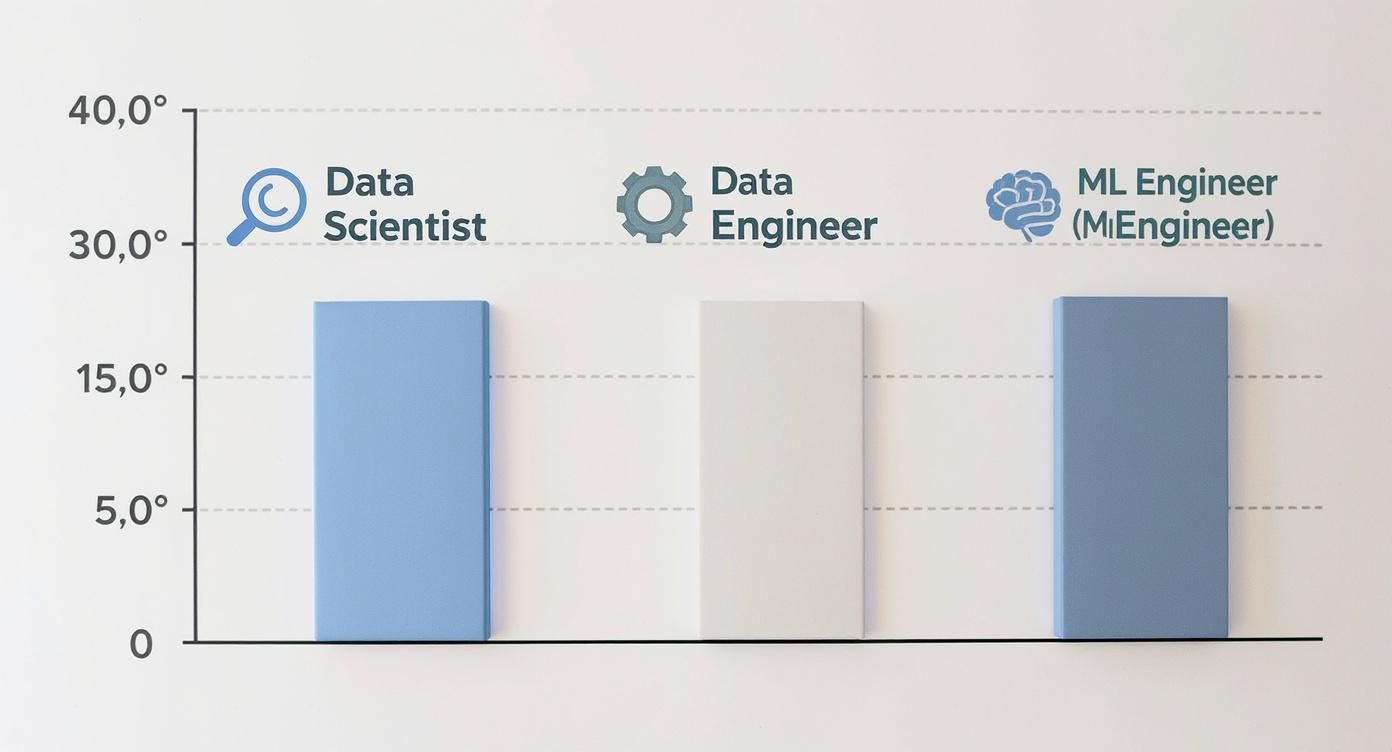
This shows a healthy demand across the board, which is great news—it means there's a thriving ecosystem for a variety of data-focused skill sets.
Understanding Your Full Compensation Package
A German job offer is always more than just the base salary. To really understand what's on the table, you need to look at the entire compensation package. Companies use a mix of financial and non-financial perks to attract and keep the best people.
Here's what you'll typically find:
- Base Salary (Grundgehalt): This is your fixed, reliable monthly income and the biggest piece of the puzzle.
- Performance Bonus: This is often tied to your performance, your team's success, and the company's overall results. It can add a nice chunk to your annual earnings.
- Company Pension Scheme (Betriebliche Altersvorsorge): Many companies will contribute to a private pension plan on your behalf, helping you build a nest egg for retirement.
- Professional Development Budget: A common and valuable perk. This budget for courses, conferences, and certifications shows a company is invested in your long-term growth.
- Fringe Benefits: These are the little things that add up, like a public transport ticket, a subsidised gym membership (a pass for Urban Sports Club is a popular one), or meal vouchers.
When you're negotiating, don't get fixated only on the base salary. A slightly lower base might be easily outweighed by a fantastic bonus structure or a generous pension plan. It’s the total value of the package that truly counts.
Building Your In-Demand Data Science Skill Set
Landing a top data scientist job in Germany isn't just about having a polished CV. It’s about demonstrating a specific blend of hard-hitting technical skills and sharp interpersonal abilities. German employers aren't just looking for someone who can build a clever model; they need a well-rounded expert who can also explain its business value with total clarity.
Think of it like this: your skills are your toolkit. Having the best tools is one thing, but knowing exactly which one to use for the job—and why—is what truly makes you a professional.
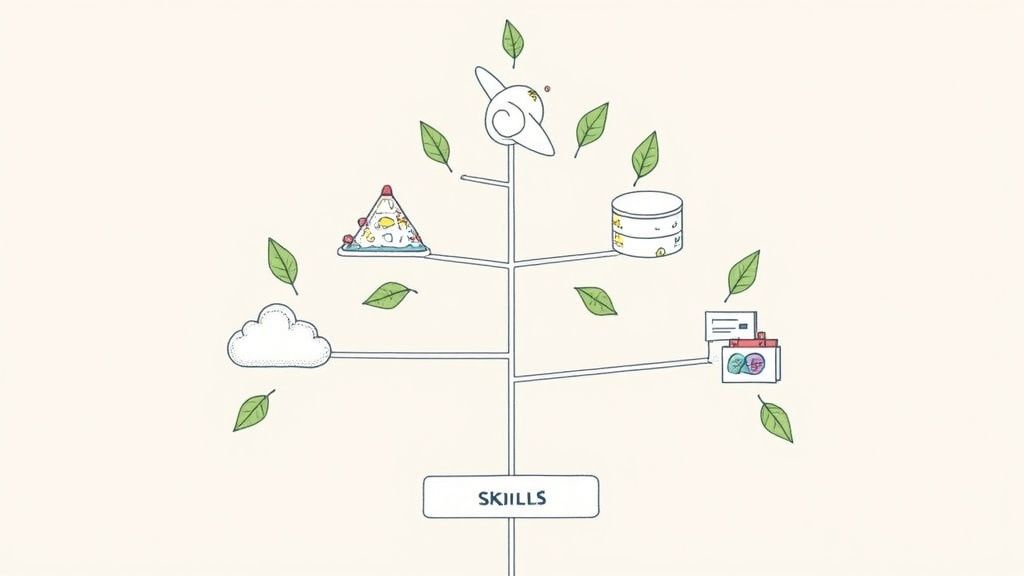
The technical foundation is non-negotiable. It all starts with programming, where Python is the undisputed leader in the German market. You need to be completely at home with its core data science libraries, treating them as your go-to instruments for wrestling data into submission.
Core Technical Competencies
Your technical arsenal needs to be both deep and wide. While every job description has its own unique flavour, a few key skills pop up time and time again as absolute must-haves for German companies.
- Python and Key Libraries: A rock-solid command of Pandas for data wrangling and Scikit-learn for machine learning is the bare minimum. You'll also be expected to know your way around NumPy for numerical operations.
- SQL Proficiency: You absolutely must be able to write complex queries to pull and shape data from relational databases. This is a day-one skill; companies expect you to hit the ground running with it.
- Cloud Platform Experience: Getting comfortable with at least one of the big three—AWS, Azure, or GCP—is becoming more critical by the day. Businesses need data scientists who can operate effectively within their existing cloud environments.
- Big Data Technologies: For roles that handle truly massive datasets, hands-on experience with tools like Apache Spark is a huge plus. It shows you're ready to tackle challenges at scale.
These skills are the bedrock of your technical profile. Without them, you’ll struggle to even make it past the initial automated screenings.
The Importance of Soft Skills in German Work Culture
Technical skills might get your foot in the door, but it’s your soft skills that will determine your success inside a German company. The professional culture here places a massive emphasis on precision, clarity, and effective collaboration.
It’s simply not enough to be a coding wizard. You also have to be a crystal-clear communicator and a structured thinker.
In Germany’s business world, the ability to translate complex data findings into a clear, actionable business strategy is valued just as highly as the technical wizardry that produced those findings. This is a common stumbling block for many otherwise brilliant candidates.
To really stand out, you need to cultivate a few key interpersonal skills:
- Structured Problem-Solving: German employers have a deep appreciation for a methodical approach. They want to see that you can break down a fuzzy business problem into a logical sequence of steps and testable hypotheses.
- Effective Communication: You must be able to explain your models and their results to people who don’t speak "data"—from product managers to the C-suite. The ability to tell a compelling story with data is a prized skill.
- Business Acumen: It’s vital to understand the company's bigger picture and how your work directly contributes to its bottom line. A great data scientist thinks like a business strategist, not just a technician.
These "softer" skills prove you can integrate into a team and drive genuine business impact, which instantly makes you a much more compelling hire.
Mapping Skills to Your Experience Level
As you move up the career ladder, the expectations change dramatically. A junior data scientist is hired for their ability to execute tasks well. A senior, on the other hand, is expected to set the strategic direction.
Knowing how this progression works helps you focus on building the right skills at the right stage of your career. The following table breaks down what German employers are looking for at each level.
Required Data Science Skills by Professional Level in Germany
| Skill Category | Junior Data Scientist (0-2 Years) | Mid-Level Data Scientist (2-5 Years) | Senior Data Scientist (5+ Years) | | :--- | :--- | :--- | :--- | | Technical Execution | Strong grasp of Python, SQL, and core libraries. Can clean data and build basic models with supervision. | Independently designs and deploys ML models. Proficient with cloud services and A/B testing frameworks. | Architects complex data solutions. Leads technical direction and pioneers new methodologies and tools. | | Problem-Solving | Can execute well-defined tasks and troubleshoot common issues in their code and models. | Translates business questions into data science projects. Manages projects with multiple dependencies. | Defines the business problems to be solved. Anticipates future challenges and develops long-term data strategy. | | Communication | Clearly explains their own work and findings to their immediate team and manager. | Presents findings confidently to cross-functional stakeholders. Creates compelling data visualisations and reports. | Influences executive-level decisions. Mentors junior team members and acts as a data evangelist for the company. |
Use this as a benchmark to see where you stand and to map out a clear path for your professional growth in the German job market.
Making Your Application Stand Out to German Employers
When you're applying for a data scientist role in Germany, simply translating your CV into German won't cut it. The whole application process is a bit different here, steeped in its own cultural norms. German hiring managers are known for valuing precision, structure, and a keen eye for detail, so a generic application is the fastest way to get your CV moved to the "no" pile.
Think of it this way: you're localising a product for a new market. Your skills and experience are the core product, but the packaging—your CV (Lebenslauf) and cover letter (Anschreiben)—needs to feel right for the local audience. Getting this right means understanding what they expect in terms of format, content, and even tone.
How to Structure Your CV for the German Market
A typical German CV is clean, to the point, and usually fits neatly onto two pages. It’s a tabular, chronological rundown of your career, with your most recent role right at the top. While it's becoming less of a strict requirement, including a professional-looking photo of yourself is still very common and often expected.
The real key, though, is to pack your experience section with tangible results. Don't just list what you were responsible for; show the impact you made.
- What to avoid: "Developed a machine learning model for customer churn."
- What to aim for: "Developed and deployed a logistic regression model that predicted customer churn with 85% accuracy, leading to a 15% reduction in subscriber loss in Q3."
See the difference? The second example instantly translates your technical skills into business value, something that really resonates with pragmatic German employers.
Writing a Cover Letter That Gets Read
Your cover letter, the Anschreiben, is where you make your first real human connection. It needs to be formal but not robotic, and it absolutely must not exceed one page. This is your chance to argue your case directly, explaining why you're the right person for this specific role at this particular company. They can spot a copy-paste job from a mile away.
Your cover letter isn’t just a formality or a rehash of your CV. It's your first real test. It demonstrates how you think, how you structure an argument, and how well you communicate—all vital skills in any German workplace.
Show them you’ve done your research. Mention a recent project they launched, their company values, or a challenge you know they're facing. Then, connect your skills—whether it’s with Python, SQL, or a specific machine learning framework—directly to how you can help them. This shows genuine interest and a professional mindset.
Where to Actually Find the Jobs
Instead of just throwing your CV everywhere, it pays to be strategic about where you look. While the big global sites have listings, you'll often get better results by focusing on platforms that are popular right here in Germany.
Top Platforms for Data Scientist Jobs in Germany
- StepStone.de: This is one of the heavyweights in the German job market, packed with listings from big, established companies.
- Indeed.de: The German portal for the global giant, it offers a huge database of roles and handy company reviews.
- XING: Think of XING as the German-speaking world's answer to LinkedIn. It's essential for networking, especially in more traditional industries.
- LinkedIn: Still a major player, particularly for tech companies, start-ups, and international firms hiring in Germany.
- Niche Tech Boards: Don't forget specialised sites like Honeypot or Stack Overflow Jobs, where you can find roles that aren't advertised elsewhere.
Juggling all these platforms can feel like a full-time job in itself. This is where a smart tool can make a real difference. A platform like Acquispect can help you cut through the noise by automatically searching across boards, pinpointing roles that match your profile, and even assisting with creating tailored application documents. It lets you focus your energy on preparing for interviews rather than getting lost in the search.
Navigating the German Data Science Interview Process
If you want to land a data scientist job in Germany, you need to be ready for a thorough and often multi-stage interview process. It’s a far cry from the sometimes chaotic, "move fast and break things" style you might find elsewhere. German companies, even the fresh-faced start-ups, tend to be methodical. Think of it as a chess match: you need to understand the board, anticipate the next few moves, and play with intention.
Your journey will almost always begin with a screening call from an HR rep or a recruiter. This isn't just a formality. They’re gauging your genuine interest, checking if your background lines up, and seeing if you’d be a reasonable fit for the team. Be prepared to explain exactly why you want this job at this company in Germany. This is the first filter, and it's a big one.
Mastering the Technical Stages
Once you're past that initial chat, you’ll enter the technical rounds. This is where they really put your skills to the test, often across several interviews designed to probe both the depth and breadth of your knowledge.
You can typically expect a combination of these challenges:
- Live Coding Challenges: Get ready to share your screen and work through problems in Python and SQL. They're not just looking for the right answer; they want to see how you approach a problem, how you structure your code, and how you think on your feet.
- Machine Learning Theory: This isn't just about buzzwords. You'll get questions that dig into the "why" behind the models. Be prepared for things like, "Walk me through the bias-variance trade-off," or "You have a highly imbalanced dataset for a fraud detection model. What are your first steps?"
- Take-Home Case Study: A very common step is receiving a dataset and a business problem to work on for a few days. This is your chance to shine and show how you can translate messy, raw data into a clear analysis and actionable recommendations.
The key to the technical rounds isn't just about being right. It’s about showcasing a clean, logical thought process. Your German interviewers are laser-focused on how you arrive at a solution, not just the final result.
The Final Hurdles and Cultural Cues
The last stage is usually a final-round interview with the team lead, potential colleagues, and maybe a department head. This used to be an "on-site" day, but now it's just as likely to be a series of video calls. The focus here shifts from raw technical ability to how you communicate, collaborate, and fit within the team dynamic.
A few cultural points are critical here. Punctuality is everything—being "on time" means being five minutes early. Communication is generally direct and straightforward, so try to avoid waffling or giving vague answers. When you present your case study or answer behavioural questions, a clear, structured response will go a long way.
Remember, this final interview is as much for you as it is for them. It’s your opportunity to ask smart questions about their current projects, their biggest challenges, and what a successful first year in the role would look like. A confident, curious, and well-prepared candidate always makes a lasting impression.
Answering Your Top Questions About Working in Germany
Moving to a new country for work always stirs up a lot of questions. For anyone eyeing a data scientist job in Germany, a few topics seem to pop up constantly, from wrestling with bureaucracy to figuring out the local work culture. Let's get straight to the point and answer the big ones so you know what to expect.
Do I Need a Visa to Work in Germany?
If you're a citizen of an EU/EEA country or Switzerland, you're in luck. You can live and work in Germany freely without needing any special permits.
For everyone else, getting a work visa is the first hurdle. The most common path for skilled professionals like data scientists is the EU Blue Card. It's a fantastic option if you have a university degree and a German job offer that meets a certain salary minimum. This visa really smooths out the process and even puts you on a faster track to permanent residency.
How Important Is Learning German?
Ah, the million-dollar question. The honest answer? It depends. In major tech hubs like Berlin, you'll find plenty of international start-ups where the entire data science team speaks English. You can definitely get a job and get by without knowing a word of German.
But here's the thing: not speaking German puts a ceiling on your career and makes daily life—from renting an apartment to dealing with local authorities—a whole lot trickier. If you want to integrate properly, move into leadership positions, and really connect with all your colleagues, learning German is a massive advantage. It shows you're serious about being there and opens doors you might not even know exist.
Think of English as the key that gets you in the door for a job. German is the key that unlocks a long-term career and a fulfilling life in the country. Even just getting the basics down makes a world of difference.
What Is the Work-Life Balance Like?
Germany has a reputation for great work-life balance, and it's well-deserved. The standard work week is usually between 38 and 40 hours. If you do work overtime, it’s almost always compensated with either extra pay or time off in lieu. On top of that, you can count on a generous holiday allowance, typically 25 to 30 days per year, plus all the public holidays.
The culture is built around working efficiently while you're at the office so that your personal time is genuinely your own. It's a system that values focused work over long hours, giving you plenty of space to enjoy life.
Are There Good Opportunities for Professional Growth?
Definitely. With such high demand for data talent, companies are keen to keep their people happy and growing. It’s common for German employers to provide a dedicated annual budget for professional development, which you can spend on conferences, new certifications, or online courses.
The work environment itself is also a great place to learn. You'll find structured projects and experienced colleagues who are often happy to mentor you, creating a clear path to take on more complex challenges and advance your career.
Tired of scrolling through endless job boards? Acquispect uses AI to find the perfect data scientist roles for you, automates your applications, and gives you the insights to get hired faster. Take control of your job search in Germany—visit the Acquispect website to start your free trial.