Landing a data scientist job in Germany is about more than just your technical chops. You need a solid grasp of the market itself, which is heavily shaped by powerhouse industries like automotive, manufacturing, and e-commerce. Success comes from blending in-demand skills—think Python, SQL, and machine learning—with an understanding of German workplace culture, where directness and a healthy work-life balance are highly valued.
Understanding the German Data Science Job Market
Germany’s powerful economy and deep-rooted industrial base make it a fascinating and rewarding place to be a data professional. It’s not a market driven purely by software companies. Instead, you'll find data scientist roles deeply embedded within traditional sectors that are in the middle of a massive digital transformation. This creates a unique landscape where your domain knowledge can be just as critical as your technical skills.
Just think of the automotive giants in Stuttgart and Munich, the manufacturing powerhouses in North Rhine-Westphalia, or Berlin's booming e-commerce and fintech scenes. These industries are generating enormous amounts of data and are desperate for experts who can turn it into a real competitive advantage. We’re not just talking about building algorithms; it's about optimising supply chains, predicting when a machine component will fail, and personalising customer experiences from the ground up.
Key Industries Driving Demand
The demand for data scientists isn't spread evenly across the country. Certain sectors are really leading the charge, creating hotspots of opportunity if you have the right kind of expertise.
- Automotive & Manufacturing: Giants like BMW, Volkswagen, and Bosch are at the forefront, using data for everything from autonomous driving to predictive maintenance and smart factory initiatives (what Germans call Industry 4.0).
- E-commerce & Retail: Berlin is the epicentre for this, home to online retailers like Zalando and delivery services like Delivery Hero. They live and breathe data for logistics, recommendation engines, and market analysis.
- Biotechnology & Pharmaceuticals: The "BioNTech effect" has put this sector into overdrive. Companies are using data science for drug discovery, analysing clinical trials, and pushing the boundaries of personalised medicine.
- Finance & Insurance: Frankfurt, a major European financial hub, is where you'll find banks and insurance firms needing data scientists for risk modelling, fraud detection, and algorithmic trading.
The Most In-Demand Technical Skills
To land one of the top data scientist jobs in Germany, your technical toolkit needs to be sharp and perfectly aligned with what employers are looking for. While the field is broad, a core set of skills pops up in job descriptions again and again.
Fluency in Python is basically non-negotiable, along with its go-to data science libraries like Pandas, NumPy, and Scikit-learn. You'll also need strong SQL skills, as you’ll spend plenty of time extracting and wrangling data. Beyond those fundamentals, solid experience with machine learning frameworks like TensorFlow or PyTorch will make your profile stand out.
These days, cloud platform experience is also becoming a standard expectation. Being comfortable with services from AWS, Azure, or Google Cloud Platform shows that you can work in modern, scalable data environments. Rounding out your profile with a visualisation tool like Tableau or Power BI is a smart move, as it proves you can communicate complex findings to people who aren't data experts. For more career insights, check out other articles on the JobCopilot blog.
One thing I've noticed is a growing convergence of roles. German employers really appreciate candidates who can blend data science skills with data engineering concepts. If you understand data pipelines and ETL processes, you'll have a serious edge over other applicants.
The market itself has some interesting quirks. For instance, an analysis from Jobtensor shows that most active job offers come directly from employers, not recruitment agencies. This tells you that companies here prefer to hire directly, meaning a strong professional network and direct applications can be a very effective strategy in Germany.
A Look at Data Scientist Salaries and Top Locations
Before you even think about accepting an offer, you need to understand the money. Let's talk about what a data scientist can realistically earn in Germany. The good news is that compensation is highly competitive, reflecting the massive demand for people with your skills. Your final paycheck isn't just one number, though; it’s a range influenced by your years in the game, the specific tech stack you've mastered, and, of course, the city you'll be calling home.
Germany's powerful economy, especially with its famous Mittelstand and industrial giants going all-in on digitalisation, means companies are ready to invest serious money in data talent. This creates a really healthy environment where your expertise is properly valued.
Just take a look at the current landscape. The opportunities aren't just clustered in one or two places.
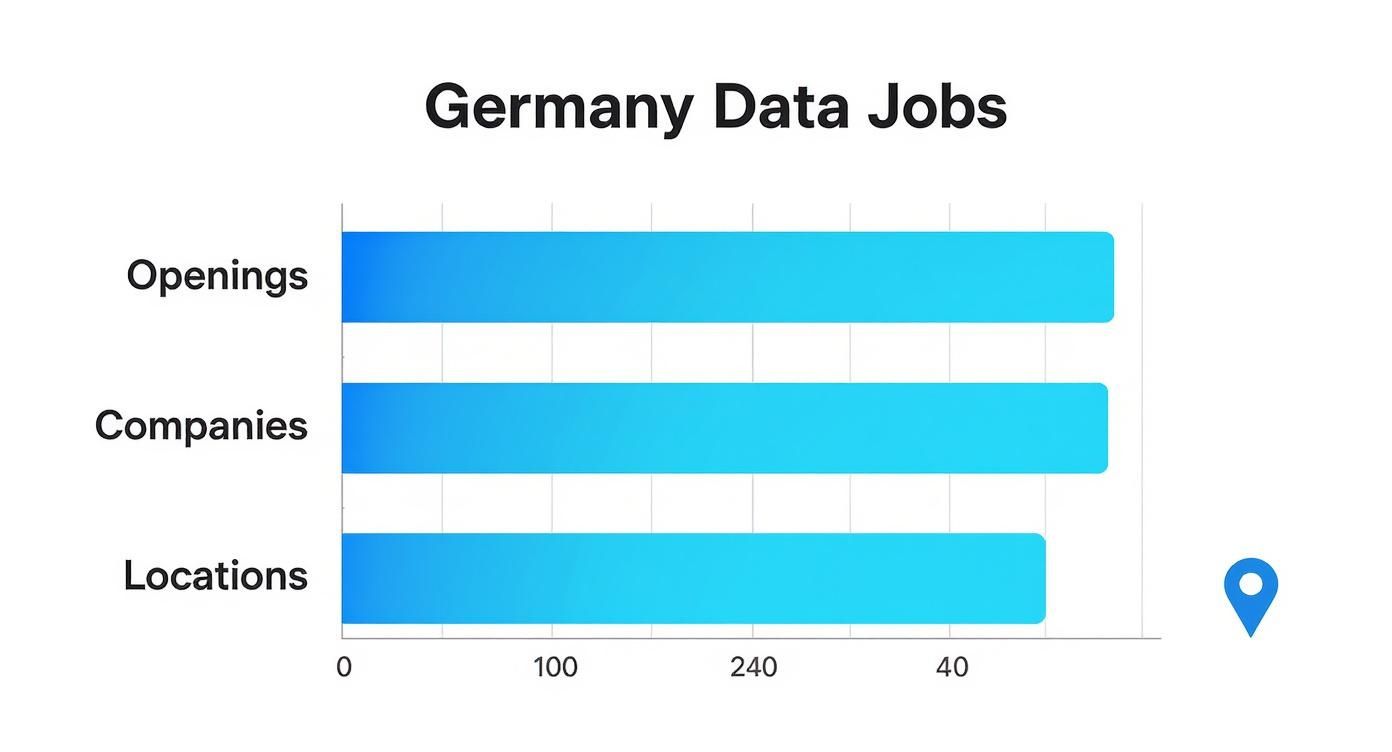
As you can see, the job market is quite decentralised. You'll find great roles spread across a surprising number of companies and cities, which gives you a lot more flexibility than you'd find in a country with just one dominant tech hub.
How Experience Shapes Your Salary
No surprise here: your experience level is the biggest dial on your salary. A junior data scientist fresh out of university is on a different pay scale than a senior pro who's spent a decade leading complex machine learning projects. The climb, however, is definitely worth it.
- Entry-Level (0-2 years): You’re building your foundation. Most of your time will be spent on data cleaning, running basic analyses, and supporting the senior members of your team. You'll earn a solid starting salary, but it's just the beginning.
- Mid-Level (3-5 years): By now, you're expected to fly solo more often. You're building predictive models and making significant, direct contributions to projects. This is where you'll see a pretty substantial jump in your compensation.
- Senior/Lead (5+ years): At this point, you’re not just a doer; you’re a leader. You're mentoring junior colleagues, architecting data solutions, and directly influencing business strategy. Your salary will be at the top of the scale, often boosted with some hefty bonuses.
The numbers back this up. Recent analysis shows the average national wage for data scientists in Germany for 2025 is around $85,115 per year, factoring in bonuses and other perks. Entry-level roles typically start around $62,341 annually, while experienced managers can pull in salaries north of $226,770.
Interestingly, these figures show that Germany has now edged past the UK in data science compensation, though it still has some catching up to do with neighbouring Switzerland. For a deeper dive, you can check out the full global data science salaries report.
Here's a clearer breakdown of what you can expect at each stage of your career.
Data Scientist Salary Bands in Germany by Experience Level
| Experience Level | Average Annual Salary (USD) | | :--- | :--- | | Junior (0-2 years) | $62,000 - $75,000 | | Mid-Level (3-5 years) | $75,000 - $95,000 | | Senior (5-10 years) | $95,000 - $120,000 | | Lead/Manager (10+ years) | $120,000+ |
This table gives you a solid benchmark for what's possible as you gain more experience and take on greater responsibilities in the German market.
Top Tech Hubs vs. Cost of Living
Where you decide to work in Germany makes a huge difference, and it's not just about the job itself. The cost of living varies wildly between the major cities, which directly impacts how much of that nice salary you actually get to keep.
Munich Bavaria’s capital is a true economic powerhouse, home to global players like BMW, Siemens, and Allianz. You'll find some of the highest data scientist salaries in the country here. But there's a catch: Munich is also Germany's most expensive city. The rent alone can take a huge bite out of your paycheck, so a higher salary here might feel the same as a lower one somewhere else.
Berlin Germany’s capital is a completely different vibe. It's a buzzing, international hub famous for its explosive startup scene, particularly in e-commerce and fintech. Salaries in Berlin might be a tick lower than in Munich, but the cost of living is significantly more manageable. This balance makes it a top choice for many who want a fantastic quality of life without the constant financial pressure.
I've seen it time and again: Berlin's unique mix of high-tech opportunities and a lower cost of living is a winning formula. For many data scientists, this means a better lifestyle and more money in their pocket at the end of the month, even if the gross salary is slightly less than what Munich offers.
Hamburg and Frankfurt Don't overlook these two. Hamburg, a major port city, has a really strong media and logistics sector, creating some fascinating and unique data science roles. Meanwhile, Frankfurt is the undisputed financial heart of Germany, so opportunities in FinTech, banking, and insurance are everywhere—think risk modelling and fraud detection. Both cities offer that sweet spot of strong salaries with a more moderate cost of living than Munich.
Sorting Out Your German Work Visa and Permits
Let's be honest, the words "German bureaucracy" can sound a bit scary, especially if you're coming from outside the EU. But when it comes to getting a work visa, the process is actually quite structured and manageable for skilled professionals. Germany is actively looking for people with tech skills, so they've created specific routes to bring in talent like data scientists.
The absolute cornerstone of your application is a signed employment contract. Think of it as your golden ticket—it's the single most important document that proves you have a concrete reason to live and work here. Without that binding job offer, your options become extremely limited.
The EU Blue Card: Your Most Direct Path
For highly-skilled non-EU citizens, the EU Blue Card is the go-to option. It's the most common and beneficial visa for data scientists. It's designed specifically to attract top talent and comes with some serious perks, like a faster path to permanent residency and making it easier for your family to join you.
So, what do you need to qualify? It really boils down to two main things:
- A Recognised University Degree: Your degree has to be considered equivalent to a German one. You can verify this yourself using the Anabin database, which is the official German portal for evaluating foreign qualifications.
- A Job Offer with a Minimum Salary: Your contract must meet a specific gross annual salary. For 2024, the threshold is €45,300 for high-demand "bottleneck" professions (which includes IT specialists) or €41,041.80 if you've graduated within the last three years.
Fortunately, this salary requirement is rarely an obstacle for data scientists. As we've seen, even junior-level salaries in Germany almost always clear this bar with room to spare.
Getting Your Application Dossier Ready
When you're dealing with German authorities, precision is everything. Your application needs to be complete, correct, and perfectly organised to avoid any frustrating delays. Treat it like your first data project in Germany—make sure the data is clean, structured, and accurate.
I see people make this mistake all the time: they underestimate how long it takes to get documents officially translated or to have their degree recognised. My advice? Start the Anabin check for your degree the moment you begin applying for jobs. Being proactive here can literally save you weeks of stress and waiting down the line.
Here’s a look at the core documents you'll almost certainly need:
- Valid Passport (with at least two blank pages)
- Completed Application Forms
- Biometric Photos (must meet the specific German standards)
- Your Signed Employment Contract
- Proof of Your University Degree (originals and certified translations if not in English or German)
- A Printout from the Anabin Database (showing your degree and university are recognised)
- Proof of Health Insurance (that's valid from day one in Germany)
Your personal situation might require a few extra documents. If the list feels a bit much, you can always explore expert guidance on German immigration to get clarity and support tailored to your specific case.
What if You Don't Have a Job Offer Yet? Explore the Opportunity Card
So, you’re confident you can land a great role, but you don't have an offer in hand just yet. Germany has created a newer pathway for this exact scenario called the "Opportunity Card" (Chancenkarte). It allows qualified people to come to Germany for up to a year with the specific purpose of finding a job.
The card works on a points-based system. You need to score at least six points, which are awarded based on things like:
- Your professional qualifications
- German and/or English language skills
- Relevant work experience
- Your age
- Any existing connections to Germany (like a previous long-term stay)
To be eligible, you also have to prove you have the funds to support yourself during your job search. For a data scientist with a solid degree, work experience, and good English skills, hitting the six-point mark is usually very achievable. This makes it a fantastic alternative if you'd rather be on the ground in Germany before you sign a contract.
Crafting an Application That Gets Noticed
Think of your CV and cover letter as your digital handshake with a German employer. In a market that prizes precision and thoroughness, getting these documents right isn't just a formality—it's the first test of your attention to detail. Firing off a generic application to a dozen companies is a surefire way to get ignored.
The real goal here is to go beyond a simple list of your qualifications. German hiring managers want to see your Motivation (motivation) and understand why you're interested in their company and this specific role. A personalised approach shows you’ve done your homework and are genuinely invested, and that's what makes all the difference.
Structuring Your German-Style CV
The German CV, or Lebenslauf, follows a pretty specific and expected format. While you can get creative in your data science projects, your CV is where clarity and professionalism rule. It needs to be a clean, chronological, and easy-to-read document, almost always capped at two pages.
There are a few key differences from what you might be used to:
- Reverse Chronological Order: Always start with your most recent job and work your way backwards. This is the standard here, and it lets recruiters immediately see what you're doing now.
- Clear Sections: Use obvious headings like Work Experience (Berufserfahrung), Education (Ausbildung), and Skills (Kenntnisse). If you have significant personal projects, a Projekte section is a great idea.
- The Professional Photo Debate: Traditionally, a professional headshot was non-negotiable on a German CV. Anti-discrimination laws have technically made it optional, but the reality is that many companies still implicitly expect one. A quality, friendly-but-professional photo helps build a personal connection. Just be warned: a bad selfie will do more harm than good.
My advice? Stick with tradition unless the company's job post explicitly mentions anonymous applications. A good photo can make your application feel more complete and personal to a German recruiter. It's a small thing that shows you're making an effort to fit in with local norms.
Writing a Compelling Cover Letter
Your cover letter, the Anschreiben, is so much more than a CV summary. This is your chance to tell a story and connect the dots for the hiring manager. It’s where you make your case for why you are the perfect fit for this specific data scientist Germany job.
A great Anschreiben is punchy and direct—one page, maximum. It should clearly answer three questions:
- Why this company? Prove you've done your research. Did you see a recent project they launched? Do their company values resonate with you? Mention it.
- Why this role? Draw a direct line between your skills and experience and what they're asking for in the job description. If they ask for experience with A/B testing, talk about a successful A/B test you ran.
- What value will you bring? Don't just list your skills. Explain how your knack for building predictive models or your expertise in optimising data pipelines will help them solve their problems or reach their goals.
Optimising for ATS and Showcasing Your Work
Many of the bigger German companies use Applicant Tracking Systems (ATS) to do the first round of screening. To make sure a human ever sees your application, you need to pepper your CV with the right keywords. Scan the job description for terms like "Python," "AWS," and "predictive modelling," and make sure those exact phrases appear in your skills and experience sections.
But once your CV lands on a human's desk, they'll want to see proof. This is where your GitHub profile or a personal portfolio becomes your most powerful asset. It’s one thing to say you know machine learning; it's another to show them a well-documented project where you actually built and deployed a model.
- Curate Your GitHub: Don't just link to a messy repo. Feature 2-3 of your best projects right at the top. Make sure they have clean code, a clear README file explaining the project, and demonstrate the full data science workflow.
- Create a Simple Portfolio: You don't need a fancy website. A clean, well-organised PDF that showcases your top projects with visuals and clear explanations of the business impact can be incredibly effective.
For anyone looking to manage this whole process—from personalising documents to keeping track of where you've applied—modern tools can be a lifesaver. You can learn more about how to manage your career applications efficiently and free up your time to focus on what really matters: acing the interviews.
Mastering the German Data Science Interview

The German interview process for a data scientist role isn't a single event; it's a multi-stage journey. Think of it less like a sprint and more like a carefully planned marathon. Each stage is designed to probe a different part of your profile, from your raw technical skills and problem-solving chops to how you’d actually fit into the team’s workflow. It’s thorough, methodical, and deeply structured.
To get through it successfully, you need to understand what they're looking for at each step. Your mission is to build a consistent and compelling story about yourself, starting with that first HR call and carrying it all the way through to the final chat with your potential boss.
Breaking Down the Interview Stages
You can usually expect the entire process to play out over three to four distinct stages. While the specific sequence might shift slightly from one company to another, the core elements are remarkably consistent across the German tech scene.
The HR Screening Call: This is the first gatekeeper. The recruiter's job is to tick the basic boxes: do you have the right qualifications, are your salary expectations realistic, and are you genuinely interested? Be ready with a crisp summary of your background and a clear, specific reason for wanting this role at this company.
The Technical Assessment: This is where you prove you can do the work. It might be a take-home case study that gives you a few days to dig into a problem, or it could be a live coding session testing your Python, SQL, and algorithm knowledge. The real key here is to show your work and talk through your thinking.
The Team and Hiring Manager Interview: This round goes much deeper, exploring your project experience and your personality. You’ll be asked to walk through past projects in detail, tackle hypothetical business challenges, and really get a feel for the team's vibe. They want to see how you think and collaborate, not just what you know.
Acing the Technical and Case Study Challenges
The technical round often feels like the most daunting part, but it's completely manageable if you prepare strategically. German hiring managers value a logical, structured approach just as much—if not more than—the perfect final answer.
For a live coding interview, grind on platforms like LeetCode or HackerRank, but focus on the fundamentals of data structures and algorithms. During the interview itself, narrate your thought process. Seriously, talk them through the problem, explain the solution you're building, and discuss any trade-offs you're considering. Silence is not your friend here.
If you get a take-home case study, treat it like a mini-project you'd deliver at work. Structure your submission professionally with a clear summary of your findings, clean and commented code, and visuals that tell a compelling story. This is your best chance to show off your business sense alongside your technical skills.
A common mistake I see candidates make is jumping straight into complex models. Start simple. A well-explained linear regression model that addresses the business problem is often more impressive than a poorly justified neural network. Show you can walk before you can run.
Understanding German Interview Culture
Beyond your technical skills, cultural fit is a huge deal. Things like punctuality, directness, and thorough preparation aren't just nice-to-haves; they're baseline expectations. Be on time, every time, for both virtual and in-person meetings.
Prepare yourself for direct questions and be ready to give direct, honest answers. The German communication style is less about sugar-coating and more about clarity and efficiency. They want to see that you can think on your feet and structure your thoughts logically under pressure.
The high demand for data scientists is backed by hundreds of open roles across Germany's key industries. This means companies are always interviewing, on the lookout for candidates who have strong quantitative skills and experience turning complex data into predictive models. Take a look at the hundreds of active data scientist positions in Germany on Indeed to get a real-time feel for the market. If you can master this interview process, plenty of opportunities are waiting for you.
Your Questions About German Data Science Jobs, Answered
When you're trying to land a data science role in Germany, especially from abroad, a lot of questions pop up. It’s easy to get lost in the details. This section is designed to clear things up, tackling the most common queries I hear from candidates.
Think of this as a practical FAQ, zeroing in on the specifics that broader guides often miss. We'll get into everything from language requirements to the real value of a PhD, giving you the clarity you need to sharpen your job search.
Is German Language a Must-Have?
This is the big one, and the honest answer is: it depends. In the major tech hubs like Berlin, you can absolutely find data scientist jobs where the office language is English. The startup scene, in particular, is incredibly international and often doesn't require a single word of German.
But once you step outside those international bubbles, the picture changes. For roles in more traditional German companies—especially the famous Mittelstand (small and medium-sized enterprises)—German often becomes essential. Even if your technical work is in English, you'll find that team meetings, documentation, and the daily coffee-run chat happen in German.
- International hubs (e.g., Berlin, Munich): English is very often enough to get by and thrive professionally.
- Traditional German companies: You'll likely need at least a B2 level in German to be a serious contender.
- Long-term career growth: No matter where you are, learning German is a massive advantage. It opens up more opportunities and makes integrating into the company culture a whole lot smoother.
Here’s a simple but effective pro-tip: check the language of the job ad itself. If it’s posted in English, that’s a very strong signal the company operates in English and is looking for international talent. If it's in German, you should assume fluency is a hard requirement.
How Important Is a Master’s or PhD?
Germany has a deep respect for formal education, and you can see that reflected in the data science field. While it's not always a deal-breaker, a Master’s degree in a quantitative field like Computer Science, Statistics, or Mathematics is pretty much the standard expectation for most data scientist positions.
A PhD can give you a serious edge, especially for roles that are heavy on research and development (R&D) or dive deep into specialised areas like NLP or deep learning. Big players in the automotive and pharmaceutical industries, with their massive R&D departments, often specifically target candidates with a doctorate.
That said, solid, practical experience can definitely level the playing field. If you have a Bachelor’s degree but can show off a stellar portfolio of complex, real-world projects and a few years of relevant work, you can be just as competitive as a fresh PhD graduate. It all comes down to your ability to demonstrate tangible results.
Can I Get a Junior Role Without Experience?
Breaking in as a junior data scientist with no commercial experience is tough, I won't lie. But it's far from impossible. The trick is to prove your potential and practical skills in other ways.
Here’s what German companies are really looking for in a junior candidate:
- A Killer Project Portfolio: This is your number one asset. A GitHub profile with well-documented projects showing your end-to-end process—from data wrangling and exploration to modelling and slick visualisations—is non-negotiable.
- Internships or Working Student Roles: In Germany, this is the classic pathway. Getting experience through an internship (Praktikum) or as a working student (Werkstudent) while you're studying is a tried-and-true method for landing a full-time role after graduation.
- Genuine Passion and Continuous Learning: You need to show you live and breathe data. Contributing to open-source projects, getting your hands dirty in Kaggle competitions, or even writing a technical blog can make your profile jump out of the pile.
Landing that first data scientist Germany job is all about strategy. You need to build a compelling story around your skills and projects that proves you have the drive and the chops to add value right from day one.
Ready to stop the endless scrolling and actually land more interviews? Acquispect uses AI to pinpoint the best job openings for your profile, crafts personalised application documents in minutes, and tracks your performance so you can see what's working. Stop wasting time on manual applications and start getting the results you deserve. Start your free 30-day trial with Acquispect today!