When it comes to cyber security salaries in Germany, the numbers are compelling. You can expect to see figures ranging from €55,000 for more technical roles all the way up to €160,000 and beyond for leadership positions. Of course, your precise earning potential will hinge on your specific role, how many years you've been in the game, and the professional certifications you hold.
The demand for skilled experts who can shield organisations from ever-present digital threats is intense, and that directly translates into substantial financial rewards.
Understanding Your Earning Potential in Cyber Security
Let's get right into the numbers. What does a cyber security salary in Germany actually look like? We'll break down the core factors that shape your payslip—from your specific job title and years of experience to the impact of certifications and even where in Germany you're based.
Think of your security skills as more than just a technical expertise; they are a critical business function. You're the one protecting revenue, safeguarding the company's reputation, and maintaining customer trust. That's precisely why companies are prepared to invest heavily to attract and retain top-tier talent.
The Financial Landscape in Germany
In Germany, the salaries on offer mirror the high-stakes nature of the work. For example, a Head of Information Security overseeing a team of ten or more can command a salary north of €160,000 annually. Other senior roles, like a Head of IT Risk or Head of Cyber Defence, typically fall into the €130,000 to €200,000 bracket.
Stepping down a level, a mid-level IT Risk Manager can expect to earn between €95,000 and €140,000. On the more hands-on technical side, a vital role like a SOC (Security Operations Centre) Engineer has a typical salary range of €55,000 to €95,000. For a more detailed look, this German cyber security salary guide is a great resource.
To give you a clearer picture right from the start, here's a quick summary of what you can expect for some of the key roles in the industry.
Cyber Security Salary Benchmarks in Germany at a Glance
This table provides a quick overview of typical annual salary ranges for various cyber security roles in Germany, from entry-level to leadership.
| Job Title | Typical Salary Range (Annual) | | :--- | :--- | | SOC Engineer | €55,000 - €95,000 | | IT Risk Manager | €95,000 - €140,000 | | Head of Cyber Defence | €130,000 - €200,000 | | Head of IT Risk | €130,000 - €200,000 | | Head of Information Security | €160,000+ |
These figures provide a solid baseline. As we go deeper, we'll explore exactly how your unique skills and experience can push you towards the higher end of these ranges.
A career in cyber security is not just about defending against threats; it's about building a financially secure future. The high demand for professionals means your skills are a valuable asset that companies are prepared to pay a premium for.
With this overview in mind, we can now start dissecting the individual components that make up your total compensation. Understanding how your job title, certifications, and experience all fit together is the first step toward getting the salary you deserve.
How Your Role Defines Your Salary
In the world of cyber security, your job title is much more than just a line on your business card—it’s a direct reflection of your earning potential. While the field as a whole pays well, the specific responsibilities you handle every day are what truly shape your salary. Put simply, a company’s willingness to pay a premium is tied directly to the value and impact of your work.
Think of it like a specialist medical team. Every member is a vital professional, but the neurosurgeon performing complex operations commands a different salary than the radiologist who analyses scans. Both are essential, but the nature of their work, the risks involved, and the highly specialised skills required create a natural pay scale. The same principle applies here; the more critical your function is to protecting an organisation’s most valuable assets, the higher your compensation will be.
This chart gives you a good idea of how compensation levels typically break down across technical, mid-level management, and leadership roles here in Germany.
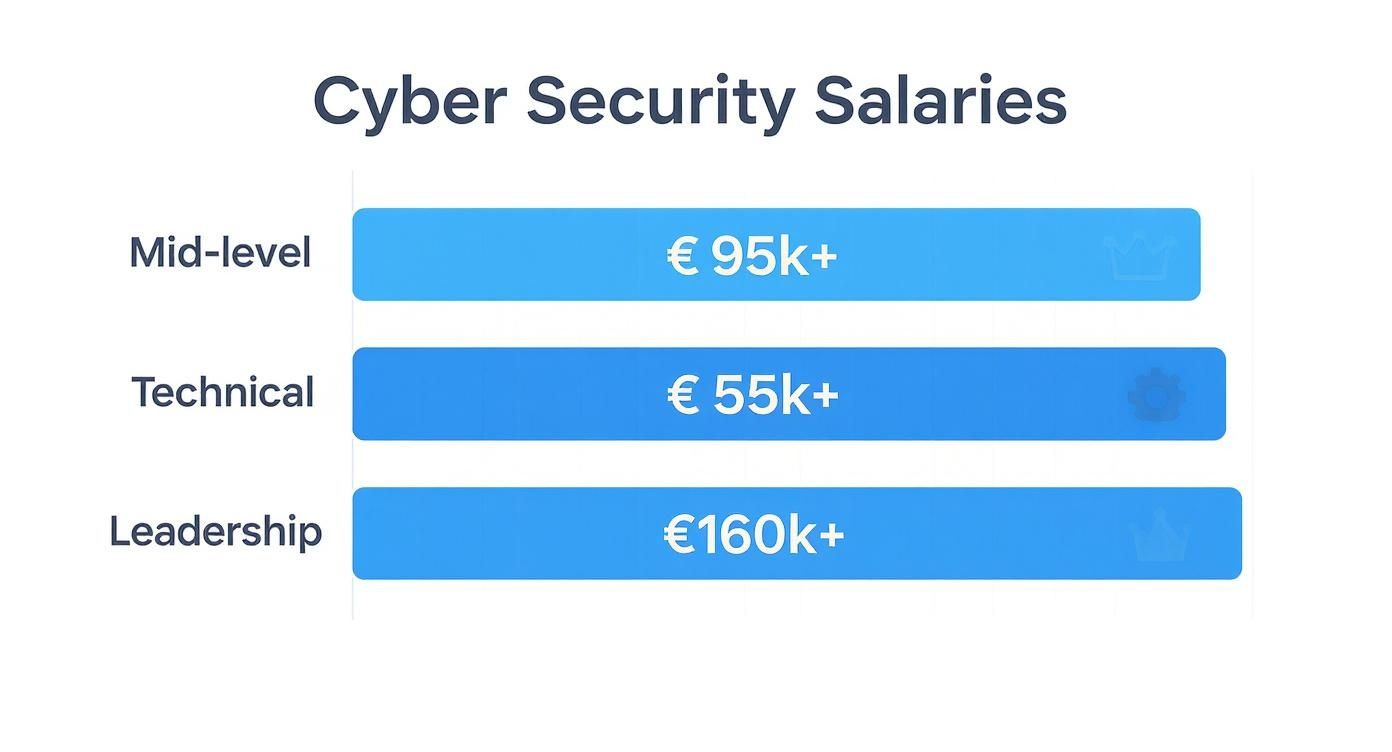
As you can see, while technical roles provide a strong financial foundation, moving into management and leadership is where you can unlock significantly higher earning potential.
To give you a clearer picture of how this plays out in the real world, let's break down some of the most common roles and what you can expect.
Comparing Key Cyber Security Roles and Salary Expectations
The table below offers a snapshot of some popular cyber security jobs in Germany, outlining their core duties, the skills needed to succeed, and the typical salary ranges you might encounter. This should help you see the direct line between responsibility and remuneration.
| Role | Primary Responsibilities | Key Skills | Annual Salary Range | | :--- | :--- | :--- | :--- | | Cyber Security Analyst | Monitoring networks for threats, investigating security alerts, and performing initial incident response. The first line of defence. | SIEM tools (e.g., Splunk, QRadar), network protocols, intrusion detection systems, analytical thinking. | €50,000 – €80,000 | | Penetration Tester | Legally hacking into systems and applications to identify vulnerabilities before malicious actors can exploit them. Simulating real-world attacks. | Metasploit, Burp Suite, Python/scripting, deep knowledge of OS and network vulnerabilities, creative problem-solving. | €65,000 – €110,000+ | | Security Engineer | Designing, building, and maintaining an organisation's security infrastructure (firewalls, VPNs, endpoint protection, etc.). | Network security, cloud security (AWS, Azure), scripting (Python, PowerShell), strong understanding of security architecture. | €60,000 – €100,000 | | Security Manager | Overseeing the security team, managing security projects and budgets, developing policies, and reporting on risk to senior leadership. | Leadership, project management, risk assessment frameworks (ISO 27001, NIST), communication, strategic planning. | €90,000 – €140,000 | | CISO | Setting the organisation's overall security strategy, managing compliance, and being accountable for protecting information assets. A top-level executive role. | Business acumen, strategic leadership, risk management, governance, strong communication skills, budget management. | €150,000 – €250,000+ |
Ultimately, whether you're a hands-on technical expert finding flaws or a strategic leader shaping policy, your specific contribution dictates your market value. Now, let’s explore a few of these role types in more detail.
The Frontline Defenders: Analysts and SOC Engineers
At the heart of any security operation are the hands-on technical experts. These are the people building, monitoring, and defending the digital frontlines day in and day out. Their compensation reflects the immediate and tangible impact of their work.
- Cyber Security Analyst: As the first line of defence, analysts watch networks for suspicious activity, investigate alerts, and triage potential incidents. Their constant vigilance is absolutely crucial.
- SOC Engineer: Specialising in the Security Operations Centre, these engineers manage and fine-tune the tools analysts rely on, such as SIEM (Security Information and Event Management) systems. Their expertise keeps the organisation’s detection capabilities sharp.
These roles are the bedrock of any security programme. Even though they are often considered entry-to-mid-level, their contribution is indispensable, providing a solid salary base from which to grow a career. A skilled SOC Engineer in Germany, for instance, can expect to earn between €55,000 and €95,000 annually.
The Proactive Specialists: Penetration Testers
Moving beyond purely defensive work, some of the most highly valued roles are those that take a proactive—and even offensive—approach to security. These professionals don't just wait for attacks; they find weaknesses before criminals can. This proactive value creation often leads to a higher paycheque.
A Penetration Tester’s job is to think like an attacker to make the organisation stronger. By simulating real-world cyberattacks, they uncover critical vulnerabilities that, if left unfixed, could lead to catastrophic financial or reputational damage.
This unique skill set, which blends deep technical knowledge with a creative, attacker-like mindset, is in extremely high demand. As a result, Penetration Testers (or Ethical Hackers) often command impressive salaries. Their value is measured not in the incidents they respond to, but in the ones that never get a chance to happen.
The Strategic Builders: Engineers and Architects
At the upper end of the technical pay scale, you'll find the architects and engineers who design and build the security infrastructure from the ground up. Their work requires a powerful mix of deep technical knowledge, foresight, and a solid understanding of business goals.
- Security Engineer: This role is focused on the practical side of things, implementing security solutions. They build and maintain firewalls, intrusion detection systems, and other critical controls that form the backbone of a company's defences.
- Security Architect: Taking a bird's-eye view, an architect designs the entire security framework. They make the big strategic decisions about which technologies to use and how they should be integrated to protect the organisation now and in the future.
Because their decisions have such a long-lasting and wide-ranging impact on the company’s security posture, these roles are compensated accordingly. A Security Architect is responsible for the entire blueprint of security, a responsibility that carries significant financial reward and often pushes salaries well into six figures. Understanding these distinctions is key to mapping out a career path that aligns with your financial ambitions.
Level Up Your Paycheck with Experience
Think of your cyber security career like climbing a ladder. Each rung represents more experience, deeper expertise, and, naturally, a bigger paycheck. It's a journey from hands-on, tactical work to high-level strategic oversight. Your salary isn't a fixed number; it grows as you do.
When you're starting out, you’re in the trenches, focused on mastering the tools and fighting off immediate threats. As you gain experience, your perspective broadens. You start thinking about how to prevent those threats in the first place and, eventually, how to design the entire security strategy from the ground up.

This progression is clearly mirrored in your earning potential. Let's walk through what this financial journey typically looks like across the German market.
The Entry-Level Foundation (0-4 Years)
Fresh in the field, your main goal is to soak up knowledge and prove you can handle the pressure. Roles like a Junior SOC Analyst or an IT Security Technician put you right on the digital front line, where you'll apply your textbook knowledge to real-world incidents.
Your day-to-day work is crucial but often task-oriented. You'll be monitoring alerts, running initial checks on incidents, and helping maintain security tools, usually under the guidance of a senior colleague. These early years are all about building that solid foundation of practical skills that the rest of your career will stand on.
Even at this stage, the pay is solid. In Germany, professionals with 0-4 years of experience can expect to earn between €45,000 and €65,000 annually. This salary recognises the vital role you play while accounting for the on-the-job learning and mentorship you’ll need.
The Mid-Level Specialisation (5-9 Years)
After a few years on the job, you’re no longer just following the instructions—you're starting to write them. At this mid-level stage, you've likely found your niche, whether that's in threat intelligence, cloud security, or incident response. You're working more independently, leading projects, and even starting to guide the newer members of the team.
Your value to the company skyrockets because you're now proactively spotting risks and suggesting improvements instead of just reacting to problems. This is where your salary really starts to climb.
With a solid track record and proven expertise, mid-level professionals with 5-9 years of experience command salaries in the €65,000 to €95,000 range. It’s the difference between being a capable operator and becoming a go-to specialist.
This period is a launchpad for the rest of your career. The skills you hone and the reputation you build here will pave the way for senior and leadership roles.
The Senior and Leadership Apex (10+ Years)
Once you have a decade or more under your belt, your role shifts dramatically. You move from the operational to the strategic. Whether you're a top-tier technical expert like a Security Architect or in a leadership position like a Security Manager or CISO, your focus is now on the big picture.
You're not just defending the network anymore; you're defining the organisation's entire security culture. This means managing budgets, making sure security goals align with business objectives, and leading entire teams. Your decisions have a direct, long-term impact on the company's safety and bottom line.
This level of responsibility, of course, comes with the highest financial rewards. Here’s a look at how compensation scales at the top end:
- Senior Technical Experts: A seasoned pro in a role like a Security Architect can pull in an average salary of around €120,000 or more.
- Management and Leadership: Security Managers and CISOs regularly earn salaries well above €140,000, with executives at major corporations earning substantially more.
At this career stage, your salary isn't just about what you know—it's about your ability to lead, strategise, and be the ultimate guardian of the organisation's digital assets. Every year of experience adds another layer to your value.
Boosting Your Value with Certifications and Skills
Experience is the bedrock of a solid cyber security salary, but adding the right skills and certifications is like bolting a turbocharger onto your career. It’s the most direct route to proving your expertise, bumping up your market value, and getting a foot in the door for those higher-paying gigs. Think of it as a direct investment in your professional future—one that often pays off immediately.
In a field that moves at breakneck speed, standing still is the same as falling behind. Employers know this, and they’re more than willing to pay a premium for people who are visibly committed to staying sharp. A relevant certification isn’t just a fancy bit of paper; it’s a clear signal to hiring managers that your skills are up-to-date, tested, and ready to go.
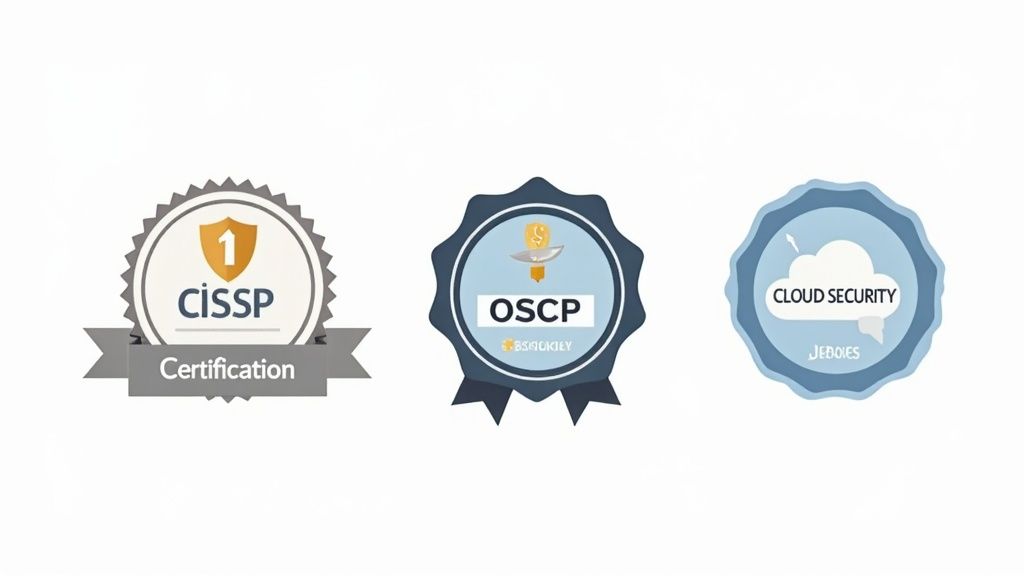
This kind of proactive development is what separates a good candidate from a truly indispensable one, and it shows up directly in the salary offers you receive.
Certifications That Act as Salary Multipliers
Let’s be clear: not all certifications are created equal. Some are great for getting your foot in the door, while others are highly specialised and can add serious money to your paycheque. The trick is figuring out which ones make sense for your specific career path.
Here’s a look at some of the heavy hitters and what they can do for you:
- CISSP (Certified Information Systems Security Professional): Often called the gold standard, this one is for security leaders and managers. Earning a CISSP proves you have a wide-ranging grasp of security concepts and can easily add 15-25% to your salary. It tells a company you’re ready to think strategically.
- CISM (Certified Information Security Manager): Think of the CISM as a cousin to the CISSP, but with a laser focus on governance, risk, and compliance. It’s perfect for anyone who wants to climb the management ladder by showing they can align security programmes with core business objectives.
- OSCP (Offensive Security Certified Professional): This is a badge of honour for the hands-on, technical crowd. The OSCP is a brutally practical, exam-based cert that proves you’ve got the chops to be a top-tier penetration tester. It’s massively in demand and a surefire way to command a higher salary in offensive security.
The right choice really boils down to where you want to go. Aiming to lead teams and set strategy? CISSP or CISM should be on your radar. Want to be the elite technical specialist who can break into anything? The OSCP is your ticket.
High-Demand Skills for a Higher Paycheque
Certifications are one piece of the puzzle. The other is developing deep expertise in specific, high-growth areas that companies are desperate for. Focusing on these specialisms is where you can see a massive jump in your cyber security salary.
Your general security knowledge gets you in the door. Your specialised expertise in a high-demand area is what gets you the top-tier salary offer. It proves you can solve the most current and complex problems businesses are facing today.
If you’re looking to invest your learning time, start with these critical domains:
- Cloud Security: As nearly every organisation moves workloads to AWS, Azure, or Google Cloud, the demand for people who can secure these complex environments has skyrocketed. Skills in cloud-native security tools, Identity and Access Management (IAM), and container security are incredibly valuable right now.
- Data Privacy and Compliance: With regulations like GDPR carrying the threat of massive fines, professionals who live and breathe data privacy are no longer a luxury—they’re a necessity. Expertise in building compliant systems and managing data protection policies is a highly sought-after skill set.
- AI-Driven Security Operations: The future of security operations is tangled up with artificial intelligence. Anyone who can manage and interpret data from AI-powered threat detection platforms—or even help develop secure AI models—is working on the very edge of the industry. And they get paid accordingly.
Where You Work Matters for Your Salary
Your experience and skills are definitely the engine of your earning potential, but your location is the road you're driving on—and not all roads are paved the same. A cyber security salary in Munich is calculated very differently from one in Berlin. Getting a handle on these regional nuances is key to maximising your income, because Germany's diverse economic landscape creates distinct pockets of demand and compensation.
It’s not just about which city is biggest; it's about what makes each city's economy tick. The main industries in a region directly shape the kind of security talent they need most, and how much they’re willing to pay for it. A professional protecting a major bank's assets in Frankfurt faces a completely different set of challenges than someone securing a fast-moving startup in Berlin, and their pay reflects that.
A Tale of German Tech Hubs
Each major German city has its own unique flavour, which creates a really varied job market for security professionals. The trick is to match your skills to the city where they'll be valued most.
Frankfurt am Main: As Germany's financial centre, Frankfurt is all about banking, insurance, and FinTech. Companies here have zero tolerance for risk and a massive budget for security. They're constantly hunting for experts in risk management, compliance (especially with BaFin regulations), and data protection to guard sensitive financial data. This almost always translates into a premium salary for those roles.
Munich: Home to corporate giants like BMW, Siemens, and Allianz, Munich is a powerhouse for established technology and engineering firms. The focus here is on securing industrial control systems (ICS), protecting intellectual property, and managing complex corporate networks. This creates huge demand for security architects and engineers with really deep technical knowledge.
Berlin: The vibrant, fast-paced startup capital of Germany has a completely different vibe. Startups need versatile, adaptable security pros who can jump from cloud security to product security in an agile environment. While salaries are competitive, they often come with equity options, which is a classic part of the startup culture.
Balancing Salary with Cost of Living
A high salary in Munich looks fantastic on paper, but you absolutely have to factor in the cost of living. A €95,000 salary in Munich might feel very different from an €85,000 salary in Berlin, where rent and daily expenses are generally much lower.
Your real take-home pay isn't just the number on your contract; it's what you have left after all your bills are paid. Always research the cost of living in a city before accepting an offer to understand your true financial gain.
Thinking about these regional differences gives you the context you need to make smarter career moves. Whether you're considering a move or just starting out, knowing where your skills are most in-demand is a powerful advantage. To make your search more efficient and pinpoint opportunities in these specific hubs, you can find relevant openings with JobCopilot.de. Understanding these geographical differences helps you target your job hunt for the best possible financial outcome.
How to Negotiate the Salary You Deserve
https://www.youtube.com/embed/59js74_R8-Q
Knowing your market value is one thing, but actually getting it takes a bit of strategy and confidence. This is where you turn all that research into a real number in your bank account. The best way to think about negotiation isn't as a battle, but as a conversation. You're working together to land on a figure that truly reflects what you bring to the table.
The secret is to base your discussion on cold, hard facts—not just a gut feeling about what you should be earning. When you can point to the salary benchmarks we’ve covered, you’re not just asking for more money; you’re framing your request with solid market data. That’s a language every hiring manager understands.
Build Your Case with Data and Value
You wouldn't go into an exam without studying, so don't go into a salary talk unprepared. Your goal is to build a rock-solid case for the number you’re targeting. Just saying "I'd like more" won't cut it. You have to show them why.
Your prep work should stand on two legs:
Market Research: Get your numbers straight. Use the data in this guide to pin down a realistic salary band for your specific role, seniority, and city. Knowing that a Security Engineer in Frankfurt with your skills typically makes between €75,000 and €95,000 gives you an immediate, powerful anchor for the conversation.
Your Value Proposition: This is where you connect the dots for them. How will your cloud security background help them lock down their AWS environment and prevent a costly breach? Can you point to a time your pentesting skills saved a previous company from a major vulnerability? Put a number on your achievements whenever you can.
Think of it this way: negotiation is about proving your future value by showcasing your past impact. Don't just list your skills; present them as direct solutions to the company's biggest security headaches.
Mastering the Conversation with Real Examples
When it's time to talk numbers, all that prep work lets you lead the conversation with confidence. It's common for a company to start with an offer on the lower end—they're testing the waters. Don't be phased; it’s just part of the dance. Your response is what matters.
Instead of a flat "yes" or "no," treat their initial offer as the start of a discussion. It's your cue to make your case. For more career insights like these, you can always find great tips on the JobCopilot.de blog.
Here are a few ways to handle common scenarios:
When they give a lowball offer: "Thank you for the offer. Based on my research for similar roles here in Munich, and factoring in my experience with GDPR compliance, I was targeting a range closer to €90,000 to €100,000. Could we talk about how you arrived at your proposed figure?"
When they ask for your salary expectation first: "Right now, my main focus is on finding the perfect role. That said, I've seen that positions with this level of responsibility typically fall between €X and €Y. I'm sure we can find a number that works well for both of us."
When they say the budget is fixed: "I completely understand working within a budget. Since there isn't much flexibility on the base salary, could we perhaps look at other areas of the compensation package? I'm thinking of things like a performance bonus, a budget for professional development, or even a few extra holiday days to help close the gap."
By keeping the conversation professional, backing up your points with data, and always tying it back to the value you deliver, you shift the dynamic. It stops being an awkward chat about money and becomes your opportunity to secure the cybersecurity salary you've worked so hard to earn.
Got Questions About Cyber Security Salaries? Let's Clear Things Up.
Thinking about a career in cyber security, or maybe looking to make your next move? You've probably got a lot of questions about what you can realistically earn. It's a valid concern, and getting straight answers is key to planning your future.
Let’s break down some of the most common questions we hear about cyber security salaries in Germany. We'll cover everything from what to expect when you're just starting out, to how much a top-tier certification can really boost your paycheque.
What’s a Realistic Starting Salary in Germany?
If you're stepping into your first role, maybe as a Junior SOC Analyst or an IT Security Assistant, you should be looking at a salary between €45,000 and €60,000 a year. That’s a pretty solid starting point.
Of course, that number isn't set in stone. Where you are in Germany makes a difference – a job in a major hub like Munich or Frankfurt will likely pay a bit more to account for the higher cost of living. Don't forget, any internships you've done or foundational certifications you've already earned are great bargaining chips to push your offer towards the top end of that range.
How Much of a Bump Can I Get From a CISSP?
Getting a well-respected certification like the CISSP (Certified Information Systems Security Professional) is a game-changer for your earning potential. It’s not just a piece of paper; it’s a clear signal to employers that you know your stuff. On average, professionals with a CISSP can expect to earn 15% to 25% more than their non-certified colleagues with similar experience.
What does that look like in real terms? For someone in the middle of their career, that could mean an extra €15,000 to €25,000 in your pocket each year. The certification proves you have a strategic grasp of security principles and management, which makes you a far more valuable hire.
Do Remote Cyber Security Jobs Pay Less?
There used to be a time when remote roles came with a bit of a pay cut, but those days are largely behind us. The market has changed. For skilled cyber security talent in Germany, compensation for remote work is now right on par with on-site positions.
Think about it: companies are all competing for the same small pool of qualified experts. They’ve realised that what matters is your skill set, not your postcode. Your salary is going to be shaped by your experience, your niche, and how well you negotiate, not by whether you're working from home or the office.
Which Cyber Security Fields Pay the Most?
Right now, the roles with the biggest paycheques are the ones that mix deep technical know-how with a direct impact on the business. If you're chasing the highest salaries, you'll want to look at fields like:
- Cloud Security: Expertise in multi-cloud environments, especially with AWS and Azure, is incredibly valuable.
- Application Security (AppSec): Every company needs to protect its software, making AppSec specialists essential.
- Senior-Level Penetration Testing: Top-tier ethical hackers who can find critical vulnerabilities are always in high demand.
But if you’re aiming for the absolute top, you need to look at leadership. The highest salaries are consistently found in executive roles like the Chief Information Security Officer (CISO). A CISO sets the security strategy for the entire organisation, and that responsibility comes with a salary that often starts above €160,000 and can easily climb past €200,000.
Ready to stop guessing and start applying to the roles that match your salary goals? Acquispect uses AI to scan thousands of job listings, identify your best-fit opportunities, and even crafts personalised application letters to help you secure more interviews. Take control of your job search with a free trial of Acquispect today.