Germany is a hotspot for cybersecurity jobs, and it's not hard to see why. As one of the world's leading economies, its rapid shift to digital makes it a prime target for cyber-attacks, creating a huge and growing demand for skilled security professionals.
Why Germany Is a Prime Destination for Cyber Security Talent
Think of Germany's economy as a high-tech fortress. It’s powerful, advanced, and full of valuable assets. But with every new digital connection, a new potential vulnerability appears. This is why the country isn't just offering jobs; it's recruiting elite guards to defend its most critical digital walls.
This constant need for defenders comes from a few key pressures. The massive push towards "Industrie 4.0"—the full digitisation of manufacturing and industrial controls—opens up brand new avenues for attack that simply didn't exist a decade ago. Add to that Germany's famously strict stance on data privacy, and you have a unique, challenging, and rewarding environment for security experts to work in.
Key Demand Drivers
The demand for cybersecurity talent in Germany isn't a temporary trend; it’s a fundamental need tied directly to its economic stability and future. It all boils down to a few core drivers.
- Pervasive Digitalisation: From small businesses to industrial giants, German companies are going digital, which naturally expands the "attack surface" for cybercriminals to target.
- A Tough Regulatory Climate: Germany is serious about data protection. Laws like the GDPR and the new NIS2 Directive mean companies face heavy fines if they don't get their security right.
- The Widening Skills Gap: There simply aren't enough qualified people to fill all the open roles. This puts skilled candidates in a fantastic negotiating position.
The infographic below neatly shows how these forces—digital transformation, regulations, and the resulting job growth—are all connected, creating a perfect storm of opportunity.
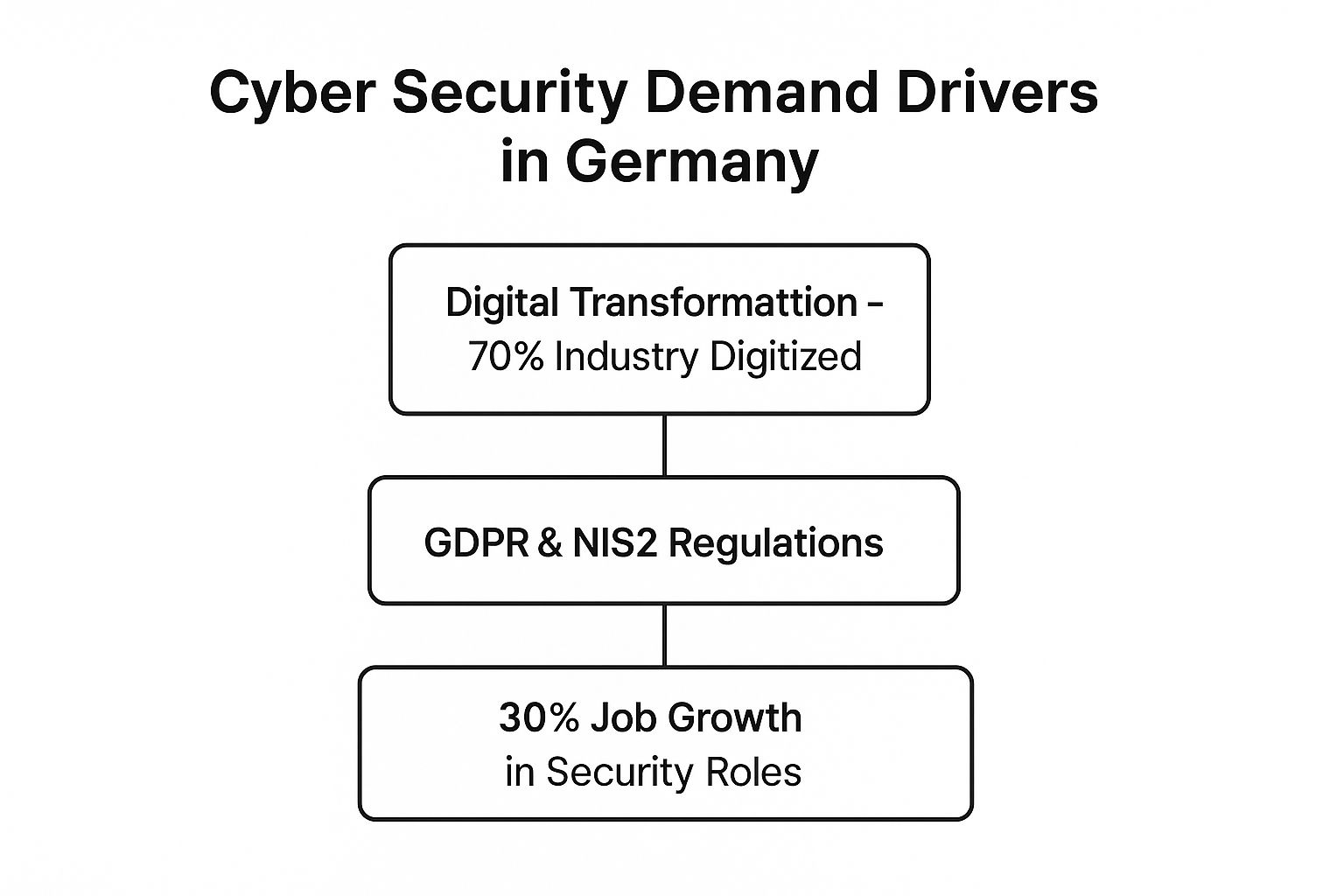
As you can see, the relationship is clear: as industry digitises and regulations get tougher, the need for security professionals skyrockets.
Let's break down these market forces into a clearer picture. The table below summarises what’s really fuelling the demand.
Germany's Cybersecurity Job Market at a Glance
| Driving Factor | Impact on Job Market | Key Statistic | | :--- | :--- | :--- | | Industrie 4.0 & Digitalisation | Creates vulnerabilities in new areas like industrial control systems (ICS) and IoT, requiring specialised security skills. | Over 90% of German industrial companies are investing in digitising their factories. | | Strict Data Privacy Laws (GDPR, NIS2) | Mandates strong security controls and dedicated roles (like DPOs), making compliance a top business priority. | Fines for non-compliance can reach up to 4% of global annual turnover. | | The Growing Talent Shortage | Companies are competing fiercely for talent, leading to higher salaries, better benefits, and more opportunities for skilled professionals. | An estimated 106,000 cybersecurity positions will be unfilled by 2026. |
These factors combine to create a market that is not just growing, but actively searching for people with the right skills to protect its digital future.
A Critical Workforce Shortage
The numbers really drive home how urgent the situation is. Projections show Germany will have around 106,000 unfilled cybersecurity positions by 2026. This isn't just a local problem; it reflects a much larger European skills gap of nearly 300,000 professionals.
With the global cost of cybercrime predicted to hit an eye-watering $10.5 trillion by 2025, the need for talent has never been more critical. If you're looking to understand just how significant this opportunity is, it's worth exploring the latest cybersecurity market reports for a deeper dive.
Exploring the Most In-Demand Cyber Security Roles
When you start looking at cyber security jobs in Germany, you quickly realise it's about much more than a generic title. To get a real feel for the industry, you have to understand what these professionals actually do day-to-day. The field is a mosaic of highly specialised roles, and each one demands a unique mix of skills, a particular mindset, and deep technical expertise to stand a chance against today’s threats.
Think of a large company’s digital infrastructure as a sprawling, modern city. It has its protective walls (firewalls), its gatekeepers checking IDs (access controls), and its city-wide surveillance network (monitoring tools). The professionals hired to protect this city aren't just guards; they're the detectives, the special forces units, the urban planners, and even the diplomats. Each one plays an absolutely vital part in keeping things safe and running smoothly.
Let's break down some of the most sought-after roles in the German market. This should give you a clearer picture of where your own skills and interests might fit in.
The Digital Detective: Security Analyst
Right at the heart of any Security Operations Centre (SOC), you'll find the Security Analyst. This is your first line of defence—the guard in the watchtower, constantly scanning the horizon for the first sign of trouble. Their main job is to monitor an organisation's networks and systems, hunting for anomalies and potential threats.
Picture a detective sifting through a mountain of evidence. That’s a Security Analyst, poring over security logs, network traffic data, and alerts from tools like Security Information and Event Management (SIEM) systems. They are pattern-seekers at their core, connecting seemingly unrelated events to spot the subtle, early signs of a cyberattack.
A typical day might involve:
- Monitoring and Analysing: Keeping a close eye on security alerts and logs to spot any suspicious activity.
- Vulnerability Identification: Helping with scans to find weaknesses in IT systems before an attacker does.
- Initial Incident Triage: Acting as the first responder to a security alert, quickly figuring out how serious it is and escalating it if needed.
This role is a fantastic entry point into the cyber security world. It gives you broad exposure to real-world operations and lays a solid foundation for moving up the career ladder.
The Ethical Hacker: Penetration Tester
While the Security Analyst defends from the inside, the Penetration Tester—often called an "ethical hacker"—takes a completely different tack. Their job is to think and act like the enemy, actively trying to break through the company's defences from the outside. The whole point is to find and exploit vulnerabilities before the real criminals can.
It’s like hiring a team of master locksmiths to try and crack your own high-security vault. When they get in, they don't take anything. Instead, they give you a detailed report explaining exactly how they did it, so you can reinforce your weak spots. Penetration Testers use the same tools and techniques as malicious hackers, from network scanners like Nmap to exploitation frameworks like Metasploit.
A key part of the German cyber security labour market involves a diverse range of roles with strong growth potential. Security analysts and ethical hackers are in particularly high demand, reflecting the proactive and reactive needs of modern businesses.
The Crisis Commander: Incident Responder
When a security breach finally happens—and it often does—the Incident Responder is the emergency services team that rushes to the scene. Their job is to contain the damage, eradicate the threat, and get everything back to normal as fast as possible. This is a high-pressure role that calls for a cool head and razor-sharp analytical skills.
Incident Responders dive deep into forensic analysis to figure out how an attacker got in, what data was stolen, and what needs to be done to make sure it never happens again. They are absolutely crucial for minimising the financial and reputational fallout from an attack.
The Cloud Guardian: Cloud Security Expert
With so many German companies moving their operations to cloud platforms like AWS, Azure, and Google Cloud, the demand for Cloud Security Experts has gone through the roof. These specialists are masters of the unique security challenges that come with cloud environments.
They're responsible for configuring cloud services securely, managing who has access to what, and ensuring the company complies with data protection laws in the cloud. This role demands a deep understanding of both cloud architecture and core security principles.
The Strategic Advisor: Cybersecurity Sales Professional
The maturity of the German market has also created a real need for professionals who can connect deep technical knowledge with business strategy. A Cybersecurity Sales Professional is far more than just a salesperson; they're a trusted advisor.
These individuals need a solid grasp of technical solutions like firewalls and intrusion detection systems, but they also need a nuanced understanding of German legal frameworks like GDPR and the NIS2 directive. They help organisations navigate the complex landscape of security products to find the right solutions for their specific needs and compliance duties. The growth of these varied roles really underscores the dynamic future of cyber security in Germany. You can explore more insights on the German cybersecurity job market to get a better handle on these trends.
Understanding Salaries and Top Tech Hubs
Let's talk about two of the biggest questions on anyone's mind when looking for a new job: How much can I earn, and where are the best places to work? For cyber security jobs in Germany, the answers are pretty encouraging. You'll find competitive salaries that often beat other tech roles and a handful of dynamic cities that have become real hotspots for security professionals.
The intense demand for security talent means German companies are willing to pay a premium to attract and keep skilled experts. It's a direct reflection of how vital these roles are for protecting everything from sensitive customer data to a company's core intellectual property. Getting a handle on these two factors—money and location—is your first step to mapping out a successful career here.
Decoding Cyber Security Salaries in Germany
One thing is clear: a career in cyber security in Germany pays well. While your exact salary will naturally depend on your experience, the specific role, your location, and the company's size, the overall trend is very positive.
If you're just starting out, a role like a Junior Security Analyst can command a starting salary of around €55,000 per year. That's a strong entry point into the field. From there, the numbers climb quickly as you build your skills and rack up experience.
Professionals with a few years under their belt often find themselves in the €70,000 to €85,000 bracket. And for senior specialists, especially those in high-demand fields like penetration testing or cloud security, salaries pushing past €100,000 are common.
In fact, salaries in cyber security are some of the highest in the entire German tech sector. The reported average annual earnings hover around a hefty €112,000. To put that in perspective, it surpasses other sought-after tech roles like cloud engineers (around €97,000) and data scientists (up to €102,000). If you're curious, you can find more insights about the German tech job market to see how competitive these figures are.
Where the Opportunities Are: Germany's Top Tech Hubs
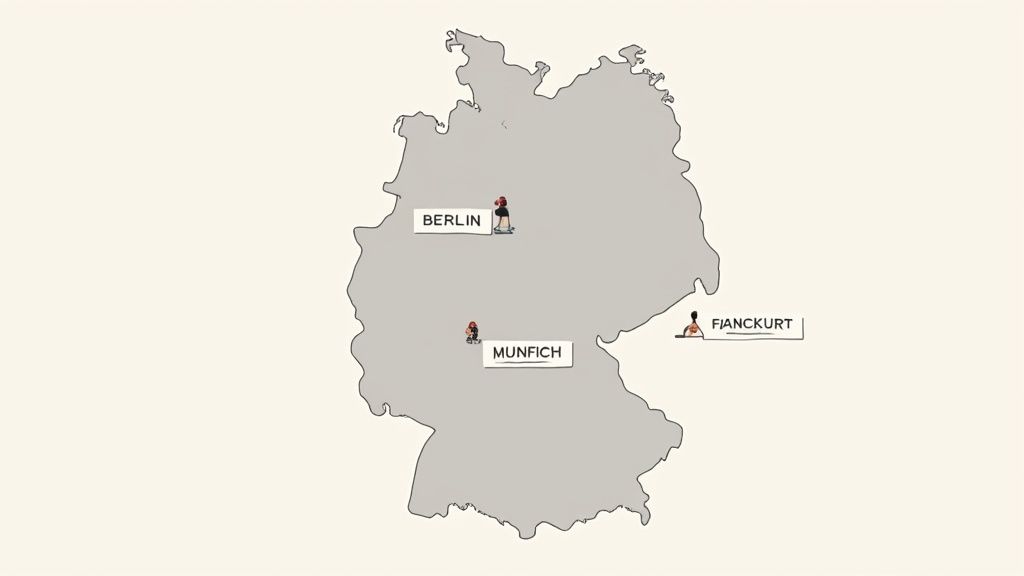
While security jobs are popping up all over the country, a few key cities have really cemented themselves as Germany's main cyber security hubs. These cities offer the perfect mix of big-name corporations, fresh start-ups, and critical infrastructure, all of which need top-tier security.
Each city has its own distinct flavour, both professionally and culturally, so it's worth thinking about what kind of environment you'd thrive in.
Berlin: Known for its buzzing, creative start-up culture, Berlin is a magnet for innovation. Tech companies here are often agile and move fast, creating exciting roles in areas like SaaS and product security. It's also incredibly international, so you'll find that English is the go-to language in many offices.
Munich: As the powerhouse of Bavaria's economy, Munich is home to corporate giants like Siemens and BMW, plus a huge insurance and finance sector. Jobs here often focus on securing massive corporate networks and industrial control systems, with a greater emphasis on process and stability.
Frankfurt: No surprise here—Germany's financial capital is the epicentre for FinTech and banking security. If you work in Frankfurt, you'll likely be dealing with regulatory compliance, fraud detection, and protecting highly sensitive financial data. The city's importance is further underscored by the presence of the European Central Bank.
Of course, the action isn't limited to just these three. Cities like Stuttgart (automotive) and Hamburg (logistics and media) are also seeing a surge in demand as their traditional industries go digital. Companies like McKinsey, Bosch, and SAP have a major presence in these key hubs, offering competitive packages to attract the best people. For a deeper dive into landing a role, you can read the full 2025 guide on getting a tech job in Germany.
Building the Skillset German Employers Want
Landing one of the many cyber security jobs in Germany isn't just about having a passion for the field. It’s about building a specific toolkit—one that combines deep technical know-how, sharp awareness of German regulations, and certifications that prove you’ve got what it takes.
Think of it this way: employers aren't just looking for someone who can do the job. They're looking for the candidate who is ready to tackle their specific challenges from day one. To be that person, you need to deliberately build your skills around what the German market is demanding right now.
Core Technical Competencies in Demand
At its core, cyber security is a hands-on, technical field. German companies expect you to have a solid grasp of the fundamentals. These are the skills you’ll see pop up in almost every single job description, and they’re absolutely non-negotiable.
You'll want to focus on getting practical experience in these key areas:
- Network Security: This is the bedrock. You need to be comfortable with firewalls, intrusion detection systems (IDS/IPS), and VPNs. It's all about knowing how to fortify an organisation's digital walls against threats.
- Threat Analysis and Incident Response: Think like a digital detective. Can you sift through logs, spot the tell-tale signs of an attack, and know exactly what to do when a breach happens? This is the bread and butter of roles like a SOC Analyst.
- Cloud Security: With so many German companies shifting to the cloud, skills in platforms like Amazon Web Services (AWS) and Microsoft Azure are in red-hot demand. This means getting to grips with identity and access management (IAM), secure configurations, and the complexities of container security.
These aren't just buzzwords for your CV. Employers want to see that you can actually apply this knowledge to solve real problems.
A staggering 87% of German businesses have suffered breaches directly because of a lack of skilled cybersecurity staff. This statistic really hits home just how desperate companies are for qualified experts. The skills gap is so wide that employers are practically begging for candidates with proven abilities. You can read a more detailed breakdown of German cybersecurity job market trends to see the full picture.
Understanding the German Regulatory Landscape
Here’s what separates a good candidate from a great one in Germany: understanding the local rules of the game. Technical skills get you in the door, but knowing the regulatory environment gets you the job. Compliance isn't just a suggestion here; it's a legal and business imperative.
Get familiar with these two key pieces of legislation:
- General Data Protection Regulation (GDPR): In Germany, data privacy is taken incredibly seriously. You absolutely must have a working knowledge of GDPR, as it governs how every company handles personal data.
- NIS2 Directive: This is the newer kid on the block, and it's a big deal. It extends strict cybersecurity rules to a much wider range of industries. Companies are scrambling to find professionals who can guide them through its new risk management and reporting requirements.
When you can talk intelligently about these regulations, you show that you're thinking about the bigger picture—not just the tech, but the business and legal impact too.
The Power of Professional Certifications
So, how do you prove you have all these skills? Certifications. In the German market, they are highly respected and serve as a trusted stamp of approval on your abilities. They cut through the noise and tell an employer that you meet a certain standard.
In fact, over 90% of employers see certifications as a key factor when they're sorting through applications. It's so important that many companies will even pay for their employees to get certified.
Here are a few of the most valuable ones to consider:
- CompTIA Security+: A fantastic starting point that proves you have the essential, foundational skills.
- CISSP (Certified Information Systems Security Professional): This is the gold standard for experienced security pros, recognised all over the world.
- CEH (Certified Ethical Hacker): Shows you have the offensive security skills needed for penetration testing.
Putting together a strong portfolio of the right skills and certifications is the most direct route to a great job in this field. For more tips on building your career and navigating the job hunt, make sure to check out the expert insights on the JobCoPilot blog.
A Practical Strategy for Your Job Search
Having the right qualifications is one thing, but knowing which doors to knock on is what truly gets you hired. When it comes to cybersecurity jobs in Germany, a targeted search strategy will always beat the scattergun approach of sending out dozens of generic applications. It’s all about understanding where German recruiters spend their time and what they expect to see from a serious candidate.
Your best bet is a mix of platforms. Of course, global sites like LinkedIn are fantastic for networking and landing roles at international corporations. But you absolutely cannot ignore the German-specific job portals like StepStone.de and XING, which is essentially Germany’s professional networking equivalent to LinkedIn. A huge number of traditional German companies, especially the famous "Mittelstand" (small and medium-sized enterprises), post their vacancies exclusively on these local sites.
Tailoring Your Application for German Employers
Once you've zeroed in on an interesting role, your next challenge is putting together an application that clicks with German hiring managers. The local business culture puts a high premium on precision, structure, and attention to detail. A hastily prepared CV or a generic cover letter will likely get your application binned before it’s even properly read.
Think of your application as your first professional handshake. It needs to be firm, confident, and perfectly in line with what they’re used to seeing. This means taking the time to customise your documents for every single application, carefully highlighting the skills and experiences that directly match the job description.
A massive part of this is getting to grips with the unique structure of German application documents.
- Your CV (Lebenslauf): This is usually a crisp, one-to-two-page document. It might feel a bit old-fashioned, but including a professional-looking photo is still common practice and often expected.
- Your Cover Letter (Anschreiben): This is absolutely not an optional extra. A well-crafted cover letter is your golden opportunity to showcase your motivation and draw a clear line between your past achievements and the company's future needs.
The differences between a standard international CV and a German Lebenslauf can seem small, but they carry a lot of weight. To help you navigate this, the table below points out some of the key distinctions.
German vs International CV (Lebenslauf) Key Differences
When you're adapting your CV, you'll notice a few cultural nuances that are important to get right. German employers often appreciate a level of detail and a format that might seem unusual elsewhere.
| Feature | Typical German Expectation | Common International Practice | | :------------------ | :---------------------------------------------------------------------------------------- | :------------------------------------------------ | | Photo | A professional headshot is often included and placed prominently. | Generally omitted to avoid potential bias. | | Structure | Strictly chronological, with the most recent experience listed first. No gaps unexplained. | Similar, but skills-based or functional formats are also used. | | Personal Details| Can include date of birth and marital status, though this is becoming less common. | Limited to contact information for privacy reasons. | | Signature | Traditionally, the CV is physically signed and dated at the end (or a digital signature is used). | Rarely, if ever, signed. |
Getting these details right shows you've done your homework and are serious about fitting into the German professional environment.
Where to Look for Opportunities
Your job hunt should also be guided by geography. While you can find roles dotted all over the country, some areas are buzzing with far more activity than others. Major tech hubs like Berlin, Munich, and Frankfurt are naturally the epicentres for cybersecurity opportunities, particularly within large, multinational corporations.
But don’t make the mistake of overlooking Germany's industrial heartlands. The small and medium-sized enterprises (SMEs) in regions like Bavaria and Baden-Württemberg are desperate for cybersecurity talent to protect their high-tech manufacturing and engineering operations. As you explore the market, it's worth reading up on the future of cybersecurity in Germany at packgtm.com to understand the bigger picture.
A Note on Automation: Let’s be honest—finding jobs, customising CVs, and writing cover letters for each one can be a massive time sink. This is where some of the newer tools can give you a real edge, helping you manage the whole process much more efficiently.
Ultimately, a winning job search strategy in Germany is a blend of casting a wide net across the right platforms and then taking a meticulous, culturally aware approach to every single application. By investing the time to get your Lebenslauf and Anschreiben just right, you're sending a powerful signal to employers that you’re a professional who means business. And if you're looking to streamline the entire job-hunting marathon, you might be interested in using an AI-powered platform to automate your job search with JobCopilot.
Navigating Visas and German Work Culture
Congratulations, you’ve landed one of the many exciting cyber security jobs in Germany! That's a huge milestone. But getting the offer is really just the beginning of the adventure.
Now comes the practical side of things: sorting out your move and getting used to a new professional rhythm. For anyone coming from abroad, that means tackling the visa process and learning the ins and outs of German work culture. Getting these two things right is what will make your transition smooth and set you up for real success.
Demystifying the German Visa Process
If you're from outside the European Union, the work visa is your number one priority. The good news is that Germany actively wants skilled professionals, especially in high-demand fields like ours, and has created clear pathways to make it happen.
The go-to option for many is the EU Blue Card. You can think of it as a fast-track visa for highly qualified non-EU citizens. The main requirements are a university degree that Germany recognises and a concrete job offer that pays above a certain salary. This minimum salary figure changes periodically, so always check the latest numbers on official government sites.
Of course, there are other routes, like the standard work visa for qualified professionals. No matter which path you take, the steps are generally the same:
- Get a Job Offer: This is the absolute first thing you need. No contract, no visa.
- Apply from Home: You'll start the application process at the German embassy or consulate in your home country.
- Collect Your Paperwork: You'll need your employment contract, degree certificates, proof of health insurance, and, of course, a valid passport.
Be warned: start the visa application the moment you have your contract. The process can easily take several weeks, sometimes even a couple of months. For the most reliable information, stick to official sources like your local German embassy or the government's "Make it in Germany" portal.
Understanding German Work Culture
Once you’re here and settled in, you’ll notice the German workplace has its own distinct flavour. It might be quite a shift from what you're used to, but understanding these unwritten rules is the key to fitting in and working well with your new colleagues.
Direct is the Default Germans tend to be very direct in their communication. Feedback is usually straightforward and to the point—it’s meant to be constructive, so try not to take it personally.
Punctuality is Everything This one is not a cliché. Being on time for meetings and appointments is a fundamental sign of respect. Consistently showing up late is a quick way to make a bad impression.
Work Stays at Work There’s a very clear line between professional and private life. When the clock hits 5 PM, the workday is genuinely over for most people. Working late isn't seen as a sign of dedication; it's more likely to be viewed as a sign of poor planning.
Getting a feel for these cultural norms will do more than just help you avoid awkward moments. It will help you build strong relationships and a genuinely rewarding career here in Germany.
Frequently Asked Questions
Jumping into a new job market always stirs up a few questions. Let's tackle some of the most common ones I hear about landing a cyber security role in Germany to help you get your bearings and set realistic expectations.
Do I Need to Speak German?
This is the big one, and the honest answer is: it depends. If you're eyeing a role at an international tech company in a major hub like Berlin or Munich, you can often get by with just English, especially in highly technical, non-client-facing positions.
But here's the reality: not speaking German puts a ceiling on your opportunities. The real engine of the German economy, the famed "Mittelstand" (small and medium-sized businesses), largely operates in German. If you want access to the full job market and aim for long-term growth, learning the language is a massive advantage. It's not just about work; it makes life outside the office a whole lot easier, too.
In the buzzing startup scene, English can be your entry ticket. But for real career progression and a wider choice of jobs, think of learning German as a key investment in your future here.
What Are the Opportunities for Entry-Level Professionals?
It's actually a great time to be starting out. The demand for cyber security talent is so high that many German companies are more than willing to bring on junior professionals and train them up. They know they can't afford to wait for the "perfect" candidate with ten years of experience.
Keep an eye out for titles like "Junior SOC Analyst," "IT Security Trainee," or "Cybersecurity Associate." If you're switching careers, don't underestimate your existing skills. Things like analytical thinking, methodical problem-solving, and a sharp eye for detail are gold dust in this field.
To stand out at the entry-level, you should have a few things in your corner:
- A relevant degree or a completed apprenticeship (Ausbildung).
- A solid foundational certification, like the CompTIA Security+.
- A portfolio showing your passion—think personal projects or Capture The Flag (CTF) competitions.
These things prove you're serious and have the aptitude to learn on the job, which can often be more compelling than a thin CV with no real-world experience.
Are Certifications More Important Than a University Degree?
Ah, the classic debate. The truth is, they're both valuable but for different reasons. A university degree in computer science or a related field is often the ticket to senior management and strategic planning roles. It shows a depth of theoretical understanding that's hard to replace.
That said, for the hands-on, technical jobs that make up the bulk of the market, certifications can be your golden ticket. For over 90% of employers, credentials like the CISSP, CISM, or CEH are seen as direct proof that you can do the job. In a market this hungry for practical skills, a strong certification can absolutely give you the edge over a candidate with only a degree.
Tired of endlessly scrolling through job boards? Acquispect uses AI to find your perfect job matches, craft tailored applications, and track your success, saving you hours every week. Start your free 30-day trial and automate your job search today.