At its core, a sustainability management job is a strategic role responsible for weaving environmental, social, and governance (ESG) principles into the very fabric of a company's operations. It’s less about box-ticking and more about guiding the entire business toward a future that's both profitable and resilient, all while managing its footprint on the planet and society. This career path is quickly becoming a non-negotiable part of modern business here in Germany and across the globe.
Why Sustainability Management Jobs Are in High Demand
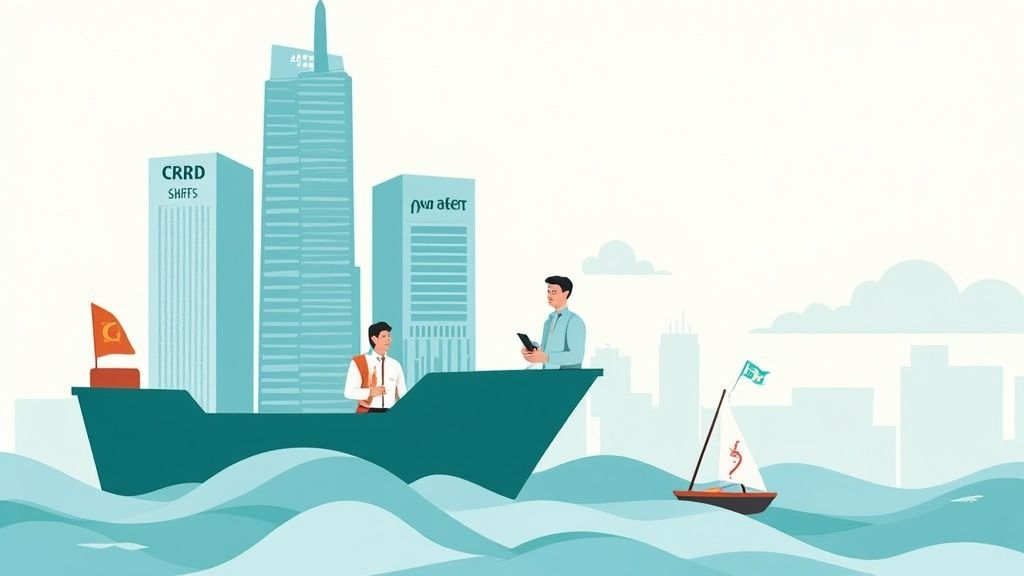
The surge in demand for sustainability managers isn't just a passing trend. It signals a deep, fundamental shift in what it means to run a successful business today. I like to think of a sustainability manager as a company's future-navigator, tasked with steering the ship through the complex, often choppy waters of a changing world. This role has become absolutely essential for a few key reasons.
For one, the regulatory landscape is getting tighter. New directives, like the EU's Corporate Sustainability Reporting Directive (CSRD), now require businesses to report on their environmental and social impacts with incredible detail. Companies desperately need experts who can navigate these rules to ensure compliance and sidestep hefty penalties.
Then there's the massive shift in what customers and investors expect. Modern consumers are voting with their wallets, choosing brands that show a real, tangible commitment to doing good. At the same time, investors are increasingly using ESG performance as a key metric for a company's long-term health and risk profile, making a robust sustainability strategy crucial for attracting capital.
The Growing Need for Strategic Navigators
You can see this shift playing out clearly in the German job market. The number of advertised jobs related to sustainability skyrocketed by an incredible 68% between 2020 and 2023, jumping from around 12,500 to over 21,000. This isn't just a small uptick; it's a clear signal of the urgency companies feel to bring qualified professionals on board. You can find more great insights on in-demand sustainability jobs from Enable Green.
Ultimately, a job in sustainability management is about creating value that goes far beyond the profit and loss statement. These professionals are the ones who:
- Mitigate Risks by spotting potential environmental liabilities or weaknesses in the supply chain before they become major problems.
- Drive Innovation by discovering new ways to use resources more efficiently or developing the next generation of sustainable products.
- Strengthen Brand Reputation through honest communication and a track record of genuine, measurable impact.
A sustainability manager doesn't just manage compliance; they uncover opportunities. By turning challenges like resource scarcity and climate change into catalysts for innovation, they build a more resilient and profitable business for the future.
This potent mix of regulatory necessity, market demand, and strategic business advantage makes a career in sustainability management one of the most stable and opportunity-filled paths you can pursue today.
What a Sustainability Manager Actually Does
Let's cut through the corporate-speak for a moment. What does a sustainability manager really do all day? To get a feel for it, let's walk through a typical day in their shoes. It’s a role that’s far from one-dimensional, blending hard data with human connection and long-term vision with hands-on problem-solving.
Your morning might kick off not just with a coffee, but with a deep dive into the company’s supply chain emissions data. You're hunting for patterns and red flags. Why did that supplier in Southeast Asia suddenly show a carbon footprint 15% higher than last quarter? This isn't just about crunching numbers; it's investigative work with a direct impact on the planet.
Then, before you know it, it's mid-morning and you’re shifting gears entirely. You're now in a room leading a workshop with the product development team. The mission? To figure out how to design the company's star product using circular economy principles. This is a creative, collaborative session with engineers and designers, tossing around ideas on how to use recycled materials, slash waste, and design something that can be easily taken apart and repurposed when it's no longer needed.
From Data Analysis to Strategic Influence
After grabbing a quick lunch, the afternoon is all about communication and persuasion. You might spend an hour polishing a presentation for the board of directors. Here, your job is to take complex Environmental, Social, and Governance (ESG) metrics and spin them into a rock-solid business case. You need to show them how that new water recycling facility isn't just an environmental win but will also deliver a clear return on investment in under three years.
This part of the job is absolutely critical. A sustainability manager has to be a compelling storyteller, using data to build a narrative that convinces senior leaders to open up their budgets. You’re not just a champion for the planet; you're a strategic partner for the business.
Later on, you could find yourself on a call with major investors grilling you about the company's social initiatives. They want to know about the labour practices in your factories and what you’re actively doing to build a more diverse and inclusive workforce. Being able to give them straight, transparent answers is how you build trust and protect the company's reputation.
At its heart, the job of a sustainability manager is to turn abstract goals into concrete actions. It’s about connecting the dots between an emissions report, a product design, and a boardroom decision to create a more resilient and responsible company.
The day might wrap up with you reviewing the draft of the annual sustainability report. This isn't just a document; it’s a public statement. You have to make sure it’s accurate, honest, and clearly communicates the company's progress—warts and all. It’s a role that truly demands a unique blend of skills:
- Analytical Prowess: You need to be comfortable deciphering complex data from lifecycle assessments and emissions reports.
- Creative Problem-Solving: The job is all about sparking innovation in how products are made and processes are run.
- Strategic Communication: You must be able to influence everyone from the factory floor staff to the executives in the C-suite.
Ultimately, a sustainability manager is an internal agent of change, a strategist, and an innovator, all wrapped up in one incredibly dynamic and important career.
What It Takes: Building Your Skillset for a Sustainability Career
To land a great job in sustainability management, you need a special blend of technical know-how and people skills. It’s a bit like being an architect—you absolutely need to understand the principles of engineering (the hard skills), but you also have to be persuasive enough to get the city council to approve your groundbreaking design (the soft skills). One without the other just doesn't work.
This is exactly what companies are looking for. They need someone who can dive deep into the data from a complex lifecycle assessment, and then turn around and explain those findings in a way that gets the leadership team excited and ready to act. Your success really hinges on being both a sharp analyst and a compelling advocate.
Mastering the Technical Toolkit
The bedrock of any sustainability role is a firm command of the technical details. These are the measurable, teachable skills that prove you know your stuff and can accurately track, report on, and manage a company's environmental and social impact.
Think of these as your non-negotiables:
- ESG Reporting Frameworks: You need to be fluent in standards like the Global Reporting Initiative (GRI), SASB, and the EU's new Corporate Sustainability Reporting Directive (CSRD). This is essential for keeping the company compliant.
- Data Analysis and Management: The job involves collecting, making sense of, and presenting complex data on everything from energy use and carbon emissions to supply chain metrics.
- Lifecycle Assessments (LCA): Knowing how to evaluate a product's full environmental footprint—from raw material to disposal—is key to creating truly sustainable products.
- Knowledge of Regulations: You must stay on top of ever-changing national and international environmental laws and climate policies to manage risk effectively.
The infographic below really brings to life the core missions you'd be driving as a sustainability manager, all of which depend heavily on these technical skills.
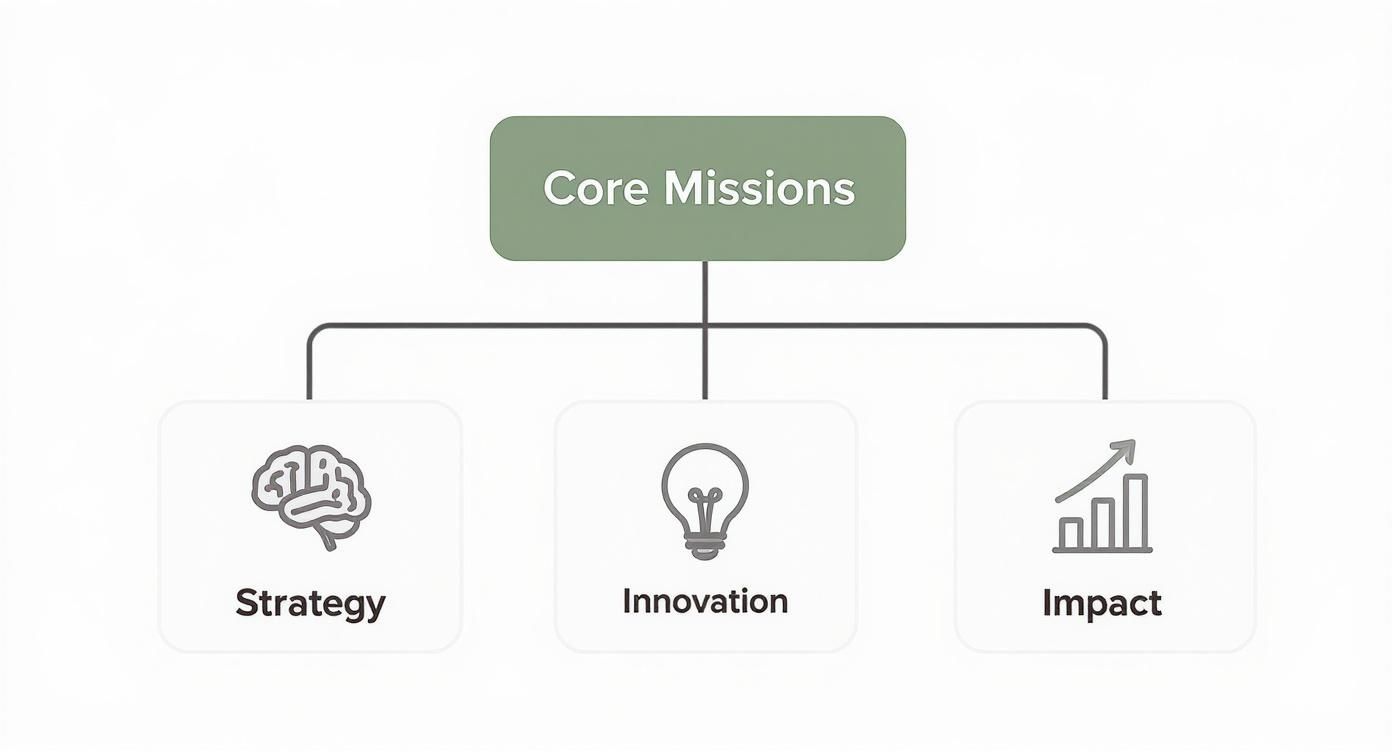
As the diagram shows, your technical expertise is the fuel for developing strategy, sparking innovation, and ultimately, delivering results that matter.
The Art of Persuasion and Collaboration
While hard skills might get you the interview, it’s your soft skills that will make your career soar. These are the human-centric abilities that allow you to shift the company culture and get genuine buy-in for your sustainability goals.
The most brilliant sustainability strategy is useless if it stays on paper. The real work lies in convincing a sceptical CFO to invest in a green energy project or motivating a factory manager to adopt a new waste reduction process.
This is where your knack for communication and stakeholder engagement truly comes into play. The demand for these skills is growing fast. A 2022 study revealed that 78% of large German companies now have at least one dedicated sustainability manager. These professionals typically have a background in business or environmental science and bring an average of five years of experience to the table. For more on this, check out these insights on sustainability management careers in Germany.
To give you a clearer picture, here’s a breakdown of the skills that are absolutely essential for success.
Table: Essential Skills for a Sustainability Management Job
| Skill Category | Specific Skill | Why It Matters (Real-World Example) | | :--- | :--- | :--- | | Technical (Hard Skills) | ESG Reporting & Frameworks | You need to prepare an annual report that meets CSRD standards, ensuring legal compliance and transparent communication with investors. | | Technical (Hard Skills) | Data Analysis | Analysing factory energy consumption data to identify inefficiencies and propose a targeted upgrade that cuts costs and carbon emissions. | | Interpersonal (Soft Skills) | Stakeholder Engagement | Convincing the supply chain department to switch to a more expensive but sustainable supplier by demonstrating long-term brand value and risk reduction. | | Interpersonal (Soft Skills) | Communication & Storytelling | Presenting the company's carbon reduction progress to all employees in a compelling way that inspires them to participate in new green initiatives. | | Strategic (Hybrid Skills) | Project Management | Overseeing the rollout of a new company-wide recycling programme, coordinating with facilities, HR, and marketing teams to ensure a smooth launch. | | Strategic (Hybrid Skills) | Problem-Solving | When a new regulation suddenly bans a key chemical in your product, you must quickly find a viable, eco-friendly alternative without disrupting production. |
Developing these interpersonal skills is every bit as important as memorising reporting standards.
If you’re looking for more career advice and job-hunting tips, be sure to explore the resources over at the JobcoPilot blog. At the end of the day, blending deep technical knowledge with exceptional communication is the true recipe for becoming an effective and influential leader in this field.
Exploring Different Career Paths and Specialisations
The term "sustainability manager" isn't a one-size-fits-all job title. It's less of a single role and more of a launchpad into a whole universe of specialised and incredibly rewarding careers. Think of it like a major motorway – there are countless exits, each leading to a different destination. Each path calls for a unique mix of skills and passions, letting you find a niche that truly clicks, whether you're a data guru, a creative problem-solver, or a policy wonk.
The sheer variety in this field is staggering. One person might be neck-deep in spreadsheets, modelling climate risk for an investment firm. Meanwhile, someone else could be collaborating with engineers to dream up a product that can be endlessly recycled. This diversity means you can carve out a career that’s not just impactful, but also genuinely exciting and aligned with what you love to do.
The Data-Driven Analyst
If you're someone who gets a kick out of finding the story hidden in the numbers, then a role as an ESG Analyst or Climate Data Analyst could be a perfect match. These are the people who provide the hard evidence for a company's sustainability strategy.
- What they do: They're responsible for gathering, crunching, and making sense of huge amounts of environmental, social, and governance (ESG) data. This could be anything from calculating a company's carbon footprint across a complex global supply chain to measuring the real-world impact of its community projects.
- Where you'll find them: You'll often see these roles pop up in the finance world, at investment firms, and within large corporations that are under pressure to report their ESG performance to investors and regulators.
Without their meticulous work, sustainability claims are just talk. They ensure everything is backed by solid, verifiable proof.
The Strategic Innovator
Are you more interested in tearing up the old rulebook and designing entirely new systems? If so, you might be drawn to a career as a Circular Economy Specialist or a Sustainable Product Manager.
These roles are all about innovation and radical redesign. They don't just focus on making things less bad; they aim to create systems that are inherently good by designing waste out from the very start. A Circular Economy Specialist at a fashion brand, for instance, might create a programme for taking back old clothes to be recycled into new ones. Or one at an electronics company could be working on modular phones that are simple to repair and upgrade, not just throw away.
The core mission of a strategic innovator is to fundamentally change how business works. They’re constantly asking, "How can we create value not just by selling more stuff, but by building closed-loop systems where nothing is ever wasted?"
The Policy and Communications Expert
For those who excel at communication, persuasion, and untangling complex regulations, a job like Climate Strategist, Corporate Social Responsibility (CSR) Manager, or Sustainability Communications Manager is an excellent fit.
These professionals are the vital link between a company and the wider world. They’re skilled at turning technical sustainability initiatives into powerful stories that resonate with customers, engaging with government officials on new environmental laws, and forging partnerships with non-profits. A Climate Strategist, for example, is the architect behind a company’s plan to decarbonise, setting ambitious science-based targets and mapping out the entire journey to get there.
At the end of the day, picking a specialisation is about finding the best way to apply your own unique talents to one of the biggest challenges we face. Whether your passion lies in data, design, or dialogue, there's a dynamic and meaningful career path in sustainability waiting for you.
What Can You Earn? A Look at Salaries and Industry Demand in Germany
Let's get straight to the point. When you're thinking about a career change, two questions always come up: "How much can I make?" and "Will I be able to find a job?"
If you're eyeing a career as a sustainability manager in Germany, the news is good on both fronts. Not only is the pay competitive, but there's a serious talent shortage. That puts you, as a skilled professional, in a very strong negotiating position.
Typical Salary Ranges in Germany
Of course, your exact salary will depend on your experience, the size of the company, and the industry you're in. But we can paint a pretty clear picture of what to expect.
Here’s a rough breakdown of the salary brackets you'll likely see:
- Entry-Level (Analyst/Coordinator): Just starting out, maybe with one to three years under your belt? You can expect to see offers between €45,000 and €60,000 a year.
- Mid-Career (Manager): Once you have three to seven years of experience and are managing your own projects or strategies, your salary will typically jump into the €60,000 to €85,000 range.
- Senior-Level (Head of/Director): For seasoned leaders with a proven track record, the sky's the limit. Senior roles often start around €90,000 and can easily cross the €120,000 mark, especially in big corporations.
These aren't just arbitrary numbers. They reflect a real competition for talent. Germany's push for a green economy and its bold climate goals have created a massive demand for sustainability expertise.
In fact, a 2023 analysis revealed that 85% of renewable energy companies were struggling to hire qualified sustainability managers. A staggering 60% of them called this talent gap a major roadblock to their growth. This pressure has pushed the average time to fill a sustainability role to 78 days—a big jump from just 52 days back in 2020. You can see the trend for yourself by looking at the growing number of sustainability jobs in Germany.
Where is the Demand Highest?
While the need for sustainability experts is growing across the board, a few sectors are really driving the hiring boom in Germany. These industries are under intense pressure to change and see huge value in bringing dedicated experts onto their teams.
A sustainability professional is no longer a "nice-to-have" but a strategic necessity. In manufacturing, they drive resource efficiency; in finance, they manage ESG risk; and in tech, they design the circular products of tomorrow.
The industries leading the charge are:
- Manufacturing and Automotive: These giants are dealing with complex global supply chains and massive energy consumption. They urgently need experts to shrink their environmental footprint and navigate a maze of new regulations.
- Technology and IT: From making data centres more energy-efficient to designing hardware for a circular economy, the tech world is buzzing with sustainability challenges.
- Finance and Investment: Banks and investors are desperate for ESG analysts who can spot risks, identify sustainable investment opportunities, and handle increasingly strict reporting requirements.
Knowing these salary benchmarks and industry hotspots gives you a real edge. It helps you understand your market value and focus your job search where it will count the most.
So, How Do You Actually Land Your First Sustainability Management Job?
Getting your foot in the door of the sustainability world can feel like a tough nut to crack, especially if you’re coming from a completely different field. But it’s far from impossible. It's all about strategically reframing what you've already done and building the right connections.
Think of it as translation. You need to learn how to speak the language of sustainability and apply it to your own career history. A project manager, for example, is a pro at handling budgets and deadlines—skills that are absolutely critical for rolling out a new company-wide recycling initiative. Someone from marketing? They know how to distill complex ideas into a compelling story, which is exactly what’s needed to create an engaging annual sustainability report that people actually want to read.
Your CV and cover letter are where this translation really happens. Don't just list your old job duties. Instead, frame your achievements through a sustainability lens. For instance, instead of a generic "managed logistics," you could say, "Optimised supply chain routes, cutting fuel consumption by 15% and reducing transport emissions." See the difference?
Crafting a Standout Application and Building Your Network
Your cover letter is your golden opportunity to connect the dots for the hiring manager. This is where you tell your story. Be clear about what draws you to this specific role and how your unique background is the secret ingredient they didn't know they needed. A great way to show you're serious is to mention specific company initiatives you admire—it proves you’ve done your homework.
For those looking to really level up their job search, you can explore platforms that help you tailor applications and monitor how they perform, like the tools you'll find at JobCopilot.
At the same time, don't underestimate the power of networking. It’s absolutely massive in this field. Start connecting with sustainability professionals on LinkedIn, join relevant online groups, and show up at sustainability events, whether they’re virtual or in your city. The key is to build relationships, not just ask for jobs. A simple message like, "I was really impressed by your work on circular economy projects and would love to hear a bit about your career journey," can open doors you never expected.
When you get to the interview, put on your sustainability manager hat. These professionals are always thinking about impact and value. Your goal is to show you can think strategically, not just recite facts.
Expect questions that sit right at the crossroads of business and sustainability. A classic one you might face is, "How would you measure the ROI of a new sustainability initiative?" A top-tier answer shows you can build a solid business case. You'd want to talk about direct cost savings (like lower energy bills) but also intangible benefits like enhanced brand value and improved public perception. Proving you can link green initiatives directly to the bottom line will make you a truly memorable candidate.
Common Questions About Sustainability Management Careers
Stepping into a new field always brings up a lot of questions. For a role as dynamic as sustainability management, it's natural to wonder about the necessary qualifications, what a typical career path looks like, and how the job itself is changing. Let's tackle some of the most frequent queries.
Do I Need a Specific Degree for This Job?
Not necessarily. While a degree in Sustainability, Environmental Science, or even Business gives you a fantastic head start, it's far from the only way in. Many of the most effective people in this field come from completely different backgrounds.
Think about it: experience in engineering, finance, or supply chain management can be a huge asset. What really counts is having a genuine understanding of sustainability principles and a toolkit of transferable skills. You'll need to be good with:
- Data Analysis: Making sense of complex environmental data and performance metrics is a must.
- Project Management: You have to be able to plan, run, and complete sustainability projects from concept to conclusion.
- Stakeholder Communication: You'll be talking to everyone, from people on the factory floor to the executives in the C-suite.
A great way to fill any gaps in your formal education is through certifications. Earning a credential from a recognised body like the Global Reporting Initiative (GRI) or SASB sends a strong signal to employers that you're committed and have specialised knowledge they can count on.
What Is a Typical Career Progression?
Most people start out as an Analyst or Coordinator. In these roles, you're deep in the details—gathering data, supporting bigger projects, and getting a handle on reporting. It's the perfect place to learn the fundamentals.
After a few years, you're ready to step up to a Sustainability Manager position. This is where you start shaping and driving the strategy. From there, the path can lead to senior roles like Head of Sustainability or even Chief Sustainability Officer (CSO), where you’re steering the entire ESG vision for the company.
How Is AI Changing Sustainability Management?
Artificial intelligence is becoming an incredible ally, not a threat. It gives professionals the power to sift through huge amounts of data to model climate risks, find ways to cut energy use, and build more transparent supply chains.
Essentially, AI is shifting the job away from tedious manual data collection and more towards high-level strategic thinking. Being comfortable with technology is now a serious advantage. It allows sustainability managers to make smarter, data-driven decisions much faster, leading to a much bigger impact.
Ready to fast-track your job search and land your ideal role in sustainability? Acquispect uses AI to find the perfect job openings for you, creates tailored application documents, and tracks your success so you can focus on what matters—making an impact. Start your free trial and increase your interview chances today at https://acquispect.com.