Landing a data scientist job in Germany is about more than just finding a position; it’s about plugging into one of Europe's most powerful economies, where data is the engine driving world-class industries. The role is a big deal here, mixing deep technical know-how with real business impact, making Germany a magnet for skilled professionals.
Understanding the German Data Scientist Role
First, let's get one thing straight. The stereotype of a data scientist hunched over a keyboard, isolated from the rest of the business, doesn't really fly in Germany. A better way to think about it is like a Meister, or a master craftsperson. This is someone who doesn’t just follow instructions but is a respected expert who takes raw materials and meticulously shapes them into something of immense value. For a data scientist, the raw material is data, and the finished product is a powerful predictive model or a game-changing business insight.
This mindset is key. German powerhouses in automotive, logistics, and healthcare aren’t just looking for number-crunchers; they want strategic partners. They expect a data scientist to take on a hefty business challenge—like fine-tuning a supply chain for BMW or forecasting patient outcomes for Berlin's Charité hospital—and build a solid, data-driven solution from scratch.
To give you a clearer picture, let's quickly summarise what being a data scientist in Germany is all about.
Data Scientist Career in Germany at a Glance
| Aspect | Key Details | | :--- | :--- | | Role Perception | Seen as a strategic partner or "Meister" (master craftsperson). | | Focus | Building end-to-end, reliable solutions for complex business problems. | | Core Industries | Automotive, logistics, e-commerce, healthcare, engineering. | | Average Salary | €58,100 per year (gross). | | Senior Salary Range | Top 25% earn over €86,500; experts can reach €130,000. | | Key Skills | Technical expertise (ML, data pipelines) + strong business communication. |
This table shows that the role is both demanding and well-rewarded, blending technical depth with a direct influence on business success.
More Than Just Numbers
So, what does the day-to-day actually look like? It's a mix of different hats, for sure. You're not just analysing data; you're orchestrating the entire process.
A typical workflow might involve:
- Translating Business Needs: Sitting down with managers or product owners to really understand a problem and figure out how data can actually help solve it.
- Building Data Pipelines: This is the foundational work of finding, cleaning, and organising massive datasets so they’re actually ready for analysis.
- Developing Predictive Models: Here’s where the magic happens. You’ll use machine learning algorithms to predict trends, spot potential risks, or automate manual tasks.
- Communicating Insights: The job isn't done until you can explain your complex findings to people who aren’t data experts, making it clear what the business should do next.
It's this combination of technical grit and business savvy that makes the role so challenging, but also incredibly rewarding. You’re building tools that create real, measurable value—whether that’s making a factory run more efficiently or creating personalised shopping experiences for millions of people.
Of course, finding a role that perfectly fits your skillset is the first step. To get a feel for what's out there, you can explore platforms that aggregate these kinds of opportunities. You can check out our guide on how to streamline your job search with AI tools on JobCopilot.de.
A Highly Valued and Compensated Position
The strategic importance of data scientists in Germany is clearly reflected in their paycheques and the sheer demand for their skills. According to the Hays IT Salary Report 2023, the average gross salary for a data scientist in Germany sits at a healthy €58,100 per year. The top 25% are pulling in over €86,500, and for seasoned pros with specialised experience, salaries can soar as high as €130,000 annually.
You can find more detailed salary breakdowns on the Hays Germany website. And this demand isn't just a tech-bubble thing; it cuts across e-commerce, medicine, engineering, and even agriculture.
A data scientist in Germany is fundamentally a problem-solver. The expectation is not just to analyse data, but to own the entire process from identifying the right question to delivering a robust, scalable solution that drives the business forward.
How Much Can You Earn as a Data Scientist in Germany?
Alright, let's talk numbers. What can you actually expect to make with a data scientist job in Germany? Your salary isn't some fixed number pulled out of thin air; it’s a direct reflection of your skills, your experience, and where you choose to work.
Think of it this way: a junior data scientist joining a fledgling startup in Berlin will have a very different pay packet than a seasoned pro leading a data team for a car manufacturer in Munich. Both are great roles, but the context completely changes the compensation.
This quick overview gives you a solid idea of what to expect as you move up the career ladder.
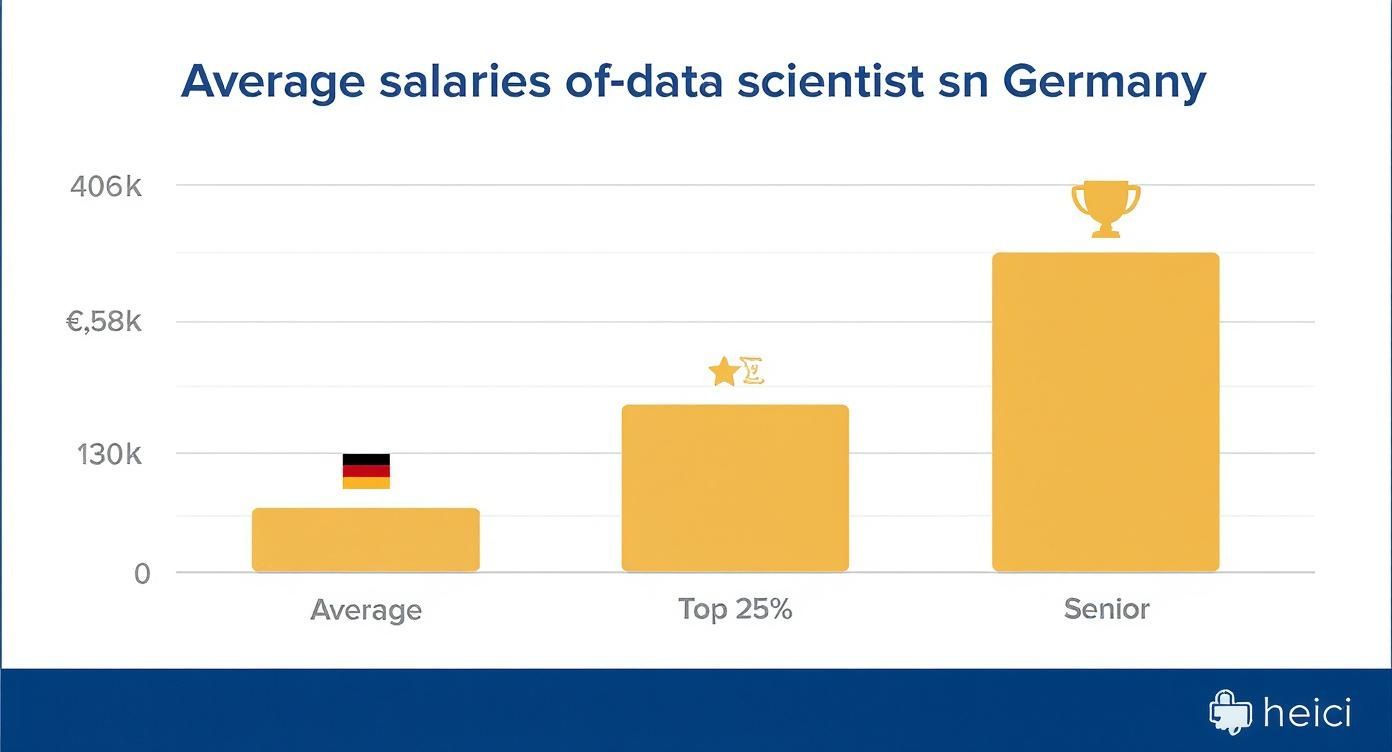
As you can see, experience pays. Senior data scientists often earn more than double the national average, a testament to the value they bring to a business.
What Really Influences Your Pay?
To set realistic expectations and negotiate confidently, you need to understand the main ingredients that go into a German salary offer. It really boils down to three core factors.
Here’s what employers are looking at:
- Your Experience: This is the big one. As you progress from a junior to a senior role, your salary will jump significantly. It's a direct reward for the proven impact and greater responsibility you take on.
- Your Location: Germany doesn't have a single economic centre. Big cities like Munich, Berlin, and Hamburg are all major hubs, but they each have different salary standards and, just as importantly, different costs of living.
- The Company Itself: A massive, established corporation in a traditional industry like manufacturing will have a very different salary and benefits structure compared to a high-growth tech startup.
Your salary is a direct reflection of the value you bring. In Germany, this is measured not just by your technical skills, but by your proven ability to apply those skills to solve tangible business problems and drive growth.
A Look at the Numbers: Salary Benchmarks by Experience and City
So, let's get more specific. As a general guide, a junior data scientist in Germany can expect a starting salary that allows for a comfortable lifestyle. From there, the climb for mid-level and senior professionals is pretty steep.
Current research for 2025 puts the average annual salary for a data scientist in Germany at around $85,115, which includes bonuses and other perks. Entry-level positions typically start somewhere in the neighbourhood of $62,341. With experience, however, that figure can skyrocket, with senior managers pulling in $226,770 or more per year. To give you a city-specific example, in a pricier hub like Munich, the median base salary is about $73,497, with the total average package hitting around $78,941. You can find more global comparisons in this excellent report on data science salaries around the world.
The city where you land your data scientist job in Germany is a massive piece of the puzzle. The table below breaks down what you might expect in the country's main tech hubs.
Data Scientist Salary by Experience and City
This table gives you a ballpark idea of average annual salaries you can expect across Germany's major tech hubs, based on your years of hands-on experience.
| Experience Level | Berlin (Average Salary) | Munich (Average Salary) | Hamburg (Average Salary) | | :--- | :--- | :--- | :--- | | Junior (0-2 years) | €50,000 - €60,000 | €55,000 - €65,000 | €52,000 - €62,000 | | Mid-Level (3-5 years) | €65,000 - €80,000 | €70,000 - €90,000 | €68,000 - €85,000 | | Senior (5+ years) | €85,000 - €110,000+ | €95,000 - €130,000+ | €90,000 - €120,000+ |
As you can see, Munich often comes out on top, which makes sense given its high concentration of major corporations in high-paying sectors like automotive and deep tech. Berlin, with its buzzing startup scene, has competitive salaries that might be slightly lower but are often sweetened with other perks like stock options. Hamburg, a hub for logistics and media, sits comfortably in between.
Look Beyond the Base Salary
Finally, remember that the number on your employment contract is just the beginning. German companies are known for offering attractive benefits that make up your total compensation package.
Don't forget to factor in things like:
- Performance Bonuses: It's common to receive an annual bonus tied to your performance and the company's success.
- Company Pension Schemes: Many employers will contribute to your retirement fund.
- Professional Development Budgets: Companies often pay for conferences, courses, and certifications to help you grow.
- Transportation Allowances: Subsidies for your monthly public transport ticket are a very common perk.
When you get an offer, always look at the full picture. A slightly lower base salary at a company with fantastic benefits and clear opportunities for growth might just be the smarter long-term move.
What Skills Do You Actually Need for a Data Scientist Job in Germany?
If you're aiming for a top data scientist role in Germany, you need to understand one thing: German employers are incredibly pragmatic. A fancy degree is a great start, but what they really want to see is what you can do. Think of your skillset as a professional toolkit. Someone with a range of specialised, well-maintained tools will always be more valuable than a person who only has a hammer.
Your technical foundation is the first hurdle. It's the cost of entry, and without the right programming languages, frameworks, and platform experience, your CV might not even get a second glance.
The Core Technical Toolkit
To build a profile that gets you noticed, you’ll want to focus on the technologies that pop up time and time again in German job postings. These are the absolute workhorses of the industry, and you need to know them inside and out.
- Programming Languages: Python is, without a doubt, the king of the castle in the German data science world. Its versatility and massive ecosystem of libraries make it the top choice. R still holds its ground, particularly in academic circles and biostatistics, but for most commercial roles, Python is what you need to master.
- Machine Learning Libraries: You must have real, hands-on experience here. Scikit-learn is the bread and butter for most machine learning tasks. For anything involving deep learning, you’ll need to be proficient in either TensorFlow or PyTorch.
- Data Wrangling and Analysis: Being fluent in SQL is non-negotiable. The same goes for data manipulation libraries like Pandas and NumPy. A huge part of the job is querying, cleaning, and reshaping messy data, so these skills are fundamental.
- Cloud Platforms: More and more German companies are shifting their infrastructure to the cloud. Getting comfortable with at least one of the big players—AWS, Microsoft Azure, or Google Cloud Platform—is quickly becoming a standard expectation.
It's also worth noting that the market has its ups and downs. Recent data, for example, highlighted a temporary but sharp dip in advertised roles, with listings falling by over 70% (from 460 to around 153) over a three-month period. Even in that tighter market, the most sought-after skills were scikit-learn, PyTorch, and data mining software, proving just how essential they are.
It's Not Just About the Code: The Soft Skills That Seal the Deal
Technical abilities might get you in the door for an interview, but it's your soft skills that will ultimately land you the job and help you thrive. In the German work environment, certain non-technical skills are highly valued because they have a direct impact on a project's success.
German employers are looking for 'Datenkompetenz'—a deep-seated data literacy. This isn't just about building models; it’s about structured thinking, clear communication, and tying your data insights back to tangible business goals.
This idea of Datenkompetenz is absolutely vital. It's the bridge connecting your complex technical work to real-world business value. It shows you understand the "why" behind what you're doing, not just the "how."
Communication and Structured Thinking
Can you explain your complex findings to someone who isn't a data expert? A brilliant model is completely useless if the head of marketing or a factory floor manager can't understand its implications for their work.
- Structured Problem-Solving: The German business culture really appreciates a methodical, logical mindset. You have to show that you can take a vague business problem and break it down into a clear, step-by-step plan for analysis.
- Effective Communication: This is about presenting your findings clearly and concisely, whether you're speaking or writing. You need to be comfortable explaining not just your results, but also the limitations of your model and the confidence level of your conclusions.
- Business Acumen: What truly sets a candidate apart is showing you grasp the company's big-picture goals. Frame your projects in business terms. Talk about the potential ROI, the efficiency gains, or how your work can reduce risk.
At the end of the day, the ideal candidate for a data scientist job in Germany is a hybrid professional—a skilled technician with the mind of a business strategist. If you can build that dual expertise, you'll be on the surest path to success. For more tips on how to build and present your professional story, have a look at the resources on our https://jobcopilot.de/blog.
Top Cities and Industries Hiring Data Scientists
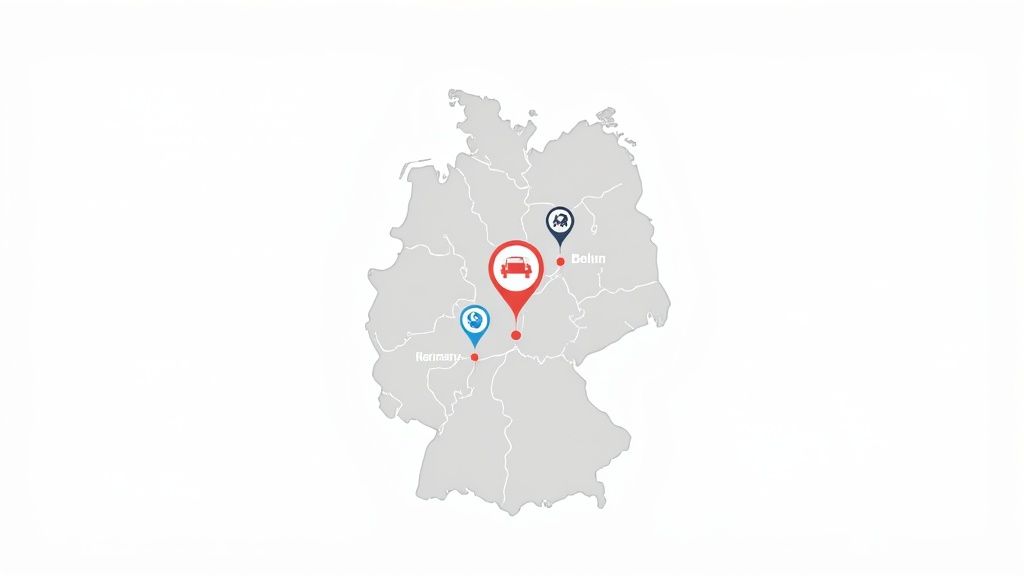
To land the right data scientist job in Germany, you need to know where to look. The country’s economy isn’t a single entity; it’s a patchwork of powerful, specialised hubs, each with its own character and opportunities. Your perfect role might be waiting in a scrappy Berlin startup or a global automotive giant in Munich. Knowing the lay of the land is half the battle.
Think of it as an ecosystem with distinct habitats. Every major city and its core industries create a different environment for a data scientist to thrive in. By understanding this map, you can focus your search and make sure your skills are a perfect match for what local companies are looking for.
Berlin: The Startup Capital
Berlin is Germany's creative soul, and its tech scene is buzzing with that same energy. It's the undisputed centre of the startup universe here, making it a brilliant spot for data scientists who love fast-paced, dynamic environments where innovation is simply how things are done.
You'll find a massive concentration of e-commerce, FinTech, and digital media companies. These businesses run on data, creating huge demand for experts who can decode user behaviour, build smart recommendation engines, and fine-tune digital products. While salaries might trail Munich slightly, they often come with perks like stock options and a much more relaxed work culture.
Munich: The Engineering Powerhouse
If Berlin is the passionate artist, Munich is the master engineer. As the capital of Bavaria, it’s home to some of Germany's most legendary corporations. This is where you’ll find the global headquarters for titans of the automotive, aerospace, and advanced engineering industries.
For a data scientist, working here means tackling incredibly complex, high-stakes challenges. Imagine building predictive maintenance models for a BMW production line, optimising aerodynamics for Airbus, or analysing sensor data for Siemens. Munich’s companies need data scientists with a rigorous, analytical mindset and, ideally, a solid grasp of engineering concepts. The cost of living is steep, but the salaries are among the highest in the country, reflecting the premium placed on deep technical skill.
Germany’s strength lies in its industrial diversity. A data scientist can find equally challenging and rewarding roles, whether they are optimising a logistics network in Hamburg or building a FinTech platform in Frankfurt. The key is aligning your career goals with the right regional hub.
Hamburg and Frankfurt: The Specialists
Beyond the big two, other German cities offer fantastic, specialised opportunities. They’ve each carved out a niche, attracting very specific kinds of companies and talent.
Hamburg: With one of Europe's biggest ports, Hamburg is a world leader in logistics and trade. Data scientists here are busy optimising global supply chains, forecasting shipping demand, and making warehouse automation smarter. The city also has a robust media and gaming scene, with roles focused on content personalisation and player analytics.
Frankfurt: This is, without a doubt, the financial capital of continental Europe. Home to the European Central Bank and Deutsche Bank, Frankfurt is a magnet for FinTech firms and major financial institutions. A data scientist job in Germany's financial centre will likely involve algorithmic trading, sophisticated risk modelling, and fraud detection.
Ultimately, where you go depends entirely on what you want to do. Want to be on the front lines of digital disruption in a startup? Head to Berlin. Prefer solving massive engineering puzzles for a global powerhouse? Munich is calling your name. By zeroing in on the right city, you dramatically boost your chances of finding that perfect role.
Your Visa Guide for Moving to Germany
Let's be honest, navigating German bureaucracy can feel like a maze. But for skilled data scientists, the path is actually quite well-lit. Once you've landed that job offer, the journey to getting your work visa becomes much more straightforward. The good news is that Germany genuinely wants experts like you and has created specific routes to smooth out the process.
For those of us from outside the EU, it generally boils down to two main options. Think of them as two different highways leading to the same destination: your new data scientist job in Germany. Which highway is best for you depends mostly on your salary and qualifications.
The EU Blue Card: The Premier Route
The EU Blue Card is the VIP ticket for highly qualified professionals. It's designed to attract top-tier talent from around the world and comes with some fantastic perks, like a faster track to permanent residency and making it easier for your family to join you.
So, what does it take to get one? There are two main hurdles to clear.
First, you need a university degree that Germany recognises. They use a database called Anabin to check if your degree is up to snuff. Second, your job offer must meet a minimum annual salary. This number gets updated each year, but for 2024, the magic number is €45,300 for roles in high-demand "shortage" fields—which, luckily, often includes IT and data science. For other jobs, the threshold is a bit higher.
The EU Blue Card isn't just a visa; it’s a clear signal. It tells you that Germany values your expertise and wants to make your move as seamless as possible, offering a privileged path for in-demand professionals.
This visa is incredibly popular because it simplifies so many things about living and working not just in Germany, but potentially across the EU down the road.
The Skilled Worker Visa: A Broader Pathway
What if your salary doesn't quite hit the Blue Card threshold? Or maybe your qualifications are more vocational than academic? Don't worry, there's another excellent route: the Skilled Worker Visa (Visum für Fachkräfte). This option is much more flexible and covers a wider range of qualified professionals.
For this visa, you still need a firm job offer and official recognition of your qualifications in Germany. That recognition step is key—it’s how they confirm your skills meet German standards. The main difference here is that the salary requirement isn't a hard number. Instead, your salary just needs to be comparable to what other employees in a similar role earn in Germany. This makes it a fantastic and accessible option for many data scientists, particularly those in mid-level positions or joining a startup.
The Application Process, Step by Step
Alright, you’ve got the signed contract in hand. Now the real fun begins. It might look like a mountain of paperwork, but it’s really just a series of manageable steps.
Here’s a quick look at what you can expect:
- Get Your Degree Recognised: First things first, check if your university degree is listed and recognised in the Anabin database. If not, you’ll likely need to get a Statement of Comparability from the Central Office for Foreign Education (ZAB).
- Gather Your Documents: Time to collect everything. You'll need the usual suspects: your passport, the signed job contract, proof that your degree is recognised, and the filled-out visa application form.
- Schedule an Embassy Appointment: You have to apply for the visa from your home country (or wherever you legally reside). Book an appointment at the local German embassy or consulate as early as you can—wait times can be surprisingly long.
- Attend Your Appointment: Head to your appointment to submit all your documents and have a brief chat. Once everything is approved, you’ll get an entry visa stamped in your passport, which is your ticket to Germany.
- Register and Get Your Residence Permit: Once you arrive, you’re on the home stretch! The final steps are registering your new address (Anmeldung) and then visiting the local Foreigners' Authority (Ausländerbehörde) to get your final residence permit.
By breaking it down like this, the entire process becomes a clear, actionable checklist. Knowing your options and the steps involved will give you the confidence to navigate the path to your new life and career in Germany.
Crafting an Application That Gets Noticed
So, you're ready to apply for a data scientist job in Germany? Great. But before you just translate your existing CV and hit send, take a step back. Getting noticed here is about more than just listing your skills; it's about understanding and respecting a unique set of professional norms.
German hiring managers live and breathe clarity, structure, and thoroughness. Your application is your first chance to prove you get it. Think of it as your very first project for the company: the data points are your skills and experiences, and you need to present them in a way that leads to one simple conclusion—you're the perfect fit.
The whole package boils down to two key documents: the Lebenslauf (your CV) and the Anschreiben (your cover letter). Let's break down how to get them right.
Mastering the German Lebenslauf
The German CV, or Lebenslauf, isn't just a brief summary; it's a comprehensive, factual, and chronological story of your career. While you might see some slick, creative layouts floating around the Berlin startup scene, a clean, well-structured format is always a safe bet, especially with more established companies.
Here’s what German recruiters are often looking for:
- A Professional Photo: It's technically optional because of anti-discrimination laws, but a high-quality, professional headshot is still very common. It puts a face to the name and helps personalise your application.
- Complete Contact Information: Don't just stop at your email and phone number. Include your full address and a link to a sharp LinkedIn profile or a professional portfolio that showcases your work.
- Reverse-Chronological Order: Always start with your most recent job and work backwards. German employers look for a complete timeline. If you have any gaps, don't just ignore them. Briefly explain them with something like "Parental Leave" or "Professional Sabbatical."
- Detail Your Impact: This is huge. For every role, go beyond just listing your duties. Use bullet points to highlight what you actually achieved. Quantify everything you can. "Developed a model that reduced shipping costs by 15%" hits a lot harder than a vague "built predictive models."
Your Lebenslauf is your proof. German recruiters want to see a clear, logical career path backed up by real, tangible results. Every line item should build the case that you're a capable and reliable professional.
Writing a Compelling Anschreiben
In Germany, the Anschreiben (cover letter) is absolutely not an afterthought—it’s a deal-maker. This is where you connect the dots from your CV and tell a compelling story that speaks directly to the job description. The tone should be formal, the content concise, and every word should be tailored to the specific role.
A winning Anschreiben almost always follows this flow:
- Find a name. Address the hiring manager directly if you can. A generic "To Whom It May Concern" often comes across as lazy.
- Get straight to the point. Open by stating which specific data scientist job in germany you're applying for.
- Prove you're the one. This is the heart of your letter. Draw direct lines between your key skills and experiences and the requirements they listed in the job advert.
- Show you've done your homework. Explain why you want to work for this company and what excites you about this particular role.
- Close professionally. End by stating your availability and expressing your enthusiasm for an interview.
By putting this level of care into your application, you show them you're not just another talented data scientist. You're a professional who understands and respects the way things are done in the German work culture.
Got Questions? We've Got Answers
Moving to a new country for a job always brings up a ton of questions. Let's tackle some of the most common ones we hear from data scientists looking to make their mark in Germany. This should give you some clear, straightforward advice to help you get started.
Do I Really Need to Speak German?
This is probably the question I get asked the most. The short answer is: it depends, but you should absolutely learn it.
In the big tech hubs like Berlin or Munich, you can definitely get by with just English, as many startups and international companies use it as their primary language. However, not speaking German puts a ceiling on your opportunities. You’ll miss out on fantastic roles in Germany's famous Mittelstand—the thousands of successful small and medium-sized enterprises that form the backbone of the economy.
Think of B2 level German (upper-intermediate) as your target. It's the sweet spot that unlocks most doors. For any role that involves talking to clients or working outside the main tech bubbles, you'll likely need C1 (advanced). Honestly, even just having the basics shows you're committed to integrating, which German employers really appreciate.
Will Germany Recognise My University Degree?
This isn't just a nice-to-have; for your visa, it's a must. The German authorities need to see that your degree is on par with a German one, especially if you're aiming for the EU Blue Card.
Your first stop should be the official Anabin database. It's a tool where you can check if both your university and your specific degree are already recognised. If you can't find them, don't panic. You'll just need to apply for a "Statement of Comparability" from the Central Office for Foreign Education (ZAB). My advice? Get this sorted out as soon as you start job hunting. The process can take a few weeks, and you don't want it holding up a great job offer.
Don't sleep on the paperwork. Getting your degree officially recognised is a hard requirement for any work visa. Kicking off this process early will save you a massive headache down the line.
What’s the Work-Life Balance Actually Like?
Germany has a stellar reputation for work-life balance, and for good reason. The entire work culture is built around being highly productive and efficient during working hours so you can properly switch off afterwards.
- Working Hours: A typical week is between 38 and 40 hours. Overtime isn't a badge of honour here. If you do have to work extra, it's usually compensated with time off in lieu.
- Holidays: The legal minimum holiday allowance is 20 days plus public holidays, but almost every company you'll see offers between 25 and 30 days.
- Punctuality: This is no joke. Being on time is a sign of respect for your colleagues' time and is deeply ingrained in the professional culture.
This mindset allows you to have a rewarding career and a personal life, which is a huge draw for professionals from all over the world.
Ready to fast-track your job search? Acquispect uses AI to match your profile with the best roles and generates tailored application documents in minutes. It saves you a ton of time and seriously boosts your chances of getting that interview. Start your free trial and find your perfect data scientist job in Germany today.