Finding your "Traumjob"—your dream job—is far more than just luck. It's about getting real with yourself, figuring out what truly makes you tick, and then building a clear-headed strategy to get there. The entire journey really boils down to three key stages: deep self-reflection to nail down your non-negotiables, strategic market alignment to find where you're genuinely needed, and mastering the application process to actually land the role.
Let's walk through how to do it.
Starting Your Search for a Dream Job in Germany
The idea of a "Traumjob" can feel a bit abstract, like chasing some perfect, almost mythical position. But in reality, it's much more concrete. The trick is to stop thinking about a single, perfect job title and start focusing on the components of a role that align with your core values, play to your strengths, and support the lifestyle you actually want.
Think of it less like a treasure hunt and more like an architectural project—with you as the architect, designing a career that fits you perfectly. This guide will give you the blueprint for navigating Germany’s professional world, moving past the usual vague advice to give you practical steps for today's market.
Understanding the German Job Market
Right now, Germany's economic landscape offers a fantastic opportunity for skilled professionals. The market is hungry for talent across a whole range of industries. We're talking about a very low unemployment rate of 4.2% and over 770,000 open positions nationwide. The conditions are genuinely on your side, provided you know where to aim your efforts.
This huge number of vacancies points to a serious need for qualified people, especially in fields like IT, healthcare, engineering, and skilled trades. This situation gives you real negotiating power, but only if your job search is strategic. Knowing which sectors are booming and what skills are in high demand is your first big advantage.
A Three-Pillar Strategy for Success
To keep this from feeling overwhelming, we're going to tackle it with a clear, three-pillar strategy. Each pillar builds on the last, giving you a complete roadmap from self-discovery all the way to signing a contract. A solid understanding of your career goals is the foundation, and our guide on how the JobCopilot can help you define those objectives is a great place to start.
To give you a high-level view, here’s how these strategic components fit together.
Three Pillars for Finding Your Dream Job
| Pillar | Focus Area | Key Outcome | | :--- | :--- | :--- | | Self-Discovery & Goal Setting | Identifying your core values, skills, and career non-negotiables. | A clear "Career Compass" that defines what you truly want and need in a job. | | Market Research & Opportunity Matching | Analysing the German job market to find industries and roles that align with your profile. | A curated list of high-potential job opportunities that are a genuine fit for you. | | Application & Interview Mastery | Crafting compelling applications and acing interviews to secure your target role. | Receiving a job offer for a position that meets your personal and professional goals. |
This structured approach ensures you’re not just firing off applications into the void.
A dream job isn't something you find; it's something you build by making a series of informed, strategic decisions. It's the intersection of what you love, what you're good at, and what the market will pay for.
Instead of random searching, you'll be zeroing in on roles that fit your professional DNA and promise long-term satisfaction. By breaking the hunt down into these manageable steps, you turn a daunting task into an achievable project.
Uncovering Your Professional DNA
Jumping onto job boards without a clear plan is a bit like grocery shopping when you’re starving—you end up with a cart full of stuff you don’t actually need. Before you even think about polishing your CV, the real first step on the path to your dream job is an internal one.
This isn’t about just listing your hard skills. It's about getting to the heart of your Professional DNA: that unique mix of values, motivations, and interests that defines what a fulfilling career actually looks like for you. Without that clarity, every job description starts to look plausible, and you risk landing in a role that drains your energy instead of fuelling it.
Shifting from “What” to “Why”
Most people kick off their job search by asking, "What jobs can I do with my skills?" It seems logical, but it’s a limiting question. It focuses entirely on what you’re capable of, not what brings you satisfaction.
A much more powerful question to ask yourself is this: "What kinds of problems do I genuinely enjoy solving?"
Think about the difference. A project manager might be great at building timelines and managing budgets. But maybe what they truly love is the messy, human challenge of uniting a dysfunctional team or bringing order to a chaotic process. That insight changes everything. Suddenly, they're not just looking for generic "project management" roles but for specific environments where they can tackle the problems that really get them fired up.
Try a “Joy and Frustration” Log
One of the most practical ways to spot these patterns is to keep a "joy and frustration log" based on your past work. This isn't some huge, complicated task; it's a simple, powerful reflection exercise.
Grab a notebook or open a new document and make two columns. For the next week, think back on your past jobs and start filling it out.
- The Joy Column: List specific moments, tasks, or projects that made you feel energised, proud, or completely absorbed. Don't be vague. Instead of "teamwork," write, "That time I brainstormed a new marketing concept with two colleagues, and we felt like we were really onto something." Get specific.
- The Frustration Column: Note down the things that consistently sucked the life out of you or made you want to pull your hair out. Maybe it was "spending hours formatting pointless reports" or "dealing with constant interruptions that shattered my concentration."
After a week, take a good look at your log. The patterns that pop up are direct clues to your Professional DNA. They show you the kind of work and environments where you thrive and, just as importantly, the ones you need to run away from.
Defining Your Core Professional Values
That log will also help you pinpoint your core professional values—the non-negotiables that a job absolutely must have for you to feel satisfied. These are the bedrock of your dream job. One person might see that moments of independent decision-making brought them the most joy, pointing to autonomy as a core value. Another might realise their proudest moments came from directly helping a client, which highlights social impact.
Your Professional DNA is your personal filter for the job market. When a role aligns with it, you'll feel a natural pull. When it doesn't, you'll recognise the mismatch instantly, saving you a world of time and emotional energy.
Common professional values often include:
- Stability: A predictable workplace with clear expectations.
- Creativity: The freedom to experiment and bring new ideas to life.
- Collaboration: Working closely with a supportive team.
- Growth: Constant opportunities to learn and move forward.
Try to identify your top three to five values. These become your personal checklist for every opportunity that comes your way.
Pulling It All Together with Ikigai
A great framework for making sense of all this self-discovery is the Japanese concept of Ikigai, which roughly translates to "a reason for being." It’s found at the intersection of four key elements, which you should now have a much better handle on.
| Ikigai Element | Guiding Question | | :--- | :--- | | What You Love | What activities and topics genuinely excite you? (Your "Joy Log" is full of clues!) | | What You Are Good At | What are your proven skills and natural talents? | | What the World Needs | What problems out there can you help solve? | | What You Can Be Paid For | Which of your skills are actually in demand? |
The goal here isn't to magically find a perfect job title that ticks every single box overnight. It's about using these reflection tools to build a detailed profile of your "Professional DNA." This profile becomes your compass, guiding you toward roles that offer far more than just a pay cheque—they offer a genuine sense of purpose and fit.
Mapping Your Skills to Germany's High-Demand Sectors
Alright, you've done the hard work of defining your Professional DNA. Now comes the exciting part: connecting that personal profile to the real-world job market. Answering the question "wie finde ich meinen traumjob" isn't just about what you want; it's about pinpointing where your unique abilities are desperately needed and genuinely valued.
This is where taking a strategic look at Germany's booming sectors becomes your secret weapon. Instead of just firing off applications into the void, we're going to build a solid bridge between your skills and the tangible career paths available right now. We need to move beyond vague ideas like "the tech industry is growing" and get down to the specific roles that are driving that expansion.
Identifying Germany's Economic Powerhouses
Germany's economy is humming, with several key sectors not just growing, but actively hunting for skilled professionals. When you understand these high-demand areas, you can target your job search with surgical precision, which massively boosts your chances of landing a role that's both fulfilling and secure.
The real trick is to see how your personal strengths can solve the actual problems these industries are wrestling with. This goes way beyond matching keywords on a CV; it's about a deep understanding of what a sector truly needs.
This diagram helps visualise the core components we've discussed. Now, let's align them with what the market is looking for.
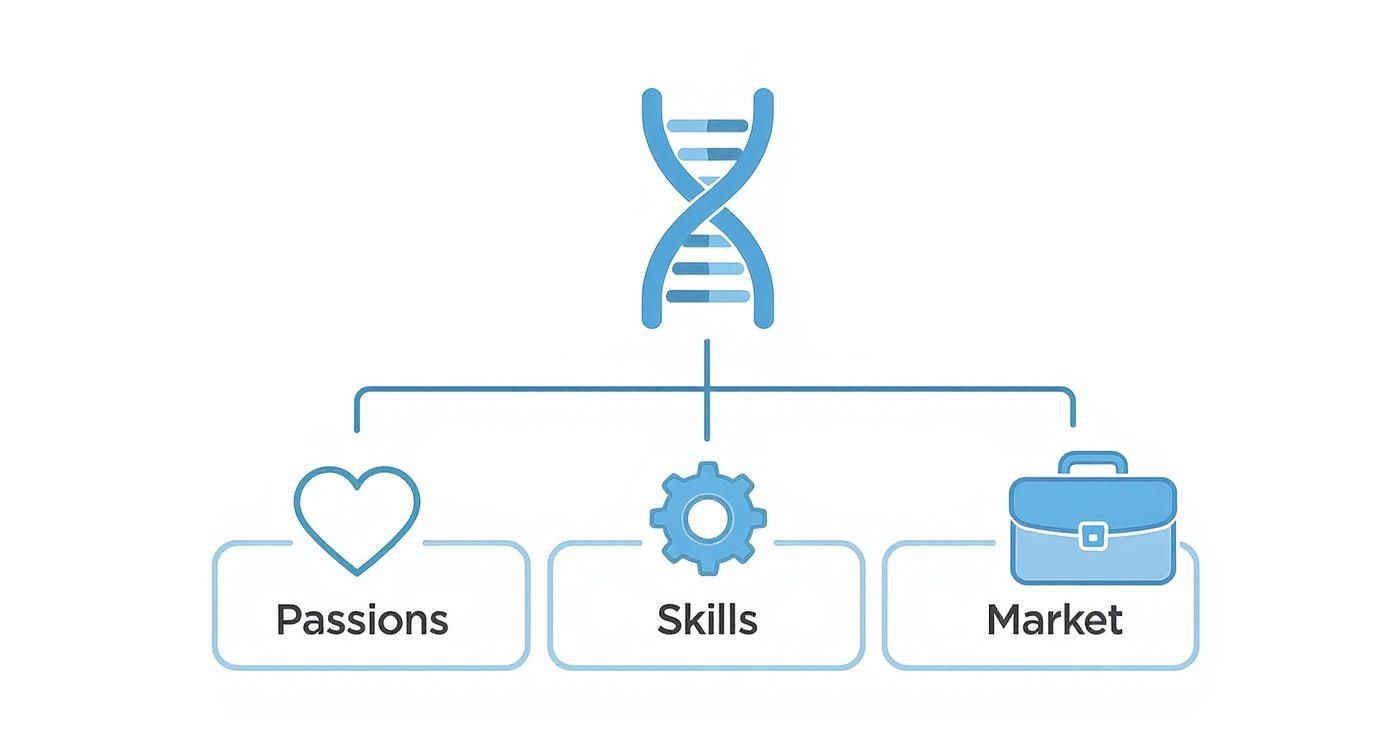
As you can see, the sweet spot—your dream job—is right where your passions and skills intersect with real market demand.
Diving Deep into High-Growth Fields
Let’s get specific. By looking closely at the roles in demand, you might discover that your current skills can be transferred into a whole new context, opening doors you never even knew existed.
The Tech and IT Sector
This is, without a doubt, Germany's most dynamic field right now. The technology and IT sector is a massive engine for the national economy and is expected to expand significantly by 2030. Companies are practically begging for specialists to fuel this growth.
You’ll find high demand for software engineers, mobile app developers, data scientists, and cybersecurity experts, with typical annual salaries falling between €50,000 to over €100,000. You can find more detail on these trends in Germany's fastest-growing job sectors on canamgroup.com.
My advice? Get specific. Don't just label yourself an 'IT professional'. Are you a cloud engineer who loves building scalable infrastructure? Or are you a cybersecurity analyst passionate about defending digital fortresses? Each path requires a very different focus in your job search.
Renewable Energy and Green Technology
Germany's firm commitment to the Energiewende (energy transition) has created an enormous need for professionals in green technology. And it’s not just a field for environmental scientists.
- Mechanical Engineers: Your design and manufacturing expertise is vital for developing the next generation of wind turbines and solar panel technology.
- Project Managers: The industry needs strong leaders to oversee the construction of vast new solar farms and critical grid infrastructure projects.
- Data Analysts: Optimising energy consumption and grid performance is a huge puzzle that relies entirely on skilled data professionals to solve.
Digital Health and Health-Tech
The healthcare industry is in the middle of a huge digital transformation, creating a fascinating blend of medical science and technology. This has given rise to a whole host of new roles that simply didn't exist a decade ago, making it a perfect area to pivot your skills into.
Think about a project manager with a background in logistics. They might not have a shred of direct healthcare experience, but their expertise in streamlining complex processes is exactly what a health-tech start-up needs to manage the rollout of a new medical software platform. Their transferable skills in organisation and stakeholder management are incredibly valuable.
Making the Connection Real
To make this more concrete, the following table shows how you can directly map common skills to some of Germany's most promising industries.
Aligning Your Skills with German Growth Sectors
| Your Transferable Skill | High-Demand Sector | Potential Dream Job Role | | :--- | :--- | :--- | | Project Management | Renewable Energy | Project Lead for Wind Farm Development | | Data Analysis & Visualisation | Health-Tech / Digital Health | Healthcare Data Analyst | | B2B Marketing & Comms | IT & Cybersecurity | Product Marketing Manager (SaaS) | | Logistics & Supply Chain | E-commerce / Green Tech | Supply Chain Optimisation Specialist |
This table is just a starting point. Think creatively about where your unique combination of skills could fit. The goal is to see the underlying need, not just the job title.
Let’s look at another real-world scenario. Imagine a marketing specialist who has spent years working in retail. Their Professional DNA reveals a deep-seated passion for projects with a tangible social impact and a core talent for translating complex ideas into simple, compelling messages.
Instead of staying in retail, they could map these attributes to the health-tech sector. A company developing an app to help elderly patients manage their medication needs a marketer who can explain its benefits clearly and with empathy. Suddenly, the marketer’s core skills are a perfect fit, and the role aligns beautifully with their desire for more meaningful work.
This is the very essence of a strategic job search. You stop looking at the market for job titles and start looking for problems you are uniquely equipped—and genuinely motivated—to solve. When you do that, you shift from simply looking for a job to actively designing your dream career.
Find Your Advantage: Targeting Germany's "Bottleneck" Professions
When you're figuring out "wie finde ich meinen traumjob," one of the smartest moves you can make is to go where you're genuinely needed most. This isn't about giving up on your dreams; it's about strategically aligning your ambitions with Germany's most urgent economic needs. Do that, and you’ll create a powerful career advantage for yourself.
This brings us to a key concept in the German job market: Mangelberufe, or "bottleneck professions." These are roles where the demand for skilled people completely outpaces the available supply, leaving a major skills gap that companies are desperate to fill.
What Are Mangelberufe, Really?
The term Mangelberufe points to a very real struggle for companies trying to fill open positions. It’s not just a passing trend; it’s a deep-seated challenge in the German economy, fuelled by an aging population and massive technological shifts.
For you as a job seeker, this scarcity is a golden opportunity. Seriously. It completely flips the power dynamic. Instead of you chasing them, companies are highly motivated to attract, hire, and keep people with your skills. That translates directly into better offers and more security for you.
Right now, Germany is grappling with a critical shortage of skilled workers in over 70 different occupations. The gaps are most obvious in sectors like healthcare, IT, engineering, and teaching, covering vital roles like medical doctors, nurses, IT service managers, and engineers. You can dive deeper into Germany's shortage occupations on jobbatical.com.
The Strategic Edge of Targeting These Roles
When you focus your job search on these bottleneck professions, you gain a massive competitive edge. Forget about fighting for attention in a crowded market. You’re positioning yourself as the solution to a company's biggest headache.
The benefits are clear and tangible:
- Rock-Solid Job Security: Companies in these fields are playing the long game. They want to retain talent, which means roles are often far more stable.
- Real Negotiating Power: When your skills are hot property, you have much more leverage to ask for a better salary, flexible work arrangements, or extra perks.
- A Less Painful Application Process: Recruiters are actively hunting for qualified candidates. This often leads to a faster, more responsive, and less frustrating hiring experience.
If you’re an international professional, targeting Mangelberufe can also be a game-changer for your visa application. It can significantly smooth the path to getting credentials like the EU Blue Card, simply because the government is eager to bring in talent for these specific roles.
Aligning your career with a bottleneck profession turns the job market from a competitive battlefield into a field of opportunity. You're not just welcomed; your skills are actively celebrated.
Key In-Demand Roles and What They Require
While the official list of Mangelberufe is long, a few key areas consistently pop up. Getting to know these roles and their typical requirements can help you see where your own skills might be a perfect match.
Let’s break down a few real-world examples:
- Healthcare Professionals: We're talking about doctors, nurses (especially in geriatric care), and physiotherapists. A high level of German (usually C1) is a must, along with getting your professional qualifications officially recognised in Germany.
- IT Specialists: The demand for software developers, cybersecurity experts, and IT administrators is constant. While many tech companies work in English, having a B1 or B2 level of German is a huge plus for fitting into the team.
- Engineers: There's a big need for civil, mechanical, and electrical engineers, especially those with experience in automation, renewable energy, and construction. Technical German is often needed, but many international firms are quite flexible.
The main takeaway here is to do your homework on the specific requirements for the job you want. Even if your German isn't perfect yet, showing you're committed to learning can make all the difference to an employer who desperately needs your technical skills. By zeroing in on these areas, you're not just finding a job—you're stepping into a career where you’re valued from day one.
Crafting an Application That Gets Noticed in Germany
So you've found a few promising roles at companies you'd love to work for. That's a great start, but now comes the part where you need to make a real impression on a German recruiter. This is where many international applicants stumble.
The German application process has its own rhythm and unwritten rules. Just translating your home-country CV and firing it off is a classic mistake—one that often lands your application straight in the "no" pile before it's even properly read.
To truly answer the question "wie finde ich meinen traumjob" (how do I find my dream job?), you need to do more than just find the listing. You have to present yourself in a way that clicks with local professional standards. That all comes down to mastering two key documents: the Lebenslauf (your CV) and the Anschreiben (your cover letter).
Deconstructing the German Lebenslauf
Think of the German CV, or Lebenslauf, as more of a detailed, factual report than a marketing brochure. It's typically a chronological account of your career, presented in reverse order (your latest job comes first). The golden rules here are clarity and structure.
Recruiters want a clean format that's easy to scan, and you should aim to keep it to two pages maximum. One of the biggest differences you'll notice is the photo. While it's not a legal requirement, including a professional, high-quality headshot is still very much the norm and generally expected. A good photo adds a human touch and helps you make a solid first impression right away.
Your Lebenslauf isn't the place for a creative essay; it's a precise record of your professional life. Your goal is to make it comprehensive yet scannable, allowing a busy recruiter to see your value in under a minute.
Here are a few things that make a German CV stand out:
- Personal Details: This section is often more fleshed out. You'll typically include your date and place of birth, your nationality, and sometimes even your marital status.
- Professional Photo: This is a non-negotiable for many recruiters. Invest in a proper headshot taken against a neutral background. It screams professionalism.
- A Complete Timeline: Gaps in your professional history are a red flag. Be sure to account for any time off. If you spent six months travelling or took a year for further education, just state it briefly.
Writing an Anschreiben That Truly Connects
Your cover letter, the Anschreiben, is where you bring your CV to life. It’s your opportunity to tell your story and connect the dots for the hiring manager. The tone should be formal and direct, and it absolutely must be written specifically for the job you want. Generic, copy-and-paste letters are painfully obvious and get deleted in seconds.
The structure itself is quite formal and follows the format of a standard German business letter. You'll need your address, the company's address, the date, and a clear subject line. But the real magic happens in your very first sentence.
Ditch weak, overused openers like "I am writing to apply for the position of..." You need to grab their attention from the get-go with something confident and compelling.
Examples of Strong Opening Lines
| Weak Opener | Stronger Alternative | | :--- | :--- | | "I saw your advertisement on..." | "Your company's commitment to sustainable engineering, particularly in the recent XYZ project, perfectly aligns with my own professional focus and experience in..." | | "I am very interested in this role." | "Having successfully managed complex software rollouts for the automotive sector for the past five years, I am confident I can deliver that same success to your team." |
This simple shift shows you've actually done your homework. It proves you're interested in their company and mission, not just any old job. For more tips on sharpening your application game, you'll find plenty more advice on the JobCopilot blog.
The Understated Power of Modern Networking
In the German professional world, networking can feel a bit more subtle, but it's every bit as crucial as it is elsewhere. Professional platforms are your best friends here, especially XING (the go-to network in German-speaking countries) and, of course, LinkedIn. These are fantastic tools for building a few connections before your application even lands in anyone's inbox.
Start by looking for key people at your target companies. This could be a hiring manager, a department head, or even someone already doing the job you're aiming for. But don't just send a cold connection request and hope for the best.
Instead, play the long game. Engage with their posts, leave a thoughtful comment, or mention a recent company win in your connection message. It’s a small effort that transforms you from just another name on a PDF into a familiar face. When your application finally shows up, that flicker of recognition can be the very thing that makes them pause and give it the attention it deserves.
A Few Common Questions About Finding Your Dream Job
Landing a job in Germany that you actually love can bring up some tricky, practical questions. You're not just looking for any role; you're looking for the role. So, let's cut through the noise and get you some straight answers to the things job seekers ask us most.
Think of this as your quick guide to navigating some of the specific hurdles and local expectations you'll encounter on your quest to answer the big question: "wie finde ich meinen traumjob?"
How Important Is It to Speak German?
Honestly? It really depends on your field and where you're based. If you're in the tech scene in a major hub like Berlin or Munich, you can absolutely build a great career in an English-speaking office. A lot of international start-ups and big tech firms run their operations in English.
But the minute you step outside that tech bubble, the game changes. For most other industries—engineering, healthcare, public administration, you name it—German language skills become incredibly important. A professional working proficiency, usually a B2 level or higher, isn't just a "nice-to-have"; it's often a hard requirement. Speaking the language opens up a much wider pool of jobs and is key to really fitting in at work and growing your career long-term.
What's the Biggest Mistake Foreigners Make When Applying?
Hands down, the most common pitfall is sending out a generic, one-size-fits-all application. German hiring managers and recruiters have a deep-seated cultural preference for applications that are obviously and carefully tailored to their specific company and the role on offer. They want to see you've done your homework.
This means more than just changing the company name. You need to adapt your documents to German standards, especially the classic, chronological Lebenslauf format. A CV that looks like it was designed for the US or UK market can be an immediate red flag, suggesting you haven't taken the time to understand the local culture.
The applications that get noticed are the ones that show a genuine understanding of the company's problems and draw a clear, straight line between your skills and their solutions. A generic application just can't build that connection.
Should I Put a Photo on My German CV?
This is a classic, and the answer has a bit of nuance. Legally, thanks to anti-discrimination laws, you don't have to include a photo. But in reality, it's still a very common and often expected part of a German CV (Lebenslauf). For many recruiters, it simply helps put a face to the name and makes the application feel more personal.
Now, if you do include one, it absolutely must be a professional headshot. A casual selfie or a cropped photo from your last holiday will seriously damage your credibility. If you're on the fence, it's generally safer to include a high-quality, professional picture than to leave a blank space—unless the company's application guidelines specifically say not to.
Do I Need to State My Salary Expectations?
Yes, but only if the job ad specifically asks for your Gehaltsvorstellung (salary expectation). It's a very common request here, and ignoring it can be seen as a sign that you don't follow instructions, which is a surefire way to get your application tossed.
When you're asked, be specific. Provide a clear annual gross salary figure or a very tight range (think €55,000 - €58,000). Vague statements won't cut it. Before you put a number down, do your research on the average salary for your role, industry, and location. This shows you're well-informed and know your market value.
How Long Should This Whole Process Take?
The timeline for a job search can be all over the place, and it really hinges on a few things:
- Your Industry: If you're in a high-demand field like IT or healthcare, you might see results much faster than someone in a more niche sector.
- Your Experience Level: A senior professional's search is often longer and more targeted compared to an entry-level candidate's.
- The Time of Year: Things naturally slow down during the big holiday periods, like over the summer or in late December.
Generally speaking, you can expect the job search in Germany to take anywhere from three to six months. The key is to be patient and persistent. A strategic, well-prepared approach will always beat a rushed, scattergun one. Focus on the quality of your applications, not just the quantity.
Ready to stop searching and start getting noticed? Acquispect uses AI to pinpoint your perfect job matches, draft personalised cover letters in minutes, and help you track your application success. You can be up and running in under five minutes, letting our technology do the heavy lifting on your path to a dream job.
Start your free 30-day trial with Acquispect today!