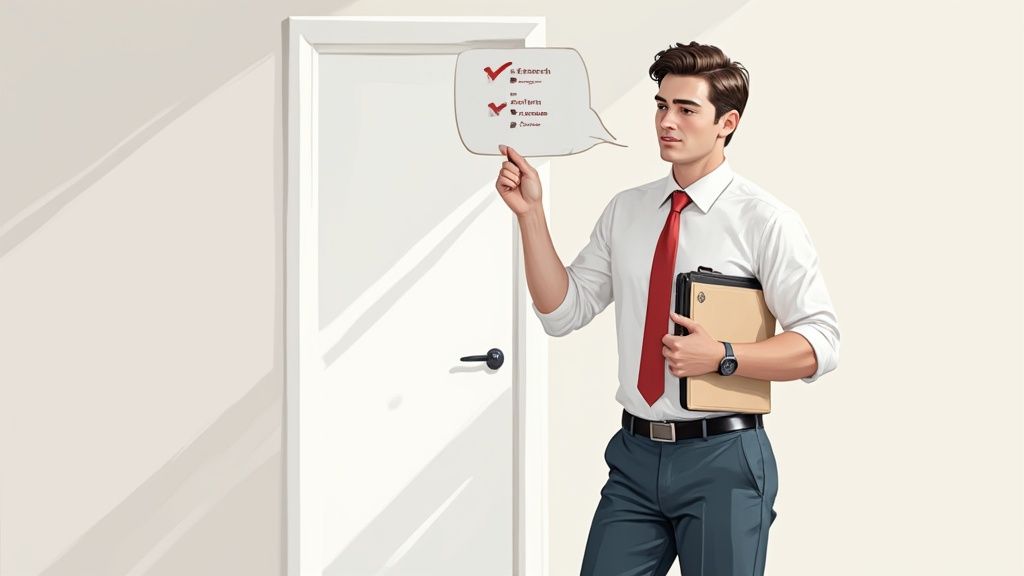
Walking into an interview unprepared is one of the easiest ways to get a rejection. But "preparation" doesn't just mean memorising a few answers. It's about building a solid foundation of confidence by focusing on four key areas: digging deep into the company's world, crafting compelling stories about your achievements, understanding the local etiquette, and coming armed with your own smart questions. Get this right, and you'll transform that pre-interview anxiety into genuine confidence.
Your Essential Interview Preparation Framework
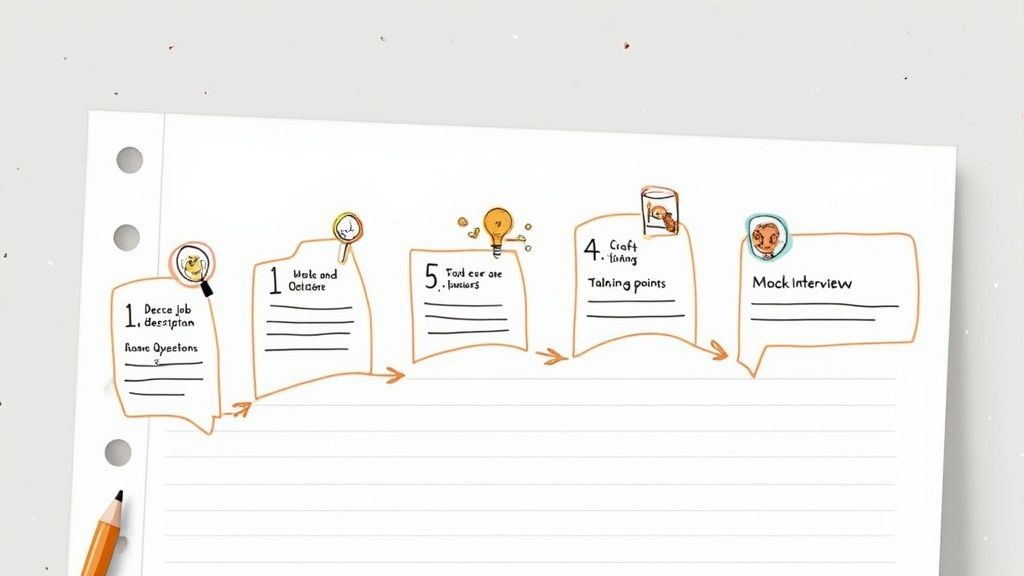
So, where do you actually start? It can feel like a mountain of work, but the secret is a structured approach. Think of it as a roadmap that ensures you cover all the critical bases, so you're not just reciting facts but genuinely connecting your value to what the employer needs. The first step in figuring out "wie bereite ich mich auf vorstellungsgespräch vor" (how I prepare for a job interview) is to work with what you've already got.
Your CV and the job description are your two most important documents right now. Your CV isn't just a piece of paper; it's your personal script filled with talking points. For every single role and project you've listed, you need to be ready to tell a story about what you did, how you did it, and what the result was. This simple habit prevents that awkward pause when an interviewer asks for a specific detail about a project from three years ago.
Transform Your CV into a Story Hub
Stop thinking of your CV as a list of duties. It’s a collection of narratives. This mindset is especially vital in the German job market. While a staggering 95% of recruiters in Germany still expect a classic CV, the traditional cover letter is losing its grip—only about 30% of companies now ask for one. This shift puts a much heavier weight on your CV and how well you can bring it to life during the interview. You can read more about the top recruiting trends in Germany to see how the landscape is changing.
The job description is the other side of the coin. Print it out. Grab a highlighter. Mark every key skill, responsibility, and qualification they’re looking for. The real magic happens when you start drawing lines, literally or mentally, from your CV to these highlighted points. This exercise is your best tool for predicting their questions and pre-building answers that hit the nail on the head.
A well-prepared candidate doesn't just answer questions; they connect their personal career story directly to the company's future needs. Your CV is the script, and the job description provides the context.
Prepare Your Own Insightful Questions
Lastly, and this is crucial, you need to prepare your own questions. This isn't just a polite formality to wrap things up. It's your opportunity to show you’re a serious candidate who has done their homework and is thinking strategically. Good questions signal that you're interviewing them just as much as they're interviewing you.
Here are a few areas to think about for your own questions:
- Team Dynamics: "Could you tell me a bit about the team structure and how collaboration works on a day-to-day basis?"
- Company Culture: "What's an example of how the company's core values play out in practice within the team?"
- Future Growth: "What does the typical growth path look like for someone in this role, and what opportunities are there for professional development?"
This simple shift turns the interview from a one-sided interrogation into a two-way professional conversation. It immediately builds a stronger rapport and lays the groundwork for a successful outcome. For more tools to help manage your entire job search, you can find a wealth of resources at https://jobcopilot.de/.
To help you get started, here's a quick summary of the most important preparation steps, tailored to what recruiters in Germany are often looking for.
Interview Preparation Quick-Start Guide
| Preparation Step | Why It Matters in Germany | Action Item | | :--- | :--- | :--- | | Analyse the Job Ad | German recruiters value precision. They want to see a direct match between their needs and your skills. | Print the job description. Highlight every key skill and responsibility required. | | Map Your CV | Your CV is your evidence. You must be able to back up every claim with a concrete example. | For each highlighted skill, find a specific example from your CV where you demonstrated it. | | Craft STAR Stories | Storytelling makes your achievements memorable and demonstrates your impact clearly. | Write out 3-5 short stories using the STAR method (Situation, Task, Action, Result) for your biggest accomplishments. | | Prepare Your Questions | Asking smart questions shows genuine interest and that you are evaluating the role seriously. | Draft at least 3 thoughtful questions about the team, the culture, or the role's future. |
Following these steps will ensure you're not just prepared, but truly ready to make a lasting impression.
Digging Deep: How to Research the Company and Role Like a Pro
Let’s be honest: a quick glance at the company’s homepage just won’t cut it anymore. If you really want to impress a hiring manager, especially in Germany’s detail-oriented job market, you need to go much deeper.
True preparation means understanding the organisation’s pulse—its challenges, its ambitions, and where it’s headed. This is what separates a good candidate from a great one. You're not just collecting facts; you're building a case for how your skills can solve their real-world problems.
Go Beyond the Obvious "About Us" Page
The company website is your launchpad, not the final destination. Sure, read the "About Us" page, get a feel for their mission, and understand their products or services. But that's just scratching the surface. The real gold is hidden in the story behind the corporate jargon.
Dive into their press releases or the "News" section. What have they been celebrating lately? A new product launch? A strategic partnership or expansion into a new market? These aren't just trivia; they are perfect conversation starters that show you’re genuinely invested in their journey.
To help structure your deep dive, think about your research in distinct categories. It’s easy to get lost in a sea of information, so a focused approach is key.
Here’s a breakdown of what to look for and where to find it:
Research Avenues for Interview Success
| Information Category | Primary Source | What to Look For | | :--- | :--- | :--- | | Company Culture & Values | Company Website (Mission/Values page), Glassdoor, Kununu | Mission statement, employee reviews (both positive and negative), stated company values, articles about their work environment. | | Recent News & Milestones | Company Blog, Press Releases, Google News | Product launches, recent funding rounds, new executive hires, awards, market expansion announcements. | | Your Interviewers | LinkedIn, XING | Their career path, recent posts or shared articles, professional interests, tenure at the company, any shared connections or interests. | | Industry Standing | Industry news sites, competitor websites | Key competitors, the company's unique selling proposition (USP), recent market trends affecting the industry. | | The Role Itself | The original job description, LinkedIn profiles of team members | Key responsibilities (read between the lines), required skills vs. "nice-to-have" skills, the team's structure and background. |
This table isn't just a checklist; it's a road map. Following it ensures you cover all your bases, moving from a broad understanding of the company to a specific appreciation of the role and the people you'll be speaking with.
Use Professional Networks for Insider Insights
Platforms like LinkedIn and its German-language counterpart, XING, are absolute goldmines. They offer a real-time window into a company's culture and the people who drive it. Start by following the company page to see the kind of content they share—it often reveals their current priorities.
Even better, look up the people who will be interviewing you. You don’t need to become a stalker, but a little homework on their professional background can give you a massive edge.
- Check out their role: What’s their title? How long have they been with the company? This gives you clues about their perspective and influence.
- Look for common ground: Did you attend the same university, work for a company you admire, or share an interest in a specific field? A small connection builds instant rapport.
- Analyse their activity: What articles have they recently shared or written? This points directly to their professional passions.
Imagine you see your interviewer recently shared an article on sustainable supply chains, and you have experience in that exact area. Boom. You've just found a powerful, relevant talking point that shows you’re an engaged professional, not just another applicant.
Knowing your interviewer's background isn't about flattery; it's about context. It helps you tailor your answers to resonate with their specific expertise and priorities, making the conversation more relevant and impactful.
Understand the Competitive Landscape
No company exists in a bubble. To show real strategic thinking, you need to understand where the organisation fits within its industry. Who are their main rivals? What makes this company different?
A simple search for "[Company Name] vs [Competitor Name]" can uncover articles and analyses that spell out their strengths and weaknesses. This knowledge is your secret weapon for answering the inevitable question, "Why do you want to work for us?"
Instead of a generic answer, you can deliver something with substance: "I'm really drawn to how your company has focused on superior user experience to differentiate itself from competitors like X and Y. I believe my background in UX design can directly contribute to strengthening that advantage." Now that's an impressive answer.
Turn Your Research into Smart Questions
All this digging should lead to one thing: a list of intelligent, specific questions for your interviewers. This is your chance to flip the script and show off your analytical skills. Vague, generic questions are a total waste of this opportunity.
Based on your findings, you could ask things like:
- "I saw the recent press release about your expansion into the Swiss market. What are some of the key challenges the marketing team is anticipating with this new audience?"
- "On LinkedIn, I noticed the team includes several members with a background in data science. How is data analytics being integrated into the day-to-day decision-making for this role?"
Questions like these prove you’ve connected the dots. You took public information and thought critically about what it means for the team and your potential role. This is exactly the kind of diligence and proactive mindset that hiring managers in Germany value so highly. It screams genuine interest.
Crafting Your Answers to Key Interview Questions
All the research you’ve done is your foundation, but this is where you start building the house. Answering interview questions well isn't about memorising a script. It’s about learning to frame your experience in a way that tells a compelling story, one that speaks directly to what the hiring manager needs to hear. This is the heart of preparing for a successful interview.
Let's be honest, generic answers are forgettable. They blend into the background noise of all the other candidates. But a specific, well-told story about a real challenge you tackled and solved? That’s what sticks. This is your moment to make your CV come alive and show, with concrete examples, the value you bring.
The Power of the STAR Method
If there's one tool you need in your back pocket, it’s the STAR method. It's hands-down the most effective way to structure your answers, especially for those tricky behavioural questions like, "Tell me about a time when..." It's a simple framework that guides you to be clear, concise, and focused on results—all qualities highly valued in the German professional world.
Here’s the breakdown:
- Situation: Briefly set the scene. What was the context? Who was involved?
- Task: What was your specific goal? What were you responsible for?
- Action: Describe the exact steps you personally took to handle the task. Always use "I" statements, not "we."
- Result: What was the outcome? This is where you bring in the numbers. Quantify your success with percentages, figures, or specific improvements whenever you can.
Using this method transforms a vague answer into a powerful narrative. It’s the proof that you don’t just have the skills on paper; you know how to use them to get real, tangible results.
Tackling the "Tell Me About Yourself" Question
This question isn't an invitation to walk them through your entire life story. Think of it as a strategic opportunity to deliver your professional "elevator pitch." A great answer is a tight, 90-second summary that connects your past experience to the future of this specific role.
Try framing it this way:
- Present: Kick off with your current role and a key achievement. "I'm currently a Project Manager at Company ABC, where I recently led a project that boosted our team's process efficiency by 15%."
- Past: Quickly link how your previous experience got you here. "Before this, I was in a more junior role where I really honed the stakeholder management skills that proved crucial for my later success."
- Future: Bring it home by explaining why you’re sitting in that chair today. "I’m now looking to take my expertise in process optimisation and apply it to a larger-scale challenge, which is exactly why this opportunity at your company caught my eye."
This structure is direct, relevant, and shows you've genuinely thought about how you fit into their organisation.
Handling Questions About Weaknesses and Failures
Ah, the dreaded weakness question. Everyone tenses up here, but it’s really just a test of your self-awareness and potential for growth. The trick is to be honest but strategic. Ditch the clichés like "I'm a perfectionist" or "I work too hard." Instead, pick a genuine, minor weakness and, most importantly, show what you’re actively doing to improve it.
A strong answer about a weakness shows humility and a proactive mindset. It tells them you're committed to your own professional development, which is a far more valuable trait than pretending to be perfect.
For instance, you could say: "In the past, I sometimes struggled with delegating smaller tasks because I wanted to ensure everything was done just right. I realised, however, that this could slow the team down. I've since taken a course on effective delegation and now make a conscious effort to assign tasks based on my team's strengths. This has really improved our overall output."
See the difference? The answer is honest, it points to a concrete action you took, and it ends with a positive result. It turns a potential negative into a powerful story of growth. For more in-depth advice on crafting answers and navigating your job search, you'll find helpful articles on the JobCoPilot blog.
Preparing for Questions About Your CV
The interviewers will have your CV right in front of them, so you can bet they’re going to dig into the details. You need to be ready to expand on every single point, from your day-to-day responsibilities in a past role to the specific outcome of a project you listed.
Never assume they’ll automatically understand the context or the impact of your work. Your job is to connect the dots for them.
- If your CV says: "Managed a social media campaign."
- You should be ready to explain: "I was tasked with increasing engagement for our Q3 product launch. To do that, I developed a content strategy built around video testimonials. This resulted in a 40% increase in user interaction and directly contributed to a 10% uplift in sales leads from our social channels."
The difference is massive. One is a task; the other is a story of achievement with a measurable impact. Practise telling these mini-stories for every key point on your CV. This is the kind of detailed preparation that allows you to talk about your career journey with the confidence and precision that will truly set you apart.
Navigating German Interview Etiquette And Culture
It’s easy to focus solely on what you’re going to say in an interview, but in Germany, how you present yourself can be just as important. Understanding the unspoken rules of German business culture is often the deciding factor. Getting this right is a huge part of any solid "wie bereite ich mich auf vorstellungsgespräch vor" (how do I prepare for a job interview) strategy.
From the moment you arrive, you’re being observed. Your punctuality, your handshake, and your outfit are all sending signals about your professionalism and whether you'd be a good fit. Think of it as the non-verbal part of your interview.
Punctuality Is Non-Negotiable
Let's be clear: in Germany, "on time" means "early." This isn't just a stereotype; it's a deeply ingrained cultural value. Punctuality is seen as a direct measure of your reliability, organisational skills, and simple respect for the interviewer's schedule.
Aim to arrive ten to fifteen minutes before your scheduled time. This gives you a moment to catch your breath, use the restroom, and get a feel for the office vibe. Arriving late, even by a couple of minutes, starts you off on the wrong foot and can be very difficult to overcome. In fact, over 90% of German interviewers view tardiness as a major red flag. Always plan your route, check for public transport delays, and make getting there early a top priority.
Dressing for Success The German Way
Your clothes tell a story before you even open your mouth. The goal is to look polished, professional, and serious about the role. It’s always better to be a bit overdressed than too casual.
For traditional corporate jobs in finance or law, you can't go wrong with classic business formal wear—a dark suit and conservative tie for men, or a blouse and blazer for women. But things are changing. Recent research shows that about 55% of employers now lean towards smart-casual, while 26% still stick to formal attire. Only 19% have no specific dress code.
What does this mean for you? Do your homework on the company culture. When in doubt, smart-casual is a safe bet. Think tailored trousers or a skirt, a crisp shirt or blouse, and a blazer. If you want to dive deeper, you can learn more about these German interview expectations and how to prepare.
Projecting Confidence Through Non-Verbal Cues
How you carry yourself says a lot. German business communication is typically direct and formal, so a confident, professional demeanour is essential.
- The Handshake: A firm, brief handshake at the beginning and end of the interview is standard practice. It’s a simple gesture that signals confidence.
- Eye Contact: Don't be shy. Maintain direct, steady eye contact. It shows you're engaged, trustworthy, and sure of what you’re saying.
- Posture: Sit up straight and lean slightly forward. This small adjustment conveys interest and attentiveness. Slouching or fidgeting can be seen as nervousness or, worse, a lack of seriousness.
The trick is to find the right balance. Confidence is prized, but arrogance is a dealbreaker. A staggering 59% of recruiters will pass on a candidate they find arrogant. On the flip side, 39% of candidates leave a poor impression because they lack confidence or don't smile. You want to come across as self-assured yet humble, friendly but always professional.
This infographic breaks down how to structure your answers—another fantastic way to project clarity and preparedness.
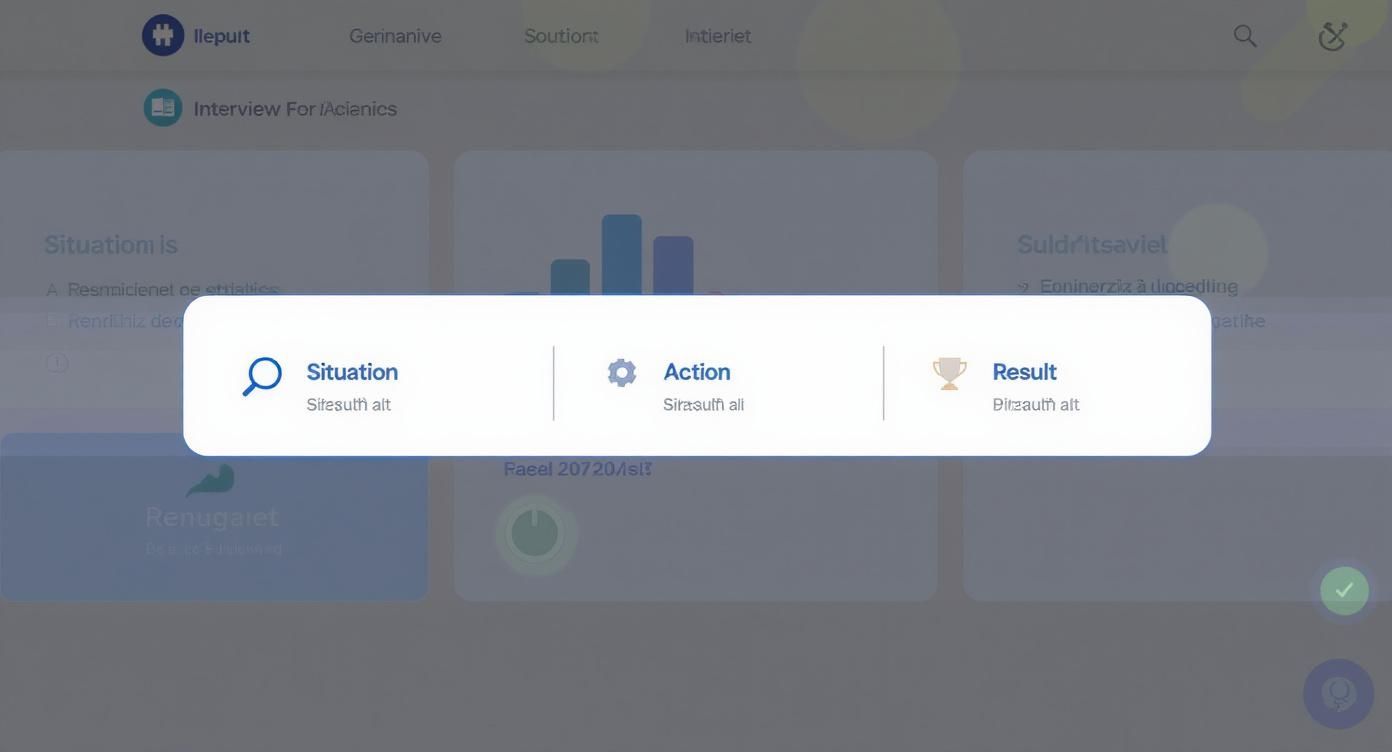
Using a clear framework for your responses helps you communicate your wins effectively, which perfectly complements the professional image you're building with your body language and etiquette.
Navigating Formality and Directness
The German business world still leans towards formality. Always start by addressing your interviewers with the formal "Sie" and their surname (e.g., "Herr Schmidt" or "Frau Meyer"). Let them be the ones to suggest using the informal "du" or first names; don't assume. This might not even happen in a first interview.
This formal approach also applies to the communication style. It’s often very direct and to the point. Don’t be taken aback by straightforward, almost blunt, questions about your skills. This isn’t aggression; it’s a cultural preference for efficiency and clarity. Your best bet is to respond with equal directness, backing up everything you say with concrete examples.
Mastering these cultural points isn't about changing who you are. It's about showing respect for the professional environment you wish to join and demonstrating that you are an adaptable and observant candidate.
What to Do After the Interview: The Professional Follow-Up
The interview doesn't truly end when you walk out the door or click "Leave Meeting." What you do in the hours and days that follow can be just as crucial. A thoughtful, professional follow-up is your final opportunity to leave a lasting positive impression, showing you’re genuinely interested and respect the interviewer's time.
Your first move? The thank-you note. Don't mistake this for an old-fashioned formality; it's a powerful strategic tool. It puts your name back on the hiring manager's radar and gives you one last chance to drive home your enthusiasm for the role.
Timing and Format Are Everything
When you follow up, speed and the medium you choose really matter. The gold standard is to get your thank-you note out within 24 hours of the interview. This sweet spot shows you're prompt and organised, and it lands while the conversation is still fresh in their mind.
Email is the way to go. It’s fast, professional, and gets your message directly to the right person without delay. While a handwritten note might feel like a personal touch, it’s often too slow for a modern hiring process and can easily get lost in a busy office. Stick to email.
Writing a Thank-You Email That Actually Gets Read
Your follow-up email needs to be sharp, professional, and—most importantly—personal. Ditch the generic templates you find online. The goal here is to be memorable, which is a key part of answering the question, "wie bereite ich mich auf vorstellungsgespräch vor," even after the interview itself is done.
Here’s a simple structure I’ve seen work time and time again:
- A Crystal-Clear Subject Line: Make it impossible for them to miss. Something simple like "Thank you - Interview for [Job Title]" works perfectly.
- A Personalised Greeting: Address the interviewer by name, matching the tone of your conversation (e.g., "Dear Herr Schmidt,").
- Lead with Gratitude: Start by genuinely thanking them for their time and for the chance to learn more about the position and the company culture.
- Mention a Specific Detail: This is your secret weapon. Bring up something specific from your conversation that resonated with you. For instance, "I especially enjoyed our discussion about the upcoming XYZ project and was thinking about how my experience with agile methodologies could really help move that forward." This proves you were engaged and not just nodding along.
- Briefly Reiterate Your Interest: Subtly remind them of your excitement for the role and your confidence that you can make a real contribution.
- A Professional Sign-Off: Close with a classic like "Sincerely" or "Best regards," followed by your full name and contact details.
A well-crafted follow-up note is more than just good manners. It’s your final sales pitch, reinforcing why you’re the right fit and how much you want to be part of their team.
Navigating the Waiting Game
Once you've sent your thank-you note, the waiting begins. Honestly, this can be the toughest part of the whole experience, but how you handle it says a lot about your professionalism. You absolutely must resist the temptation to follow up over and over again. It can quickly make you seem pushy or even desperate.
Typically, the interviewer will have given you a rough timeline for their decision. Trust that process. If the date they mentioned comes and goes without a word, it’s perfectly fine to send a single, polite check-in email. A brief note asking for an update on the hiring timeline is completely acceptable.
This final phase is a test of your patience. By executing a thoughtful follow-up and managing the wait with grace, you cement your reputation as a considerate, organised, and top-tier candidate right through to the finish line.
Your Top Interview Prep Questions, Answered
Even with a solid game plan, you're bound to have some nagging questions or worry about tricky situations. I get it. This section is all about tackling those common queries candidates have when they’re figuring out wie bereite ich mich auf vorstellungsgespräch vor. Think of it as a quick-reference guide to help you iron out the final details and walk in with real confidence.
These are often the little things that can make a huge difference, ensuring you're ready for whatever comes your way.
How Should I Get Ready for a Video Interview?
Let's be clear: video interviews aren't just a screening tool anymore. For many companies, they're the new standard. While the core preparation is the same—research, practice, smart questions—the virtual format adds a technical layer you absolutely cannot afford to mess up.
First things first, test your tech. I can't stress this enough. Check your camera, microphone, and internet connection well ahead of time. Don't wait until five minutes before the call starts. A choppy connection or bad audio can instantly throw you off your game and make you look disorganised.
Next up, your environment. It matters more than you think.
- Your Background: Find a spot that’s neutral, tidy, and professional. A clean wall or a neat bookshelf works wonders. A glimpse of your unmade bed or a cluttered kitchen? Not so much.
- Good Lighting: Make sure your face is lit from the front. If you sit with a window behind you, you’ll just be a silhouette. A simple desk lamp can make all the difference.
- Eye Contact: This one feels a bit weird at first, but it's crucial. Look directly into the camera lens when you're talking, not at the interviewer's face on your screen. To them, it will feel like you're making direct eye contact, which makes you seem far more present and engaged.
Bottom line: treat it with the same gravity as an in-person meeting. That includes dressing professionally from head to toe—you never know if you'll need to stand up unexpectedly.
What Salary Should I Ask For?
Ah, the salary question. It can feel like a high-stakes poker game, but it doesn't have to. The secret is to walk into that conversation armed with data, not just a number you're hoping for. Before you even get to the interview stage, you need to research the typical salary range for your role, experience level, and specific location in Germany.
Sites like Glassdoor, Kununu, and Gehalt.de are your best friends here. Digging into the data allows you to provide a thoughtful, realistic salary expectation when the question comes up.
Here's a pro tip: instead of stating a single number, offer a range. For instance: "Based on my research into the market rates for this position and considering my experience in [mention a key skill], I'm looking for a salary in the range of €X to €Y." This approach shows you've done your homework and opens up a conversation rather than sounding like a rigid demand.
Your salary expectation should be a well-researched figure, not a number plucked from thin air. Grounding your request in market data shows professionalism and puts you in a much stronger negotiating position.
How Do I Explain Gaps in My CV?
Listen, employment gaps happen. They're far more common than you might think, and they are definitely not an automatic deal-breaker. The most important thing is to be honest and frame the time off in a positive light. Whatever you do, don't try to hide a gap or get fuzzy on the details—that’s a huge red flag for recruiters.
Instead, prepare a clear, confident explanation. Focus on what you were doing during that time and, if you can, connect it back to your personal or professional growth.
Here are a few ways you could frame different situations:
- Further Education or Training: "I took a six-month break to complete a certification in project management, which I knew would be a vital skill for the next step in my career."
- Travel: "After five years in my last role, I took a planned sabbatical to travel. It was an incredible experience that really improved my adaptability and cross-cultural communication skills."
- Personal Reasons: "I needed to take some time away from work to focus on a family matter. That's fully resolved now, and I'm energised and completely ready to dive back into my career."
The goal is simple: show that the time was used constructively or that the reason for the break is no longer an issue.
What If I Don’t Know the Answer to a Question?
It’s going to happen at some point. An interviewer will throw you a curveball that completely stumps you. How you handle this moment is a test in itself. The absolute worst thing you can do is panic and try to fake an answer. Trust me, they can spot it a mile away.
The best approach? Take a breath and be honest. It is completely fine to say something like, "That's a really interesting question. To be honest, I haven't encountered that exact scenario before, so I don't have a direct answer based on my own experience."
But don't stop there. Follow it up by showing them how you think. For example: "However, if I were faced with that, my approach would be to first research [X], then consult with my colleagues on [Y], and analyse the data to work out a solution. I'm a fast learner and feel confident I could get up to speed on that quickly." This response turns a potential negative into a positive, showcasing your honesty, problem-solving skills, and willingness to learn.
Keep in mind that the German job market is also changing. It's not just about technical skills anymore. Post-pandemic, what people want from a job has shifted; things like aligning with company values and having growth opportunities are just as important as the salary. With video interviews now used by 69% of employers, your ability to connect digitally is non-negotiable. To truly stand out, you need to clearly articulate how your personal values and career goals match the company's mission. You can find more insights about recruitment challenges in Germany to help position yourself as the perfect candidate.