Think of it this way: what do people say about you professionally when you’re not in the room? That, in a nutshell, is your personal brand. It’s the story that your skills, your experience, and your personality tell about you.
What Is Personal Branding Really About
Let's get one thing straight. Personal branding isn't about crafting some fake persona or trying to become an influencer overnight. It’s much more practical than that.
Imagine you are the CEO of your own career, a company of one called "You, Inc." Your personal brand is simply your company's reputation. It’s the deliberate process of shaping how others see your professional value.
The truth is, you already have a personal brand, whether you’ve put any thought into it or not. It’s there in your digital footprint, in the way your colleagues remember working with you, and in what a recruiter sees when they type your name into a search bar.
The real goal of personal branding is to take the wheel. Instead of letting your reputation form by accident, you become the one actively shaping it. You want to build a public presence that genuinely reflects who you are, what you stand for, and where you want your career to go. It's about making sure your online story matches your real-life ambitions.
A strong personal brand is your silent advocate. It works for you 24/7, building trust and opening doors to opportunities you might not even know exist. It answers the question, "Why should someone choose you over anyone else?"
Ultimately, figuring out was ist personal branding for yourself is the first step toward taking control of your professional path. It’s what helps you cut through the noise in a crowded job market by showcasing what makes you uniquely valuable. This foundation is crucial for anyone looking to move up, find a better-fitting job, or build a strong network. It’s about becoming known for something specific and being great at it.
Why Your Personal Brand Matters in Today's Job Market
In a crowded job market, your CV is really just the ticket to get in the door. Recruiters and hiring managers don't stop there anymore; they want to see the whole picture, the story behind the bullet points. This is where getting a handle on was ist personal branding stops being a trendy phrase and starts being a serious career tool.
Think of your personal brand as your professional reputation working for you 24/7. It builds trust and shows off your value long before you ever sit down for an interview. It’s the online footprint that backs up your skills, gives a glimpse of your personality, and shapes the story you want to tell about your career. For an employer, it’s a way to feel more confident about their hiring choice by getting a much clearer sense of who you really are.
Your Digital Presence Is Your New First Impression
Forget the firm handshake—your first impression is now made online, often before you even know you've made one. A solid, consistent brand gives a recruiter a compelling reason to pick your CV out of the pile, especially when stacked against someone with a nearly identical skillset.
This is particularly true in the German market, where credibility and trust are everything. Studies have revealed that a staggering 69% of German employers turn to search engines to learn more about candidates. Digging deeper, one report found that while 44% of employers hired someone because of what they found online, an even greater 54% rejected a candidate because of a weak or negative digital footprint.
That’s a powerful statistic, isn't it? Your online presence is either opening doors for you or quietly closing them.
The infographic below breaks down how your skills, values, and unique personality come together to create that powerful first impression.
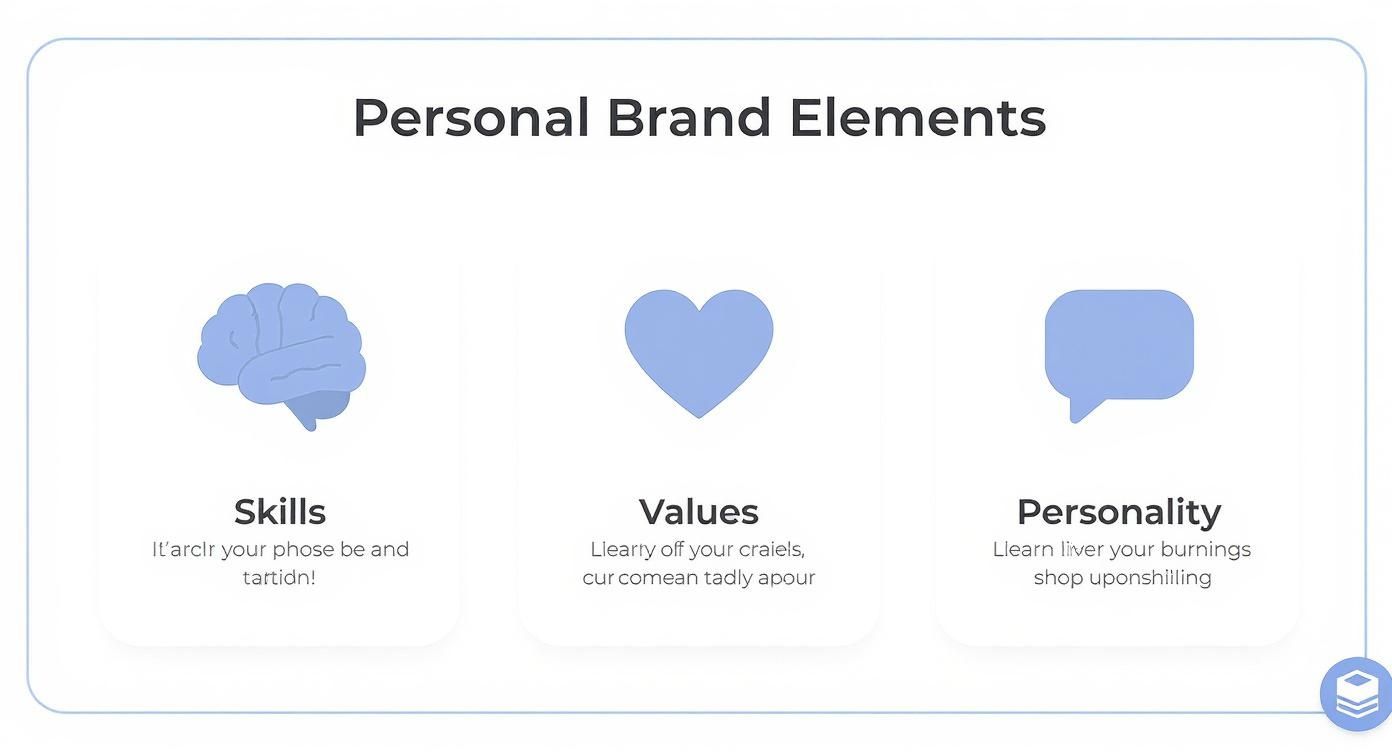
As you can see, a brand is so much more than a simple list of jobs and achievements. It's the complete package of your professional identity. When you communicate these elements clearly and consistently, you create a memorable and authentic impression that truly makes you stand out.
Ignoring this is essentially leaving your career up to chance, and that's a risk few of us can afford to take. You can learn more about optimising your entire job search with powerful tools at https://jobcopilot.de/.
The Three Pillars of a Powerful Personal Brand
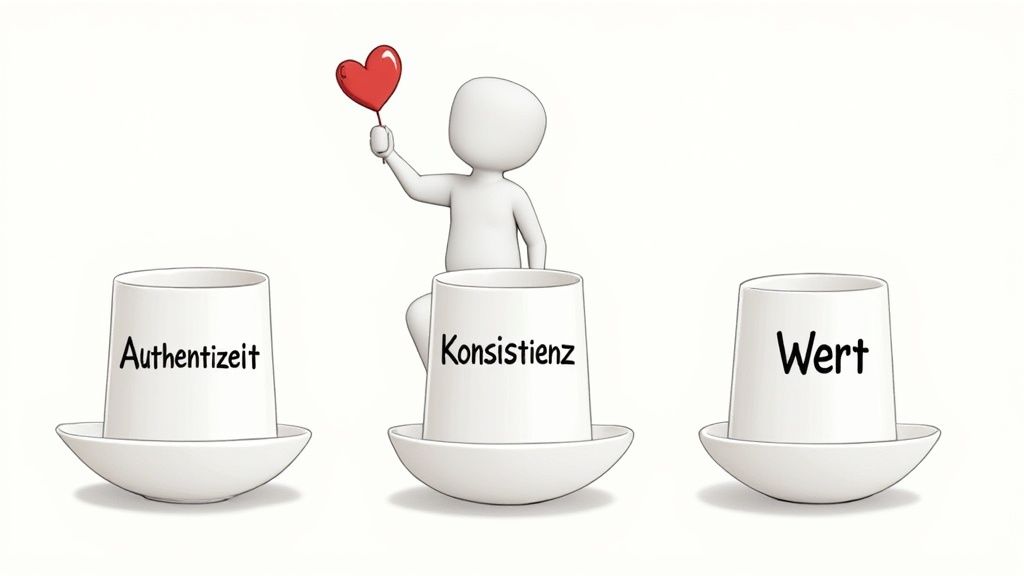 A strong personal brand is much more than just a slick headshot and a polished bio. To build something that truly lasts, you need a solid foundation. Think of it like building a structure – without the right supports, the whole thing can feel wobbly and unconvincing.
These three core pillars work together to create a reputation that doesn’t just get you noticed, but earns you genuine respect and trust within your professional circle.
Pillar 1 Authenticity
First up, and arguably the most important, is authenticity. This is the bedrock of your entire brand. It’s not about projecting some perfect, airbrushed version of yourself. It’s about making sure your public persona is a true reflection of your genuine values, skills, and personality. At the end of the day, people connect with real people, not carefully managed masks.
To get to that authentic core, you need to do a bit of self-reflection. What really matters to you in your professional life? What unique perspective do you bring to the table? When you know the answers, your brand message will feel natural because it’s just… you.
Pillar 2 Consistency
Next, we have consistency. If authenticity is the "what" of your brand, consistency is the "how" you deliver it. This means presenting a cohesive version of yourself everywhere, whether it’s on your LinkedIn profile, in your email signature, or even in how you introduce yourself at a conference.
This isn’t about being boring or repetitive. It's about being reliable. Your visual elements (like photos and colours), your tone of voice, and the key ideas you talk about should all tell the same story. That kind of repetition builds familiarity, which is the first step toward building trust and being seen as a credible expert.
Pillar 3 Value
The final pillar that holds everything together is value. A brand that doesn’t offer anything useful is just noise. Your personal brand has to give something tangible to your audience, whether that’s expert knowledge, a rare skill, or practical advice that helps them out.
Your personal brand gains strength not by what you say about yourself, but by the value you consistently provide to others. The goal is to become a resource, not just a resume.
Always be asking yourself, "How can I help my audience solve a problem or reach a goal?" When you shift your focus to generously sharing your expertise, you stop being a self-promoter and start becoming a go-to authority. That’s the real power behind understanding was ist personal branding.
Crafting Your Brand Narrative on Social Media
Think of social media as the stage where your professional story comes to life. It’s the place where your personal brand stops being an abstract idea and becomes something real—a living narrative that recruiters, colleagues, and potential clients can engage with. The trick is to stop being a passive spectator and start actively shaping a presence that works for you.
This means looking at platforms like LinkedIn as far more than just a digital CV. It's your dynamic, ever-evolving portfolio. Your aim should be to create and share content that truly showcases your expertise and unique perspective, not just regurgitate your past job titles.
Choosing Your Stage and Your Story
Every social media platform has its own audience and purpose, so you can't treat them all the same. Your first big decision is figuring out where to invest your time and energy.
- LinkedIn: This is the non-negotiable hub for professional networking, especially in B2B industries. It's built for demonstrating thought leadership through longer articles and detailing your career wins.
- X (formerly Twitter): Want to join real-time conversations and share quick, punchy insights? This is your platform. It’s particularly effective for anyone in tech, media, or other fast-moving sectors.
- Industry-Specific Forums: Don’t forget about the power of niche communities. A developer's profile on GitHub or a designer's portfolio on Behance can speak volumes to the right people.
After picking your platforms, your content strategy is your script. The goal isn't just to shout about your accomplishments; it's to provide genuine value. Share an interesting article and add your two cents, offer a solution to a common industry problem, or give a shout-out to a team member for a recent success.
This strategy is particularly effective in the German market. Younger professionals are increasingly using online platforms to build their identities. In fact, one report found that 51% of Germans aged 16-34 use social media as a primary source for brand research, which shows just how crucial it is for shaping professional impressions. You can dig deeper into how personalisation connects with audiences by reading the full report on mintel.com.
Think of your social media content as a conversation, not a monologue. You're there to engage, help, and build genuine relationships. Consistency is what turns a passive follower into a true advocate for your brand.
By carefully and thoughtfully crafting your story online, you build a compelling, authentic picture of who you are and what you bring to the table. That’s what makes you a memorable candidate in a sea of applicants. For more inspiration on creating content that connects, take a look at the resources on our Jobco-pilot blog.
Building Trust and Credibility Authentically
Getting noticed is one thing, but getting chosen is another entirely. A strong personal brand isn't just about visibility; it’s built on a bedrock of trust that runs much deeper than your follower count. The real goal is to create a reputation that isn't just seen, but is actively respected and sought out.
This all starts with a simple shift in focus: stop talking about yourself and let your actions and your network do the talking for you. Instead of just listing your skills on a profile, show them in action. Share valuable insights, help others solve a problem, or offer a unique perspective. When you genuinely engage with your professional community, you build rapport and position yourself as a reliable, helpful expert.
The Power of Peer Validation
Let's be honest, real credibility is rarely self-proclaimed. It's earned when other people vouch for you. Think about it—you’re far more likely to trust a recommendation from a friend than a slick advertisement. The exact same principle applies to your professional reputation. Testimonials, endorsements from colleagues on LinkedIn, and good old-fashioned word-of-mouth are the gold standard of social proof.
This isn’t just a gut feeling; the numbers back it up. A special report from the Edelman Trust Barometer found that a staggering 84% of people trust recommendations from friends and family, and 80% trust reviews from customers like themselves. In stark contrast, only 58% trust what a CEO or influencer says. This tells us that validation from our peers is infinitely more powerful than any top-down message. You can learn more about these findings from Edelman's report and see just how much trust shapes perception.
Your brand's credibility is a direct reflection of the trust you've built within your network. Focus on nurturing relationships and providing consistent value, and the social proof will naturally follow.
By focusing on authentic communication and letting others highlight your value, you build a personal brand that isn't just visible, but is genuinely trustworthy.
Common Personal Branding Mistakes to Avoid
 Building a strong personal brand is often more about dodging the common landmines than it is about executing a perfect strategy. So many people start with the best intentions, only to see their efforts stall because of a few crucial—and entirely avoidable—errors.
Let's look at the most common tripwires.
Inconsistency Across Platforms
This is a big one. It's when your LinkedIn profile paints you as a serious data analyst, your X feed is full of casual memes, and your portfolio website has a completely different tone. When your story changes from place to place, it creates a jumbled picture that erodes trust. You want people to have a clear, cohesive idea of who you are and what you stand for, no matter where they find you.
Turning Your Brand into a Non-Stop Sales Pitch
Another classic mistake is treating your personal brand like a constant commercial for yourself. If all you do is shout about your achievements without ever offering real value, your audience will tune you out—fast. Think about it: people connect with those who teach, help, or inspire them. They don't stick around for someone who only ever talks about themselves. The key is to give, not just take.
The goal is not to be a walking advertisement for yourself. It’s to be a trusted resource in your field. This shift in mindset changes everything about your approach.
Being Too Generic or "Safe"
Finally, there's the trap of trying to appeal to everyone. This usually means watering down your personality with safe, corporate jargon until there's nothing unique left. The irony is that by trying to offend no one, you end up connecting with no one. Your quirks, your specific point of view, and your authentic voice are your biggest strengths. Don't hide them. They’re what make you memorable and attract the right people and opportunities.
Got Questions About Personal Branding? Let's Clear Things Up.
So, you're thinking about personal branding, but a few questions are probably rattling around in your head. Is this going to eat up all my free time? Does a person in my role really need one? Let’s get straight to the point and answer some of the most common worries people have.
How Much Time Does This Really Take?
Building a brand is a marathon, not a sprint, and it certainly doesn’t need to take over your life. Forget intensity; focus on consistency.
You can start with just 15-20 minutes a day. Use that time to share a genuinely interesting article on LinkedIn, jump into a relevant conversation, or just jot down a few ideas for a future post. These small, daily actions add up, creating real momentum without leading to burnout.
Is a Personal Brand Actually Necessary for Every Profession?
Absolutely. A software developer's brand will obviously look and feel different from a sales executive's, but the underlying goal is the same for everyone. A personal brand is your tool for getting recognised for what you do best, growing your professional circle, and opening doors to better opportunities.
It's really about taking control of your own professional story, no matter what your job title is. And in a world where 50% of employers are checking out candidates on social media, having a deliberate online presence is a smart move for anyone.
Think of your personal brand not as a second job, but as an integrated part of your career management. It’s the background work that makes your primary work more visible and valued.
How Can I Tell If It’s Actually Working?
Success here isn't about vanity metrics like follower counts. You need to look for the signs that really matter.
Here’s what to watch for:
- You start getting connection requests from people you actually want to know in your industry.
- Your posts and articles are sparking more conversations (likes, comments, and shares).
- People begin reaching out to you for your opinion or to collaborate on projects.
- Recruiters are finding you with opportunities that genuinely match what you're looking for.
When you see these things happening, you know your brand is successfully building trust and credibility.
Ready to make your job search smarter, not harder? Acquispect uses AI to automate your applications, create personalised cover letters, and track your success, giving you back valuable time. Find your next job faster with Acquispect.