The era of simply knowing the event loop is over. Today’s Node.js interviews, especially for roles building sophisticated, high-stakes platforms, demand a deeper, more practical understanding of distributed systems, robust security, and real-world performance. Generic theoretical questions are being replaced by scenario-based challenges that test your ability to architect and maintain complex applications. This shift requires a new level of preparation that moves beyond memorising definitions.
This guide provides a comprehensive roundup of the critical topic areas you will face, delivering the actionable insights needed to prove your expertise. We are moving past the basics to give you a definitive list of node js developer interview questions that reflect the modern challenges of backend development. For each of the ten core topics, you will find detailed questions tailored for junior, mid-level, and senior roles, complete with model answers and practical coding examples.
We will cover essential concepts including:
- System Architecture: Designing and communicating between microservices.
- Asynchronous Operations: Mastering
async/awaitand advanced Promise handling. - API and Database Design: Building secure RESTful APIs and optimising database interactions.
- Security and Reliability: Implementing authentication, authorisation, and comprehensive error handling.
- Performance and Scalability: Optimising application performance for high-traffic environments.
Prepare to transition from just answering questions to demonstrating your capability to build scalable, secure, and resilient applications in a professional context. This structured approach will equip you with the knowledge to confidently tackle any interview scenario.
1. Event-Driven Architecture, Webhooks, and External Integrations
Node.js is built on an asynchronous, event-driven architecture, making it exceptionally well-suited for building scalable, real-time applications. This paradigm is crucial for modern systems that rely heavily on integrating with external services. Instead of blocking operations while waiting for a response, Node.js uses an event loop to handle concurrent tasks efficiently.
This approach is fundamental for any serious Node.js developer interview. You will be expected to understand how to create and manage custom events using the EventEmitter class, handle asynchronous data flows, and build systems that can react to external triggers like webhooks from services like GitHub or Stripe.
Why This is a Core Skill
A candidate's ability to design and implement robust event-driven systems is a direct indicator of their capacity to build high-performance, resilient applications. This skill is not just about writing non-blocking code; it’s about architecting solutions that can handle unpredictable loads, recover from external service failures, and scale horizontally. For example, processing a webhook requires validating its signature, handling the payload, and potentially calling another API, all without disrupting the main application flow.
Actionable Tips and Best Practices
To demonstrate expertise in your Node.js developer interview, be prepared to discuss these practical implementation details:
- Prevent Memory Leaks: Always clean up listeners to avoid memory leaks, especially in long-running processes. Use
emitter.removeListener()for persistent listeners oremitter.once()for events that should only be handled a single time. - Validate Webhooks Securely: Never trust an incoming webhook payload without verification. Use
crypto.timingSafeEqual()to compare the signature sent in the header (e.g.,X-Hub-Signature-256) with a signature you generate using a shared secret. This prevents timing attacks. - Implement Resilient API Calls: External services can fail. Implement a robust retry mechanism like exponential backoff with jitter (
delay = base * (2 ** attempt) + randomJitter) to handle temporary outages gracefully without overwhelming the service. - Use Idempotency Keys: For critical, non-repeatable actions like minting a credential or processing a payment, use an idempotency key. This ensures that if the same request is sent multiple times due to network issues, the operation is only performed once.
2. Microservices Architecture and Service Communication in Node.js
Microservices architecture is a design pattern that structures an application as a collection of loosely coupled, independently deployable services. In Node.js, this means building small, focused applications that communicate over well-defined APIs, often using HTTP/REST or asynchronous messaging queues. This approach is fundamental for creating scalable, maintainable, and resilient cloud-native platforms.
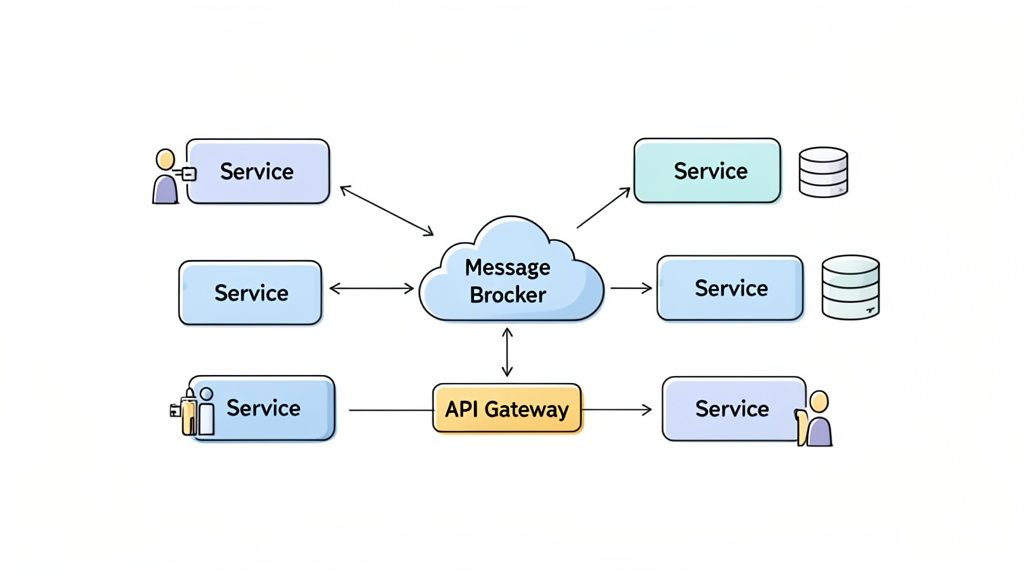
Understanding this paradigm is a non-negotiable part of modern Node.js developer interview questions. You must be able to explain how to design services that can be developed, deployed, and scaled independently. For instance, an Identity Service could be a separate microservice that listens for a ProofValidated event from a message broker and mints a verifiable credential, completely decoupled from the service that initiated the proof.
Why This is a Core Skill
A developer's grasp of microservices directly reflects their ability to build complex, enterprise-grade systems. It’s not just about splitting a monolith; it’s about understanding the trade-offs in distributed computing, including network latency, data consistency, and service discovery. A candidate who can articulate strategies for inter-service communication and fault tolerance demonstrates the architectural maturity needed for senior roles.
Actionable Tips and Best Practices
To excel in your interview, be prepared to discuss the practicalities of building and managing a distributed Node.js system:
- Implement Health Checks: Every service must expose a health check endpoint (e.g.,
/healthz). Orchestration tools like Kubernetes use these to determine if a service instance is healthy and ready to receive traffic, enabling automated self-healing. - Use Correlation IDs: When a request enters your system, generate a unique correlation ID and pass it in the headers of all subsequent inter-service calls. This allows you to trace a single user action across multiple services, which is invaluable for debugging in a distributed environment.
- Define Clear API Contracts: Use tools like OpenAPI (formerly Swagger) to define and document the API for each service. This creates a clear contract that prevents integration issues and allows teams to work on different services in parallel.
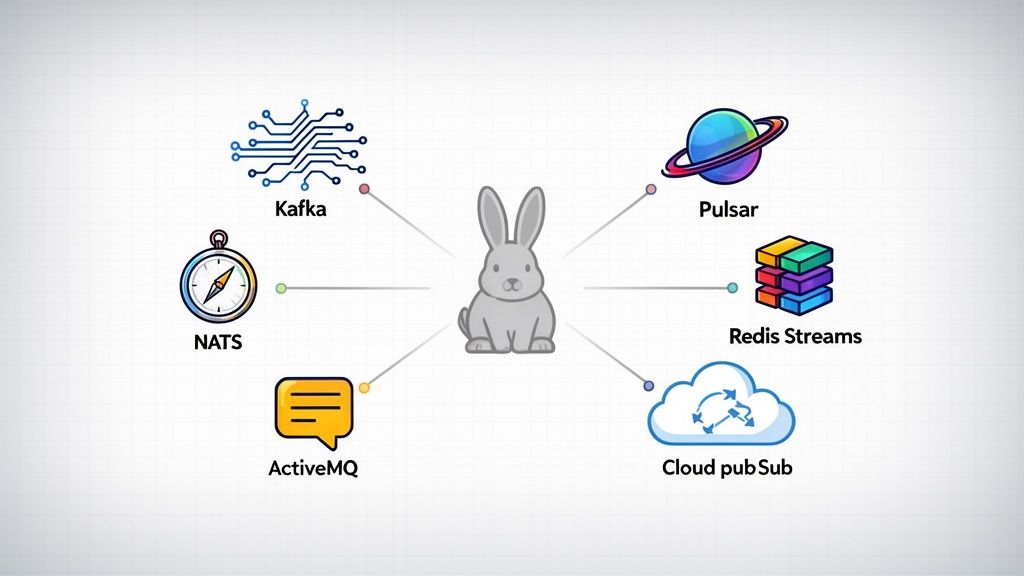
- Choose the Right Communication Pattern: Use synchronous communication (like REST) for immediate, critical requests. For non-critical, background tasks or to decouple services, use asynchronous messaging patterns with a message broker like RabbitMQ or Kafka.
3. Async/Await and Promise Handling
Async/await is syntactic sugar built on top of Promises, allowing developers to write asynchronous, non-blocking code that reads with the clarity of synchronous code. This is fundamental in Node.js, where managing I/O operations like database queries or API calls without halting the event loop is critical for performance. A deep understanding of Promise handling, including error management and concurrency patterns, is a non-negotiable skill for any Node.js role.
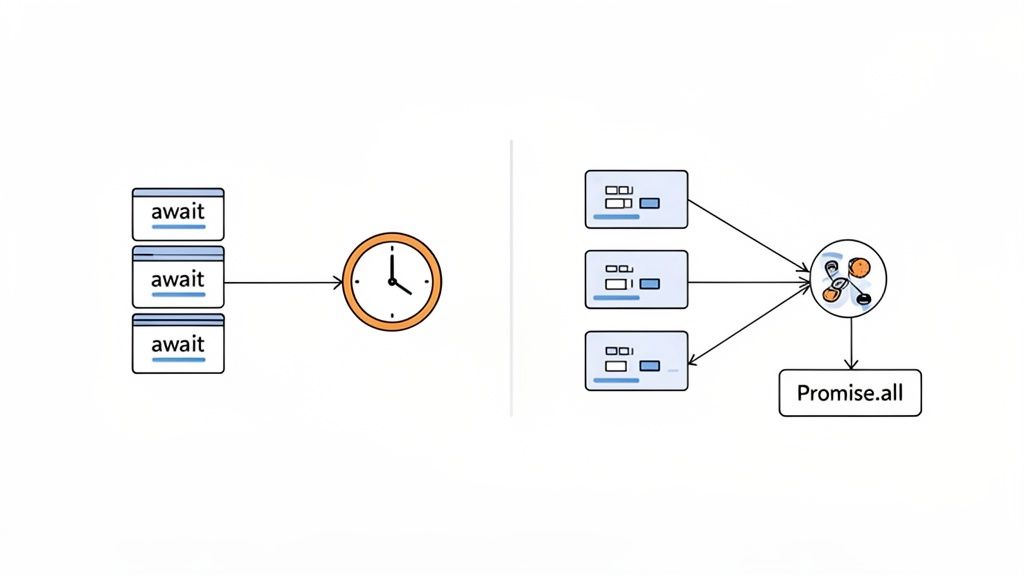
Interview questions in this area will probe your ability to handle complex asynchronous flows efficiently. For instance, you might be asked to design a system that fetches data from multiple external APIs in parallel, such as a Semantic Kernel agent awaiting embedding generation from Azure OpenAI while simultaneously retrieving user data from another service.
Why This is a Core Skill
A candidate’s proficiency with async/await and Promises directly reflects their ability to build performant and reliable applications. Poorly managed asynchronous code leads to common but severe issues like unhandled promise rejections, resource leaks, and inefficient sequencing of operations. Knowing when to run tasks in parallel versus sequentially is key. For example, using sequential await calls to analyse multiple independent GitHub repositories is far less efficient than executing them concurrently with Promise.all().
Actionable Tips and Best Practices
To excel in a Node.js developer interview, demonstrate your grasp of these advanced asynchronous patterns and error-handling techniques:
- Embrace
try...catchBlocks: Always wrapawaitexpressions withintry...catchblocks to gracefully handle rejected Promises. Unhandled promise rejections can crash a Node.js application, making this a critical practice for production-ready code. - Maximise Concurrency with
Promise.all(): When operations are independent, avoid sequentialawaitcalls inside loops. Instead, collect all the promises into an array and pass them toPromise.all()to execute them in parallel, drastically reducing total execution time. - Use
Promise.allSettled()for Resilience: If you need to wait for all asynchronous tasks to complete, regardless of whether some fail, usePromise.allSettled(). This is ideal for scenarios where a partial failure should not stop the entire workflow. - Implement Timeouts with
Promise.race(): External services can hang indefinitely. Prevent your application from stalling by wrapping API calls in aPromise.race()with a timeout promise. This ensures your system remains responsive even when dependencies are slow.
4. RESTful API Design and HTTP Best Practices
RESTful API design is foundational for building scalable and maintainable web services in Node.js. It leverages the standard HTTP protocol to create stateless, client-server communications. This architectural style uses predictable resource URLs and standard HTTP methods like GET, POST, PUT, and DELETE to perform actions, making APIs logical and easy to consume.
In any Node.js developer interview, a deep understanding of REST principles is non-negotiable. Candidates will be expected to design endpoints like GET /api/v1/users/{userId} or POST /api/v1/credentials, handle request bodies and query parameters correctly, and use appropriate HTTP status codes to communicate outcomes clearly.
Why This is a Core Skill
A developer's grasp of RESTful API design is a strong indicator of their ability to build interoperable and robust systems. Proper API design streamlines development for both front-end and back-end teams, simplifies third-party integrations, and ensures the service is scalable. It is about more than just creating endpoints; it involves architecting a clear, consistent, and predictable interface that can evolve without breaking existing client applications.
Actionable Tips and Best Practices
To demonstrate expertise in your Node.js developer interview, be prepared to discuss these practical implementation details:
- Use Precise HTTP Status Codes: Don't just default to 200 or 500. Use
201 Createdfor successful resource creation,400 Bad Requestfor client-side validation errors,401 Unauthorizedfor authentication issues, and404 Not Foundfor missing resources. - Implement API Versioning: Plan for future changes by versioning your API from the start. A common and explicit strategy is to include the version in the URL, such as
/api/v1/. This allows you to introduce breaking changes in a new version without disrupting existing users. - Provide Meaningful Error Responses: When an error occurs, the API should return a JSON object with a helpful message. A response like
{ "status": "error", "message": "Invalid email address provided" }is far more useful than a generic "Bad Request" string. - Secure Endpoints with Rate Limiting: Protect your API from abuse and denial-of-service attacks by implementing rate limiting. This involves restricting the number of requests a client can make within a specific time frame, ensuring fair usage and service stability.
5. Database Design and Query Optimization in Node.js
Node.js applications are often data-intensive, making robust database design and query optimization critical for performance and scalability. A developer's expertise is not just about connecting to a database but architecting schemas, writing efficient queries, and managing connections effectively. This involves choosing the right database for the job, such as PostgreSQL for structured data like user credentials or MongoDB for flexible audit logs.
These skills are a cornerstone of many Node.js developer interview questions because poor database interaction can bottleneck an entire application, no matter how well the server-side logic is written. Interviewers will probe your understanding of both relational and non-relational database principles, indexing strategies, and connection management within the Node.js environment.
Why This is a Core Skill
The ability to design and optimise database interactions directly impacts application latency, cost, and user experience. A candidate who understands these concepts can build systems that retrieve data swiftly and handle high transaction volumes without overwhelming the database. For example, they can design a schema for verifiable credentials with a DID as a primary key for fast lookups or use TTL indexes in MongoDB to automatically clean up expired proof audit logs, ensuring the system remains performant over time.
Actionable Tips and Best Practices
To confidently answer questions on this topic in your Node.js developer interview, be ready to discuss concrete strategies and their impact:
- Prevent SQL Injection: Always use parameterised queries or an ORM like Prisma that handles this for you. Never concatenate user input directly into a SQL string.
- Implement Connection Pooling: Manage database connections efficiently using a pool to avoid the overhead of establishing a new connection for every query. For example, with
pg:const pool = new Pool({ max: 20 }). - Use Indexes Strategically: Create indexes on columns frequently used in
WHEREclauses,JOINconditions, andORDER BYstatements. For instance, an index on(userId, proofType, validatedDate)can drastically speed up proof history queries. - Analyse Query Performance: Utilise tools like
EXPLAINorEXPLAIN ANALYZEin PostgreSQL to understand how the database executes your queries. This helps identify missing indexes or inefficient joins. - Leverage Caching: Use an in-memory store like Redis to cache frequently accessed data, such as freelancer profiles or skill vectors. This reduces database load and improves response times for common requests.
6. Authentication and Authorization Patterns
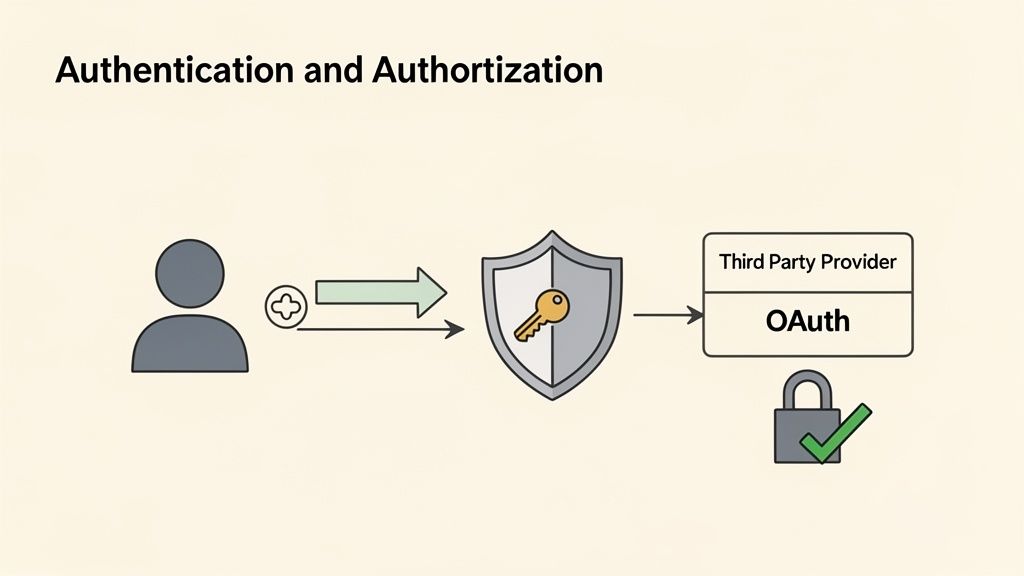
Implementing secure authentication (verifying who a user is) and authorisation (determining what they can access) is fundamental to application security. In Node.js, this involves managing various patterns, from traditional JWTs for stateless APIs to more complex flows like OAuth2 for third-party logins and decentralised identifiers (DIDs) in Web3 contexts.
A Node.js developer must understand how to securely manage user identity across different services and protocols. An interview question in this area will test your knowledge of security best practices, token management, and implementing role-based access control (RBAC) to protect sensitive data and functionality.
Why This is a Core Skill
A candidate's grasp of authentication and authorisation directly impacts an application's security posture. A single vulnerability, such as improper JWT validation or exposing sensitive tokens, can lead to catastrophic data breaches. For example, building a secure OAuth2 flow for GitHub login or verifying a decentralised credential requires a deep understanding of cryptographic principles, secure token storage, and state management to prevent session hijacking or replay attacks.
Actionable Tips and Best Practices
To demonstrate expertise during your Node.js developer interview, be prepared to discuss specific implementation details and security trade-offs:
- Secure JWT Storage: Store JWTs in
httpOnlycookies to prevent access from client-side scripts, mitigating Cross-Site Scripting (XSS) attacks. Avoid storing them inlocalStorage, which is vulnerable. - Implement Token Rotation: Use short-lived access tokens (e.g., 15 minutes) paired with long-lived, securely stored refresh tokens. Implement refresh token rotation, where a new refresh token is issued on each use, to enhance security.
- Enforce Strict Validation: Always validate the token's signature using the correct public key or secret. Additionally, check the issuer (
iss) and audience (aud) claims to ensure the token was intended for your specific service. - Plan for Revocation: For immediate user logouts or in case of a compromised token, implement a JWT blacklist or denylist using a fast-access database like Redis. This allows you to invalidate a token before it expires.
- Rate Limit Endpoints: Protect authentication endpoints (e.g.,
/login,/refresh-token) with strict rate limiting to defend against brute-force and credential-stuffing attacks.
7. Error Handling, Logging, and Monitoring
Production-grade Node.js applications require comprehensive observability through robust error handling, structured logging, and proactive monitoring. It's not enough for code to work; it must be resilient and debuggable in a live environment. This involves gracefully catching exceptions, recording meaningful logs, and using tools to track system health and performance over time.
This area is a key focus in any serious Node.js developer interview because it separates developers who can build features from those who can build and maintain reliable, production-ready systems. Candidates are expected to discuss strategies for centralised error tracking, Application Performance Monitoring (APM), and distributed tracing, especially within a microservices architecture.
Why This is a Core Skill
A candidate's knowledge of observability is a direct measure of their seniority and experience with real-world applications. A system without proper logging and monitoring is a black box; when issues arise, debugging becomes a nightmare of guesswork. An engineer who can design and implement a solid observability strategy is invaluable, as they can diagnose production issues quickly, maintain system health, and ensure high availability. For example, tracing a single user request across multiple services is crucial for pinpointing latency bottlenecks.
Actionable Tips and Best Practices
To demonstrate expertise in your Node.js developer interview, be prepared to discuss these practical implementation details:
- Implement Structured Logging: Use libraries like Pino or Winston to produce structured, machine-readable logs (e.g., JSON). Always include a
correlationIdto trace a request across different services and log entries. For example:logger.info({correlationId, userId, action: 'MintCredential'}). - Use a Global Error Handler: Catch uncaught exceptions and unhandled promise rejections at the application level to prevent crashes. Use
process.on('uncaughtException', ...)andprocess.on('unhandledRejection', ...)as a last line of defence, but always try to handle errors locally first. - Instrument with OpenTelemetry: Adopt OpenTelemetry for vendor-agnostic distributed tracing. This allows you to visualise the entire lifecycle of a request as it travels through your microservices, making it easy to identify performance issues or failure points in the call chain.
- Never Log Sensitive Data: Be vigilant about scrubbing sensitive information like passwords, API keys, and Personally Identifiable Information (PII) from logs before they are written. This is a critical security and compliance requirement.
- Establish Proactive Alerting: Configure monitoring tools (like Prometheus or Datadog) to alert your team when key metrics breach critical thresholds, such as an error rate exceeding 2% or a p95 response time rising above 500ms.
8. Testing Strategies: Unit, Integration, and End-to-End Tests
A comprehensive testing strategy is non-negotiable for building reliable, production-ready Node.js applications. It involves a multi-layered approach that validates code at different levels of abstraction, from isolated functions to complete user workflows. This includes unit tests for individual components, integration tests for service interactions, and end-to-end (E2E) tests for entire application flows.
This topic is a cornerstone of any mid-to-senior Node.js developer interview. You'll need to demonstrate not just how to write a test, but how to architect a testing suite. This involves understanding mocking, managing test data, and integrating tests into a continuous integration pipeline to prevent regressions and ensure code quality.
Why This is a Core Skill
A candidate's understanding of testing directly reflects their professionalism and commitment to building robust software. It shows they can think beyond the "happy path" and consider edge cases, error conditions, and external dependencies. An engineer who can articulate a clear testing strategy is more likely to produce maintainable, resilient code that reduces long-term operational costs and builds trust in the system.
Actionable Tips and Best Practices
To excel in your Node.js developer interview, be prepared to discuss these practical testing details:
- Isolate and Mock Dependencies: In unit tests, use frameworks like Jest to mock external modules (
jest.mock('axios')). This ensures you are testing the logic of your component in isolation, making tests faster and more reliable by avoiding real network or database calls. - Use Test Data Factories: Avoid hardcoding test data. Implement a factory pattern to generate consistent and customisable test objects, for example,
const user = createTestUser({ role: 'admin' }). This makes tests more readable and easier to maintain. - Leverage Database Transactions: For integration tests that require a database, wrap each test case in a transaction and roll it back afterwards. This guarantees a clean state for every test, preventing side effects and ensuring test independence.
- Write Descriptive Test Names: Name your tests to describe their behaviour clearly, such as
it('should return a 401 Unauthorized error if the JWT is expired'). This makes test output act as living documentation for your application's behaviour. - Test Error Scenarios: A robust test suite covers more than just successful outcomes. Explicitly test for failures like invalid user input, network timeouts, and API rate limits to ensure your error-handling logic works as expected.
9. Security Best Practices and Common Vulnerabilities
Node.js applications, like any web service, are constant targets for malicious actors. Understanding how to secure an application is not an optional skill; it is a fundamental requirement. This involves a deep knowledge of common threats like injection attacks, authentication bypass, and cryptographic failures, often summarised by the OWASP Top 10 vulnerabilities.
For any Node.js developer interview, expect to be questioned on your approach to defensive coding. A senior developer must be able to articulate how to protect sensitive data, validate inputs, manage dependencies securely, and implement robust authentication and authorisation mechanisms. In contexts involving verifiable credentials and DIDs, security is non-negotiable, as it underpins the entire system's integrity.
Why This is a Core Skill
A candidate's grasp of security best practices directly reflects their ability to build trustworthy and reliable software. A single vulnerability can lead to catastrophic data breaches, financial loss, and reputational damage. An engineer who proactively implements security measures demonstrates a mature understanding of the development lifecycle and their responsibility to protect users and the business. This skill separates developers who merely write functional code from those who engineer professional, production-ready systems.
Actionable Tips and Best Practices
To prove your security expertise in a Node.js developer interview, be ready to discuss and implement these critical practices:
- Prevent Injection with Parameterised Queries: Never concatenate user input directly into database queries. Use a library's parameterised query feature to ensure data is treated as values, not executable code (e.g.,
db.query('SELECT * FROM users WHERE id = $1', [userId])). - Securely Hash Passwords: Never store passwords in plain text or using outdated hashing algorithms like MD5. Use a strong, adaptive hashing function like bcrypt or argon2 with a sufficient work factor (salt rounds).
- Sanitise All User Input: To prevent Cross-Site Scripting (XSS), always validate and sanitise user-provided data on both the client and server sides before rendering it. Use libraries like
DOMPurifyto neutralise malicious scripts. - Use Security-Focused Middleware: Leverage middleware like Helmet for Express.js applications. A single line (
app.use(helmet())) sets numerous crucial HTTP headers, such as Content-Security-Policy and X-XSS-Protection, mitigating many common attacks. - Manage Dependencies Diligently: Regularly run
npm auditor use tools like Snyk to identify and patch vulnerabilities in your project's dependencies. Outdated packages are a primary vector for attacks. - Protect Secrets with Environment Variables: Never hard-code API keys, database credentials, or other secrets in your source code. Store them in environment variables and use a
.envfile locally, ensuring it is listed in your.gitignore.
10. Performance Optimization and Scalability
While Node.js is renowned for its I/O performance, its single-threaded event loop can become a bottleneck if not managed correctly. Building applications that remain performant and scalable under heavy load requires a deep understanding of memory management, caching strategies, and leveraging multi-core systems. For any application where user experience is paramount, performance is not an afterthought but a core architectural concern.
These concepts are central to senior Node.js developer interview questions, where candidates are expected to diagnose performance issues and design scalable systems. You must be able to explain how to profile an application, offload CPU-intensive tasks from the event loop, and implement effective caching to reduce latency and database load.
Why This is a Core Skill
A candidate's ability to optimise and scale a Node.js application is a powerful indicator of their seniority. It demonstrates an understanding that goes beyond just writing functional code to building robust, production-ready systems that are cost-effective to run. For instance, knowing when to use worker threads for a CPU-bound task versus when to scale horizontally with the cluster module can dramatically impact both application responsiveness and infrastructure costs.
Actionable Tips and Best Practices
To prove your expertise in performance and scalability during a Node.js developer interview, be prepared to discuss these concrete strategies:
- Profile Before Optimising: Don't guess where bottlenecks are. Use Node.js's built-in profiler (
node --prof app.js) or tools like Clinic.js to get actionable data on CPU usage, memory leaks, and event loop delays. - Offload CPU-Intensive Work: Protect the event loop at all costs. For heavy computations like image processing or complex data analysis, use
worker_threadsto run the task in a separate thread without blocking the main application. - Implement Smart Caching: Use an in-memory datastore like Redis for frequently accessed, non-critical data. Set a sensible Time-To-Live (TTL) based on data volatility (e.g.,
redis.set('user:123', data, 'EX', 3600)for a one-hour cache). - Utilise All CPU Cores: For stateless applications, use the built-in
clustermodule to fork your application process across multiple CPU cores. This allows a single server to handle significantly more concurrent traffic by distributing the load. - Compress Responses: Reduce payload size and improve client-side load times by enabling gzip or Brotli compression. Middleware like
app.use(compression())makes this a straightforward and impactful optimisation.
Node.js Developer Interview Topics — 10-Point Comparison
| Pattern | Implementation complexity 🔄 | Resource requirements ⚡ | Expected outcomes ⭐ | Ideal use cases 💡 | Key advantages 📊 | |---|---:|---:|---|---|---| | Event-Driven Architecture, Webhooks, and External Integrations | Medium–High — asynchronous flows, event topology to manage | Moderate — HTTP clients, webhooks, brokers optional, retry/rate-limit logic | High real-time scalability and non-blocking workflows ⭐⭐⭐ | Real-time notifications, webhook-driven proof processing, external API calls | Scalable, responsive integrations; decouples producers/consumers | | Microservices Architecture and Service Communication in Node.js | High — service decomposition, orchestration, distributed concerns | High — containers, orchestration (K8s), message brokers, service discovery | Independent scaling and resilience ⭐⭐⭐ | Large distributed platforms (Proof Engine, Identity, Marketplace) | Fault isolation, team autonomy, flexible deployments | | Async/Await and Promise Handling | Low–Medium — language-level async patterns; avoid anti-patterns | Low — runtime support; developer tooling and best practices | Cleaner async control flow, better error handling ⭐⭐ | Parallel I/O tasks, orchestration of API calls, Promise.all workflows | Readability, easier debugging, controlled concurrency | | RESTful API Design and HTTP Best Practices | Medium — design discipline for resources, versioning, status codes | Moderate — API gateways, auth, rate limiting, docs (OpenAPI) | Clear interoperable contracts and predictable APIs ⭐⭐ | Service-to-service communication, external integrations, wallets | Universal tooling, caching opportunities, easy testing | | Database Design and Query Optimization in Node.js | Medium–High — schema modelling, indexing, query tuning | High — DB instances, vector stores, caching (Redis), migrations | Efficient storage and fast queries for large datasets ⭐⭐⭐ | Storing credentials, audit logs, semantic vector search | Performance via indexes, caching, transactional integrity | | Authentication and Authorization Patterns | High — secure token flows, DID management, key handling | High — KMS, auth servers, refresh/blacklist stores, MFA | Strong access control and identity guarantees ⭐⭐⭐ | User login (OAuth/GitHub), DID-based VCs, service auth | Stateless JWT, delegated access, decentralized identity support | | Error Handling, Logging, and Monitoring | Medium — global handlers, tracing, log standards | Moderate — ELK/APM/OpenTelemetry, alerting, storage | Production visibility and faster root-cause analysis ⭐⭐⭐ | Debugging multi-service failures, SLA monitoring, alerts | Traceability across services, real-time alerts, historic analysis | | Testing Strategies: Unit, Integration, and End-to-End Tests | Medium — layered tests plus mocking and fixtures | Moderate — CI, test DBs, E2E infrastructure, contract tooling | Higher reliability and reduced regressions ⭐⭐⭐ | Proof validation, credential issuance flows, contract compatibility | Confidence for refactoring, living documentation, prevented regressions | | Security Best Practices and Common Vulnerabilities | High — secure coding, dependency hygiene, crypto care | Moderate–High — scanners, secret management, TLS, audits | Reduced breach risk and preserved trust ⭐⭐⭐ | Handling VCs, private keys, authentication endpoints | Prevents data loss/forgery, regulatory/PII protection | | Performance Optimization and Scalability | Medium–High — profiling, event-loop tuning, worker model | High — caching layers, load testing, horizontal autoscaling | Consistent low-latency under load; cost-efficient scaling ⭐⭐⭐ | High-concurrency proof analysis, semantic search, VC minting spikes | Improved UX, resource efficiency, predictable scaling |
From Theory to Practice: Proving Your Node.js Expertise
Navigating the landscape of Node.js developer interview questions has evolved far beyond simple algorithmic challenges. As we've explored, the modern interview process seeks to uncover a deeper, more practical understanding of the entire application lifecycle. It's a comprehensive assessment of your ability to build, secure, and scale robust backend systems. Success no longer hinges on reciting the definition of the event loop; it depends on your ability to articulate its impact on architecture, performance, and error handling in a real-world scenario.
This comprehensive guide has covered the ten critical pillars of Node.js mastery, from the foundational principles of asynchronous programming with Promises and async/await to the complex architectural decisions involved in designing microservices and optimising database interactions. Each category of questions, from junior to senior and system design, is designed to probe a different facet of your expertise. Remember, the goal isn't just to provide the correct answer, but the most thoughtful one.
Key Takeaways for Your Interview Preparation
To synthesise this knowledge into a powerful preparation strategy, focus on these core principles:
- Context is King: Always consider the trade-offs. Why choose a microservices architecture over a monolith? What are the implications of using JWTs versus session-based authentication for a specific application? Demonstrating that you understand the "why" behind your technical choices is a hallmark of a senior developer.
- Security is Not an Afterthought: From sanitising inputs to prevent NoSQL injection to implementing robust authentication and authorisation, a security-first mindset is non-negotiable. Weave security considerations into your answers for API design, database queries, and system architecture.
- Performance is a Feature: Your ability to diagnose bottlenecks, optimise database queries, and leverage Node.js's non-blocking I/O model effectively is a major differentiator. Be prepared to discuss specific techniques like caching strategies, connection pooling, and using tools like
clinic.jsto profile application performance. - Show, Don't Just Tell: The most convincing interviews involve concrete examples. When discussing error handling, describe a specific strategy you implemented. When talking about testing, mention the libraries you used (like Jest or Mocha) and why you chose them. Reference past projects to substantiate your claims.
Actionable Next Steps to Solidify Your Knowledge
Theoretical knowledge is the foundation, but practical application is what secures the role. Use the questions in this article as a roadmap for hands-on learning.
- Build a Mini-Project for Each Pillar: Create small, focused applications. Build a RESTful API with proper authentication. Design a simple microservice that communicates via a message queue like RabbitMQ. Write a suite of unit and integration tests for an existing application.
- Conduct Mock Interviews: Partner with a peer and grill each other on these Node.js developer interview questions. Practice articulating your thought process out loud, especially for system design scenarios. This helps refine your communication skills under pressure.
- Contribute to an Open-Source Project: Find a Node.js project on GitHub and contribute. This provides real-world experience with large codebases, collaborative workflows, and code review processes, all of which are invaluable talking points in an interview.
Ultimately, mastering these topics transforms you from a candidate who can write JavaScript into a genuine backend engineer who can deliver value. It demonstrates that you are not just a coder but an architect, a problem-solver, and a reliable custodian of a company's technology stack. This deep, practical expertise is precisely what top-tier organisations, DAOs, and elite freelance platforms are searching for. Your preparation today is the key to unlocking your next significant career opportunity.
Tired of interviews that only test theory? At Acquispect, we believe your code and contributions speak louder than words. Our platform connects elite Node.js developers with innovative projects by verifying your real-world skills through practical, paid tasks. Join Acquispect today to prove your expertise and find opportunities where your work is the interview.