Writing a cover letter, or 'Anschreiben', for the German job market feels like cracking a code. It demands a unique blend of formality, precision, and personal motivation that can seem daunting, especially when standard templates fall short. Generic examples often fail to capture the specific nuances that German recruiters value, leaving your application overlooked.
This guide moves beyond basic advice. We will provide seven distinct and detailed sample cover letter in German examples, each meticulously broken down with strategic analysis and actionable takeaways. Our goal is to give you a replicable framework for your unique situation, helping you craft a compelling narrative that resonates with German hiring standards.
Whether you're a recent graduate, a seasoned professional making a switch, or a career changer, you will find a tailored model. We will explore the unwritten rules, from DIN 5008 formatting to expressing your motivation in a culturally appropriate manner. By understanding the strategy behind each sample, you can build a powerful application that stands out for all the right reasons and helps you secure that all-important interview. Let's dive into the examples that will get you noticed.
1. Classic German Cover Letter (Bewerbungsschreiben) - Professional Format
The classic German cover letter, or Bewerbungsschreiben, is the cornerstone of any professional application in Germany, Austria, and Switzerland. It is a highly structured, formal document that adheres to strict conventions, most notably the DIN 5008 standards for business correspondence. This format emphasises professionalism, precision, and a clear, logical presentation of your qualifications and motivation, making it the default expectation in conservative industries.
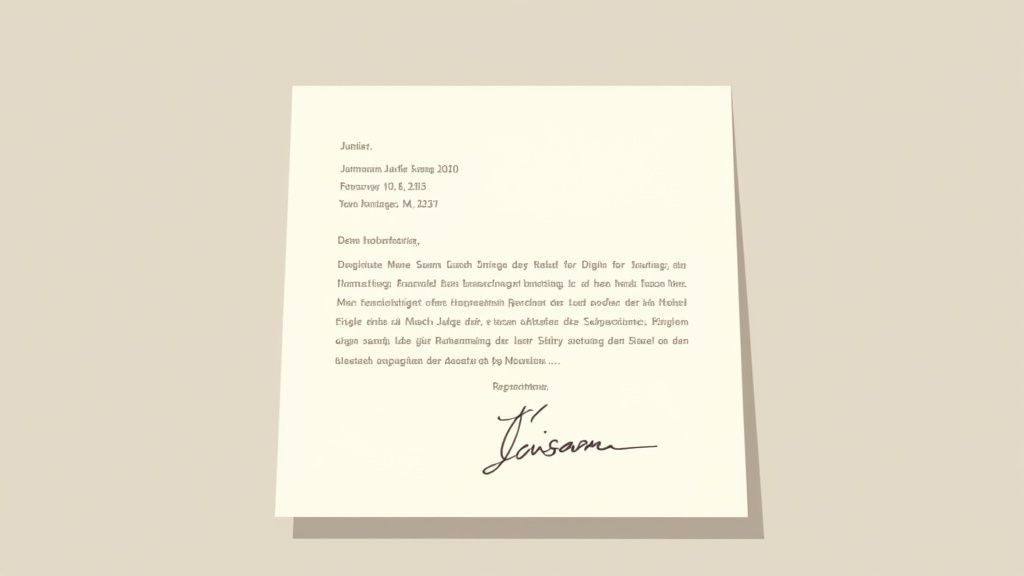
This format's power lies in its universally recognised structure, which allows hiring managers to quickly find key information. From the sender and recipient addresses at the top left to the date on the right, the formal salutation (Sehr geehrte/r...), and the structured body, every element has a purpose. This formal approach is especially crucial when applying for roles in sectors like finance (e.g., at Deutsche Bank), law, or government positions (Öffentlicher Dienst), where adherence to protocol is highly valued.
Strategic Breakdown
The classic Bewerbungsschreiben serves as your professional introduction, demonstrating not just your skills but also your understanding of German business etiquette. It signals that you are a serious, detail-oriented candidate who respects corporate norms.
- Structure and Compliance: Following the DIN 5008 format shows you've done your homework. It includes precise layouts for addresses, date, subject line, and signature block.
- Formal Tone: The language must be professional and direct. Avoid casual phrasing or overly creative language, which can be perceived as unprofessional.
- Conciseness: The entire letter must fit onto a single A4 page. This forces you to be selective and impactful with your wording, focusing only on the most relevant skills and experiences for the specific role.
Actionable Takeaways
To create an effective sample cover letter in German using this format, follow these essential tips:
- Personalise the Salutation: Always research the specific contact person. A generic "Sehr geehrte Damen und Herren" is a last resort. Addressing the hiring manager by name shows initiative.
- Reference the Job Posting: Your subject line must clearly state the position you are applying for and include any reference numbers mentioned in the advertisement.
- Proofread Meticulously: Grammatical errors and typos are significant red flags in German applications. Read your letter aloud and use proofreading tools to ensure perfection.
- Maintain Professionalism: Use a professional email address (e.g., firstname.lastname@provider.com) in your contact details. For deeper insights into crafting the perfect structure, explore various resources to master the Classic German Cover Letter (Bewerbungsschreiben) - Professional Format.
2. German Cover Letter for Entry-Level/Graduate Position (Bewerbung für Berufseinsteiger)
The cover letter for an entry-level or graduate position, known as a Bewerbung für Berufseinsteiger, is specifically tailored for applicants with limited professional experience. This format strategically shifts the focus from a long work history to academic achievements, internships, transferable skills, and genuine motivation. It is essential for recent graduates from institutions like the University of Munich applying to graduate programmes at Siemens or for entry-level roles at major corporations like SAP or Deutsche Telekom.
This format’s strength lies in its ability to build a compelling narrative around potential rather than past performance. While it maintains the formal DIN 5008 structure, the content is geared towards demonstrating that your academic background and practical experiences during your studies have prepared you for the role's challenges. This approach is heavily promoted by career centres at German universities and is the expected standard for management trainee programmes at leading consulting firms and DAX corporations.
Strategic Breakdown
This type of cover letter serves as a bridge between your academic life and the professional world. It is your opportunity to prove that you are a proactive, knowledgeable, and highly motivated candidate ready to contribute from day one, despite a lack of extensive on-the-job experience.
- Focus on Potential: The core strategy is to connect academic knowledge with the company's needs. You must show how your coursework, thesis, and internships have equipped you with relevant skills.
- Demonstrate Initiative: Highlighting extracurricular activities, volunteer work, or relevant personal projects shows ambition and a well-rounded personality, qualities highly valued in junior candidates.
- Show Company Alignment: Proving you have researched the company and understand its values, products, and challenges is crucial. This shows you are not just looking for any job, but a career with this specific employer.
Actionable Takeaways
To craft a powerful sample cover letter in German as a recent graduate, implement these key tactics:
- Quantify Internship Achievements: Don't just list your duties. Describe what you accomplished with measurable outcomes, such as "assisted in a project that increased social media engagement by 15%."
- Connect Your Thesis to the Role: If your final thesis or a major academic project is relevant to the position, dedicate a short paragraph to explaining its findings and how that specialised knowledge can benefit the company.
- Highlight Transferable and Technical Skills: Explicitly mention software proficiency (e.g., SAP, Salesforce, Python), language skills, and soft skills like analytical thinking or project management learned during your studies.
- Express Clear Motivation: State precisely why you are interested in this specific role and company. Generic phrases are a major pitfall; instead, mention a specific company project, value, or technology that excites you.
3. German Cover Letter for Experienced Professional (Bewerbung mit Berufserfahrung)
The cover letter for an experienced professional, or Bewerbung mit Berufserfahrung, transitions from showcasing potential to proving impact. Unlike an entry-level application, this document is less about academic qualifications and more about tangible career achievements, leadership, and specialised expertise. It is crafted to immediately signal value and strategic fit to a hiring manager, positioning the candidate as a seasoned expert who can deliver results from day one.
This format's strength lies in its confident, evidence-based narrative. It forgoes generic statements in favour of concrete metrics and accomplishments that directly align with the target company's challenges. For instance, a senior engineer applying to Bosch from a competitor would highlight specific projects that reduced production costs or improved efficiency, demonstrating direct industry knowledge. This approach is standard practice for roles filled via executive search firms and is expected when applying for senior positions in major German industries, from automotive to finance.
Strategic Breakdown
For a seasoned professional, the cover letter is a strategic tool to frame their career narrative and demonstrate a deep understanding of the industry and the specific role. It’s an opportunity to connect past successes directly to the future needs of the employer, showing you are not just qualified, but the ideal solution.
- Achievement-Oriented Focus: The letter must lead with quantifiable results. Instead of listing duties, it quantifies accomplishments (e.g., "managed a team of 12," "increased sales by 25%").
- Demonstrate Industry Acumen: This letter must show you understand the German market, the company's competitive landscape, and its specific challenges mentioned in the job posting.
- Strategic Positioning: It addresses potential questions head-on, such as employment gaps or lateral moves, and frames them as deliberate, strategic career decisions.
Actionable Takeaways
To write a compelling sample cover letter in German as an experienced professional, focus on impact and alignment:
- Lead with a Powerful Opening: Start by immediately stating your most impressive and relevant achievement that mirrors the requirements of the new role. This grabs attention and establishes your credibility.
- Use Specific Metrics: Quantify your successes whenever possible. Numbers provide concrete evidence of your capabilities and make your contributions tangible to a recruiter.
- Connect Past to Future: Explicitly link your past achievements to the challenges and goals outlined in the job description. Show the hiring manager exactly how you will solve their problems.
- Show Continuous Growth: Briefly mention relevant advanced training, certifications, or professional development to demonstrate that you are a proactive and evolving expert in your field.
4. German Cover Letter for Technical/IT Positions (Bewerbung für technische Berufe)
When applying for roles in engineering, IT, or software development in Germany, a specialised cover letter is essential. This format, the Bewerbung für technische Berufe, maintains German formality while strategically foregrounding technical competencies, project experience, and specific tool proficiencies. It is designed to speak directly to hiring managers and team leads who prioritise tangible skills and quantifiable achievements.
This approach is powerful because it bridges the gap between traditional German business correspondence and the data-driven nature of the tech industry. It allows candidates to demonstrate their expertise in a structured way that is easily digestible for technical recruiters. This format is the standard expectation for applications to tech giants like SAP, engineering firms such as Infineon Technologies, or the tech divisions of DAX corporations like Deutsche Bank and Zalando.
Strategic Breakdown
The technical cover letter serves as a high-level summary of your technical value proposition, providing context that a CV alone cannot. It highlights not just what you can do, but how you have applied your skills to solve real-world problems. This narrative helps you stand out in a competitive field by connecting your technical abilities to the company's specific needs.
- Skill Prioritisation: This format moves beyond a simple list of qualifications. It integrates key technologies (e.g., Python, AWS, C++) and project methodologies (e.g., Scrum, Agile) directly into the narrative of your professional experience.
- Evidence-Based Claims: Instead of just stating you are a skilled developer, you mention a project where you "reduced database query time by 20% using optimised SQL procedures." This provides concrete evidence of your impact.
- Motivation and Fit: It clearly articulates why you are interested in this specific technical challenge at this specific company, demonstrating genuine interest beyond a generic job search.
Actionable Takeaways
To craft a compelling sample cover letter in German for a technical role, focus on precision and proof:
- Mirror the Job Description: Scrutinise the job posting for required technologies and skills. Mention the most critical ones in your opening paragraph to immediately signal your suitability.
- Quantify Your Achievements: Use metrics and data to showcase the impact of your work. For example, state the scale of a project, the percentage of performance improvement, or the number of users your application served.
- Link to Your Portfolio: Include a hyperlink to your GitHub, GitLab, or personal portfolio directly in your contact information or closing paragraph. This provides tangible proof of your coding skills.
- Reference Certifications Smartly: Mention relevant, high-value certifications (e.g., AWS Certified Solutions Architect, Certified Kubernetes Administrator) to validate your expertise in key areas.
5. German Cover Letter for Career Change/Career Pivot (Bewerbung bei Karrierewechsel)
A cover letter for a career change, known as a Bewerbung bei Karrierewechsel, is a specialised document designed to persuade a German employer of your potential despite a non-traditional career path. This format moves beyond simply listing past duties; it constructs a compelling narrative that connects your previous experience to the requirements of the new role. It is your primary tool for addressing a hiring manager's potential scepticism about your motivation and suitability for a completely different field.
This format’s strength is its strategic focus on transferable skills and motivation. Instead of relying on direct industry experience, it highlights adaptability, problem-solving capabilities, and a genuine passion for the new sector. This is crucial for candidates like a sales manager pivoting to project management in tech or an insurance professional moving to a fintech start-up, where demonstrating a clear understanding of the new industry and its challenges is paramount.
Strategic Breakdown
The career change cover letter must proactively bridge the gap between your past and your desired future, turning what might be seen as a weakness into a unique strength. It demonstrates self-awareness, strategic thinking, and a proactive approach to professional development.
- Motivation as the Core: Clearly and honestly articulate why you are making the change. This narrative should be positive and forward-looking, focusing on the pull of the new industry rather than any push from your old one.
- Mapping Transferable Skills: You must explicitly connect your existing skills (e.g., leadership, analytical thinking, client management) to the specific requirements listed in the job description. Don't leave it to the recruiter to make the connection.
- Proactive Credibility Building: Mentioning recent certifications (from platforms like Coursera), relevant projects, or deep research into the target company demonstrates commitment and mitigates concerns about your learning curve.
Actionable Takeaways
To craft a powerful sample cover letter in German for a career pivot, implement these targeted strategies:
- Lead with a Strong Opening: Start by directly acknowledging your career change and express your strong, well-researched motivation for this specific role and company.
- Use a Two-Part Structure: Dedicate the first part of the body to highlighting 2-3 key transferable skills with concrete examples. In the second part, show your understanding of the new industry and how your unique background offers a fresh perspective.
- Address Objections Head-On: Acknowledge the potential learning curve with confidence. Frame it as an opportunity to apply a diverse skill set, stating something like, "While my background is in [old field], my proven ability in [transferable skill] will allow me to quickly master [new task]."
- Quantify Achievements: Use numbers and metrics from your past roles to make your transferable skills tangible and impactful, even if the context is different. For more in-depth guidance, find tailored strategies for your German Cover Letter for a Career Change/Career Pivot (Bewerbung bei Karrierewechsel) on jobcopilot.de.
6. German Cover Letter for International/Expat Position (Bewerbung für internationale Positionen)
The cover letter for an international or expatriate position is a specialised version of the classic Bewerbungsschreiben. It is designed for foreign candidates applying to German companies or for German nationals applying for international roles within Germany-based organisations. This format balances the strict formalities of German business correspondence with the unique need to address language skills, cultural adaptability, and visa status.
The power of this format lies in its ability to proactively address potential concerns a hiring manager might have about an international candidate. By clearly stating language proficiency (e.g., German C1 level), mentioning work permit status, and framing international experience as a strategic advantage, the applicant demonstrates foresight and professionalism. This approach is essential when applying to global companies like Siemens, SAP, or Mercedes-Benz, where international talent is common but adherence to German standards remains paramount.
Strategic Breakdown
This type of cover letter serves as a bridge, connecting your international profile to the specific expectations of a German employer. It showcases not only your professional qualifications but also your readiness to integrate into the German workplace culture.
- Proactive Communication: Directly addresses key topics like language skills, visa status, and cultural awareness, preventing them from becoming unspoken barriers.
- Cultural Competence: Demonstrates an understanding of German business etiquette and norms, signalling a smooth transition into the company.
- Value Proposition: Frames your diverse background and international experience as a unique asset that brings a global perspective to the role.
Actionable Takeaways
To craft a compelling sample cover letter in German for an international position, incorporate these essential tips:
- Lead with Language Proficiency: State your German language level (e.g., according to the CEFR scale) in the introductory paragraph to immediately establish your communication capabilities.
- Frame Experience as an Asset: Instead of just listing international roles, explain how your cross-cultural experience has developed key skills like adaptability, problem-solving, and global market understanding.
- Address Logistics Transparently: If you are a non-EU citizen, briefly and positively mention your visa status or eligibility for a work permit. For example, "I am eligible for the EU Blue Card."
- Show Cultural Homework: Mentioning efforts to integrate, such as attending German language courses or familiarity with German industry standards, shows genuine commitment. For more strategies on adapting your application, you can find valuable insights on crafting a German Cover Letter for International/Expat Position (Bewerbung für internationale Positionen).
7. German Cover Letter for Industry-Specific Positions (Bewerbung für spezifische Branchen)
Adapting your application to a specific industry is a powerful strategy in Germany, where sectors like automotive, finance, and pharmaceuticals have distinct cultures, vocabularies, and values. An industry-specific cover letter, or branchenspezifische Bewerbung, demonstrates that you are not just a qualified candidate, but an insider who understands the unique challenges and standards of the field. This approach moves beyond generic skills to highlight specialised knowledge and domain expertise.
This tailored approach is crucial when targeting roles in highly regulated or specialised fields. For instance, an automotive engineer applying to Daimler might emphasise their expertise in quality management (Qualitätssicherung) and DIN standards, while a financial analyst targeting Deutsche Bank would highlight their proficiency in BaFin compliance. By using industry-specific terminology and referencing relevant regulations or standards, you signal immediate value and a deep understanding of the employer's world.
Strategic Breakdown
A sector-focused cover letter proves you have invested time in understanding the industry's ecosystem. It positions you as a low-risk, high-reward hire who can integrate quickly and contribute meaningfully from day one.
- Demonstrate Domain Expertise: Using industry-specific keywords and acronyms (e.g., EMA for pharmaceuticals, VDA for automotive) correctly shows you speak the language of the business.
- Align with Industry Values: Different sectors prioritise different values. Engineering values precision and efficiency, healthcare values empathy and patient safety, and the creative industry values innovation and brand storytelling.
- Address Specific Challenges: A strong letter acknowledges current industry trends or challenges and positions your skills as part of the solution, showing proactive and strategic thinking.
Actionable Takeaways
To create a compelling industry-specific sample cover letter in German, consider these tactics:
- Integrate Industry Keywords: Research the target company and its industry through publications like Handelsblatt or trade association websites (e.g., VDMA for machinery). Weave relevant terminology naturally into your letter.
- Highlight Relevant Certifications: Explicitly mention certifications, standards, or regulatory knowledge that are critical in the sector, such as ISO 9001 in manufacturing or GMP in pharmaceuticals.
- Tailor Your Motivation: Connect your personal career goals to the future direction of the industry. Explain why you are passionate about contributing to that specific field, whether it's automotive electrification or digital finance.
- Reference Industry Leaders: Mentioning your admiration for a company's specific project or contribution to the industry can show genuine interest and a well-researched application.
7-Point Comparison of German Cover Letter Types
| Cover Letter Type | 🔄 Implementation Complexity | ⚡ Resource Requirements | 📊 Expected Outcomes | 💡 Ideal Use Cases | ⭐ Key Advantages | |---|---:|---:|---|---|---| | Classic German Cover Letter (Professional Format) | 🔄 Medium — strict DIN rules, formal structure | ⚡ Low — template, proofreading, sender/recipient details | 📊 High credibility with traditional employers; strong formal acceptance | 💡 Finance, law, public sector, conservative corporate roles | ⭐ Universally recognized; reduces formatting errors; shows cultural respect | | Entry-Level / Graduate | 🔄 Low — template with emphasis on academics | ⚡ Low — CV, transcripts, internship descriptions | 📊 Good for securing interviews despite limited experience | 💡 Recent graduates, trainees, junior roles at large firms | ⭐ Highlights academic strengths and learning potential | | Experienced Professional | 🔄 Medium–High — concise, achievement-focused editing | ⚡ Medium — quantified results, tailored examples, references | 📊 High impact for senior roles; supports higher salary discussions | 💡 Mid/senior management, specialists, leadership positions | ⭐ Demonstrates track record, measurable ROI, credibility | | Technical / IT Positions | 🔄 Medium — balance tech detail and readability | ⚡ Medium — portfolio/GitHub links, certifications, project metrics | 📊 Very effective in tech sector; eases skill verification | 💡 Software engineers, IT specialists, cloud architects, hardware roles | ⭐ Showcases hands‑on skills, projects, and technical fit | | Career Change / Pivot | 🔄 High — requires coherent transition narrative | ⚡ Medium — upskilling evidence, mapped transferable skills | 📊 Variable — persuasive if motivation and fit are clear | 💡 Professionals switching industries/functions, reskilling candidates | ⭐ Frames diverse background as advantage; addresses employer concerns | | International / Expat Position | 🔄 Medium — add language/visa information and cultural cues | ⚡ Medium — language proof, visa status, international experience docs | 📊 Strong for global roles when language and visa concerns are addressed | 💡 Non‑German applicants, returning expats, international transfers | ⭐ Highlights multilingualism and cross‑cultural competence | | Industry‑Specific Positions | 🔄 High — tailored to sector jargon and standards | ⚡ High — deep research, certifications, industry examples | 📊 Very persuasive when accurate; increases relevance to hiring managers | 💡 Automotive, pharma, finance, engineering, healthcare, creative sectors | ⭐ Demonstrates sector expertise and alignment with industry expectations |
Automate and Optimise Your German Job Application
Throughout this guide, we've dissected seven distinct types of German cover letters, moving far beyond generic templates. From the formal structure required for established professionals to the passion-driven narrative of a career changer, the key takeaway is clear: personalisation is non-negotiable. Each successful Anschreiben is a strategic document, meticulously aligned with the specific role, company culture, and German business etiquette.
The examples have demonstrated that a powerful cover letter is not merely a summary of your CV. It’s a compelling argument that connects your unique skills, experiences, and motivations directly to the employer's needs. Mastering this skill is the difference between an application that gets noticed and one that is quickly discarded.
Your Strategic Blueprint for Success
The core principles we have explored are universal, even if their application varies. Let's recap the most critical strategies:
- Deconstruct the Job Description: Every detail in the Stellenbeschreibung is a clue. Your primary task is to mirror its language and address its requirements directly, proving you have paid close attention.
- Structure is Paramount: Adherence to DIN 5008 standards, a professional salutation, and a clear, logical flow are baseline expectations. This demonstrates diligence and respect for professional norms.
- The "Motivation" is Key: German recruiters want to understand your why. Why this company? Why this specific role? Your Motivationsschreiben section must be genuine and well-researched.
- Show, Don't Just Tell: Instead of simply listing skills, provide concrete examples and quantifiable achievements. Use the STAR method (Situation, Task, Action, Result) to build a powerful case for your candidacy.
From Theory to High-Volume Application
Understanding how to write a great sample cover letter in German is the first step. The next challenge is applying this knowledge efficiently and consistently across numerous applications. Crafting a unique, tailored letter for every single job opening is an immense time investment that can quickly lead to application fatigue and burnout.
This is where you can leverage technology to gain a significant competitive advantage. The goal is not to replace your personal input but to automate the repetitive, time-consuming aspects of the process. Modern AI tools can analyse a job description and your professional profile, then generate a highly customised draft that incorporates the specific keywords and cultural nuances we've discussed.
By automating the initial drafting phase, you free up your valuable time and mental energy to focus on the high-impact activities: researching companies in-depth, networking with key contacts, and preparing meticulously for the interviews that your optimised applications will secure. This strategic blend of human insight and technological efficiency will dramatically increase both the quantity and, more importantly, the quality of your job applications, accelerating your path to your next career milestone in Germany.
Ready to stop writing from scratch and start getting more interviews? Let Acquispect be your strategic partner. Our AI-powered tool generates perfectly tailored, culturally aware German cover letters in minutes, allowing you to apply for more jobs with higher quality. Visit Acquispect to see how you can automate your job search and land your dream role faster.