Landing a remote data analyst job isn't a pipe dream anymore. Companies are scrambling to find talent who can turn raw data into smart business decisions, and they don't care where you're located. This guide is your complete playbook, walking you through everything from building a killer portfolio to acing the remote interview and negotiating an offer you’re excited about.
Let's dive into the practical steps that will get you from where you are now to a top-tier remote role in this booming field.
Your Roadmap to a Remote Data Analyst Career
The demand for sharp data analysts is exploding—we're seeing a 41% annual growth rate in the profession. Combine that with the massive shift to remote work, and you've got the perfect recipe for a flexible, location-independent career.
Think about it: the core of a data analyst's job—pulling data with SQL, cleaning it with Python, and building dashboards in Tableau—is tailor-made for a remote setup.The work is digital, often requires deep focus, and doesn't rely on you being physically present in an office.
This isn't just a trend; it's a fundamental shift in how companies hire. They're casting a much wider net for talent, prioritising proven skills over proximity. For you, this blows the job market wide open, giving you access to opportunities well beyond your daily commuting range.
Navigating the Modern Job Market
Here’s the thing, though. Succeeding in the remote job market isn’t just about having the right technical skills. You also have to prove you're a top-notch remote employee—someone who can communicate clearly, manage their own time, and deliver consistently without a manager looking over their shoulder.
To give you a real-world example, take a look at the German job market. Right now, there are over 500 data-related openings on specialised job boards, many of which are fully remote Data Analyst positions. These roles aren't just about crunching numbers; they're about blending data expertise with business strategy to drive real decisions. Exploring the variety of data roles available in the DE region gives you a great sense of what companies are looking for.
To help you visualise the journey ahead, I've broken it down into five key stages. This is the exact process we'll cover in this guide.
Here's a quick look at the path we'll be taking together.
| Stage | Core Focus | Desired Outcome | | :--- | :--- | :--- | | 1. Define & Prepare | Identifying your ideal role and building a standout portfolio. | A clear career target and a collection of projects that prove your skills. | | 2. Source & Find | Discovering and evaluating the best remote job openings. | A curated list of high-potential remote opportunities. | | 3. Apply & Customise | Crafting a compelling CV and cover letter for each application. | Securing interview invitations by highlighting your remote readiness. | | 4. Interview & Assess | Mastering remote interviews and technical take-home tests. | Demonstrating your technical and collaborative skills effectively. | | 5. Negotiate & Onboard | Negotiating your offer and starting your new role successfully. | Accepting a great offer and hitting the ground running from day one. |
This process gives you a clear, step-by-step framework to follow.
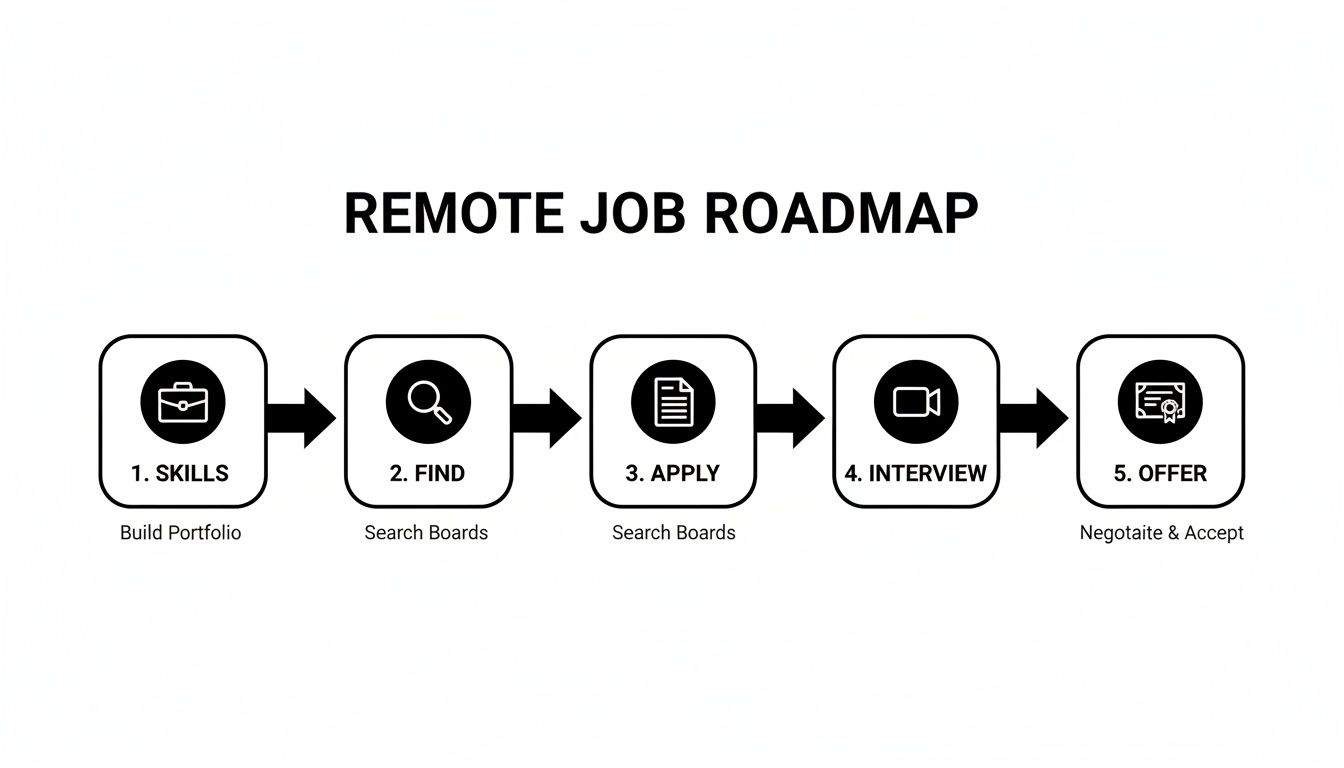
Each of these steps is a chance to strategically position yourself as the ideal candidate. By following this roadmap, you’ll build the skills, confidence, and tools you need to land that remote data analyst job you’ve been aiming for.
Building a Remote-Ready Skillset and Portfolio

When you're going for a remote data analyst job, your portfolio and skills are doing all the talking for you. Think about it: a hiring manager can’t see you grinding away at your desk in an office. They need to see cold, hard proof that you can deliver incredible work on your own. This goes way beyond just knowing your tech stack; it’s about proving you're built for remote work.
Of course, the core technical skills like SQL and Python are table stakes. But for remote roles, employers are also scanning for experience with the tools that make distributed teams click. Knowing your way around a data visualisation tool like Tableau or Power BI is a given, but what about the collaboration software? Being comfortable in a remote ecosystem—think asynchronous communication on Slack and managing projects in Asana or Jira—is just as critical.
Showcasing Your Technical and Collaborative Skills
Your portfolio is, without a doubt, your most powerful asset in this hunt. It needs to feature projects that tell a full story, taking the hiring manager on a journey from messy, raw data to a clean, insightful, and interactive dashboard.
But don't just show off the pretty final product. You need to walk them through your entire process. Explain the initial business problem you were trying to solve, detail your data cleaning steps (the messier the original data, the better!), describe the analysis you ran, and, most importantly, highlight the actionable insights you uncovered.
If you can, try to include a project that was a team effort with people in different time zones. It's a fantastic, practical way to demonstrate that you can communicate clearly and hit shared deadlines without ever being in the same room.
A portfolio for a remote role has to answer the one silent question every hiring manager is asking: "Can this person deliver exceptional results with minimal supervision?" Every single project you include should be a resounding "yes."
Highlighting Essential Soft Skills
Your technical chops will get your CV to the top of the pile, but it's your soft skills that will land you the job—especially when it's a remote one. The very nature of a remote jobs data analyst position demands that you're a proactive communicator and a master of your own time. No one is going to swing by your desk to see how you're getting on.
So, how do you make these skills feel real? Weave them into your portfolio and CV. Instead of a bland "good communication skills" bullet point, describe a time you had to present complicated findings to a non-technical team over a video call.
Here are the soft skills you absolutely must emphasise:
- Proactive Communication: Show that you're someone who gives regular updates without being asked, isn't afraid to ask for clarification early, and is always responsive on platforms like Slack or Microsoft Teams.
- Independent Problem-Solving: Demonstrate that you're resourceful. Talk about how you tackle tricky data problems on your own and use your critical thinking skills before immediately asking for help.
- Self-Discipline and Time Management: Mention your personal system for prioritising work, hitting deadlines, and structuring your day to stay productive when no one is looking over your shoulder.
By consciously building a portfolio that demonstrates both your technical wizardry and the soft skills that make remote work successful, you're not just showing you're a good analyst. You're showing you're a candidate who will thrive, no matter where your desk is.
How to Find High-Quality Remote Job Openings
Forget the high-volume, generic job boards. Your ideal remote data analyst role probably isn’t sitting on the front page of a massive aggregator. The real gems are usually tucked away on specialised platforms built for people who work remotely.
These niche sites are goldmines because they cut through all the noise. They feature companies with genuine remote-first cultures, not just organisations dipping their toes into work-from-home policies. This approach saves a ton of time and connects you with much better opportunities.
Target Specialised Remote Job Boards
Instead of mindlessly scrolling through thousands of irrelevant listings, switch your focus to platforms designed from the ground up for remote work. I'm talking about sites like RemoteRocketship, We Work Remotely, and Himalayas.app. These places list jobs from established remote companies that actually know how to support a distributed team.
This is what a smart, targeted search looks like on one of these platforms.
Notice how the listings show crucial details like salary ranges and company size right away. That kind of transparency is a huge time-saver and lets you vet opportunities in seconds. It’s pretty standard on these niche boards.
For example, in Germany, it's not unusual to see remote data analyst roles offering competitive salaries between €67,000 to €112,000 annually, especially in established tech and finance firms. These are often larger companies with solid remote setups already in place. It's always a good idea to check current salary benchmarks for remote data analyst jobs in Germany to make sure your expectations are realistic.
Decode Job Descriptions Like an Expert
Once you have a list of interesting roles, it’s time to put on your detective hat and dissect the job descriptions. A well-written JD tells you way more than just the required skills—it gives you a glimpse into the company’s culture and how serious they are about remote work.
Keep an eye out for specific phrases that signal a true remote-first mindset.
- "Asynchronous communication": This is a huge green flag. It means the company trusts you to manage your own schedule and prioritises deep, focused work over a calendar packed with meetings.
- "Experience with distributed teams": This tells you they’re not new to this. They likely have established processes for remote collaboration, so you won’t be their guinea pig.
- "Home office stipend" or "co-working allowance": These are tangible perks that show a company is willing to invest in its remote employees' success and comfort.
A critical distinction to watch for is "fully remote" versus "remote-friendly." A truly remote role gives you location independence. A remote-friendly one might still require you to be in a specific time zone or even show up for occasional in-person meetings. Always clarify.
By concentrating your search on the right platforms and learning to read between the lines, you stop being just another applicant and become a strategic job seeker. This focused method ensures you’re applying for high-quality remote data analyst jobs where you can actually build a career and do your best work.
Crafting an Application That Stands Out Remotely
In the world of remote hiring, your application is your digital handshake. For a remote jobs data analyst role, it has to do more than just tick the boxes on technical skills; it needs to scream autonomy, discipline, and proactive communication from the very first glance.
Generic applications are the fastest way to get lost in the digital shuffle. A hiring manager sifting through hundreds of CVs needs to see immediate proof that you can deliver incredible work without someone looking over your shoulder. This means every part of your application has to be deliberately framed to highlight your remote-readiness.
Showcasing Your Autonomy and Impact
Remote-first companies don’t hire people to just do tasks; they hire them to drive outcomes. Your CV needs a fundamental shift in perspective—away from a laundry list of responsibilities and towards a showcase of measurable achievements. This is doubly true for any project where you worked independently.
Think about it. Instead of simply saying, "Responsible for analysing sales data," reframe it to show the tangible impact you made.
- Before: Maintained weekly sales dashboards.
- After: Developed and automated a weekly sales performance dashboard in Tableau, providing insights that helped the marketing team reallocate their budget and boost lead conversion by 15% in Q3.
See the difference? The "after" version immediately proves your technical skill (Tableau), shows initiative (you developed and automated it), and, most importantly, links your work to a direct business impact. It tells the hiring manager you can connect the dots between data and results, a non-negotiable skill when you're working on your own.
Your CV shouldn't just be a record of what you did. It should be a collection of compelling evidence proving you can drive results on your own, making you an ideal candidate for a remote role.
Tailoring Your Cover Letter for Remote Work
The cover letter is your chance to connect the dots for the hiring manager. This is where you tell a story—not just about why you're a great data analyst, but why you're a great remote data analyst. Please, don't just rehash your CV. Use this space to tackle the unique demands of remote work head-on.
Zero in on a specific project that really highlights your remote chops. Maybe you collaborated with a team scattered across different time zones? Talk about how you used asynchronous tools like Slack and kept everyone aligned with meticulous documentation in Asana. That’s the kind of detail that matters.
A simple structure I’ve seen work wonders goes like this:
- The Hook: Open with genuine enthusiasm for the company and the role. Mention something specific that shows you’ve actually done your homework.
- The "Remote" Paragraph: Dedicate a whole paragraph to explaining why you excel in a remote setup. Talk about your self-discipline, communication style, and any experience with distributed teams.
- The "Impact" Story: Briefly walk them through a key project. Focus on the problem, your actions, and the measurable result, just like you did on your CV.
- The Close: Reiterate your interest and tie your skills back to what the company needs, showing how you can start adding value from day one.
When you proactively show you can work independently and communicate like a pro, your application naturally rises to the top of the "interview" pile.
Nailing the Remote Interview and Technical Test

This is it. The remote interview is where all your preparation—the portfolio projects, the tailored CV—finally comes to life. Unlike a traditional interview, you get to control your environment. This is a massive advantage if you use it wisely, but it can also be a major pitfall.
Your setup isn't just about looking presentable; it’s a direct reflection of your readiness for a fully remote role. It shows you’re organised, professional, and take this opportunity seriously.
How to Connect When You're Miles Apart
Building rapport through a screen takes a bit more conscious effort than in person. Your body language and how you communicate are suddenly under a microscope.
The single biggest tip? Look at the camera, not the person's face on your screen. It feels a little strange at first, but to them, it looks like direct eye contact. It’s a small change that makes a huge difference in building a connection.
When you're answering questions, especially the behavioural ones ("Tell me about a time when..."), the STAR method (Situation, Task, Action, Result) is your best friend. It gives your answers a clear, compelling structure.
Let's say they ask about a high-pressure deadline. Instead of a vague answer, you can walk them through a real story: describe the situation (an urgent report was needed for a board meeting), the task (cleaning and analysing a messy dataset), the actions you took (using specific SQL queries and Python scripts), and the quantifiable result—delivering accurate insights 24 hours ahead of the deadline. Now that’s an answer they'll remember.
The goal of a remote interview is to close the distance. Your preparation, communication, and ability to articulate your thought process are the tools you use to build that bridge and make a memorable impression.
Your Remote Interview Preparation Checklist
Walking into a video interview without a plan is a recipe for disaster. Use this checklist to make sure you've covered all your bases and can show up cool, calm, and collected.
| Category | Action Item | Why It's Critical | | :--- | :--- | :--- | | Technology | Do a full tech rehearsal the day before. | A flaky connection or poor audio makes you look unprepared and can derail the entire conversation. | | Environment | Find a quiet space with good, front-facing light. | Good lighting helps the interviewer read your expressions, and a clean, non-distracting background keeps the focus on you. | | Presentation | Look directly into the camera when speaking. | This simulates eye contact, which is crucial for building rapport and showing you're engaged. | | Communication | Prepare 3-4 STAR method stories for common questions. | Having structured, real-world examples ready demonstrates your skills much more effectively than generic answers. | | Company Research | Re-read the job description and research their recent news. | Asking informed questions shows genuine interest and that you've done your homework. |
Ticking these boxes will help you project confidence and prove that you have what it takes to thrive in a remote setting.
Showing Your Skills in the Take-Home Test
The take-home technical test is where you get to roll up your sleeves and really show what you can do. Whether it’s an analysis project or a live coding challenge, remember they're evaluating your thought process, not just the final answer. For any remote jobs data analyst role, this is how they confirm you can solve problems independently.
Here's how to stand out:
- Ask Questions Before You Start: Make sure you are 100% clear on the requirements, the data, and what they expect as a final deliverable. Smart, clarifying questions show you're thorough.
- Show Your Work: Don't just hand over a final script or dashboard. Your submission should include well-commented code or a separate document explaining your methodology, your assumptions, and any challenges you ran into.
- Talk Through Your Thinking: If it's a live challenge, narrate your process out loud. Explain what you're trying to do with each step. This demonstrates clear communication and collaboration skills—essential for any remote team.
The demand for analysts who can prove these abilities is real. Just look at the German market, where there are currently around 284 remote Data Analyst openings. You can explore the current remote data analyst job listings in Germany yourself to get a feel for what companies are truly looking for.
Getting the Offer Right and Making Your Mark
Landing the job offer is a fantastic feeling, but don't pop the champagne just yet. Now you've got to handle the negotiation and then, the real challenge begins: starting strong in your new remote role. This is where you lock in a package that reflects your true worth and lay the foundation for a successful run with the company.
Negotiating for a remote position has its own flavour. It’s about more than just the base salary; it's about building a total compensation package that genuinely supports a productive and healthy work-from-home setup. You have to think bigger than just the number on your contract.
It’s Not Just About the Paycheque
A competitive salary is obviously a key piece of the puzzle, but remote-specific perks can add a huge amount of value. When that offer lands in your inbox, take a breath and look at everything they're putting on the table.
Here are a few critical points you should consider bringing into the conversation:
- Home Office Stipend: Will they help you foot the bill for a proper, ergonomic workspace? We're talking about a good chair, a solid desk, or quality monitors that you'll be staring at for hours.
- Internet and Utilities Allowance: For a remote data analyst, a fast, reliable internet connection is non-negotiable. It's your lifeline. Many forward-thinking companies offer a monthly stipend to cover this essential cost.
- Truly Flexible Hours: What does "flexible" actually mean to them? Are you free to structure your day, or are you expected to be glued to your screen during rigid "core hours"? Getting clarity on this is absolutely vital for your work-life balance.
- Professional Development Budget: How are they going to invest in you? Ask about support for new certifications, online courses, or even attending virtual conferences to keep your skills sharp.
The secret to a good negotiation is framing it as a win-win. Don't just ask for things; explain how having them will enable you to deliver even better work for the company. A well-equipped, supported analyst is a more productive analyst.
Nailing the First 90 Days
Once you've signed on the dotted line, your focus needs to pivot to hitting the ground running. When you're remote, you can't just bump into people at the coffee machine to build rapport. You have to be deliberate and proactive from day one.
In those first three months, your entire mission is to build trust, show them they made the right choice, and seamlessly plug into the team's way of working. This is especially true for any remote jobs data analyst role, where your value is measured by the quality of your insights and your ability to communicate them.
A brilliant first step? Schedule short, 15-minute one-on-one video calls with everyone on your immediate team. The goal isn't to talk shop; it's to get to know them as human beings. It might feel a bit formal, but this small gesture is huge for building the personal connections that strong remote teams are built on.
From there, get into the habit of over-communicating, especially early on. Post regular, quick updates on your projects in your team’s Slack or Microsoft Teams channel. This isn't about micromanagement; it's about visibility. It shows you're engaged and making progress, and it gives your manager confidence that you can crush it without someone looking over your shoulder. By being proactive, you'll quickly prove you're a reliable and valuable part of the team.
Your Questions Answered: Navigating the Remote Data Analyst Job Market
Jumping into the remote job hunt can feel like navigating a maze. When you're aiming for a technical role like a data analyst, you probably have a lot of questions swirling around. Let's break down some of the most common ones I hear from aspiring analysts to give you a clearer path forward.
What’s a Realistic Salary for an Entry-Level Remote Analyst?
For junior remote data analyst roles, especially in a competitive market like Germany, you're typically looking at a starting salary between €45,000 and €60,000 annually. Of course, this isn't set in stone; it can shift based on the company's size, its industry, and the specific tech stack they're using.
The best way to push your offer towards the higher end of that scale? A killer portfolio. If you can show tangible proof of your project experience, you've got serious leverage. Also, don't just focus on the base salary. Look at the whole package—things like a home office stipend or a professional development budget can add a lot of real-world value.
Do I Really Need a Master’s Degree to Land a Remote Job?
Honestly, a Master’s degree is nice to have, but it’s rarely a deal-breaker for a remote data analyst job. These days, what you can do matters far more than your academic credentials.
Most companies I see are far more interested in your practical skills. A strong portfolio that walks them through how you handle data—from the messy cleaning stage all the way to a clean, insightful visualisation—is infinitely more powerful than a degree certificate. If you want to beef up your profile, focus on getting certified in essential tools like SQL, Python, or Tableau. That’s what really catches a hiring manager’s eye.
The most convincing argument you can make is a portfolio that clearly shows you can solve real-world business problems with data. This tangible proof of skill often outweighs formal academic credentials in a remote hiring process.
How Can I Prove I’m a Good Remote Worker Without Any Remote Experience?
Ah, the classic chicken-and-egg dilemma. It's a common hurdle, but you can definitely clear it. The trick is to reframe your existing experience to highlight the core traits of a great remote employee: autonomy, self-discipline, and proactive communication.
Think back on your past experiences, even if they weren't official "remote" jobs:
- University Projects: Did you have to coordinate with classmates online? You probably used shared documents and had to hit deadlines without a professor hovering over you. That’s remote collaboration.
- Freelance Gigs: Have you ever managed a project for a client almost entirely through email or chat? That shows you can deliver quality work with minimal supervision.
- Self-Paced Learning: Teaching yourself a new coding language or a data viz tool is a massive testament to your self-discipline and initiative.
When you write your CV and head into interviews, make sure you talk about these things. Mention your comfort with collaboration tools like Slack, Microsoft Teams, or Asana. Frame your communication style as proactive and your time management as deliberate. A well-documented portfolio project is the ultimate proof that you can get the job done on your own.
What Are the Most Important Soft Skills for Remote Analysts?
Your technical skills will get you in the door, but your soft skills are what will make you successful in a remote data role. Companies need to know you can thrive without the built-in structure of a physical office.
Here are the non-negotiables:
- Proactive Communication: You can't wait to be asked for an update. You need to be comfortable over-communicating, whether that's through clear written reports or explaining complex findings on a video call.
- Self-Discipline: There’s no manager walking past your desk to check in. Your internal drive to stay on task and hit your deadlines is everything.
- Independent Problem-Solving: As an analyst, you'll be diving into messy, complex problems. Remote employers need people who can think critically and figure things out on their own without needing constant hand-holding.
Stop scrolling through endless job boards and start landing interviews. Acquispect uses AI to automate your job search, find the best-fitting remote data analyst roles, and create customised application materials in minutes. Take control of your career and see the difference data-driven job seeking can make. Start your free trial at Acquispect.