Your language skills aren't just another line item on your CV—they're a critical piece of data that recruiters, especially in Germany, will absolutely zero in on. Think about it from their perspective: vague terms like 'fluent' or 'conversational' are subjective and don't really tell them anything. On the other hand, a standardised level like B2 German gives them a concrete, immediate understanding of what you bring to the table. Nailing this section is a strategic move that can seriously boost your chances of getting that interview.
Why Your Language Section Is a Dealbreaker on a German CV
In a job market as competitive as Germany's, the language section of your CV is far more than a simple footnote. It’s a powerful signal of your ability to integrate into the team, collaborate effectively, and hit the ground running from day one.
Employers need to be confident that you can hold your own in meetings, understand complex instructions, and build genuine relationships with colleagues. Ambiguous descriptions simply don't offer that assurance. This is precisely why the Common European Framework of Reference for Languages (CEFR) has become the gold standard here. It replaces subjective guesswork with a clear, universally understood system.
Stating you have "B2 German" tells a hiring manager exactly what you can do: participate in technical discussions, understand nuanced documents, and communicate spontaneously without much strain.
What the German Market Demands
The need for clear language proficiency isn't just a casual preference; for many roles, it's a non-negotiable requirement. In fact, around 97% of job postings in Germany require some level of German.
The expectations are often very specific. You'll frequently see employers looking for candidates with at least B2 level skills for professional roles, as this is widely seen as the benchmark for true workplace fluency.
A well-defined language section does more than just list a skill. It shows you're a professional who understands business standards and respects the employer's need for absolute clarity. It’s an immediate credibility boost.
Moving Past the Vague and Ambiguous
Ultimately, listing a clear, standardised language level on your CV is about removing risk and uncertainty for the employer. It proves you understand the professional landscape in Germany and have taken the time to properly evaluate and quantify your abilities.
This one simple act of precision can be the deciding factor that moves your application from the 'maybe' pile straight to the 'interview' list. Using a tool to fine-tune your entire application, including sections like this, can give you an even greater edge. To see how it works, you can explore the features of the JobCoPilot CV optimisation platform.
Let's be honest, putting "conversational German" on your CV is a gamble. What does that even mean? For one recruiter, it might mean you can handle small talk over coffee. For another, it could mean you're expected to jump into a technical discussion about project specs. That kind of ambiguity doesn't do you any favours.
To cut through the confusion, you need a system that speaks a universal language to hiring managers. In Europe, and especially in Germany, that system is the Common European Framework of Reference for Languages (CEFR). It’s the gold standard, offering a clear six-point scale from A1 (the very basics) right up to C2 (total mastery). Using it isn’t just a good move; it’s what professionals expect to see.
So, What Do CEFR Levels Actually Look Like at Work?
Forget the textbook definitions for a moment. What really matters is how these levels translate into real-world abilities in an office. When a hiring manager sees a CEFR level on your CV, they're picturing what you can do.
Here’s a practical look at what each tier means in a professional setting:
- Basic User (A1/A2): At this level, you’re handling simple, predictable tasks. You can understand basic instructions, write a short introductory email, or ask a colleague a straightforward question. It’s a solid foundation, but it typically isn’t enough for roles that need you to work independently in that language.
- Independent User (B1/B2): This is the magic zone for many professional jobs in Germany. If you’re at a B1 level, you can navigate most day-to-day work situations, follow along in familiar meetings, and write clear, direct emails. Hitting B2 is a game-changer. It means you can actively contribute to technical discussions, get the nuances in complex documents, and express your thoughts fluently without constantly searching for words.
- Proficient User (C1/C2): With a C1 level, you're operating at an advanced, fully professional capacity. You can confidently lead complex business negotiations, draft detailed, well-structured reports, and articulate your ideas with precision and flair. C2 is essentially native-level command. You can handle any situation, academic or professional, with complete ease and mastery of the language.
Why Precision Always Wins
Using a standardised framework like CEFR immediately adds weight and credibility to your claims. This isn't just a matter of opinion; it's a trend backed by data. The European Survey on Language Competences found a strong preference for certified skills in the German job market, where language proficiency and education are closely linked. If you're curious, you can explore more about these language competence findings and see how they impact hiring.
To really see the difference, let’s put the vague terms side-by-side with their CEFR counterparts.
CEFR Levels vs Vague Terms: A Comparison for Your CV
This table compares the standardised CEFR proficiency levels with common but ambiguous terms, helping you choose the most professional and clear description for your language skills.
| CEFR Level | What It Means in Practice | Vague Term to Avoid | Why It's Unclear | | :--- | :--- | :--- | :--- | | B2 | Can actively participate in team meetings and discussions. | Conversational | Does this mean small talk or complex negotiations? | | C1 | Can write detailed reports and compelling presentations. | Fluent | Is this social fluency or professional fluency? | | B1 | Can handle routine work correspondence and phone calls. | Intermediate | What's the upper and lower limit of this ability? | | A2 | Can understand simple, direct work-related instructions. | Basic | Can you read an email or just order coffee? |
See the difference? Vague terms leave everything up to the imagination, which is a risk you don't want to take.
Choosing a CEFR level provides a concrete, verifiable benchmark. Saying you’re ‘B2’ is a specific claim tied to a recognised set of professional skills. ‘Conversational’, on the other hand, is just a subjective opinion that can weaken your entire application.
By taking a few minutes to accurately assess your skills against the CEFR scale, you present your abilities with confidence and make it incredibly easy for recruiters to see the value you bring to the table.
How to Format Your Language Skills for Maximum Impact
You’ve figured out your language level—great. But how you actually present that information on your CV can be the difference between getting noticed and getting overlooked. The right format makes your skills clear, professional, and impossible for a recruiter to miss.
Your main goal here is to make this section clean, easy to scan, and instantly understandable. Let's ditch the confusing graphics and vague descriptions and focus on a layout that works.
Choosing the Right Location on Your CV
Where you put your language skills really matters. The last thing you want is to have this vital info buried on page two where no one will see it. For maximum visibility, give your "Languages" or "Sprachkenntnisse" section a prime spot.
I always recommend placing it right after your core sections, like "Work Experience" and "Education." Think about it: a recruiter reads through your professional background, and the very next thing they see is your impressive language abilities. It’s a powerful way to reinforce your value.
This diagram gives a great visual breakdown of the CEFR levels, grouping them into the three main tiers you'll be using.
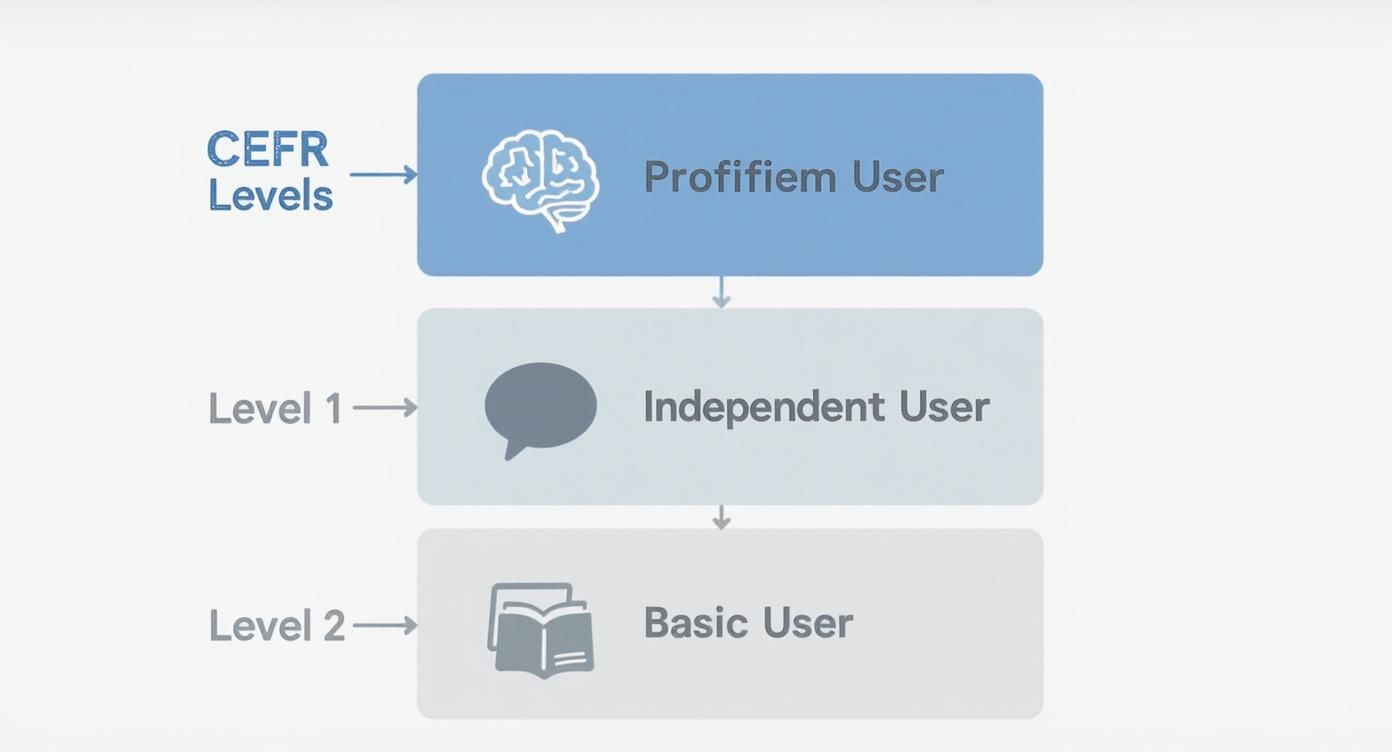
It helps you quickly see where your skills fit—whether you're a Basic, Independent, or Proficient User.
Crafting a Clear and Professional Format
Consistency is key. I’ve seen countless CVs with fancy progress bars, star ratings, and other graphics. Please, avoid these. Not only are they subjective and often look unprofessional, but most Applicant Tracking Systems (ATS) can't read them. Your skills could be completely ignored by the software.
Stick to a clean, simple, text-based list. The best approach is to list the language and follow it with your proficiency level. And don't forget to list your native language first to provide a clear baseline.
Here are a couple of solid examples for different profiles:
A candidate with strong German and native English:
- English: Native Speaker
- German: Proficient User (C1) – Goethe-Zertifikat C1
- French: Basic User (A2)
Someone with intermediate German and another language:
- Spanish: Native Speaker
- English: Proficient User (C2)
- German: Independent User (B2)
Pro Tip: If you have a recent, relevant certificate, add a quick note next to the language. It adds instant credibility without cluttering the page. Something like "German: C1 (TestDaF Certified)" works perfectly.
This straightforward format is scannable, professional, and gives recruiters everything they need in a matter of seconds.
Phrasing for Different Proficiency Levels
The wording you choose should be direct and grounded in the CEFR framework. This eliminates any guesswork and shows you understand European hiring standards.
Listing Your Native Language Always kick things off with your mother tongue. It provides an immediate frame of reference.
- Good: English – Native Speaker
- Also Good: German – Muttersprache
Detailing Your Second Languages For every other language, just combine the name with the CEFR level and the simple descriptor. This combination is universally understood and looks sharp.
- German – C1 (Proficient User)
- French – B1 (Independent User)
- Italian – A2 (Basic User)
By sticking to this standardised format, you guarantee every language level on your CV is presented with professional precision. It’s a small detail that has a surprisingly big impact on how your entire application is perceived. For more practical advice on improving your job search, check out the resources on the JobCoPilot blog. This approach doesn't just make your skills clear; it shows you know the professional norms of the German job market.
Adding Credibility with Official Certificates
https://www.youtube.com/embed/JlEzspY4HZY
Self-assessing your language skills using a framework like CEFR is a great start, but let's be honest: backing it up with an official certificate is the ultimate power move. It instantly changes your proficiency from a subjective claim into a verified, undeniable fact.
For a hiring manager in Germany, this kind of documentation builds immediate trust. It’s the difference between telling someone you're a good driver and actually showing them your driving licence. The certificate removes all doubt, proving you've met a standardised, externally validated level of competence, which can set you miles apart from other qualified candidates. This is especially true when a specific language level is a non-negotiable part of the job description.
Recognised German Language Certificates
When you're applying for jobs in Germany, you'll quickly realise that not all certificates are created equal. Some carry far more weight simply because they are well-known and respected by employers here. If you're going to invest the time and money in a test, make it one of these.
Here are the heavy hitters in the German language certification world:
- Goethe-Zertifikat: This is arguably the most internationally recognised German qualification, offered by the Goethe-Institut. You can get one for every CEFR level, from A1 all the way to C2. For professional roles, a Goethe-Zertifikat C1 is often seen as the gold standard.
- TestDaF (Test Deutsch als Fremdsprache): Aimed at advanced learners (B2-C1), TestDaF is a common requirement for university admission, but it’s also highly respected in the professional world. Its academic focus can be a real advantage for research or technical roles.
- telc (The European Language Certificates): telc offers standardised tests across several languages, and their German certificates are very popular within Germany and the EU. They’re known for a practical, communication-first approach.
Certifications for English and Other Languages
In today’s global business world, proving your English skills can be just as important, especially at international firms based in Germany. The demand for bilingual professionals has skyrocketed, so verified English proficiency is a massive asset.
For English, the certificates you'll see mentioned most often are:
- IELTS (International English Language Testing System): A globally accepted standard for both companies and universities.
- TOEFL (Test of English as a Foreign Language): Another heavyweight, particularly valued by companies with strong ties to the United States.
Investing in a language test is a strategic career move. It's not just about passing an exam; it's about getting a tangible asset that strengthens your professional profile and opens doors that might otherwise stay shut.
Placing a recognised certificate next to your language level on your CV provides the concrete proof recruiters are looking for. It’s a simple addition that elevates your entire application, showing you're serious about your skills and professional development. Trust me, it's an investment that pays for itself many times over during the job hunt.
Common CV Mistakes That Weaken Your Application
It seems simple enough—just list the languages you speak. But I've seen countless applications get tripped up by small, avoidable errors in this section. These mistakes can seriously dent your credibility with recruiters in Germany, where attention to detail is paramount.
One of the biggest blunders is exaggerating your abilities. It's tempting, I know. You might think bumping your B1 German up to B2 is a harmless fib, but it can blow up in your face when the interviewer switches to German mid-conversation. Trust me, it’s an awkward situation you want to avoid. Honesty builds trust and manages expectations right from the start.
Another classic mistake is falling back on fuzzy, outdated terms. Words like "conversational," "fluent," or "working knowledge" are far too vague. They leave recruiters scratching their heads, trying to guess what you actually mean. This lack of precision can signal that you're out of touch with professional norms.
Why Visual Gimmicks Hurt More Than They Help
In a bid to look creative, some people add progress bars, star ratings, or little pie charts to show off their language skills. While they might seem visually appealing, they are a terrible idea for two very important reasons.
First, they’re completely subjective. What does a four-out-of-five-star rating for Spanish even mean? It tells the recruiter nothing concrete about your ability to negotiate a contract or write a professional email.
Second, and this is the real deal-breaker, Applicant Tracking Systems (ATS) can’t read graphics. That fancy progress bar is invisible to the software screening your CV. Your application could be automatically binned for not meeting the language criteria before a human ever lays eyes on it.
Stick to a clean, text-based format. Using a standardised scale like the CEFR ensures both human recruiters and the software they use can understand your proficiency level perfectly. It's the safest and most professional approach.
Vague vs. Clear Examples
Let's look at how to take a language section from weak to impressive.
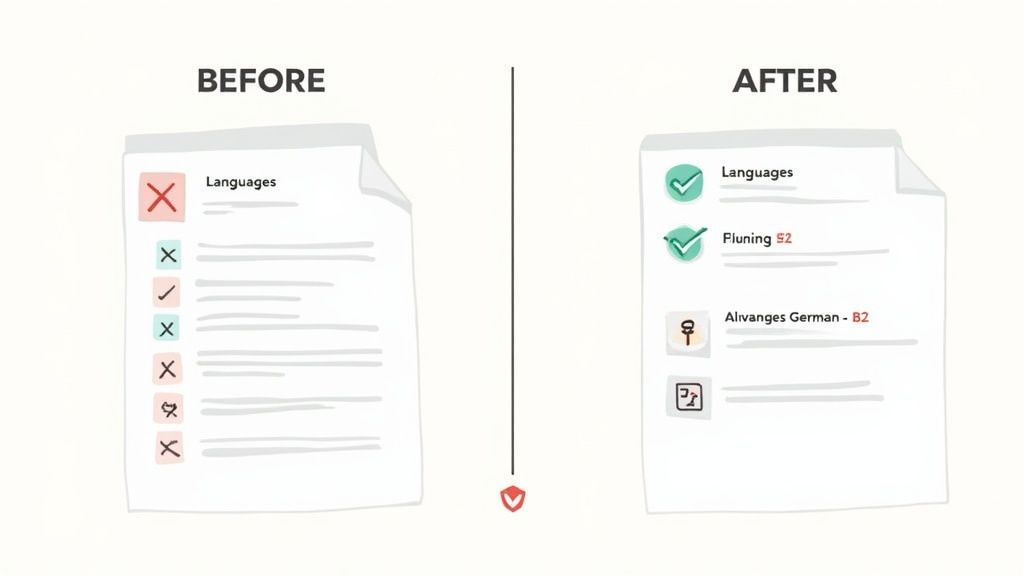
Before (Weak and Unclear):
- Languages: German (conversational), French (basic)
This version is ambiguous and feels amateurish. It forces the recruiter to guess.
After (Strong and Professional):
- German – B1 (Independent User)
- French – A2 (Basic User)
See the difference? This revision is specific, professional, and instantly understood. Getting the language level on your CV right shows you mean business.
And while German skills are often a key focus for jobs here, don't underestimate the importance of strong English. Germany ranked 10th worldwide in the 2024 EF English Proficiency Index, indicating a very high average skill level (C1). This means the bar is high for international candidates. With an estimated 56% of the population speaking some English, it's often the default language in diverse, professional environments. You can dive deeper into the data on English proficiency in Germany.
Your Questions on Language Levels Answered
Even after you've polished every other part of your CV, those last few questions about language skills can be tricky. Getting these details right is the final touch that makes your application look truly professional, especially when navigating the German job market. Let's tackle some of the most common questions I get asked.
Should I Bother Listing a Language I'm Only a Beginner In?
My advice? Yes, but be strategic about it. If you're just starting out with, say, A1 German, it’s absolutely worth including—especially if you're applying for a job in Germany. It shows you're proactive and committed to integrating.
A simple line like "German – A1 (currently studying)" signals your ambition and dedication. However, if your CV is already bursting with high-impact skills and you're listing a basic language with no relevance to the role (like beginner Spanish for a tech job in Berlin), you might be better off using that space for something more compelling.
How Should I List My Native Language?
Always, always list it. It might seem obvious to you, but it’s a critical reference point for recruiters. Skipping it can lead to confusion and make them wonder.
Keep it simple and direct. There's no need to overthink it:
- English – Native Speaker
- German – Mother Tongue (Muttersprache)
This clarity sets a professional tone and gives the hiring manager an immediate anchor for understanding the rest of your language abilities.
Don't underestimate the power of clarity. Stating your native language isn't just a formality; it's a foundational data point that helps a hiring manager quickly and accurately assess your entire linguistic profile.
What About Skill Bars or Star Ratings? Are They a Good Idea?
In a word: no. Please, avoid them. While they might look modern, visual gimmicks like skill bars, star ratings, or progress metres are a major pitfall. They’re completely subjective—what does a four-out-of-five-star rating even mean? It often comes across as amateurish.
Even more critically, Applicant Tracking Systems (ATS) can't read them. The software that scans your CV will likely skip right over those graphics, meaning your language skills become invisible. Your application could be rejected before a human ever lays eyes on it. Stick to clear, universally understood text.
Is My Old Language Certificate Still Valid?
Yes, an older certificate is still valuable proof of your abilities, but you need to give it some context. A certificate from five or more years ago shows you once reached a verified level of proficiency, which is a great starting point.
The key is to show that the skill hasn't gone rusty. Simply list the certificate with its date and add a quick note to reassure the reader. For example: "Goethe-Zertifikat C1 (2018) – Proficiency maintained through daily professional use." This small detail shows you’re transparent and confirms your skills are still sharp, which is exactly what a recruiter wants to see.
Ready to stop guessing and start getting results? Acquispect uses AI to find the perfect jobs for your profile, creates tailored application documents in minutes, and tracks your success so you can optimise your strategy. Take control of your job search with a free 30-day trial today.