Let's be honest, writing a compelling Bewerbungsschreiben mit KI (AI-assisted application letter) isn't some far-off idea anymore. It's a smart, practical way to get ahead in the current job market. With the right AI tool, you can put together a highly personalised, keyword-rich application in a fraction of the time, giving you a real leg up on the competition.
Why You Need an AI Co-Pilot for Your Job Search
The German job market is tough. Companies are flooded with applications, and to cope, many have turned to Applicant Tracking Systems (ATS). This is software that acts as a gatekeeper, scanning every application and ranking it before a hiring manager ever lays eyes on it. This is precisely where a standard, handcrafted letter can trip up—it often misses the specific keywords the system is trained to find.
This is where an AI co-pilot completely changes the game. These tools are brilliant at dissecting a job description and then naturally weaving the most critical skills and qualifications into your letter. The result? Your Bewerbungsschreiben doesn't just sail past the ATS filter; it also lands on the recruiter's desk looking sharp, relevant, and impressive.
How Recruitment in Germany Is Changing
The adoption of AI in hiring isn't just a fleeting trend—it's a fundamental shift in how things are done. By 2025, AI tools will likely be a standard part of the recruitment process across Germany. We're already seeing that 92% of HR leaders in Germany are planning to increase their investment in AI for human resources, especially for finding new talent. This tells you one thing for sure: an algorithm will almost certainly be the first to read your application.
The goal isn't to let AI write for you, but to let it amplify your own strengths. A good tool makes sure your qualifications get noticed, so your personality can really come through when you get to the interview.
To see the difference in a nutshell, let's compare the old way of doing things with the new AI-assisted approach.
Traditional vs AI-Assisted Application Letters
This quick comparison table really brings the key differences into focus.
| Aspect | Traditional Bewerbungsschreiben | Bewerbungsschreiben mit KI | | --- | --- | --- | | Time | Hours spent on research, writing, and editing. | Minutes to generate a targeted first draft. | | Optimisation | Often lacks specific keywords for ATS. | Highly optimised with relevant keywords from the job ad. | | Personalisation | Can be generic if applying to multiple jobs. | Easily personalised for each specific role and company. | | Consistency | Tone and quality can vary. | Maintains a consistent, professional tone throughout. |
Ultimately, the biggest takeaway is how much more efficient and effective your application process becomes.
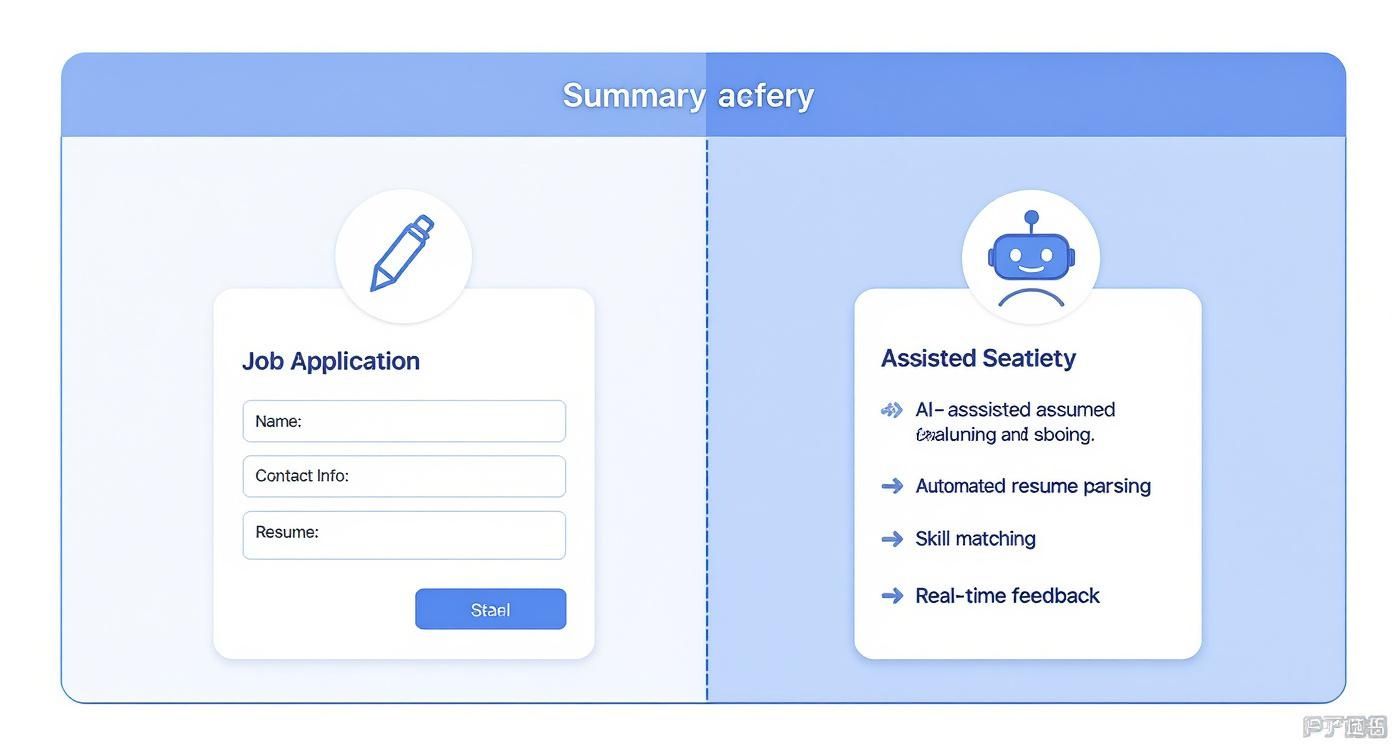
The real benefit here is the massive boost in efficiency and optimisation. You're freed up to spend your valuable time on what really matters—networking, preparing for interviews, and building connections. When you embrace this modern approach, you aren't just saving time; you're working smarter. Platforms like JobCopilot.de are built specifically to give you that advantage.
Building Your Personal AI Input Dossier
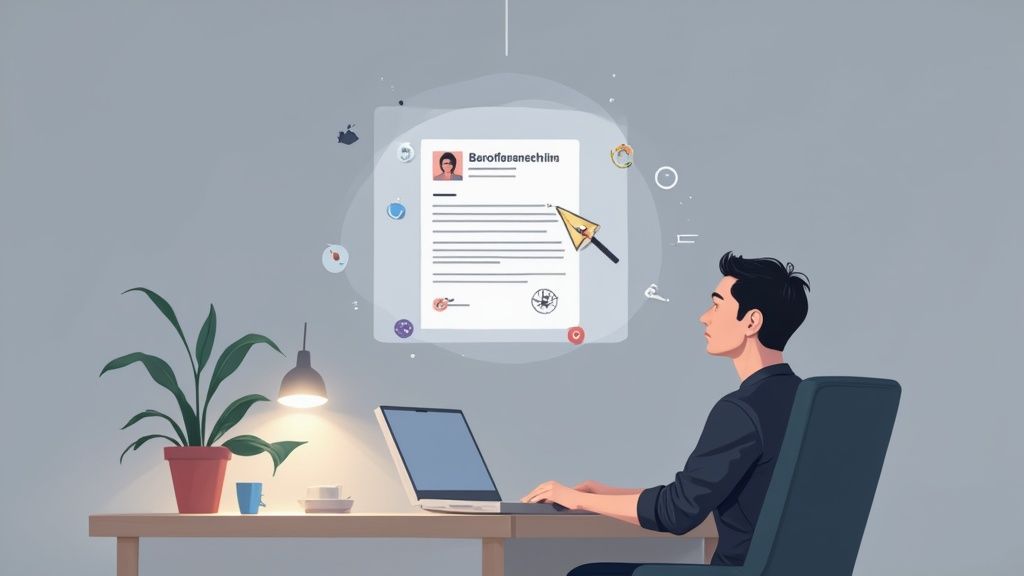
Here's the truth about AI: it's only as smart as the information you give it. If you want a truly powerful Bewerbungsschreiben mit KI, you can't just feed it a few bullet points. You need to give the system high-quality, personal data about your career by creating a comprehensive "master document" first.
Think of this dossier as your career's highlight reel. It’s the single source of truth for your skills, biggest wins, and professional story. Without this groundwork, the AI has to guess, and the result is almost always generic, weak content that recruiters will spot a mile away.
From Vague Duties to Quantifiable Wins
This is where most people go wrong. The most important part of your dossier is framing your experience around measurable results, not just listing job duties. "Managed projects" tells a recruiter absolutely nothing. You have to give the AI concrete evidence of your impact.
The STAR method (Situation, Task, Action, Result) is a fantastic way to structure this. For every key project or role, break it down:
- Situation: What was the context or challenge?
- Task: What was your specific goal?
- Action: What exact steps did you take?
- Result: What was the quantifiable outcome?
For instance, "Managed projects" transforms into something much more compelling: "Led a 5-person team (Action) to deliver Project Phoenix (Situation) two weeks ahead of schedule (Result), which directly helped cut operational costs by 15% that quarter (Result)." This is the kind of detail the AI needs to build a story that sells.
Your dossier isn't just a data dump; it's a strategic collection of proof. Every single quantified achievement becomes powerful ammunition for your AI, ensuring each application letter is packed with personal, impactful details that make a recruiter stop and pay attention.
Cataloguing Your Core Competencies
Beyond your big wins, your dossier needs a well-organised list of all your skills. I've found it's best to separate them into clear categories so both you and the AI can easily pull what's needed for a specific role.
Try grouping them like this:
- Hard Skills: Your technical abilities (e.g., Python, SAP, Adobe Creative Suite, SEO tools).
- Soft Skills: Those crucial interpersonal qualities (e.g., leadership, communication, problem-solving, teamwork).
- Certifications: All official qualifications or training you've completed.
This organised approach prevents you from ever forgetting a key skill. It also lets the AI strategically weave in the most relevant competencies based on the job description you're targeting. When it's complete, this dossier becomes your secret weapon.
How to Write Prompts That Get Results
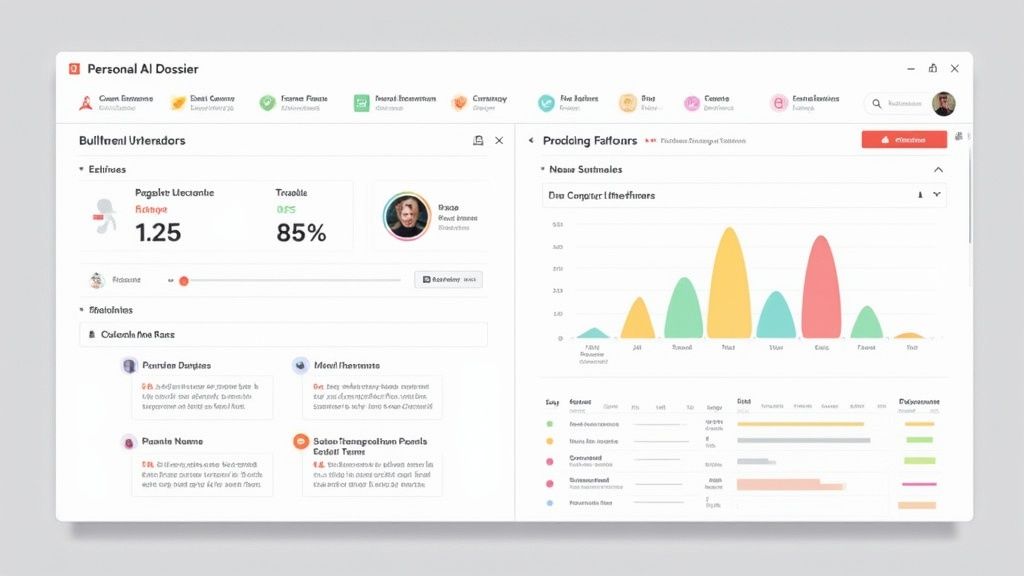
Here's the simple truth about getting a great Bewerbungsschreiben mit KI: the magic isn't in the tool, it's in how you talk to it. If you just ask an AI to "write a cover letter for me," you're going to get something bland and forgettable. It's the equivalent of handing a master chef a can of tomatoes and expecting a gourmet meal.
To get truly impressive results, you have to guide the AI with precision. Think of it like briefing a talented but very literal assistant. You'd never just tell them to "write something good." You'd give them the full picture—the context, the tone you're going for, and all the critical details they need to succeed. The same goes for AI. The more specific your input, the more personalised and powerful the output will be.
The Anatomy of a Powerhouse Prompt
A really effective prompt isn't just a one-liner. It’s a layered set of instructions that paints a clear picture for the AI. To get it right, you need to combine the context of the job, your unique value as a candidate, and a few specific constraints to steer the AI’s creative engine.
When you structure your request this way, you're not just asking a question; you're giving a strategic command. The AI doesn't just know what to write, it understands how to write it and why it matters. This allows it to weave a narrative that perfectly connects your story with what the employer is looking for.
Here are the essential ingredients I always include:
- Assign a Role: Start by telling the AI who to be. Something like, "Act as a German career expert specialising in the tech industry." This immediately frames the task and sets a professional tone.
- Define the Task: Be crystal clear about the deliverable. For example, "Draft a 250-word cover letter for the Senior Product Manager role at [Company Name]."
- Provide Your Data: This is where you bring your own story to life. "Emphasise my 7 years in agile development, my success in launching 3 major products, and my expertise in user-centric design."
- Set the Tone: Don't forget to guide the personality of the writing. "Adopt a confident, innovative tone that matches their brand values."
The difference between a weak prompt and a strong one is the difference between a generic template and a personalised story. By providing specific, multi-layered instructions, you command the AI to build a narrative around your actual achievements, making the final letter authentically yours.
Prompting in Action: Before and After
Let's make this real. The German tech market is fiercely competitive. In 2023, there were a staggering 149,000 unfilled IT positions. Recruiters are swamped and use sophisticated tools to filter candidates, so that first impression has to be sharp. If you want to dive deeper, you can learn more about the trends shaping the German tech job market and see where you fit in.
A weak, generic prompt usually looks something like this:
- Before: "Write a cover letter for a software developer job."
This gives the AI almost nothing to work with. It's guaranteed to produce a letter full of tired clichés that could have been written by anyone.
Now, let's inject the principles of a powerhouse prompt:
- After: "Act as a professional German IT recruiter. Draft a compelling 300-word cover letter for the Backend Developer (Python) position at [Tech Company GmbH]. Highlight my 5 years of experience building scalable APIs, my proficiency with Django, and the time I reduced database query times by 30% on a major project. The tone should be professional yet passionate about clean code."
See the difference? This detailed prompt provides all the necessary context, hard numbers, and tonal direction. It gives the AI the raw material to craft a Bewerbungsschreiben that is specific, impactful, and far more likely to grab a recruiter’s attention.
From AI Draft to Polished Final Version
An AI-generated draft is a fantastic shortcut, but it's never the finish line. Let's be honest, submitting a raw AI output is one of the fastest ways to get your application tossed aside. The real magic happens when you use the AI’s speed as a foundation and then weave in your own personality and experience.
Think of the AI as a brilliant but very junior assistant. It gets the facts lined up perfectly, but it completely lacks the human spark—the stories, the passion, the nuance. Your role is to step in as the senior editor, injecting the warmth and authentic voice that only you can bring to the table. This is what helps a recruiter connect with you, not just a list of your qualifications.
Making It Genuinely Yours
The first thing I always do is read the draft out loud. Does it actually sound like me? AI tools often lean towards stilted, overly formal language that feels a bit... robotic. Your job is to find those phrases and swap them out for your natural way of speaking.
Here's a quick checklist I use to guide the editing process:
- Go Beyond Generic Praise: Instead of saying you're "excited by the company's innovative work," get specific. Mention a project you admired, a recent article they published, or something their CEO said that genuinely resonated with you. This shows you've actually done your homework.
- Tell a Quick Story: Is there a place to add a short, relevant anecdote? Rather than just stating a skill like "team leadership," briefly describe a time you put it into action.
- Match the Company's Vibe: Is this a laid-back startup or a formal, traditional corporation? Adjust your language accordingly. Your tone should feel like it already belongs in their office.
A great cover letter creates a connection. It moves beyond simply listing qualifications to telling a story that resonates with the reader. Your final edit is where you find that story and make it the heart of your application.
For instance, an AI might spit out something like, "I am confident my skills in project management align with your requirements." Correct, but completely forgettable.
Let's breathe some life into that. How about this instead?
"I was really impressed reading on your blog about the recent product launch, and it reminded me of a project I led last year. We also faced some incredibly tight deadlines, but I found that my agile approach was key to delivering 10% ahead of schedule."
See the difference? This small change proves you’re genuinely interested, gives concrete evidence of your skills, and makes your application stick in the recruiter's mind. This is how you combine the power of AI with your irreplaceable human touch.
Avoiding Common AI Application Mistakes
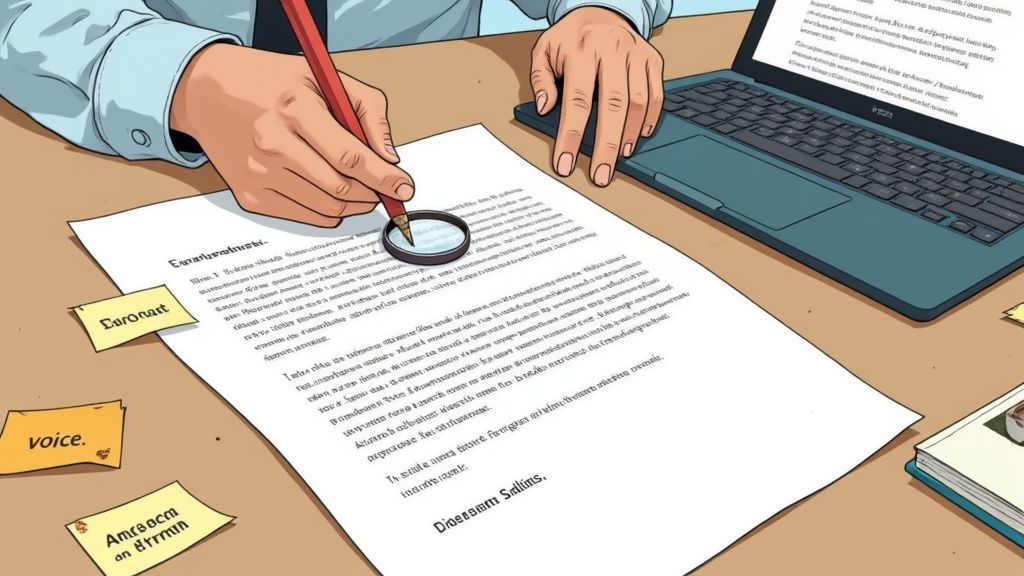
While a Bewerbungsschreiben mit KI can give you a serious edge, it also opens up a whole new world of potential mistakes. The absolute biggest blunder I see is treating the AI as a magic wand instead of the powerful tool it is. Just hitting 'generate' and then copy-pasting the output is a one-way ticket to the rejection pile.
Believe me, recruiters are getting really good at sniffing out a low-effort, AI-only application. These letters have a certain feel to them—they’re impersonal, packed with oddly formal phrases, or full of generic fluff that doesn’t actually speak to what the company needs.
Another huge pitfall is something we call an AI hallucination. This is where the tool confidently makes up facts or skills you don't have, just to make the letter sound better. Can you imagine the AI claiming you're a Python expert when you've never written a line of code? It's an awkward mistake that will get you disqualified on the spot.
Fact-Checking Is Non-Negotiable
This leads to the golden rule of using AI: you are always the final editor. You have to assume the AI could be wrong and meticulously verify every single detail. This manual check is your most critical quality control step.
Your application is your personal brand. Letting an unverified AI draft represent you is a massive risk. The real magic happens when you blend the AI’s speed with your own authenticity and accuracy.
The job market is already feeling the ripples of AI's impact on how we work. A recent study found that over 27% of German companies expect AI to lead to job cuts within the next five years. This makes a flawless, standout application more important than ever. You can read the full research on AI's impact on German companies to get a better sense of this shift.
To steer clear of these common traps, always keep this in mind:
- Proofread everything: Hunt down awkward phrasing, factual errors, and any claims that don't match your actual experience.
- Personalise the tone: Read it aloud. Does it sound like you, or does it sound like a robot? Inject your own voice.
- Verify key details: Triple-check that every name, job title, and company-specific detail is 100% correct.
Common Questions About AI Cover Letters (and Honest Answers)
It's natural to have questions when you start using a new tool for something as important as your job application. Let's tackle some of the most common concerns I hear from job seekers.
Will Recruiters Know I Used AI?
They might, but only if you hand in the first draft without a personal touch. A cover letter that sounds too perfect, generic, or completely devoid of personality can be a red flag.
That’s precisely why you can't just copy and paste. The magic happens when you infuse the AI's solid foundation with your own voice, specific career stories, and genuine excitement for the role. After you’ve worked your magic, it’s no longer an "AI letter"—it's your letter, just written more efficiently.
Is This Cheating? Am I Being Unethical?
Not at all. Think of an AI writing assistant as a super-powered version of Grammarly or a spell-checker. It’s a tool to help you articulate your thoughts more clearly and professionally.
Using technology to present your real skills and experiences in the best possible light is smart, not dishonest. The ethical line is only crossed if you invent skills or lie about your background. As long as everything in the letter is 100% true and you've given it your final, personal stamp of approval, you're in the clear.
Remember, the tool helps with the how, but the what—your experience, your skills, your personality—is all you.
What AI Tools Work Best for German Cover Letters?
You could use a general-purpose AI, but you'll get far better results from a specialised tool built for the job market. These platforms are often trained on thousands of successful résumés and cover letters, so they understand what works.
Many also have built-in features to analyse the job description and optimise your letter for applicant tracking systems (ATS). If you want to dive deeper into smart job search tactics, the JobCopilot.de blog is a great place to find more insights.
Ready to stop writing and start interviewing? Acquispect automates your job search, creates personalised cover letters in minutes, and tracks your success so you can land your next role faster. Start your free trial today.