A junior data scientist is essentially the starting point for a career in data. They work on a data science team, supporting more senior members by collecting, cleaning, and running initial analyses on data. Think of it as being a detective-in-training; you're learning the ropes of data investigation under the guidance of experienced mentors, all while helping to solve real business puzzles. It's the crucial first step on the path to becoming a data science expert.
Unpacking the Role of a Junior Data Scientist

Forget the intimidating job titles for a second. At its core, the junior data scientist role is an apprenticeship. This is where your classroom knowledge gets put to the test in the real world. Your main goal? To learn, contribute, and grow. You'll be in the engine room of the data team, handling the foundational work that allows senior scientists to focus on building complex models and shaping strategy.
This job isn’t about leading some revolutionary AI project on your first day. It's all about mastering the fundamentals. You’ll spend most of your time getting your hands dirty with the company's data, understanding the business problems they're trying to solve, and sharpening your technical skills on datasets that are often messy and far from perfect.
Core Responsibilities on a Daily Basis
While the specifics can change from company to company, a junior data scientist's day usually centres on a few key areas. These aren't just checkbox tasks; they are the absolute building blocks of a solid data science career.
Your main duties will almost always involve:
- Data Wrangling and Preprocessing: This is the big one, and it's where you'll spend a lot of your time. You'll be pulling data from different places (like SQL databases or APIs), cleaning it up to fix missing values or inconsistencies, and restructuring it so it's ready for analysis.
- Exploratory Data Analysis (EDA): Once the data is clean, you get to start digging in. This means performing initial investigations to spot patterns, find weird outliers, and develop some early ideas about what the data is telling you. It involves a mix of statistics and visualisation to get a feel for the dataset.
- Assisting with Model Development: You'll support senior scientists as they build and test machine learning models. This could mean helping with feature engineering (creating new variables from existing data), running initial model versions, or measuring how well a model is performing.
- Creating Reports and Visualisations: Data is useless if no one can understand it. A huge part of your job is turning complicated findings into simple charts, graphs, and dashboards using tools like Tableau or Power BI.
It's a common myth that data science is just building fancy algorithms. The reality for a junior data scientist is that nearly 80% of the job can be preparing and cleaning data. Getting good at this is non-negotiable if you want to advance.
A Detective in Training
A great way to think about the role is like being a junior detective on a major case. You're not expected to crack the case all on your own. Your job is to gather evidence (collect data), organise the case files (clean the data), and identify the first few solid leads (perform EDA).
You work hand-in-hand with the lead detectives (your senior data scientists), who take your foundational work to connect the dots and solve the mystery. This collaborative setup is perfect because you learn critical investigation techniques on the job while making a real contribution. It’s this hands-on experience that will turn you from a rookie into a pro, ready for bigger and more complex challenges down the line.
The Essential Tech Stack for Aspiring Data Scientists
Stepping into the world of data science can feel overwhelming. You're bombarded with long lists of programming languages, libraries, and tools, making it tough to know where to even begin.
But here’s the good news: for a junior data scientist role, you don’t need to master everything. The key is to build a rock-solid foundation in a handful of core technologies. Think of it like a chef learning their craft. You first master the essential knives and pans before worrying about specialised gadgets. For you, the focus is on the indispensable tools you’ll use daily to handle data, run analyses, and share what you've found. This is exactly what hiring managers are looking for.
Mastering the Code that Powers Data
At the heart of any modern data science toolkit, you'll find a couple of dominant programming languages. While knowing both is a great long-term goal, becoming truly proficient in one is non-negotiable for landing your first job.
- Python: This is, without a doubt, the leader of the pack in the data science community. Its syntax is clean and readable, which makes it easier to pick up. But its real strength lies in its vast ecosystem of libraries built specifically for manipulating data, running statistical analyses, and building machine learning models.
- R: Built by statisticians, for statisticians. R is an absolute powerhouse for complex statistical modelling and creating sophisticated data visualisations. While Python has become more common in many business settings, R is still heavily used in academia and research-focused roles.
For most people starting out, Python is the safer and more versatile choice. Its libraries have become the industry standard for the kind of tasks you'll be handling day-to-day.
Your goal isn't just to write code; it's to solve problems with it. A hiring manager would much rather see a candidate who can skilfully use one language to deliver a complete project than someone who has a superficial knowledge of five.
Before diving into the specific tools, let's get a high-level view of the essentials you'll need in your toolkit.
Core Tech Stack for a Junior Data Scientist
| Category | Technology | Primary Use Case in a Junior Role | | :--- | :--- | :--- | | Programming Language | Python | The go-to for data cleaning, analysis, automation, and building machine learning models. | | Essential Libraries | Pandas, NumPy, Scikit-learn | The trio for data manipulation (Pandas), numerical computing (NumPy), and machine learning (Scikit-learn). | | Database Querying | SQL | The universal language for extracting, filtering, and aggregating data directly from databases. | | Data Visualisation | Tableau, Power BI | Creating interactive dashboards and reports to communicate findings to non-technical stakeholders. |
This table summarises the foundational skills that will get you job-ready. Now, let’s break down why each of these is so important.
Your Best Friends: Essential Libraries and Frameworks
Why write code from scratch when you don't have to? Libraries are collections of pre-written code that make your life infinitely easier. For a junior data scientist using Python, these three are absolutely non-negotiable.
- Pandas: This is your Swiss Army knife for data manipulation and analysis. You'll use it constantly to load, clean, filter, transform, and explore data organised in tables called DataFrames.
- NumPy: The bedrock of scientific computing in Python. It provides powerful tools for working with large, multi-dimensional arrays and matrices, plus a huge collection of mathematical functions to run on them.
- Scikit-learn: Your gateway into the world of machine learning. It provides straightforward, effective tools for tasks like classification, regression, and clustering, making complex algorithms accessible.
If you can get comfortable with these three, you'll be well-equipped to handle the vast majority of technical tasks thrown your way in a junior role.
The Unavoidable Skill of Talking to Databases
Data rarely arrives in a neat little file. In the real world, it lives inside databases. To get it out, you have to speak the database's language, and that language is SQL (Structured Query Language).
SQL is how you ask a database questions, like, "Show me all customer sales from last quarter in the Berlin region." As a junior data scientist, you’ll be expected to write queries to pull, filter, and group data before you even start analysing it in Python. A solid grasp of SQL isn’t just a ‘nice-to-have’—it's a fundamental requirement.
This skill is so critical that it's almost always tested in technical interviews. It's no surprise that applied data science programmes are booming in Germany, attracting thousands of international students. Universities in cities like Munich and Berlin have seen enrolment in data science master's programmes surge 28% between 2020 and 2025. These courses rightly put heavy emphasis on practical skills like SQL and model testing. The proof is in the numbers: 65% of their graduates land junior data scientist jobs within 6 months, and a strong command of SQL is a huge factor in that success. You can discover more about the growth of data science education in Germany.
Telling a Story with Data Visualisation
At the end of the day, your brilliant analysis is only as good as your ability to communicate it. Data visualisation tools are what turn complex numbers and tables into clear charts and dashboards that tell a compelling story.
While you can create basic plots with Python libraries like Matplotlib and Seaborn, most companies use dedicated business intelligence (BI) tools to build interactive dashboards for managers and other teams.
- Tableau: A powerful and widely-used tool famous for its user-friendly drag-and-drop interface. It allows you to create beautiful, interactive visualisations without writing any code.
- Power BI: This is Microsoft's BI tool, and it integrates seamlessly with other Microsoft products like Excel. It's another incredibly popular choice, especially in companies that already rely on the Microsoft ecosystem.
Your Step-by-Step Data Science Career Roadmap
Breaking into data science can seem daunting, but it’s far more manageable if you break it down into smaller, concrete steps. Think of it less like scaling a sheer cliff and more like following a well-marked trail. This roadmap will guide you through the essential milestones, turning your ambition into a solid plan for landing your first junior data scientist role.
Each stage builds on the one before it, helping you gather momentum and confidence as you go. We'll start with the fundamentals, move into hands-on application, and finish by showing you how to prove your skills to potential employers.
Building Your Educational Foundation
Your journey starts with learning the core concepts. The great news is there isn't just one path to success; a traditional university degree is far from the only option. The key is to pick the route that best fits your learning style, budget, and schedule.
Here are a few of the most common pathways:
- University Degrees: A bachelor's or master's in a field like Computer Science, Statistics, Mathematics, or a dedicated Data Science programme offers a deep theoretical and practical base. This is a highly respected route, especially given Germany's academic culture.
- Online Courses and Specialisations: Platforms like Coursera, edX, and DataCamp provide structured learning tracks from top-tier universities and companies. These are fantastic for gaining specific skills in a flexible, self-paced way.
- Data Science Bootcamps: These are intensive, short-term programmes laser-focused on getting you job-ready, fast. They are incredibly practical, project-based, and designed to mimic a real-world work environment.
No matter which path you take, the goal is the same: to get a firm grip on statistics, programming fundamentals (especially in Python), and the basics of machine learning.
Assembling a Powerful Project Portfolio
Knowing the theory is one thing, but hiring managers need to see what you can actually do. Your portfolio is the single most important asset you have for showcasing your practical skills. It's the proof that you can take a messy dataset, apply your technical know-how, and pull out valuable insights.
A strong portfolio is more than just a collection of class assignments. It should demonstrate your ability to solve interesting problems from beginning to end.
Think of your portfolio as a gallery of your best work. Each project should tell a story: what was the problem, what data did you use, what techniques did you apply, and what was the outcome? This narrative is what grabs a recruiter's attention.
Need some ideas to get started?
- Analyse Public Datasets: Grab a dataset on a topic you're passionate about from sources like Kaggle, the UCI Machine Learning Repository, or government open-data portals.
- Tackle a Kaggle Competition: You don't have to win! Just participating shows initiative and gives you experience working on a real-world problem with a complex dataset.
- Create a Unique Data-Driven Project: Scrape data from the web (ethically, of course) or use an API to build something entirely from scratch. This shows a much higher level of technical skill and creativity.
The process often looks something like this—writing code to pull and clean data, querying it to find patterns, and then building visualisations to tell the story.
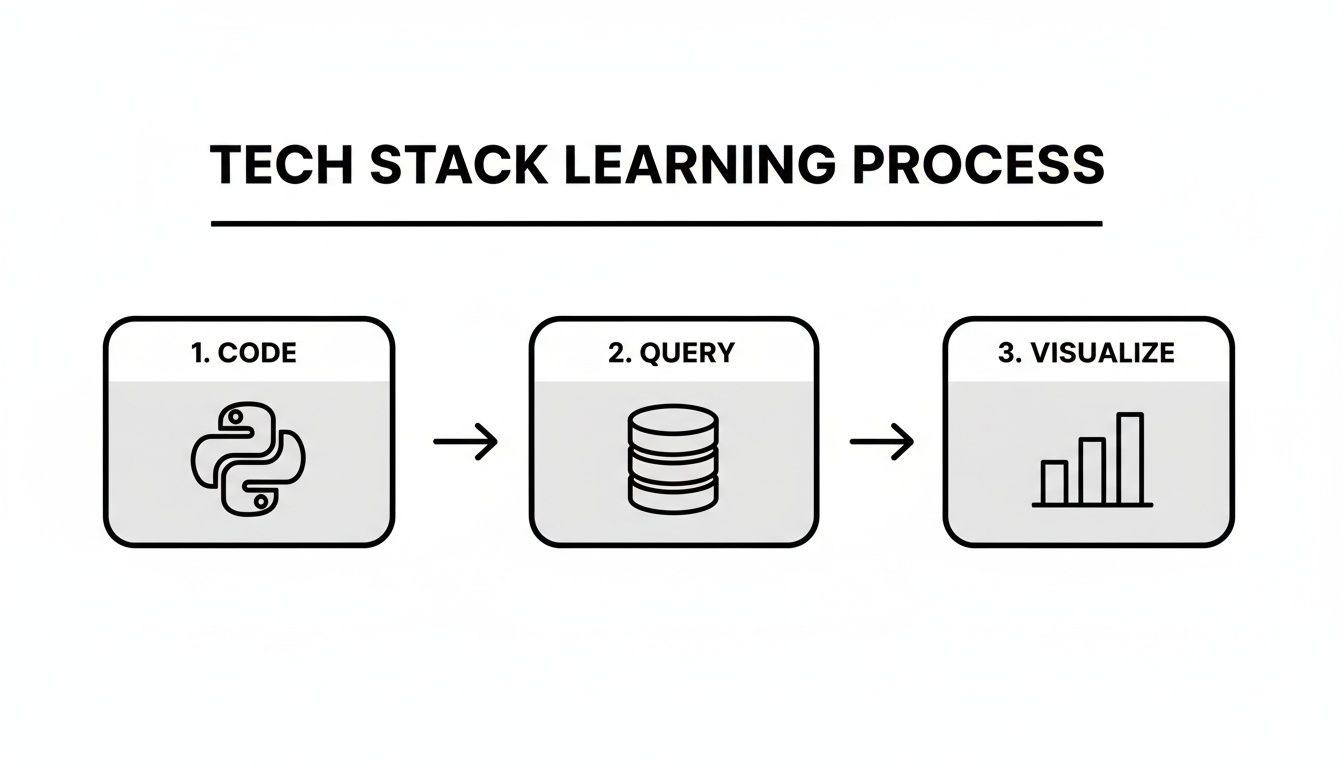
This workflow highlights how essential skills like programming, database management, and reporting all fit together in a typical data science project.
Gaining Hands-On Experience and Certifications
Once you have a solid foundation and a few projects under your belt, it's time to gain real-world experience and credentials. This is what will make your profile pop in a crowded job market.
Internships are one of the best ways to get your foot in the door. They offer invaluable experience, mentorship, and the chance to work on business problems with real stakes. Never underestimate the power of an internship on your CV; it proves you can contribute as part of a professional team.
On top of that, targeted certifications can validate your expertise with specific tools. Certifications from major cloud providers like Amazon Web Services (AWS) or Google Cloud are especially valuable, as more companies shift their data operations to the cloud. A certification shows an employer you have a specific, measurable skill they need right now, making you a much more compelling candidate for a junior data scientist position.
How to Craft a Standout Application Package

In a crowded market, firing off a generic CV is the fastest way to get ignored. To land interviews for a junior data scientist role, your application package—that’s your CV, resume, and cover letter—needs to be sharp enough to grab a recruiter’s attention from the very first line.
This isn't about using fancy templates or buzzwords. It's about translating your skills and projects into something a business understands: value. Your mission is to create documents that not only sail through the automated Applicant Tracking Systems (ATS) but also connect with the real person reading them. Let’s get into how you can build an application that actually gets you noticed.
Tailoring Your Resume and CV
I can't stress this enough: the single biggest mistake you can make is sending the same CV to every company. Recruiters can spot a generic application a mile off. The trick is to treat each application like a mini-project, with the job description as your brief.
Start by tearing the job posting apart. Hunt for the key skills, tools, and responsibilities they mention. These are the exact keywords their ATS is scanning for. Your job is to sprinkle these terms naturally throughout your CV, especially in your skills section and project descriptions. This simple step shows you’ve done your homework and aren’t just spamming applications.
Quantify Your Achievements for Real Impact
Just listing what you did isn’t enough. To make a real impression, you have to show the impact of your work, and the best way to do that is with numbers. Quantifying your accomplishments turns a bland statement into a powerful example of what you can do.
Think about the results of your projects, even the ones from university or your personal portfolio.
- Did you improve a model’s accuracy? By what percentage?
- Did you work with a big dataset? How many records or gigabytes?
- Did you automate a tedious task? How much time did it save?
Let's look at a quick before-and-after to see how this works in practice.
Before:
"Built a customer churn prediction model using logistic regression."
After:
"Developed and validated a logistic regression model to predict customer churn, achieving 89% accuracy on a dataset of 50,000+ customer records, identifying key drivers for attrition."
See the difference? The "After" version is specific, measurable, and speaks the language of business results. It proves you not only have the technical skills but also understand why the work matters.
Your resume isn't just a list of your duties; it’s a marketing document showcasing your biggest wins. Every bullet point is a chance to prove your value with cold, hard data.
Writing a Cover Letter That Connects
While your CV covers what you’ve done, your cover letter explains why you're the right person for the job and why you want to work for that specific company. A killer cover letter for a junior data scientist tells a short, compelling story that links your skills directly to the company's problems.
A simple three-part structure works wonders:
- The Hook: State the position you're applying for and show some genuine excitement. Mention something specific you admire about their work, a recent project, or their company culture.
- The Proof (1-2 paragraphs): This is where you connect the dots. Pick one or two key requirements from the job ad and tell a brief story about a project where you demonstrated those exact skills. Show them you understand their challenges and have the experience to help.
- The Close: Reiterate your interest, state your confidence in your ability to add value, and end with a clear call to action. Something simple like, "I am eager to discuss how my skills in predictive modelling can benefit your team" works perfectly.
Keep it short and punchy—three-quarters of a page is plenty. A thoughtful cover letter proves you’re a great communicator who is genuinely invested in the role. For more in-depth guides and templates, you can find a ton of helpful resources on our JobCopilot blog. This personalised approach is your best bet for turning that application into an interview.
Navigating the Technical and Behavioural Interview

This is it—the final stage where your carefully crafted application package comes to life. For a junior data scientist, the interview isn’t about being grilled on obscure algorithms. It’s a conversation designed to see how you think, solve problems, and fit into the team. They want to understand your potential to grow.
Most interview processes follow a predictable path. You’ll usually start with a casual chat with HR, then move on to one or two technical rounds, and finish with a behavioural or team-fit interview. Each step is a different lens through which they assess your abilities, from your SQL chops to how well you communicate.
Mastering the Technical Gauntlet
The technical interview can sound daunting, but think of it as a practical exam for the skills you've listed on your CV. The hiring manager simply wants to confirm you can apply what you know to the kinds of problems they face every day. Expect questions that touch on a few key areas.
You’ll almost certainly be tested on:
- SQL and Database Concepts: Get ready to write queries. You'll likely be asked to join tables, filter data, and perform aggregations based on a hypothetical business scenario.
- Statistics and Probability: This could be anything from explaining concepts like p-values and confidence intervals in plain English to solving a quick brain teaser that tests your grasp of probability.
- Machine Learning Fundamentals: No one expects you to build a complex neural network from scratch on a whiteboard. Instead, be prepared to explain the intuition behind common algorithms like linear regression, decision trees, or k-means clustering. You should also be able to talk about core ideas like overfitting and the bias-variance trade-off.
A classic mistake is trying to spit out memorised answers. Interviewers are far more interested in your thought process. Talk them through your approach, step by step, even if you’re not 100% sure of the final solution. Explaining how you'd tackle a problem is often more impressive than just getting the right answer.
Communicating Your Value in Behavioural Interviews
Technical skills might get you in the door, but soft skills are what make you a valuable teammate. The behavioural interview is all about seeing how you handle real-world work situations—collaborating on a tricky project, dealing with setbacks, or communicating a complex finding. This is your chance to tell the stories behind the bullet points on your CV.
The best way to structure your answers is with the STAR method. It's a simple framework that keeps your stories clear and impactful.
- Situation: Briefly set the scene. What was the project or challenge?
- Task: What was your specific goal or responsibility?
- Action: Detail the steps you took to get the job done. This is the heart of your answer—focus on your personal contribution.
- Result: What was the outcome? If you can, quantify it (e.g., "This improved model accuracy by 12%" or "It cut data processing time by 30%").
Using this method stops you from rambling and ensures your answers are concise, structured, and focused on results.
Finally, don’t forget that an interview is a two-way street. Come prepared with thoughtful questions for them. Asking about the team's biggest challenges, their data infrastructure, or opportunities for professional development shows you're genuinely interested and helps you figure out if the role is truly a good fit. It’s a simple step that leaves a great lasting impression.
Salary and Career Growth in Germany
Let's talk about the numbers and the future. When you're stepping into a new profession, you want to know what you can earn and where you can go. For a junior data scientist in Germany, the outlook is bright on both fronts. This isn't just another job; it’s the first step onto a high-growth career ladder in one of Europe’s strongest tech scenes.
Of course, your starting salary isn't a one-size-fits-all number. A few things will move the needle. Big tech hubs like Munich and Berlin almost always pay more, partly to cover the higher cost of living but also because the competition for talent there is fierce. The type of company matters, too. A large, established corporation might offer a higher base salary and a plush benefits package, while a scrappy startup could tempt you with company equity.
What to Expect as a Junior Data Scientist
As a newcomer to the field, your main job is to soak up knowledge and contribute wherever you can, usually under the wing of more experienced team members. Your salary will reflect that you're in this learning-and-doing phase.
In Germany, the demand for data skills means even junior roles are well-compensated. For example, it’s not uncommon to see a hybrid role in Munich advertised in the €60,000 to €65,000 range. Across the country, the median salary for a junior position typically falls between €55,000 and €70,000. In a major tech centre like Munich, you can expect that figure to be about 20% higher. You can get more real-time insights on current data scientist salaries in Germany.
Think of this first phase as building your foundation. You’ll be proving your technical chops, getting a feel for the business side of things, and showing you can turn raw data into something genuinely useful. A great attitude and solid performance are your tickets to the next level.
Your first role is an investment in your future. The skills you master and the impact you demonstrate as a junior directly set the stage for rapid salary growth and increased responsibility in the years to come.
The Path to Seniority and Beyond
The career path for a data scientist is pretty clear, and if you perform well, you can climb it quickly. After you've proven yourself, the progression feels quite natural.
Here’s what that journey typically looks like:
- Junior Data Scientist (0-2 years): You’ll spend most of your time on data cleaning, running exploratory analyses, and helping senior colleagues build models. Your goal is to get the fundamentals down cold and truly understand the business you’re in.
- Mid-Level Data Scientist (2-5 years): With a couple of years under your belt, you’ll start getting more independence. You might lead smaller projects, mentor the new juniors, and tackle more complex modelling challenges. Your salary will take a noticeable leap forward to match these new responsibilities.
- Senior Data Scientist (5+ years): At this point, you're a strategic player. You're expected to manage major data science projects from the initial idea all the way to deployment. Your focus shifts to shaping data strategy, influencing key business decisions, and driving innovation. Salaries here often push past €90,000, and top performers can earn significantly more.
This ladder offers a clear route to serious professional and financial growth. If you’re curious about how this compares to other roles, you can check out our comprehensive career guides to explore different paths in the tech industry. The journey from a junior data scientist to a senior leader is a challenging one, but it’s also incredibly rewarding.
A Practical Strategy for Your Job Search
Right, you’ve built a strong portfolio and your application materials are looking sharp. Now for the final push: turning all that hard work into actual job offers. The key to a successful job search for a junior data scientist isn't just spamming your CV everywhere. It’s about running a focused, organised campaign.
Think of it as identifying the right targets, managing your efforts, and staying persistent without burning out.
The German job market for data professionals is surprisingly buzzing with activity. A quick look at the numbers shows a vibrant scene; platforms like Indeed are listing nearly 500 data scientist positions, with a good chunk of them open to juniors with 0-3 years of experience. Even better, historical data shows that the number of postings has jumped by 35% year-over-year. With a clear talent shortage, companies are more willing than ever to hire juniors, who now account for 30% of new hires. If you want to dig deeper, you can discover more insights about the German data science job market to really focus your search.
Building Your Search Workflow
A structured approach is your best friend here—it will keep you on track and prevent that all-too-common feeling of being overwhelmed. Start by looking beyond the massive, well-known job boards.
- Major Job Boards: Of course, use platforms like LinkedIn, Indeed, and StepStone. The trick is to be strategic. Set up daily alerts for "junior data scientist" and related titles in the cities you’re targeting, like Berlin or Munich.
- Specialised Tech Communities: Websites like Honeypot and Stack Overflow Jobs are goldmines. They often have roles you won’t see anywhere else because they attract companies that are specifically looking for people with solid technical skills.
- Networking on LinkedIn: Don't just hit the "apply" button and hope for the best. Try to find the hiring manager or another data scientist at the company. A short, polite connection request with a message showing genuine interest can make your application jump to the top of the pile.
My best advice? Get organised with a simple spreadsheet. Track the company, the role, the application date, any contacts you've made, and where you are in the process. This simple tool becomes your command centre, giving you a clear-headed overview of everything.
To really get an edge, you can use tools like JobCopilot to help manage the process. It can help you quickly adjust your application for each specific role without you having to spend hours rewriting everything from scratch. This kind of systematic approach turns the job hunt from a draining chore into a proactive, and ultimately successful, mission.
Ready to accelerate your job search and increase your interview chances? Acquispect uses AI to find the perfect roles for you, creates personalised cover letters in minutes, and tracks your application success automatically. Start your free 30-day trial today and let smarter technology land you your next job.