Landing your first data science job in Germany is an exciting prospect, but it’s a competitive field. You're not just up against other recent graduates; you're vying for spots in one of Europe's most dynamic tech scenes. To succeed, you need more than just technical skills—you need a smart strategy. This guide will walk you through the German data science landscape, covering everything from the hottest job markets to what you can realistically expect to earn.
Decoding the German Data Science Job Market
First things first, let's get a feel for the lay of the land. Germany’s data science scene isn't uniform; it's concentrated in powerful tech centres where the action is. Think of cities like Berlin and Munich—these are absolute hotspots, buzzing with start-ups and big-name companies that are hungry for data talent. Knowing where the demand is allows you to focus your energy and not waste time looking in the wrong places.
The infographic below gives a great visual snapshot of the current market for junior data scientists, showing where the jobs are and which companies are hiring.
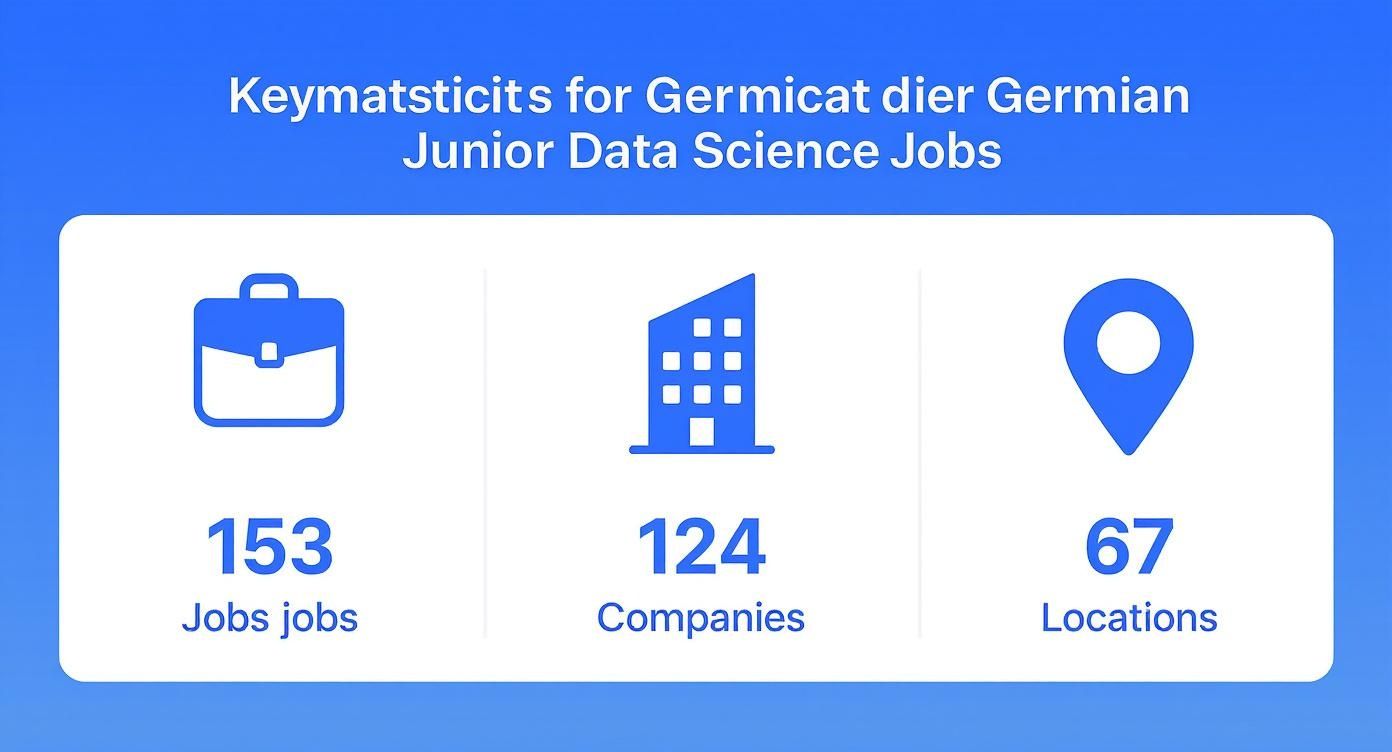
As you can see, even with the usual market ups and downs, there’s a solid base of companies actively looking for new talent across the country. This tells us the demand for data skills is here to stay.
Key Trends and Salary Insights
The job market for junior data scientists in Germany can be quite fluid. For instance, data from late October 2025 showed 153 active job listings. While this was a significant drop of about 75% from the previous quarter, it’s important to look at the bigger picture. Germany still had a healthy ecosystem with 124 companies hiring across 67 different cities. If you want to dive deeper into these figures, Jobtensor's latest statistics report is a great resource.
This kind of volatility is exactly why having a standout profile is non-negotiable. Now, let’s talk money. For a junior role, your salary will largely depend on where you are and the size of the company.
In major hubs like Munich or Berlin, a junior data scientist can realistically expect a starting salary between €50,000 and €65,000 per year. In a smaller city or at a young start-up, the offer might be a bit lower, but the trade-off is often incredible hands-on experience that can fast-track your career.
Knowing these benchmarks is crucial. It gives you the confidence to negotiate your worth and helps you weigh your options when an offer comes through. The bottom line is this: while the number of job ads might fluctuate, the fundamental need for skilled data professionals isn't going anywhere. It’s a promising field, but one where you have to be prepared to really prove your value.
Building a Portfolio That Gets You Hired
Your CV might get your foot in the door, but it’s your portfolio that truly closes the deal. For anyone starting out as a junior data scientist, a solid portfolio isn't just a nice-to-have; it's your proof of what you can actually do. This is your chance to move beyond textbook examples and show a hiring manager you can handle a project from start to finish.
Think of each project as a complete story. It should start with a real problem, walk through the often messy process of data cleaning and exploration, and conclude with insights that actually mean something. Having this all documented in a clean, organised GitHub repository is absolutely critical.
Showcase Your Problem-Solving Chops
Hiring managers are looking for more than just technical skills. They want to see how you think. Honestly, a project where you wrestle with messy, real-world data from a German open-data portal is far more impressive than a flawless analysis of a squeaky-clean, classic dataset. It’s your ability to navigate the imperfections and explain why you made certain choices that will make you stand out.
Try to align your projects with the industries you're actually interested in. If you're targeting junior data scientist jobs in e-commerce, why not analyse customer behaviour or build a simple recommendation engine? For more project ideas and career tips, you can find some great stuff over on the Jobco.de blog.
A strong portfolio instantly answers three questions for an employer: Can you find and clean relevant data? Can you pull meaningful insights from it? And can you explain what you found to someone who isn't a data expert?
How to Structure and Present Your Projects
The way you present your work on GitHub speaks volumes. A well-structured repository immediately signals that you're a professional who cares about clarity and organisation.
Here’s what every project should include:
- A Solid README.md File: Treat this as your project’s front page. It needs to clearly outline the project's goal, where the data came from, the methods you used, and what you discovered in the end.
- Clean Jupyter Notebooks: Make sure your notebooks are easy to follow. Comment your code, explain your thought process, and use plots and charts to visualise your results. No one wants to decipher a wall of uncommented code.
- A Final "Product": This doesn’t have to be complicated. It could be a link to a simple dashboard, a slide deck, or a blog post that summarises your findings for a non-technical audience. This is how you prove you have the communication skills every data scientist needs.
Crafting Your CV for German Recruiters

When you're trying to land junior data scientist jobs in Germany, sending out a generic CV is the fastest way to get your application tossed. From my experience, German recruiters are looking for something very specific: they value clarity, a logical structure, and hard proof of your skills. Your real job here isn't just to list what you've done, but to build a narrative that makes them think, "This is the person we need."
Forget simply listing your university courses. You need to reframe your academic experience into tangible projects. That thesis you wrote on complex data analysis? It wasn’t just a paper. It was a full-blown project where you managed a dataset from start to finish, applied sophisticated models, and produced actionable insights. That's the language recruiters understand.
Highlighting Your Technical Stack
Your technical skills section needs to be sharp, precise, and incredibly easy to scan. Hiring managers in Germany want to see your core competencies in seconds. Ditch vague phrases like "proficient in programming" and get specific.
I always recommend organising your skills into clear, logical categories. It just makes it easier for them to tick their mental boxes.
- Programming Languages: Python (Pandas, NumPy, Scikit-learn), R, SQL
- Databases: PostgreSQL, MySQL, NoSQL (e.g., MongoDB)
- Data Visualisation: Tableau, Power BI, Matplotlib, Seaborn
- Cloud Platforms: Basic exposure to AWS, Azure, or Google Cloud Platform
This kind of structured layout immediately signals that you understand the data science ecosystem and lets a recruiter quickly confirm you have the right tools for the job.
Your academic CV might have gotten you through university, but the industry demands a different approach. The table below shows how to shift your mindset from an academic summary to a results-driven professional document.
Standard CV vs Data Science-Optimised CV
| CV Section | Standard Approach (What to Avoid) | Data Science-Optimised Approach (What to Do) | | :--- | :--- | :--- | | Experience | Listing course titles like "Advanced Statistics" or "Machine Learning Theory." | Describing your master's thesis as a project: "Led a 6-month research project on predictive modelling, achieving an 85% accuracy rate..." | | Skills | A long, unstructured list of every technology you've ever touched. | A categorised list (e.g., Languages, Databases, Cloud) focusing on tools relevant to the job description. | | Projects | A brief mention of a "University Project" with no context. | A dedicated section with 2-3 key projects. Each entry details the problem, the methods used (e.g., "Used Scikit-learn to build a classifier..."), and the outcome. | | Summary | A generic objective statement like "Seeking a challenging role in data science." | A sharp professional summary: "Aspiring Data Scientist with hands-on experience in machine learning and data visualisation, proven through projects in customer segmentation..." |
As you can see, the optimised version is all about demonstrating impact and providing concrete evidence of your abilities, which is exactly what hiring managers want to see.
The goal of your CV is not just to list what you know, but to prove what you can do. Every line item should answer the silent question from the recruiter: "How does this skill solve my company's problems?"
This is where your cover letter, the Anschreiben, comes into play. It’s your chance to connect the dots. Don't just rehash your CV. Pick one or two crucial requirements from the job description and show them—don't just tell them—how you meet them with a specific project example.
For instance, if they need someone to analyse customer behaviour, you could write about your e-commerce project where you used Python and clustering algorithms to segment users, leading to a potential 15% increase in targeted marketing effectiveness. This direct, tangible connection makes your application feel personal and highly relevant.
It’s this strategic thinking that elevates your application from a simple summary to a compelling pitch for one of the most competitive junior data scientist jobs on the market.
A Smarter Strategy for Job Hunting and Networking
Just spamming applications on the big, generic job boards is a slow, frustrating way to land a great junior data scientist role. Let’s be honest, it rarely works. A much smarter, more proactive approach is what’s needed to actually get noticed.
You'll have a much better chance if you go beyond the huge aggregators. Start targeting company career pages directly. This is especially true for Germany's small to medium-sized businesses (Mittelstand), as many of them don't advertise on the mainstream platforms.
Your LinkedIn profile also needs to be more than just a digital CV; it should be an active search tool. Use the filters to zero in on recruiters who specialise in data roles right here in Germany. A short, personalised connection request that shows you’ve done your homework is worlds more effective than hitting "Apply" with a generic profile.
Know Where to Look: Focus Your Search Geographically
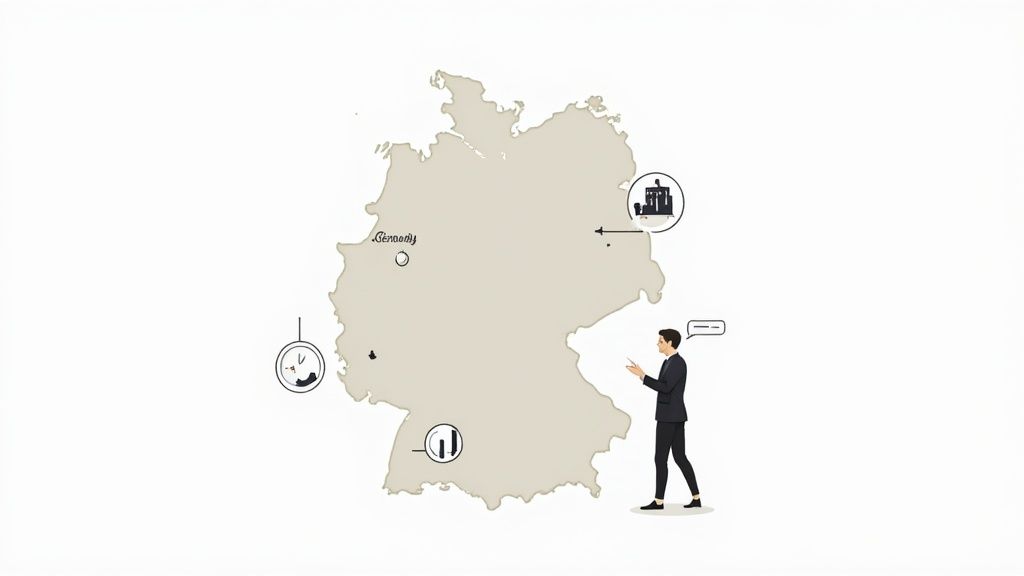
Data science jobs aren't spread evenly across the country. Germany has very distinct employment hubs, and knowing where they are is a huge advantage. Munich, for example, is a powerhouse for analytics roles. Berlin, on the other hand, is famous for its booming tech start-up scene, which is hungry for data scientists.
Focusing your search on these clusters means you’re putting your energy where the opportunities actually are. You can get a much clearer picture of these regional job markets and see how companies are hiring across 67 different locations in Germany.
This targeted approach often lets you bypass the crowded, impersonal application portals. Getting your CV directly into the hands of a real person—a hiring manager or a recruiter—dramatically improves your odds.
How to Network Effectively in Germany
Networking isn't about collecting contacts; it's about building real connections that can open doors to those "hidden" jobs that are never advertised.
Here’s how to do it right:
- Engage on the Right Platforms: Find and follow data science leaders and specialist recruiters in Germany on platforms like LinkedIn and XING. Don't just be a lurker—leave thoughtful comments on their posts. It’s a simple way to show you know your stuff.
- Show Up at Local Meetups: Search for local Python, R, or data science meetups. Cities like Berlin, Hamburg, and Munich have very active communities. These events are fantastic for meeting other professionals in a much more relaxed, informal setting than a job interview.
- Contribute to Open-Source Projects: Getting involved in an open-source project in your field is a brilliant way to network. You’ll be collaborating with experienced developers and potential employers, all while building your portfolio.
When you combine direct applications with this kind of proactive networking, you’re building a much more robust and effective job-hunting strategy. If you're looking for tools to help streamline and manage this process, you might want to see what options are available on Jobco.de.
Acing Your Technical and Cultural Interviews
https://www.youtube.com/embed/knV-opnQTbw
The interview is your final proving ground. It’s where you have to show them you’ve got the technical chops, but just as importantly, how you think, work with others, and whether you'll genuinely fit in with the team. You should be ready for a multi-stage process that will probe everything from your SQL skills to your problem-solving mindset.
For junior data scientist roles, a live coding challenge or a take-home assignment is pretty standard. If you get a live coding test, the biggest tip I can give is to practise thinking out loud. Your interviewer is often more interested in how you tackle a problem than whether you write flawless code on the first try.
Preparing for Technical Questions
The technical rounds almost always zero in on the core concepts. You can bet on getting questions about probability, statistics, and the fundamentals of machine learning. You need to be able to explain something like a decision tree or a p-value as if you were talking to someone non-technical.
Here’s a taste of what you can expect:
- SQL Queries: Get ready to write queries using joins, aggregations, and window functions on the spot. They'll give you a sample dataset and a problem to solve.
- Probability Puzzles: These are less about stats and more about your logical reasoning. Dust off some of those classic brain teasers to get your mind sharp.
- Model Explanation: You'll almost certainly be asked to walk them through a project from your portfolio. Be prepared to defend why you chose a specific algorithm and, crucially, how you measured its performance.
I can't stress this enough: consistent practice is the only way through. Don't just memorise definitions. Get your hands dirty on platforms like LeetCode or HackerRank and actually solve problems. That’s how you build real confidence, not by cramming.
Showcasing Your Cultural Fit
Technical skill gets your foot in the door, but your personality and ability to collaborate get you the job. Companies want to hire people they'll enjoy working with, which is where behavioural questions come in.
The best way to handle these is with the STAR method (Situation, Task, Action, Result). It’s a simple framework that forces you to give concrete, evidence-based answers instead of vague stories.
For example, when they ask about a challenging project, don’t just talk about the problem. Detail the specific actions you took to solve it and what the measurable outcome was. This turns a simple anecdote into compelling proof that you’d be a valuable addition to their team.
Common Questions About Data Science Jobs in Germany

Trying to break into the German job market for the first time? It’s natural to have a lot of questions. Getting the right answers can make all the difference, helping you focus your search for junior data scientist jobs and show up as a confident, clued-in candidate.
Let's clear up a few of the most common uncertainties I see from aspiring data scientists looking to work in Germany.
Do I Really Need a Master's Degree to Get Hired?
This is probably the biggest question on everyone's mind. While a Master's in a field like computer science or statistics is definitely common and highly regarded, it's not always a deal-breaker. A strong, practical portfolio can speak volumes.
If you can clearly showcase your skills in Python, SQL, and machine learning through real-world projects, you can absolutely get a foot in the door without that advanced degree.
Be aware, though, that this depends on the company. For many traditional German firms, especially the well-established Mittelstand, a Master's degree is often still the expected standard.
How Important Is Speaking German?
The honest answer: it depends. The good news is that in major international hubs like Berlin or Munich, many tech companies and start-ups operate almost entirely in English. You can definitely build a fantastic career without being fluent.
On the other hand, for more traditional German companies or any role that involves dealing directly with local clients, fluency in German often becomes non-negotiable.
Even if the job ad is in English, making an effort with some basic German can give you a real edge. It shows recruiters you're serious about integrating into the company and local life, and that’s a big plus.
What Are the Must-Have Technical Skills?
To be competitive, you need to nail the fundamentals. Absolute proficiency in Python (including key libraries like Pandas and Scikit-learn) and a solid command of SQL are the baseline. Don't even apply without them.
Beyond that, experience with data visualisation tools like Tableau or Power BI is a huge advantage. And increasingly, even for junior roles, having some familiarity with cloud platforms like AWS or Azure can be the key differentiator that sets you apart from the crowd.
Ready to stop manually searching and start getting interviews? Acquispect uses AI to find your ideal jobs, craft personalised applications, and track your success, giving you back hours every week. Start your free 30-day trial and find your next role faster at Acquispect.