So, you're thinking about using artificial intelligence to help with your job applications? Tools like Acquispect can be a game-changer, helping you craft and fine-tune cover letters in a fraction of the time. It's a modern way to beat writer's block and make sure your application speaks directly to what a company is looking for, giving you a real advantage.
The New Reality of Writing Job Applications with AI
Welcome to the future of job hunting—it's already here. Using AI for your applications isn't some futuristic gimmick anymore; it's a practical skill for anyone serious about landing their next role. These tools are fantastic for slashing the time you spend writing, customising your pitch with near-perfect accuracy, and finally saying goodbye to that dreaded blank page.
Let's be honest, today's job search often feels like a numbers game. Speed is everything. Instead of pouring hours into one "perfect" cover letter, you can generate a solid first draft in minutes. This leaves you with more time to apply for other roles, network, or nail your interview prep.
Beyond Speed, Customisation is Key
The real magic of AI is how it analyses a job description and helps you align your application to match. It's brilliant at sniffing out the exact keywords and skills that Applicant Tracking Systems (ATS) are built to look for. This means your CV and cover letter are far more likely to get past the initial digital gatekeeper and into the hands of a real person.
Think of it as having a personal assistant who reads the job ad and instantly points out which of your skills and experiences you should put front and centre. That’s exactly what AI brings to the table.
The core benefit is not just automation, but intelligent customisation at scale. You can create a unique, targeted application for every single role without the usual time investment, significantly increasing your chances of getting noticed.
Before we move on, let's quickly break down how AI can fit into your workflow.
AI in Your Application Process at a Glance
This table gives a quick summary of how AI can assist at each stage of writing your job application.
| Application Stage | How AI Helps | Key Benefit | | :--- | :--- | :--- | | Brainstorming | Generates initial ideas and structures for your cover letter. | Overcomes writer's block and provides a starting point. | | Drafting | Creates a complete first draft based on your CV and the job description. | Saves hours of writing time. | | Customisation | Identifies and helps you integrate keywords from the job ad. | Increases your chances of passing ATS scans. | | Optimisation | Suggests improvements to tone, clarity, and overall impact. | Ensures your application is polished and professional. |
As you can see, AI isn't just a one-trick pony; it’s a versatile partner throughout the entire writing process.
A More Level Playing Field
These tools are also making the job market a bit fairer. It doesn't matter if you're fresh out of university or a seasoned pro; AI can help you create a high-quality application that presents your skills in the best possible light. It’s all about working smarter.
With Germany's tech sector booming—experts predict over 137,000 job openings in fields like AI and cybersecurity by 2025—making your application stand out is non-negotiable. If you're curious, you can learn more about what an AI career in Germany looks like.
This shift lets you focus on what really matters: telling your story and showing your unique value. Let the AI handle the grunt work while you concentrate on strategy. It's a powerful partnership between your human experience and the tool's efficiency.
Picking the Right AI Tool for Your Application
So, you’re ready to bring AI into your job search. Smart move. But navigating the options can feel a bit like the Wild West. You’ve basically got two camps: the big, do-everything AI models and the specialized tools built from the ground up just for job seekers. Knowing which path to take makes all the difference.
On one side, you have the generalists like ChatGPT or Gemini. These are incredibly powerful, almost like having a universal creative assistant. You can throw anything at them—ask for a cover letter, get ideas for interview answers, you name it. They offer a ton of flexibility if you know how to steer them.
The catch? That flexibility is also their biggest challenge. Getting a truly great cover letter out of them is all on you. You have to feed them the perfect prompt, giving them your CV, the job ad, and painstakingly detailed instructions on the exact tone and style you want. A lazy prompt gets you a lazy, generic letter that recruiters can spot a mile away.
Generalists vs. Specialists
This is where the specialist tools really shine. Platforms designed specifically for writing German applications, or künstliche intelligenz bewerbung schreiben, aren't just blank slates; they're more like precision-guided systems. They’ve already been trained on what makes an application stand out to a hiring manager.
With these, you're not trying to teach a general AI how to write a cover letter. Instead, you usually just upload your CV, paste a link to the job ad, and let the software do the heavy lifting. It knows how to pull out the right keywords, match your skills to the role, and draft something compelling right from the start. It's a much more guided experience.
Ultimately, it's a classic trade-off: do you want total creative control or streamlined efficiency? General AI gives you a blank canvas but demands a lot of skilled direction. A specialised tool gives you a clear, proven path to a strong application with far less guesswork.
Think about your own process. Do you love getting under the hood, tweaking prompts, and fine-tuning every single word? A general model could be your playground. But if your goal is to send out several high-quality, tailored applications without spending all day on them, a dedicated platform is almost certainly the smarter choice.
Key Features to Look For
No matter which tool you lean towards, there are a few features that are absolutely essential for making an impact in the competitive German job market.
- Job Ad Analysis: The AI has to be able to digest the job description and truly understand what the employer is looking for—the skills, the keywords, and even the company's vibe.
- CV Integration: It must seamlessly connect the dots between the job requirements and your personal experience, pulling the most relevant details from your CV into the letter.
- Tone and Style Customisation: You need the ability to shift the tone. A letter for a hip tech start-up shouldn't sound the same as one for a buttoned-up financial institution.
- ATS Optimisation: The best tools will actively help you get past the initial screening robots by suggesting crucial keywords you might have missed.
The real goal is to find a tool that fits how you work best. If you're looking for an efficient, guided process that delivers consistent results, it’s worth exploring a tool built for the job. You can get a good feel for how these platforms operate by checking out the features of an AI Job Application Copilot. It’s a great way to see the difference for yourself.
A Practical Guide to Crafting Your Cover Letter with AI
Alright, let's get down to business. Using AI for your cover letter isn't about hitting a button and blindly sending off whatever pops out. Think of it as a partnership: you bring the strategy and personal insight, and the AI handles the heavy lifting of structure and speed. This is where theory turns into actual interviews.
The absolute golden rule when using künstliche intelligenz bewerbung schreiben tools is this: garbage in, garbage out. A vague request like "write a cover letter for a marketing job" will get you a document so bland it's basically invisible to recruiters. You have to be specific.
Mastering the Prompt
Your prompt is your command. Imagine you're a director guiding an actor—the more context and direction you give, the better the performance. A really effective prompt needs three key ingredients:
- Your Personal Data: Don't just summarise. Paste in your entire CV or a detailed breakdown of your career, including key achievements and specific skills. Always quantify your successes if you can (e.g., "Grew sales by 15% in six months").
- The Job Description: You need to provide the full text of the job advert. This is how the AI learns the company's language, understands the required qualifications, and picks up on the keywords their Applicant Tracking System (ATS) is probably scanning for.
- Your Instructions: This is where you inject the human element. Be direct about the tone you want, whether it's "professional yet approachable," "formal and respectful," or "enthusiastic and innovative." You can also tell it to focus on certain experiences, like a career change or a major project that’s highly relevant to this new role.
By combining your detailed personal history with the specific requirements of the job ad, you're essentially programming the AI to build a bridge between who you are and what the company needs. This is the secret to moving beyond generic templates.
This helpful infographic breaks down the decision you'll face when choosing the right AI tool for the job.
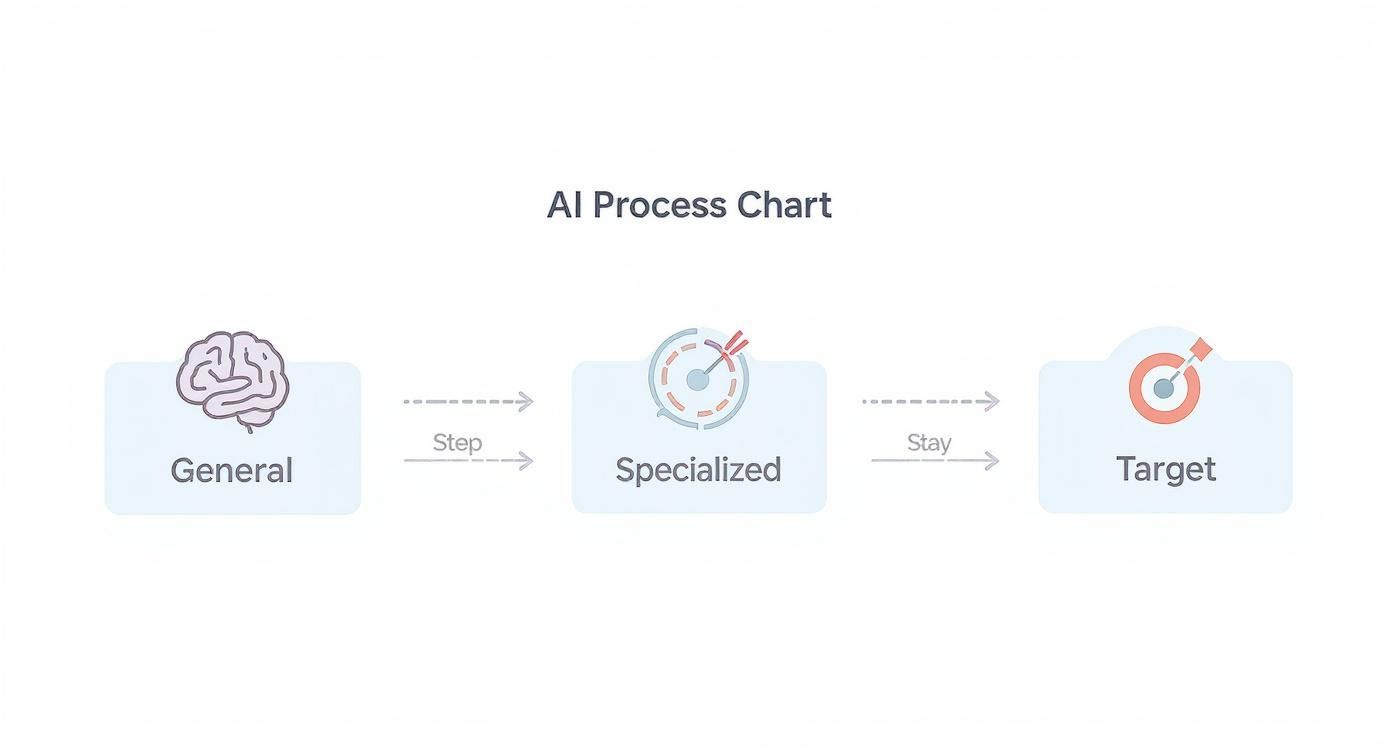
As you can see, there's a clear difference between general-purpose AI, which requires more work from you, and specialised tools designed to give you a more targeted, streamlined result.
Refining the AI-Generated Draft
Once the AI gives you that first draft, your real work begins. Treat the initial output as your raw material, not the finished product. Your job now is to refine it, inject your personality, and double-check every single claim.
First, read it out loud. Does it actually sound like you? AI can sometimes produce slightly clunky or overly formal phrasing. Go ahead and tweak sentences to match your natural way of speaking. If you'd say "use" instead of "utilise," make the change. The goal here is authenticity.
Next, you need to fact-check everything. AI can occasionally "hallucinate" and invent or embellish details. Did it claim you have a skill you don't? Did it misrepresent a project's outcome? At the end of the day, you are the one responsible for this document, so verify every sentence.
This is particularly important in Germany's fast-growing AI sector. The German AI market is projected to be worth nearly 30 billion euros by 2030. Despite this, only about 32% of German businesses had adopted AI by 2023, often because of a lack of skilled people. This just goes to show how crucial it is to represent your skills accurately. You can learn more about the state of AI in Germany.
Adding Your Unique Voice and Story
This last step is the most important. It's where you add your personal narrative. AI is brilliant at structure and keywords, but it can't share your passion or your personal "why."
- Inject a Personal Anecdote: Add a short sentence or two about what specifically excites you about this company's mission or a recent project they launched. Show you've done your homework.
- Show, Don't Just Tell: The AI might write something generic like, "I have strong leadership skills." You need to transform that into something concrete: "In my previous role, I led a team of five to successfully launch the new XYZ app ahead of schedule."
- Customise the Closing: Don't settle for a generic sign-off. End with a strong, confident closing that restates your enthusiasm and links back to a key requirement from the job description.
This refinement process is absolutely essential. It's what takes your application from being a competently written document to a compelling personal pitch that makes a recruiter genuinely want to meet you.
Optimising Your Resume and Entire Application with AI
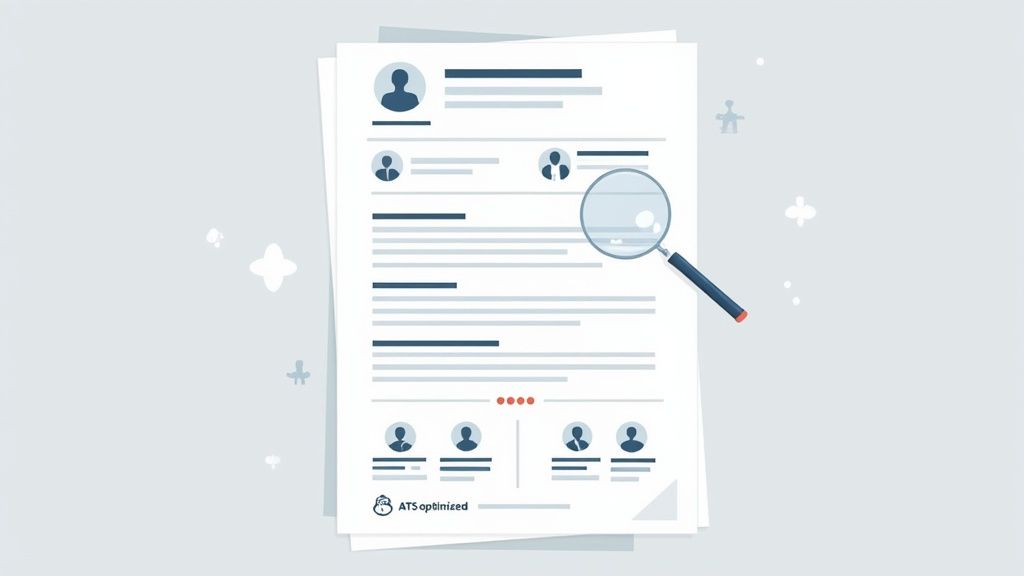
A fantastic cover letter is a great start, but it's really only half the story. To truly stand out, your entire application—especially your CV—needs to sing from the same hymn sheet. This is where moving beyond just the cover letter and using AI to fine-tune your whole package gives you a serious edge.
Think of your application as a single, compelling narrative. The CV lays out the hard facts and evidence of your career, while the cover letter injects your personality and tells the story behind those facts. If they feel like they were written by two different people for two different jobs, you’re sending mixed signals. AI can be the secret weapon that ensures every document is perfectly aligned.
For example, let's say your AI-generated cover letter beautifully highlights your project management skills. The next logical step is to ask that same AI to scan your CV. It can suggest rephrasing bullet points from your past roles to echo that strength, perhaps by using more impactful verbs or highlighting specific metrics. This creates a powerful, unified impression that recruiters notice.
Beating the Applicant Tracking Systems
Here’s a hard truth: before a human ever lays eyes on your application, it almost always has to get past an Applicant Tracking System (ATS). These are the automated gatekeepers of the hiring world. In fact, it's estimated that a staggering 75% of CVs are filtered out by an ATS without ever reaching a hiring manager, often for something as simple as missing the right keywords.
This is arguably where AI provides the most immediate value. By giving an AI tool both your CV and the job description, you can ask it to run a head-to-head comparison. It will instantly pinpoint the exact keywords and phrases from the job ad that your CV is missing.
The goal isn’t to deceptively stuff your CV with buzzwords. It’s about making sure the skills and experience you already have are described using the specific language the ATS is built to look for. This subtle shift can be the difference between your application being automatically discarded and landing in the "interview" pile.
This process of künstliche intelligenz bewerbung schreiben (using AI to write applications) allows you to tailor every last detail for maximum impact.
How to Use AI for CV Optimisation
So, how does this work in practice? Here are a few ways you can direct an AI to whip your CV into shape for a specific role:
Keyword Matching: Feed the AI your CV and the job ad. A good prompt would be, "Analyse this job description and suggest 5-7 keywords I should integrate into my CV. Show me exactly where they would fit best in my experience section."
Bullet Point Enhancement: Take a few bullet points from one of your previous jobs. Ask the AI, "Rewrite these points to be more results-focused. Use the STAR method (Situation, Task, Action, Result) and quantify the impact where possible."
Skills Section Alignment: Give the AI your current list of skills alongside the job requirements. Try prompting it with, "Based on this job's requirements, which of my skills should I feature most prominently? Suggest a re-ordered list for my 'Skills' section."
Taking this methodical approach transforms your CV from a generic, one-size-fits-all document into a highly targeted and persuasive tool. You're essentially pre-screening your own application to speak the language of both the ATS and the recruiter, making your entire submission feel deliberate, professional, and too good to ignore.
Common Mistakes to Avoid When Using AI for Applications
https://www.youtube.com/embed/HQv8aqsDocg
AI can be a brilliant co-pilot for your job search, but letting it take the wheel completely is a surefire way to land your application in the rejection pile. The biggest trap I see job seekers fall into is over-reliance. This leads to generic, soulless applications that any seasoned recruiter can spot from a mile off.
Remember, the whole point is to enhance your unique story, not to have a machine write it for you. This means that just generating a letter and sending it off without a second thought is a huge mistake. The tool gives you a great starting point, but it's your job to build on that foundation with your own personality and precision.
Blindly Trusting What the AI Writes
One of the most dangerous things you can do is assume everything the AI churns out is gospel. These models are designed to create text that sounds convincing, but they don't actually know anything. They can, and often do, just make things up.
This can pop up in a few sneaky ways:
- Inventing Skills: The AI might confidently list a piece of software you’ve never touched, just because it’s often linked to your job title.
- Misrepresenting Company Details: It could mention a recent company project or award that is completely fictional, making you look like you didn't do your homework.
- Creating "Hallucinations": This is the term for when an AI generates information that is nonsensical or entirely fabricated.
Every single detail in your application, from your skill set to the facts about the company, has to be checked by you. You are the final fact-checker, and your professional reputation is on the line.
The use of AI tools also varies massively across Germany. A 2025 study highlighted that while 43% of Germans aged 18-29 use generative AI every week, this figure plummets to just 8% for those over 65. This generational divide means you can't assume every recruiter understands AI's little quirks. That makes it even more critical that your final application is absolutely flawless. You can dig into more of these demographic trends in AI adoption if you're curious.
Neglecting the Final Human Proofread
The last mistake is also the easiest one to sidestep: skipping that final, careful human proofread. No matter how sophisticated the tech gets, it still can’t fully grasp the subtle nuances of human language.
After you've injected your personality and double-checked all the facts, take a moment to read the entire application out loud. Does it actually sound like you? Are there any clunky phrases or overly stiff sentences? This step is absolutely non-negotiable if you're serious about using künstliche intelligenz bewerbung schreiben tools to get ahead.
To make it even clearer, here's a quick rundown of what to do and what to avoid.
AI Application Writing Do's and Don'ts
| Do | Don't | | :--- | :--- | | Use AI as a brainstorming partner to generate initial ideas and structure. | Accept the first draft without any changes or critical review. | | Verify every fact, skill, and company detail the AI provides. | Assume the AI's output is 100% accurate or factual. | | Inject your own personality, anecdotes, and unique tone of voice. | Submit a generic letter that sounds like it could be from anyone. | | Read the final version out loud to catch awkward phrasing and errors. | Skip the final human proofread before sending it. |
Ultimately, it’s that personal touch that makes your application compelling and secures you the interview. The AI is just the tool; you're the one who has to make it shine.
Got Questions About Using AI for Your Job Application?
It's completely normal to have a few questions when you start using AI in your job search. Let's walk through some of the most common ones I hear from people, so you can move forward feeling confident.
Is This Cheating? Is It Ethical to Use AI?
Not at all, provided you use it the right way. The best way to think about an AI tool is as a super-powered assistant—it's there to help you brainstorm, clean up your grammar, and get past that dreaded writer's block. It's not there to lie for you.
Where you'd cross an ethical line is if you used it to invent skills you don't actually have or to fabricate parts of your work history. But using it to polish your existing experience and present your genuine qualifications in the best possible light? That’s just smart, not deceptive.
Can Recruiters Tell I Used AI?
Honestly, yes—if you’re lazy about it. A hiring manager has seen hundreds, if not thousands, of applications. They can spot a purely AI-generated letter a mile away. It just sounds a bit...off. The tone is generic, it lacks personal stories, and the phrasing can feel a little clunky or unnatural.
But that's not how you're going to use it. You're going to take the draft the AI gives you and make it your own. By weaving in your personality, adding specific examples, and adjusting the language to sound like you, the final product becomes impossible to flag. It's the perfect blend of machine-driven structure and your own human touch.
Your goal isn't to trick anyone. It's to use the tool so effectively that what you send is a true reflection of you—your voice, your accomplishments, your personality—just more polished and powerfully structured.
What Are the Best Free AI Tools to Start With?
If you're just dipping your toes in, there are some great free options out there. The free versions of general tools like ChatGPT, Claude, and Gemini are fantastic for getting initial ideas down, drafting a rough version, or just finding a better way to phrase a tricky sentence.
They’re very flexible, but you'll get much better results if you learn how to write good prompts. For more on that, you can find a ton of tips and tricks on our job application advice blog that will help you get the AI to give you what you actually want.
How Can I Make an AI-Generated Application Sound Like Me?
This is the most important part of the whole process. Turning a generic AI draft into something that truly represents you is what gets you the interview. Here’s a quick checklist I always recommend:
- Read it out loud. This is the fastest way to find anything that sounds stiff, formal, or just not like you. If you wouldn't say it in a conversation, change it.
- Inject a personal story. Find a spot to add a short, specific anecdote. Talk about a project you were proud of or a challenge you overcame. Nothing connects better than a real story.
- Tweak the vocabulary. Swap out any generic buzzwords or verbs with the words you'd naturally use.
- Double-check every single fact. AI can sometimes "hallucinate" or make things up. Make sure every single claim about your experience is 100% accurate and something you can back up in an interview.
Following these steps ensures your unique voice and personality shine through.
Ready to stop wrestling with generic drafts and start creating perfectly targeted applications in a fraction of the time? Acquispect is built to analyse job descriptions and craft compelling cover letters from your profile. Give the 30-day free trial a go and see how much faster you can start landing interviews. Learn more and get started today!