Thinking about a career change at 40 isn't about taking a step backward. Far from it. It's about making a calculated, strategic move forward, using decades of hard-won wisdom to build a professional life that truly fits who you are now. It’s a conscious choice to find a path that aligns with your evolved values, where purpose often matters more than just the paycheque.
Your experience isn't a liability; it's your greatest competitive advantage.
Why a Career Change at 40 Is a Powerful Move

The idea of a karrierewechsel mit 40 can feel intimidating, like you're being forced to start all over again. But that perspective completely misses the incredible value you bring to the table. Think about all the years you've spent navigating tricky projects, managing difficult personalities, and putting out real-world fires. That has built a kind of resilience and emotional intelligence that younger candidates simply haven't had the time to develop.
This isn't about throwing away your past. It's about rebranding it. You've collected a treasure trove of transferable skills that are desperately needed in any industry.
Your Experience Is Your Greatest Asset
Let's get one thing straight: the narrative that you're "too old" is not only outdated, it's just plain wrong, especially in Germany's current job market. Companies are finally waking up to the immense value of seasoned professionals. Your background gives you a unique mix of stability, proven reliability, and a deep-seated understanding of how businesses actually work.
Consider what you’ve already mastered:
- Problem-Solving Prowess: You’ve probably faced and fixed more professional roadblocks than you can even remember. That battle-tested experience means you find effective solutions faster.
- Refined Emotional Intelligence: Knowing how to read a room, mentor a junior team member, or smooth over a tense client relationship is a skill you've polished over years, not just read about in a book.
- Big-Picture Perspective: You don’t just see the task in front of you; you see how it connects to the company's wider goals, a strategic viewpoint that often eludes less experienced employees.
A career pivot at 40 isn't an admission that your old career didn't work out. It's a declaration of ambition for your next one, fuelled by the wisdom you've already earned.
A Welcoming Market for Seasoned Professionals
The German job market isn't just open to experienced workers; it's actively looking for them. With an aging workforce and the baby boomer generation heading into retirement, companies are facing huge skills gaps that need to be filled.
In fact, the data backs this up. The employment rate for older workers (55-64) in Germany recently hit a record high of 75.2%. That's a massive jump from just 55.3% back in 2009. You can explore more data about German employment trends to get the full picture.
This demographic shift is your opportunity. Companies need your expertise to keep things running smoothly and to drive future growth. Your career change isn't just a personal goal—it perfectly meets a pressing economic need, creating a fantastic opening for your next chapter.
Building Your Foundation with a Deep Self-Assessment
Before you even touch your CV or start scrolling through job boards, the very first step in a successful karrierewechsel mit 40 is taking a serious, honest look at yourself. This isn't just a quick skim of your past job titles. It’s about getting back in touch with your professional DNA to make sure your next move is driven by genuine purpose, not just pressure or panic.
It's completely normal to lose sight of what truly excites you after a couple of decades in the workforce. Your career path might have been shaped more by circumstance and necessity than by what you're genuinely passionate about. Now's your chance to hit pause and reconnect with what actually motivates you. Think of this as laying the groundwork; it's the compass that will guide every decision you make from here on out.
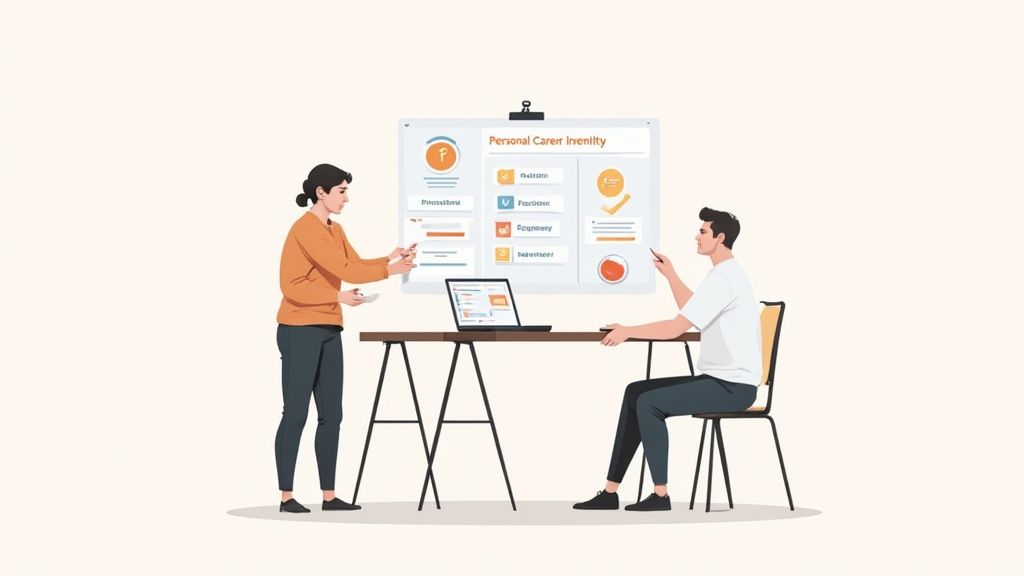
Creating Your Personal Career Inventory
The aim here is to shift your focus from what you can do to what you truly want to do. A great way to start is by seeing your career not as a straight line, but as a portfolio of different experiences, projects, and roles. This simple reframing can help you spot hidden talents and rediscover passions you’d long forgotten.
Cast your mind back over specific moments in your career:
- When did you feel completely in the zone, totally engaged and energised? What exactly were you doing?
- Which projects made you lose all track of time?
- What kind of problems do you actually enjoy tackling, even the really tough ones?
Reflecting on these questions helps uncover patterns. For instance, you might find that while your job title was "Sales Manager," the bits you actually loved were mentoring junior team members and digging into market data. Those are big clues pointing you towards a future in training, coaching, or analytics.
Self-assessment isn't some mystical quest to find your one "dream job." It’s about building a practical, clear picture of the work, environment, and values that will let you do your best work in this next chapter.
Mapping Your Skills and Passions
Once you've gathered these positive memories and insights, it’s time to drill down into the specifics. This is all about separating your hard skills, your genuine interests, and your absolute deal-breakers. A bit of structure here ensures you don’t miss anything important and helps you build a solid blueprint for your job search.
To help you get organised, I’ve put together a simple framework. This table is designed to bring clarity, preventing you from accidentally slipping back into roles that look familiar but leave you feeling uninspired.
Self-Assessment Framework for Your Career Change
This table is your personal inventory—a tool to help you map out your skills, interests, and what you really need from your next career.
| Area of Reflection | Guiding Questions | Your Notes/Examples | | :--- | :--- | :--- | | Core Skills | What are my proven, marketable abilities? (e.g., project management, data analysis, public speaking) | "Led cross-functional teams to deliver projects 15% under budget." | | Untapped Passions | What hobbies or interests could become professional skills? (e.g., photography, writing a blog, coding) | "Spent weekends building a small web app for my local sports club." | | Work Environment | In what type of culture do I thrive? (e.g., collaborative, autonomous, fast-paced, structured) | "Prefer a smaller team where my individual contribution is clear and valued." | | Non-Negotiables | What are my absolute deal-breakers? (e.g., flexible hours, specific salary, location, company values) | "Must have home office options at least two days per week. Commute under 45 minutes." |
Filling this out does more than just give you a list of keywords for your CV. It equips you with the language and stories you need to confidently explain your career change in interviews and networking conversations. This is the solid foundation your entire karrierewechsel mit 40 will be built on, ensuring your next move is not just a guess, but a strategic and fulfilling step forward.
Sharpening Your Skills for Today's Job Market

Once you've done the soul-searching and have a clear direction, it's time to roll up your sleeves. Your karrierewechsel mit 40 now enters the skill-building phase. This isn't about collecting a random handful of certificates. Think of it as a focused mission to bridge the gap between who you are today and the professional you want to become tomorrow. The goal is to be more than just qualified; it's to be a top contender.
The best way to figure out what skills you need is to play detective. Dive into job descriptions for the roles that truly excite you. Start looking for patterns. What software, tools, and qualifications pop up again and again? This simple analysis will become your personal learning roadmap, guiding you away from generic courses and toward targeted, high-impact qualifications (Weiterbildung).
Pinpointing the Skills That Matter Most
Let's be realistic: your time is precious. The aim isn't to learn everything under the sun, but to identify the qualifications that will give you the biggest and fastest return on your effort.
You need to think in terms of concrete, in-demand competencies. For instance, if you're pivoting to digital marketing, mastering tools like Google Ads or Meta Business Suite is non-negotiable. An aspiring data analyst, on the other hand, should be laser-focused on getting a certification in Python or SQL, as they are the bedrock languages of the field.
These aren't just extra lines on your CV. They're tangible proof that you're serious and capable.
Here's the magic formula: your extensive professional experience plus fresh, relevant skills. It creates a powerful, unique value proposition that very few other candidates can match. This blend of seasoned wisdom and modern expertise is what will make you stand out.
Practical Ways to Learn in Germany
Germany has a fantastic ecosystem for professional development, but you need a smart plan to navigate it. Your focus should always be on practical application and industry recognition.
Here are a few proven approaches to consider:
- Targeted Certifications: Go for certifications that are recognised and respected within the industry. A "Projektmanagement-Fachmann (IHK)" certificate, for example, carries real weight and formally validates the project management skills you've likely been using for years.
- Specialised Online Courses: Platforms like Coursera and edX, along with local German providers, offer a wealth of specialised Kurse. A focused course in "Agile Methodologies" or "UX/UI Design Fundamentals" can quickly get you up to speed with the specific vocabulary and workflows used in modern, tech-focused roles.
- Hands-On Projects: Nothing speaks louder than a portfolio. If you’re moving into a creative or technical field, theory alone won't cut it. Build a small website, run a social media campaign for a local non-profit, or analyse a public dataset. These projects are undeniable proof of your new skills in action.
The Long-Term Payoff of Upskilling
Investing in new qualifications is much more than a short-term tactic to land a new job. For seasoned professionals, it's a vital part of ensuring long-term career security. Research in Germany paints a clear picture: there's a strong link between higher qualification levels and sustained employment for workers over 50. While finding a new role can get tougher after age 54, those with medium to high qualifications maintain impressively high employment rates well into their late careers. You can learn more about the findings on sustainable working lives in Germany.
This data highlights something crucial: continuous learning isn't just about making this one career change. It’s about building a resilient, future-proof career that can adapt and grow. By strategically upskilling now, you're not only preparing for your next role but also laying the foundation for professional relevance for many years to come.
For more practical tips on your career journey, check out the other articles on the Jobco.pilot blog.
Modernising Your Application Strategy
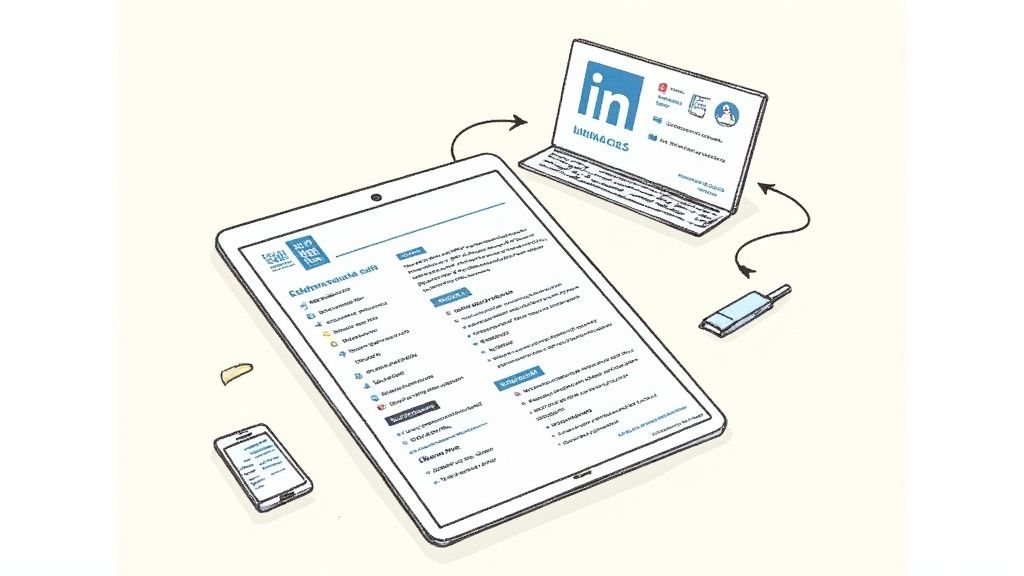
Let's be blunt: the CV and cover letter that landed you a job ten or fifteen years ago just won't cut it for a karrierewechsel mit 40. The hiring game has changed dramatically. It's time to ditch the old-school, chronological list of jobs and build application documents that tell a compelling story about your future, not just your past.
Your new application materials have one clear mission: to draw a direct line from your wealth of experience to the exact needs of the role you're targeting. This isn't just a simple update; it's a complete shift in mindset. You're no longer just listing duties, you're showcasing the value you can bring from day one.
Crafting a Skills-First CV
For anyone changing careers, the traditional CV format can be a real roadblock. It forces a recruiter to look at a career path that might seem, on the surface, completely unrelated to your new ambitions. The solution? A skills-first (or functional) CV.
This approach flips the script. It puts your most relevant abilities right at the top, immediately grabbing the recruiter's attention and showing them you’ve got what they need.
Instead of just listing your old title, "Regional Sales Manager," you'd build sections around key competencies that the new role requires. For instance:
- Team Leadership & Mentoring: Talk about how you trained and developed a team of ten, boosting regional performance by 20%.
- Data-Driven Strategy: Describe how you used market analysis to pinpoint new customer segments, which directly led to a successful product launch.
- Client Relationship Management: Highlight your track record managing key accounts and negotiating high-value, complex contracts.
This structure makes your transferable skills impossible to ignore. It helps a hiring manager see your potential, even if you’re coming from an entirely different field.
Think of your CV less like a historical record and more like a marketing brochure. Its job is to sell your skills and potential for a new future, not just to document your past.
Telling Your Story in the Cover Letter
Your cover letter is where you breathe life into your career change. This is your opportunity to tell the persuasive story that a CV simply can't. Don’t waste the opening sentence stating the obvious ("I'm applying for the role of..."). Jump right in with a powerful statement that connects your experience to what the company needs right now.
A strong cover letter for a career changer needs to do three things well:
- Address the change head-on: Be confident and explain why you are making this deliberate move.
- Connect the dots for them: Explicitly show how skills from your old job are precisely what’s needed in the new one.
- Show real passion: Let your enthusiasm for the new industry shine through. Show them you're committed to making this work.
This narrative approach turns your non-traditional background from a possible red flag into a unique selling point. It proves you're a strategic professional making a well-thought-out decision.
Optimising Your Digital Footprint
These days, your application doesn't stop with the documents you email. Recruiters will almost certainly look you up online, and your LinkedIn and XING profiles are their first stop. It's critical that these profiles are polished and perfectly aligned with your new career direction.
Start with your headline. It needs to reflect your ambition, not your old job title. So, instead of "Senior Logistics Manager," try something like "Aspiring Project Manager | Logistics Expert with a Passion for Agile Methodologies."
Rewrite your "About" section to be packed with keywords from your target field and use it to tell a short, sharp version of your career change story. For a more structured and data-informed job search, tools like those from Jobco.pilot can be a huge help. They can help you find roles that match your new profile and streamline the application process, making sure your optimised brand gets seen by the right people.
Once your application materials are up to snuff, it's time to tap into your single greatest asset: your network. Pulling off a successful karrierewechsel mit 40 is rarely a solo mission. The contacts you've built over decades are a goldmine of insights, warm introductions, and hidden opportunities. You just need a smart way to approach them.
This isn't about spamming everyone you know for a job. Think more along the lines of strategic reconnection and "informational interviews." Get in touch with former colleagues or industry acquaintances who are already in your target field. Ask for just 20 minutes of their time to hear about their role, the industry's real-world challenges, and the skills that actually matter on the ground. This paints you as a proactive researcher, not just another person looking for a job.
Turning Experience Into Your Superpower
Alright, let's talk about the elephant in the room: age bias. It’s a real thing, but you can get ahead of it by flipping the script. Your years of experience aren't a drawback; they're your core advantage. You need to make sure recruiters and hiring managers see your age as a symbol of reliability, advanced problem-solving, and emotional intelligence.
Weave this narrative into your career story by highlighting specific strengths:
- Proven Reliability: Talk about long-term projects you saw through from start to finish or tough situations you helped steer through choppy waters. This screams stability and commitment.
- Sophisticated Problem-Solving: Share a story about a complex crisis you helped untangle. This shows you're not just a rule-follower; you think on your feet when the pressure is on.
- Mentorship and Leadership: Bring up times you've guided junior team members or helped a colleague get up to speed. This positions you as a natural leader and a plus for the team dynamic.
The goal is to make it undeniably clear that you offer a level of wisdom and battle-tested resilience that younger candidates simply haven't had the time to develop.
When you talk about your career change, frame it as a deliberate, strategic move. This wasn't something you were forced into; it was your ambition and foresight guiding you toward a new, exciting chapter.
What's Happening in the German Job Market
It also helps to know what's going on in the wider German workforce, which is aging noticeably. Right now, about 23% of employees paying into social insurance are between 55 and 65. While older workers are generally less likely to be unemployed, getting back into the workforce can be tougher if you do lose a job. On average, they remain unemployed for 23 weeks, compared to 20 weeks for all age groups. You can read more about how the Federal Employment Agency views the aging workforce and its challenges.
This demographic shift is exactly why German companies need age-diverse teams now more than ever. Your experience isn't just a personal benefit; it’s a crucial resource businesses need to stay stable and retain knowledge. When you communicate this value with confidence, you not only push back against bias but also perfectly align your profile with what the market actually needs.
Your Career Change at 40: Answering the Tough Questions
Deciding on a career change in your 40s is one thing; navigating the practicalities is another. You've done the soul-searching and laid out a plan, but a few nagging questions probably remain. Let's tackle them head-on.
Think of this as the final part of your prep work. Getting clear on these common concerns will give you the confidence to move forward, knowing you’re ready for whatever comes next.
How Can I Afford to Make a Career Change?
Let’s be honest: money is a huge factor. A career pivot often means a temporary income dip, so getting your finances in order is non-negotiable. The first step? A simple but detailed budget. You need to know exactly what’s coming in and what’s going out to see where you can trim the fat. This isn't about giving up everything you enjoy, but about taking control.
Your goal should be to build an emergency fund that covers six to twelve months of essential living expenses. That buffer is your safety net, giving you the freedom to focus on your transition without stressing about every bill. Also, don't forget to look into funding opportunities. In Germany, the "Bildungsgutschein" from the Agentur für Arbeit can be a game-changer, covering the costs of retraining and further education (Weiterbildung).
A great way to ease into the change is through a phased transition. Why not take on a freelance project or a part-time gig in your new field while you’re still employed? You'll gain real-world experience and start building a new income stream before you make the final jump.
How Do I Explain My Career Change in an Interview?
This is the question that trips a lot of people up, but it’s actually a fantastic opportunity to shine. Your career change isn't a weakness; it's a story of ambition and strategic thinking. Frame it that way.
When the interviewer asks, lead with confidence. Start by mentioning a key accomplishment from your previous career to show you’re a proven professional. Then, explain your "why." Connect the dots for them. Maybe you discovered a passion for data analysis or wanted to apply your project management skills to a field you truly care about, like green tech. The trick is to show how your unique journey makes you a more valuable and versatile hire than someone who has followed a more linear path.
What are the Most Promising Fields for Career Changers in Germany?
If you're making a move, you want to land somewhere with plenty of opportunities. The smartest strategy is to target sectors in Germany that are desperate for skilled people. These industries are often far more open to hiring candidates from different backgrounds.
Here are a few hot spots right now:
- IT and Tech: The demand for specialists in cybersecurity, data science, and cloud computing is relentless.
- Green Energy & Sustainability: With Germany's focus on a green transition, there's a huge need for experts in renewables and environmental management.
- Healthcare & Social Services: An aging population means this sector is constantly expanding and looking for dedicated professionals.
- Digital Marketing: Every company needs to be online, and they need people with strategic minds to guide them.
What’s great about these fields is that they value transferable skills. Your years of experience in project management, communication, and leadership are exactly what these growing industries are looking for. Your background isn't something to overcome; it's your competitive advantage.
Ready to make your job search smarter, not harder? Acquispect uses AI to find the best jobs for you, creates tailored applications in minutes, and tracks your success so you can focus on what matters—landing more interviews. Start your free 30-day trial and see the difference data-driven job searching can make. Find your next opportunity faster.