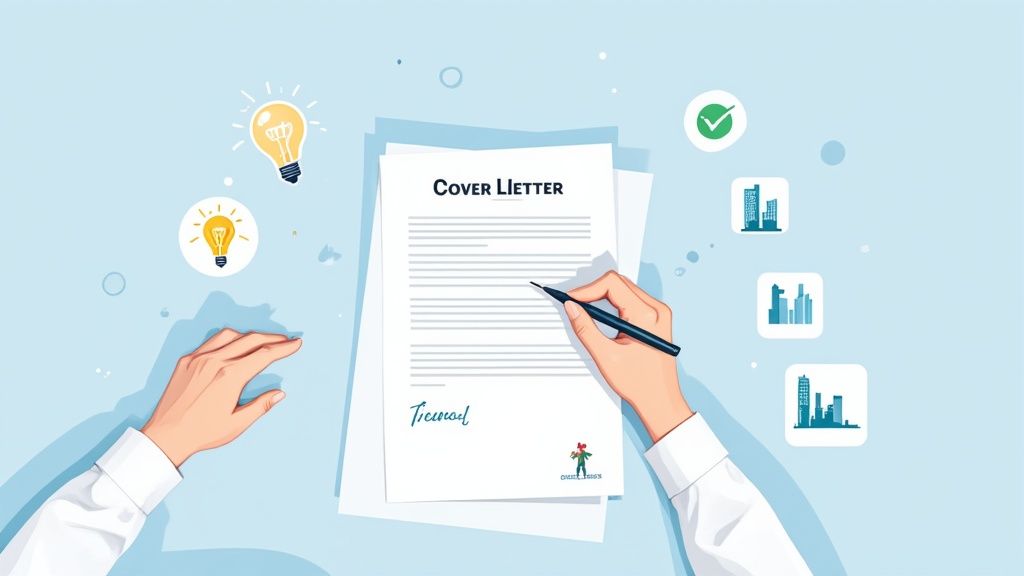
Writing a great cover letter is about much more than just rehashing your CV. It's your chance to tell a story that links your proudest moments directly to what the employer actually needs. The real goal here is to forge a genuine connection, show you're truly interested, and make it obvious that you're the one who can solve their problems.
Why Your Cover Letter Is Still a Big Deal
Let's be honest, you've probably asked yourself if anyone even reads cover letters anymore. In the German job market, the answer is a firm "yes." While your CV lays out the cold, hard facts of your career, the cover letter—or Anschreiben—is what brings that story to life. It's your first real opportunity to show your personality and step out from behind the bullet points.
Think of it this way: your CV is the "what," but your cover letter is the "why." It tackles the critical questions your CV simply can't:
- Why this specific company? What about them caught your eye?
- How do your past wins directly address the challenges mentioned in the job description?
- What gets you out of bed in the morning, and how does that vibe with the company's mission?
Your First Impression of Professionalism
In Germany, attention to detail isn't just a cliché; it's a core professional value. A polished, thoughtful cover letter acts as your first professional handshake. It proves you've done your research, you understand what the role demands, and you can argue your case with clarity. A generic, copy-paste job screams a lack of interest, and that’s a one-way ticket to the "no" pile.
This is especially true when competition is fierce. Recent hiring trends in Germany show a continued focus on cover letters, with 71% of employers still viewing them as an important part of their evaluation process. This holds steady even as some global markets move away from them. Interestingly, both startups (65%) and communication-heavy industries (70%) rely on them to gauge problem-solving skills and cultural fit.
Making Your Application Stand Out
Your cover letter is your secret weapon. It gives you the power to shape your narrative, spotlighting key achievements that might otherwise get buried in a crowded CV. Instead of just listing "project management," you can share a quick, punchy example of how you steered a project to success and what the result was.
While your CV lists your experience, your cover letter needs to explain its relevance. It's about drawing a straight line from your skills to the company's wish list.
Cover Letter vs CV Purpose
To make this distinction crystal clear, let's break down the unique job of each document.
| Document | Primary Purpose | Key Content | | :--- | :--- | :--- | | Cover Letter | To persuade and connect | Your motivation, key achievements with context, and cultural fit. | | CV | To inform and summarise | Your complete work history, skills, education, and qualifications. |
The CV provides the evidence, while the cover letter presents the argument.
This document is your chance to connect with the human on the other side of the screen. Yes, Applicant Tracking Systems (ATS) are scanning for keywords, but it's a person—a hiring manager—who makes the final call. A compelling story that radiates enthusiasm and a deep understanding of the company's needs will always leave a lasting impression.
While tools can help you personalise this process, mastering the fundamentals is the first step. For more on this, check out our guide on using smart tools like JobCopilot to get your applications out faster without sacrificing quality.
Getting the German Cover Letter Format Right
When you're applying for a job in Germany, your cover letter format – the Anschreiben – isn't just a suggestion. Think of it as the first, silent test of your professionalism. German business culture values precision and order, and getting the format wrong can, unfortunately, overshadow even the most impressive qualifications. It signals that you haven't done your homework.
The structure is quite formalised, but for good reason. It creates a predictable framework that helps busy recruiters quickly find the information they need. This isn't about killing creativity; it's about showing you understand the local professional etiquette. A familiar, correctly formatted document is simply easier for them to process and, frankly, to take seriously.
The Unspoken Rule: Understanding DIN 5008
The bedrock of all formal German business letters is the DIN 5008 standard. You don't need to memorise the entire rulebook, but grasping its core principles is essential. This standard provides guidelines for everything from margins and line spacing to where your address and the subject line should go. Following it shows a level of diligence that hiring managers appreciate.
Don't underestimate the cover letter's importance in Germany. Research shows that nearly 50% of HR professionals might reject an application if it’s missing one. Many expect these letters to follow DIN 5008, which specifies exact margins: 24.1 mm on the left, at least 8.1 mm on the right, and 16.9 mm for the top and bottom. Is it a deal-breaker if you're a few millimetres off? Probably not. But it can create a slightly negative first impression, suggesting a small lack of attention to detail. If you want to dive deeper, you can read the full research on the German job market to get a better sense of these expectations.
Here’s a visual example of a business letter structured according to DIN 5008, which gives you a clear idea of the layout. As you can see, every element has a designated zone, from the sender's details to the main body, ensuring a clean and universally understood layout.
The Core Components of Your Anschreiben
To build your cover letter correctly, just follow this accepted structure. Each piece has a specific home on the page.
- Your Contact Information (Absender): Put this right at the top. It can be left-aligned or centred in a header. Include your full name, address, phone number, and a professional email address.
- Recipient's Information (Empfänger): This goes below your details, aligned to the left. List the full company name, the hiring manager's name (if you can find it!), and the company’s address.
- Date and Place (Datum und Ort): Over on the right-hand side, write the city you're writing from, followed by the date. For example: "München, 24. Oktober 2024".
- Subject Line (Betreff): This is non-negotiable and incredibly important. It needs to be bold and direct, like "Bewerbung als Marketing Manager, Kennziffer 12345" (Application for Marketing Manager, Reference Number 12345). It cuts straight to the point, telling the recruiter exactly what they're looking at.
My Two Cents: Never underestimate the power of a name. Addressing your letter to a generic "Sehr geehrte Damen und Herren" (Dear Sir or Madam) is fine, but it’s a missed opportunity. A personalised salutation like "Sehr geehrte Frau Schmidt" is far more impactful. A quick look on LinkedIn or the company’s team page is all it usually takes.
Salutation, Body, and Closing
Once you have the header sorted, the rest of the letter follows a similar formal rhythm. This is where you make your case, but the presentation remains paramount.
The formal salutation (Anrede) is a must. Always use "Sehr geehrte/r Herr/Frau [Last Name]," followed by a comma. And remember this little German grammar quirk: the first sentence of your letter then starts with a lowercase letter.
Your main body should be broken into a few concise paragraphs. I've always found the most effective structure is a strong opening hook, a middle section that directly links your skills to what they're asking for in the job description, and a confident closing that reiterates your enthusiasm.
Finally, the sign-off (Grußformel) is almost always "Mit freundlichen Grüßen" (With friendly greetings). Leave some space for your signature—a handwritten one for printed letters or a digital scan—and then type your full name underneath. The very last thing on the page should be the heading Enclosures (Anlagen), where you list items like your CV (Lebenslauf) and any relevant certificates (Zeugnisse). It’s a simple, tidy way to give the recruiter a checklist of the documents you’ve sent.
Writing Content That Makes Recruiters Listen
Once you've got the formatting down pat, the real work begins. The content is what elevates your cover letter from just another application to a compelling pitch for why you're the perfect fit. This is your chance to go beyond the CV and build a genuine connection with the hiring manager.
Let's start by ditching the tired old opener, "I am writing to apply for the position of..." It’s a wasted sentence that states the obvious. Recruiters see this hundreds of times a day. Your goal is to hook them immediately with something that screams value or passion right from the get-go.
Crafting a Powerful Opening Hook
That first paragraph sets the tone for everything that follows. A strong opener grabs a recruiter’s attention and makes them actually want to keep reading. Think of it as the headline for your personal brand.
Here are a few approaches I’ve seen work wonders:
- Lead with a Key Achievement: Start with a concrete, measurable win that speaks directly to the role. For instance, "My success in boosting user engagement by 40% through targeted social media campaigns immediately brought to mind the goals outlined in your Senior Marketing Manager job description."
- Show Genuine Passion: Connect your personal enthusiasm for what the company does with the role itself. Something like, "As an avid user of your project management software for the past three years, I've developed a deep appreciation for its user-centric design, and I am thrilled by the opportunity to contribute my UX design skills to its continued evolution."
- Make a Direct Connection: Reference a recent company milestone, a news article, or a specific project that genuinely inspired you to apply. It shows you’ve done your homework and aren’t just spamming applications.
The key is to be bold and specific. You want the reader's first thought to be, "Okay, this person gets what we need."
The Problem-Solution Body Paragraphs
The body of your cover letter is where you really build your case. One of the most effective ways to do this is with the Problem-Solution framework. Instead of just listing your skills, you use them to directly address the company's pain points—which are usually hiding in plain sight within the job description.
Start by poring over the job advert to figure out their challenges. Are they trying to crack a new market? Improve customer retention? Streamline a clunky process? Once you’ve pinpointed a problem, you can position your experience as the ready-made solution.
My Two Cents: Treat the job description like a cheat sheet. If it says they need someone who can "optimise logistics," don't just write "I have experience in logistics." Instead, show them: "At my previous role, I re-organised our warehousing system, which cut shipping delays by 25% and saved the company an estimated €15,000 annually."
This approach demonstrates not just what you've done, but the tangible impact of your work. Always quantify your achievements with numbers, percentages, or concrete outcomes. Vague claims are forgettable; hard data is persuasive.
The process flow below outlines the classic structure of a German cover letter, moving from the professional header to the compelling body and formal closing.
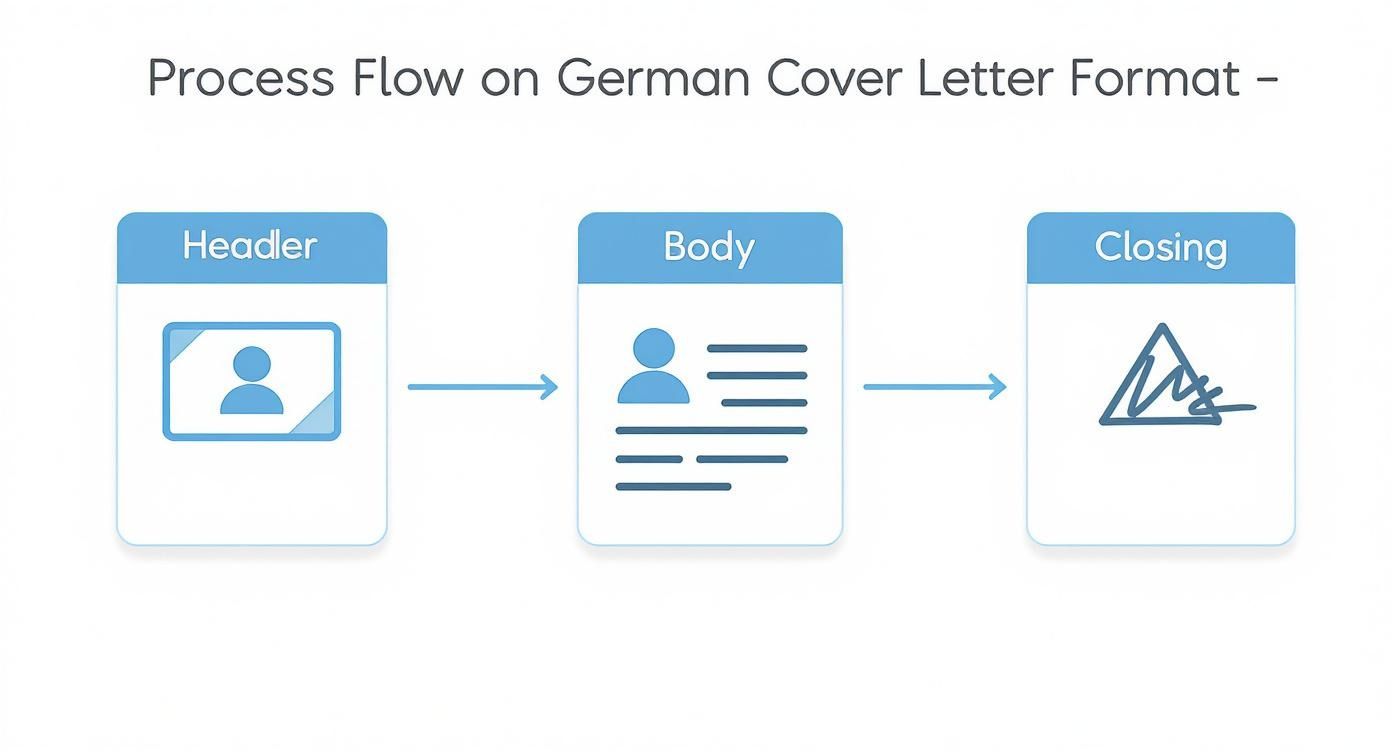
This simple three-part structure—Header, Body, Closing—provides a clear, professional framework that lets your compelling content truly shine.
Keeping It Concise and Impactful
While providing proof is crucial, you have to be brief. German cover letter norms favour a tight balance of formality and conciseness, generally landing between 250 to 400 words—about one full page, max. The expectation is that you’ll show how your skills directly solve their problems by using hard numbers and specific examples. Including measurable results, like efficiency gains or successful project completions, adds serious weight to your application. To get a better feel for these cultural expectations, you can discover additional insights about German cover letter standards.
Creating a Confident Call to Action
Your final paragraph is not a passive summary. It's your closing argument and your call to action. You need to reiterate your enthusiasm for the role and your confidence that you can help the company succeed. The goal is to leave the recruiter with a sense of excitement and a clear idea of what to do next.
Steer clear of weak closings like, "I look forward to hearing from you." Be proactive and confident instead.
Try something more assertive:
- "I am excited about the possibility of discussing how my experience in agile development can help your team meet its upcoming project deadlines."
- "I am eager to learn more about this opportunity and share some specific ideas on how I would approach the challenges of this role."
This simple shift reframes your closing from a hopeful plea to a confident statement of value. It signals that you aren't just a passive applicant but a proactive problem-solver who's ready for the next step.
Finish with a professional sign-off like "Mit freundlichen Grüßen," and you’ll have a document that not only meets German standards but also makes a powerful, lasting impression.
How to Personalise Your Cover Letter
Sending a generic cover letter is the fastest way to get your application tossed. It immediately tells a recruiter you’re just firing off résumés into the void, not that you’re genuinely interested in this specific role at this specific company.
Personalisation is what turns a form letter into a conversation. It’s your chance to prove you’re not just another applicant, but the right person for the job. And it all starts before you type a single word.
Dissecting the Job Posting
Think of the job description less as a list of demands and more as a treasure map. It’s packed with clues about the problems the company is trying to solve. Your job is to decode them.
Read between the lines. Are they constantly mentioning a "fast-paced environment" or "cross-functional collaboration"? Those aren't just HR buzzwords; they’re a window into the company's culture and the daily challenges of the role.
As you break it down, start sorting what you find:
- The Obvious Stuff: These are the hard skills they list outright, like "proficiency in Python" or "five years of project management experience."
- The Hidden Needs: These are the softer qualities they hint at. A call for an "innovative thinker" might mean they’re stuck in a rut and need fresh ideas.
- Action Words: Pay close attention to the verbs they use. Words like "develop," "optimise," "lead," or "analyse" tell you exactly what the core objectives of the position are.
Doing this first gives you a clear roadmap. You’ll know precisely which of your skills and experiences to put front and centre.
Researching Beyond the Job Ad
A truly great cover letter shows your interest goes deeper than one job posting. You need to do a bit of detective work on the company itself. This gives you the context to connect your story to their bigger picture.
The goal here is to find specific, current details you can weave into your letter. It shows you've done your homework and possess some real business sense.
My Two Cents: Go beyond a quick skim of the "About Us" page. Find a recent press release, a blog post from the CEO, or even a trade article that mentions them. Referencing their recent product launch or a new market expansion shows you’re paying attention.
Here’s what to look for:
- Recent News & Projects: Did they just launch a new feature, win an award, or announce a big partnership? Mentioning it shows you’re up-to-date.
- Company Mission & Values: Find their mission statement. If they talk a big game about "sustainability" and you once led a green initiative, that's a powerful connection to highlight.
- Key People: Look up the hiring manager or department head on LinkedIn. A quick look at their background can offer valuable clues about the team's priorities.
This isn’t about flattery; it's about finding genuine points of connection. Instead of a bland statement, you can write something like, "I was particularly impressed by your recent expansion into the Swiss market, as my experience in international logistics directly aligns with the challenges of cross-border distribution." That kind of specific detail grabs attention instantly.
Mirroring Language and Weaving in Keywords
Once you’ve got a handle on their needs and culture, it's time to start speaking their language. This involves a simple but powerful technique called mirroring. You strategically use the same keywords and phrases from the job description in your own cover letter.
This isn't just about keyword stuffing for the sake of it. It’s about showing the reader—and their software—that you’re a perfect fit.
First, it helps you get past the dreaded Applicant Tracking System (ATS). These systems are programmed to scan for specific terms, and mirroring ensures your application gets a green light.
But more importantly, it signals to the human on the other side that you get it. When you describe one of your achievements, frame it using their exact terminology. If the job ad asks for someone who can "drive user acquisition," you should write about how you were responsible for "driving user acquisition by 25%."
This creates an immediate sense of alignment and makes it incredibly easy for the recruiter to picture you in the role.
Cover Letter Examples for Your Career Stage
Knowing the theory is great, but seeing it in action is what really makes the difference. To bridge that gap, I’ve put together three distinct cover letter examples, each built for a common career scenario you'll find in the German job market.
Think of these not as templates to copy and paste, but as a framework. They're here to give you a feel for the right tone, structure, and focus needed to make an impression, whether you're just starting out or you're a seasoned pro.
For the Entry-Level Graduate (IT Sector)
When you're a recent graduate, the biggest hurdle is proving your potential without a long list of jobs behind you. Your cover letter needs to do the heavy lifting by showcasing your transferable skills, standout academic work, and genuine passion for the role. It’s all about connecting the dots for the hiring manager.
Here’s how you can build a compelling case:
- Make Your Coursework Count: Don't just say you studied something; show how you applied it. If you're going for a cybersecurity role, talk about your final-year project on network security.
- Turn Internship Duties into Achievements: "Assisted the development team" is forgettable. "Contributed to a team that improved application load times by 15% by optimising database queries" is memorable. Show your impact.
- Prove You've Done Your Homework: Research the company. Are they using a specific tech stack you're excited about? Mentioning it shows you’re not just sending out mass applications; you're genuinely interested in them.
This approach tells them you're a proactive problem-solver who's ready to contribute from day one.
A Quick Example for an Entry-Level Applicant "During my internship at TechSolutions GmbH, I was tasked with supporting the QA team. I took the initiative to develop a small automated script for common user pathways, which ended up saving the team five hours of manual testing each week. I’m excited to bring that same problem-solving drive to your junior developer team."
For the Career Changer (Marketing to Project Management)
Switching careers? Your cover letter is your single most important asset. Your CV might look a little disjointed on its own, so your letter has to be the bridge that connects your past experience to your future role. You need to reframe what you've done in the language of where you want to go.
The trick is to realise that a marketing campaign is essentially a project. It has stakeholders, a budget, and deadlines—sound familiar?
Here's how to frame it:
- Focus on the "How," Not Just the "What": Instead of talking about marketing outcomes, highlight the processes you managed: stakeholder communication, budget oversight, and hitting tight deadlines.
- Speak Their Language: Sprinkle in project management terms. Talk about "scoping" a campaign, "allocating resources," or handling "risk mitigation." This shows you already have the right mindset.
- Address the Change Head-On: Don't avoid the elephant in the room. Confidently explain why you're making the move and what specifically about project management appeals to you.
Your aim is to make the hiring manager see that while your job title was different, the core skills they need have been at the heart of your work for years. For more tips on showcasing your skills effectively, you might find valuable insights on the JobCopilot blog.
For the Senior Professional (Engineering)
Once you're at a senior level, your technical skills are a given. The cover letter's job shifts from proving you can do the work to demonstrating how you can drive business results and lead others. It's less about the daily tasks and all about strategic impact.
Your cover letter should act as an executive summary of your leadership value.
Here's what to zero in on:
- Highlight Strategic Wins: How did your work move the needle for the entire company? Instead of listing projects, frame them with business outcomes. For example: "I led the team that developed our new automation platform, which boosted production efficiency by 30% and directly contributed to €2 million in revenue growth last year."
- Showcase Your Leadership: Give a concrete example of how you've mentored junior engineers or improved how different departments work together. This proves your value goes far beyond your individual contributions.
- Demonstrate Commercial Savvy: Connect your technical decisions to the bottom line. Talk about how you saved money, improved the company's market position, or gave them a competitive edge.
This focus positions you as a business-minded leader, not just another skilled engineer.
A great way to think about this is to adjust your focus depending on where you are in your career.
Key Focus by Career Stage
This table breaks down what recruiters are looking for at each level.
| Career Stage | Primary Focus | Example Metric to Use | | :--- | :--- | :--- | | Entry-Level | Potential, enthusiasm, and transferable skills | "Reduced manual testing time by 5 hours/week." | | Career Changer | Transferable skills and strategic alignment | "Managed 10+ projects with budgets up to €50,000." | | Senior Professional | Strategic impact, leadership, and business results | "Drove a 30% increase in production efficiency." |
No matter your stage, the goal is the same: show the reader that you understand what they need and that you are the person who can deliver it.
Your Top Cover Letter Questions, Answered
Once you’ve got the basics down, it’s often the smaller details that can leave you second-guessing. How long is too long? Is an "optional" letter really optional? These are the questions that pop up right before you hit "submit."
Let's clear up these common sticking points so you can finalise your application with complete confidence.
How Long Should a Cover Letter Be?
Keep it punchy. The sweet spot is between 250 and 400 words. This length fits neatly onto a single page, which is exactly what a busy recruiter wants to see.
Think of it this way: you have about a minute of their time. Your goal is to make a powerful impression, not to document your entire career history. A single page is all you need to build a compelling case for why you're the right person for the job.
Should I Bother Writing a Cover Letter if It’s Optional?
Yes. Do it. Every single time. When an application says a cover letter is "optional," what it really is is an opportunity. Most candidates will take the easy route and skip it, which means you immediately stand out by putting in that extra effort.
It’s your chance to add colour and personality to your application, showing genuine interest in a way a CV simply can't.
A Recruiter's Perspective When I’m looking at a stack of similar CVs, the candidate with a thoughtful, well-written cover letter always gets my attention first. It tells me they're serious about the role and have taken the time to understand what we're looking for.
Who Exactly Do I Address My Cover Letter To?
Your best bet is always a specific person. A generic "Dear Hiring Manager" or the German "Sehr geehrte Damen und Herren" works in a pinch, but it feels impersonal. Addressing it directly to "Dear Ms Schmidt" or "Sehr geehrte Frau Schmidt" shows you've done your homework.
Finding the right person usually just takes a few minutes of digging:
- The Company Website: The "Our Team" or "About Us" page is a great place to start.
- LinkedIn: A quick search for the hiring manager or head of the department (e.g., "Marketing Director at [Company Name]") often works wonders.
- The Job Post: Read it carefully. Sometimes the name of the contact person is listed right there.
If you’ve searched everywhere and still come up empty, a title like "Dear Marketing Hiring Team" is a solid plan B. It's more specific than a generic greeting and still shows you're thinking about the audience.
What’s the Best Way to Send My Cover Letter?
First and foremost, follow the application instructions to the letter. Most companies will ask you to upload your documents through an online portal.
When it comes to the file itself, PDF is your best friend. It locks in your formatting, ensuring your letter looks exactly as you intended, no matter what device the recruiter uses. Avoid sending an editable Word doc unless they specifically ask for it.
Finally, a quick pro-tip: name your file clearly. Instead of a generic "CoverLetter.pdf," use a professional convention like "Max-Mustermann-Anschreiben-Marketing-Manager.pdf." It’s a small detail that makes life easier for the recruiter and subtly shows off your organisational skills.
Feeling like you're spending more time tailoring applications than you are preparing for interviews? Acquispect uses smart AI to generate personalised, high-impact cover letters in a fraction of the time. You can automate your job search, track your success, and focus on landing the interviews that matter. See how it works with a free 30-day trial at https://acquispect.com.