That gut feeling you have about your coaching background being valuable? You're spot on. Showcasing your experience as a coach on a resume is a brilliant strategic move. It immediately frames you as a leader, a sharp communicator, and someone who drives performance—exactly the skills every single employer is looking for. This simple shift turns what might feel like a side hustle into a powerful career asset.
Why Your Coaching Experience is a Career Superpower

In today’s job market, it’s not enough to just have technical skills. Companies are desperate for people who can do more—people who can elevate teams, inspire genuine growth, and handle tricky interpersonal dynamics with ease. Sound familiar? This is exactly what you do as a coach.
It doesn’t matter if you were a full-time executive coach, a part-time sports mentor, or a volunteer who guided peers. You’ve been honing a set of highly valuable, transferable skills. And let's be clear: these aren't just "soft skills." They are core business competencies that directly impact the bottom line and build resilient, effective teams. Your knack for giving constructive feedback, setting goals that actually motivate people, and empowering others to succeed is a massive advantage.
Key Skills Recruiters Are Actively Searching For
To make your coaching background pop, you need to connect your experience to what companies need. Recruiters are always on the lookout for candidates who can prove they have:
- Leadership and Influence: Can you guide and motivate people, even without a formal title over them?
- Performance Management: Do you have experience spotting strengths, addressing weaknesses, and keeping people on track toward their goals?
- Strategic Communication: Are you skilled at active listening, asking insightful questions, and explaining complex ideas simply?
- Conflict Resolution: Can you step into a disagreement and help steer it towards a productive solution?
This isn't just a local trend; it's gaining traction worldwide. For instance, in Germany, featuring coaching experience on a CV is becoming more common as the online coaching market expands. It's a fantastic, flexible way for professionals to build and showcase these very skills. You can learn more about the growth of Germany's online coaching market and how it’s shaping professional development.
Highlighting coaching on your resume does more than just fill a space. It tells a compelling story about your dedication to unlocking human potential—a narrative that truly resonates with forward-thinking organisations.
Ultimately, it all comes down to showing, not just telling. You’re not just listing another job title; you're providing concrete evidence of your leadership and people-development skills.
Strategically Placing Coaching on Your Resume
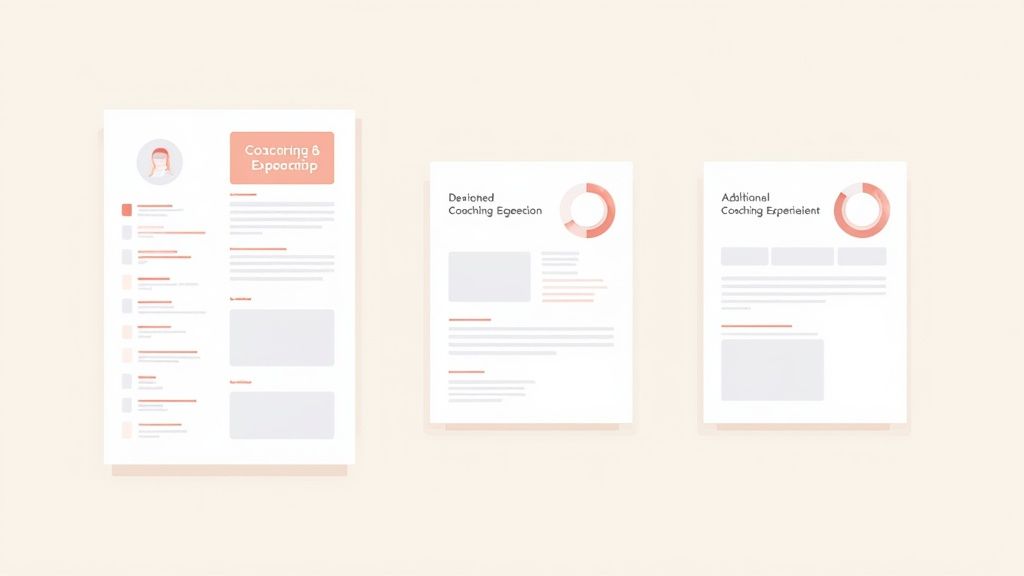
Figuring out where to list your experience as a coach on a resume isn't just a matter of formatting—it's about telling the right story. Where you place it frames your entire professional narrative. Get it right, and your coaching background becomes a major asset. Get it wrong, and it could just create confusion. The best approach really depends on how central coaching is to your career.
If coaching is what you do full-time, then it absolutely belongs front and centre. Treat it like any other job and list it right under your "Professional Experience" or "Work Experience" section. This is the clear path for full-time executive coaches, consultants, or even managers whose roles were built around developing their teams.
But for many of us, coaching is more of a significant side hustle or a parallel career. If that's you, just throwing it into your main work history can muddle your timeline and weaken the impact of both your primary job and your coaching work. A much better strategy is to give it its own space to shine.
Creating a Dedicated Coaching Section
Think about adding a new heading like "Coaching & Mentorship Experience." This does a brilliant job of organising your resume cleanly and immediately tells recruiters you have a specialised skillset in developing people. It’s the perfect solution when you have one or two significant coaching roles you want to highlight without taking the focus away from your main career path.
For instance, a marketing director who also runs a career coaching business on the side can use this section to showcase client successes. This approach keeps their marketing career timeline crystal clear while still showing off their powerful leadership and development skills.
Placing coaching experience in a distinct section prevents resume clutter and allows you to build a focused narrative around mentorship, leadership, and performance improvement. It tells a recruiter, "I don't just do my job—I elevate others."
Handling Volunteer or Informal Roles
So, what do you do with unpaid or less formal coaching? I'm talking about things like mentoring junior colleagues or even coaching your kid's sports team. This experience is still incredibly valuable and definitely has a place on your resume. The trick is positioning it correctly so it adds clear value.
The best spot for these kinds of activities is usually under a heading like "Additional Experience" or "Leadership & Volunteer Activities." This placement is smart for a couple of key reasons:
- It shows your initiative and a genuine passion for helping people grow.
- It gives you a place to provide hard evidence of transferable skills like communication, motivation, and strategic thinking.
When you list a coach on a resume this way, the focus isn't on a formal job title but on the skills you actually used. Think about it: an accountant who coached a youth football team can talk about managing the team's budget, resolving conflicts between players, and delivering motivational pre-game talks. Those are all highly relevant skills in any corporate environment. This kind of savvy placement turns a "hobby" into a compelling showcase of your leadership potential.
Writing Bullet Points That Showcase Real Impact
Anyone can list their responsibilities. "Coached clients on goals" is fine, but it’s a massive missed opportunity. It tells a recruiter what you did, but it says nothing about the value you created. To make your coaching experience pop off the page, you have to shift your thinking from tasks to tangible results.
This is where you turn a simple description into a powerful statement of achievement. Every bullet point you write should answer the silent question in a hiring manager's mind: "So what?" Frame your accomplishments well, and you'll give them a clear, compelling answer every time.
The Power of the CAR Framework
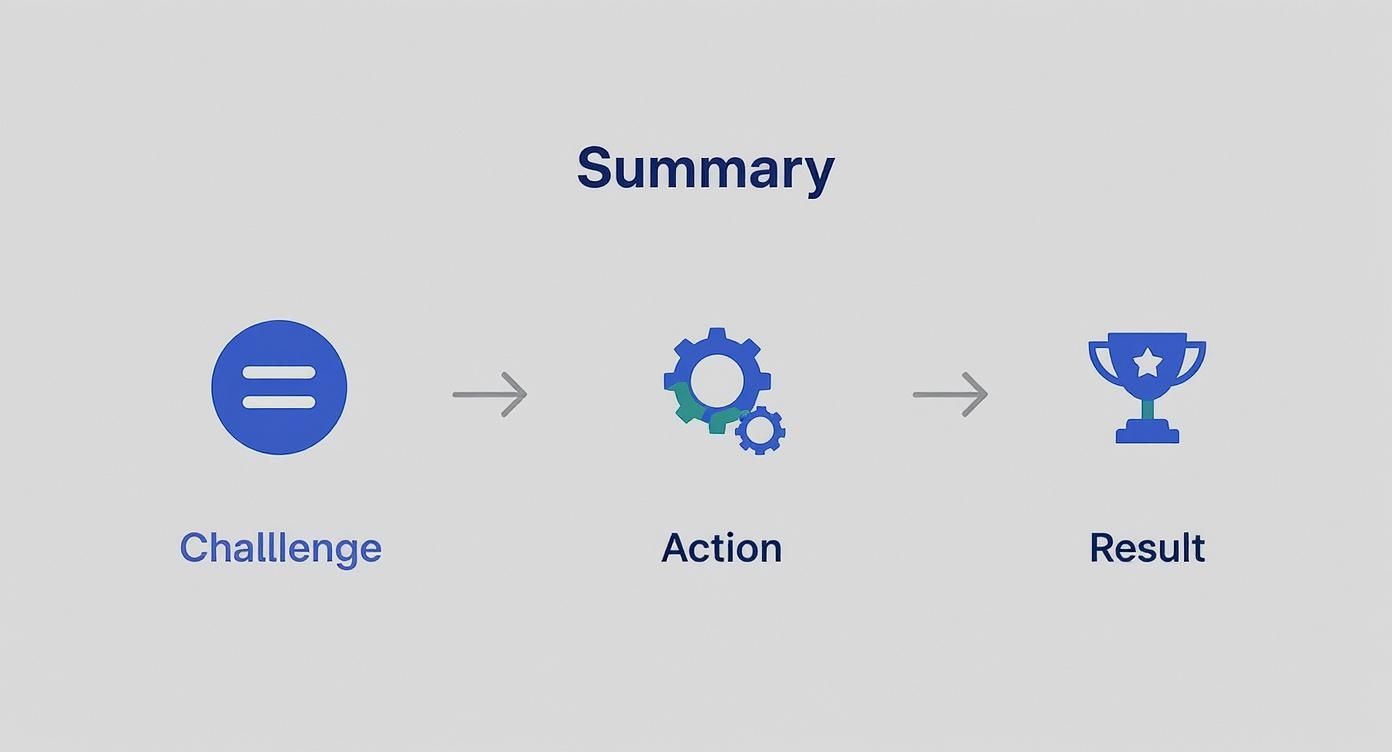
A brilliant way to structure your bullet points is the Challenge-Action-Result (CAR) framework. Think of it as a mini-story that outlines your impact, making your contributions instantly understandable and impressive.
- Challenge: What was the problem or the situation you were handed?
- Action: What, specifically, did you do to tackle it?
- Result: What was the measurable outcome of what you did?
This simple structure forces you to move beyond vague duties. Instead of a flat statement, the CAR framework helps you build a mini-case study for each bullet point, proving you’re a problem-solver who drives real change.
The best resumes don't just list jobs; they tell a story of successful interventions. The CAR framework is your secret weapon for telling these stories concisely and powerfully, proving your value with every single line.
Let's see this in action. A generic bullet point might read: "Responsible for coaching sales team members."
Using CAR, that transforms into something like this: "Mentored a team of 10 underperforming sales representatives (Challenge) by implementing a personalised weekly coaching programme focused on objection handling and closing techniques (Action), resulting in a 25% increase in team sales quota attainment within six months (Result)." The second version is undeniably more powerful.
Quantify Everything You Can
Numbers are the universal language of business. When you add metrics to your coaching bullet points, you’re providing hard proof of your effectiveness. Recruiters are trained to scan for quantifiable achievements because they're a direct signal of high performance.
Don’t get stuck if you don't have precise figures for everything. You can often use well-founded estimates or ranges to make your point. Think along these lines:
- Number of People: How many individuals or teams did you work with? (e.g., "Guided 15+ professionals through major career pivots...")
- Percentage Improvements: Did you help boost performance, satisfaction, or success rates? (e.g., "...leading to a 90% success rate in securing new roles within three months.")
- Financial Impact: Did your coaching lead to bigger salaries, more revenue, or cost savings? (e.g., "...with clients achieving an average 18% salary increase.")
- Time Saved: Did you help people or teams work more efficiently? (e.g., "Reduced new hire onboarding time by 30% by launching a structured peer-mentoring system.")
This data-driven approach is more important than ever. In Germany, for instance, the career coaching market is growing steadily, with a projected compound annual growth rate of 8.7%. That means more competition, so using solid metrics is how you cut through the noise. You can learn more about the trends in the career coaching service market to see why data truly matters.
Use Strong Action Verbs
The very first word of your bullet point sets the tone. Weak, passive phrases like "Responsible for" or "Assisted with" just water down your impact. You need to start each statement with a dynamic action verb that screams leadership and initiative.
Choosing the right verb helps frame your coaching experience in a professional light. It connects your skills directly to the things employers are actually looking for, like leadership, strategic thinking, and great communication. For more ideas on fine-tuning your entire job search, you can explore the resources on the JobCopilot blog.
Here’s a quick list of powerful verbs to get you started:
- Advised: Shows you provided expert guidance to clients.
- Empowered: Conveys that you enabled people to own their growth.
- Facilitated: Perfect for leading group sessions and workshops.
- Guided: Demonstrates you directed people through complex challenges.
- Mentored: Highlights your role in the long-term development of others.
- Motivated: Shows you inspired teams or individuals to hit bigger goals.
- Resolved: Great for showing you tackled conflicts or obstacles.
- Strengthened: Indicates you improved skills, processes, or team cohesion.
How to Reframe Your Coaching Skills for Any Industry
Let's be honest: a generic CV rarely gets a second glance. If you want to make your coaching experience pop, you have to do more than just list it. You need to translate it into the language of the job you're applying for. This isn't about fudging the truth; it's about connecting the dots for the hiring manager.
Start by tearing apart the job description. Hunt for keywords they use repeatedly—words like leadership, team development, performance management, or strategic planning. These are your bridges. Once you’ve found them, you can start framing your coaching wins to directly address what they’re looking for.
From General Win to Targeted Impact
Think of yourself as a translator. Your task is to show how your coaching successes directly solve the problems of the role you want. A single coaching achievement can sound completely different depending on who you're talking to.
For instance, say you coached a small team and helped them get better at finishing their projects on time. That's a great result, but let's make it specific.
- For a Tech Role: "Mentored a team of five junior developers in Agile methodologies, which boosted sprint completion rates by 20% and cut down code revision requests by 15%."
- For a Sales Position: "Coached a sales pod on pipeline management and closing techniques, driving a 10% increase in quarterly revenue and a 5% lift in customer retention."
- For an HR Role: "Facilitated a professional development programme for an emerging leaders group, which saw two participants earn promotions within six months."
See the difference? It’s the same core skill, just framed for a different audience. This simple formula—Challenge, Action, Result—is a bulletproof way to structure your accomplishments.
Thinking this way forces you to move beyond just listing duties and instead showcase the real, measurable impact you made. That's what gets a hiring manager's attention.
Customizing Coaching Language by Industry
To really drive this home, let's look at how one specific achievement can be rephrased to fit various sectors. This table shows how to pivot your language to align with what different industries value most.
| Coaching Achievement | Framing for a Tech Role | Framing for a Marketing Role | Framing for an HR Role | | -------------------------------------------------------------------------------------- | ----------------------------------------------------------------------------------------------------------------------- | ----------------------------------------------------------------------------------------------------------------------------- | ------------------------------------------------------------------------------------------------------------------------------------ | | Coached an individual to overcome communication barriers, leading to better team collaboration. | Guided a product manager to improve stakeholder communication, leading to a 30% reduction in cross-functional meeting times. | Mentored a brand strategist on client presentation skills, contributing to a 15% increase in successful campaign pitches. | Coached a department head on conflict resolution techniques, resulting in a 25% decrease in formal employee grievances. |
This isn't about creating different versions of the truth; it's about highlighting the facets of your experience that are most relevant to each specific role.
Keeping Up With Industry Demands
This targeted approach is absolutely essential in fast-growing fields. Take the digital health coaching market in Germany. In 2024 alone, it generated USD 543.8 million in revenue, with a huge surge in demand for mental wellbeing coaching.
This trend has opened doors for professionals who can show they have digital coaching experience, especially in healthcare and corporate wellness. Highlighting your ability to coach effectively in a digital setting shows you’re current and ready for modern challenges.
Your CV isn't just a record of your past; it's a marketing document for your future. Customising your coaching language proves you understand the company's world and are ready to contribute from day one.
By aligning your coaching skills with what a specific industry needs, you turn your CV from a generic summary into a powerful, targeted proposal. Whether you're looking for new roles or plotting a career change, tailoring your experience is non-negotiable.
A great way to stay sharp is to see what skills are in demand right now. Browsing through various career opportunities can give you fantastic insights into the language and metrics that are catching employers' eyes across different sectors, helping you refine your CV even further.
Extending Your Coaching Brand to LinkedIn
Your CV is a crucial snapshot, but your LinkedIn profile is where your professional story really comes alive. To get the full value from your coaching experience, you need to carry that narrative over from the page to your digital presence. It’s all about creating a consistent and compelling picture for recruiters.
Think of it this way: if your resume is the black-and-white film, your LinkedIn profile is the full-colour director's cut. It gives you the room to expand on your accomplishments, inject some personality, and, most importantly, provide social proof that you’re the real deal.
Optimise Your Digital First Impression
Let's start with your LinkedIn headline, which is prime digital real estate. It's often the very first thing a hiring manager sees. Avoid simply stating your current job title. Instead, weave your coaching identity right into it to signal your unique value from the get-go.
Here are a few ways to do this effectively:
- Project Manager | Certified Agile Coach & Team Mentor
- Senior Marketing Lead | Specialising in Leadership Development & Performance Coaching
- Software Engineer | Technical Mentor for Junior Developers
A small change like this immediately reframes your identity. You're not just someone who completes tasks; you're a leader who elevates others. This is a powerful signal that you’re a force multiplier on any team. For those in client-facing work, this is especially impactful. If you're curious about this positioning, you can see how professionals apply it by exploring our guide to building a career in consulting.
Weave Coaching into Your Narrative
Next up is your "About" section. This is your chance to tell a story. Don't just list a dry summary of your career. Talk about why you're passionate about mentorship and the impact you’ve seen it have—both on the people you guide and on your own professional growth.
Your "Experience" section should naturally align with your resume, but here you can add more flavour. Use those same powerful, metric-focused bullet points, but enhance them. On LinkedIn, you have the advantage of adding rich media. Link to a presentation from a workshop you ran, or showcase a project led by someone you mentored.
A great LinkedIn profile doesn't just repeat your resume; it validates it. When a recruiter sees recommendations praising your mentorship and skills endorsed by colleagues, your coaching experience shifts from a claim on paper to a proven asset.
Finally, be proactive about social proof. Ask former colleagues or clients to write recommendations that specifically highlight your coaching skills. A testimonial that says, "Anna's guidance was instrumental in helping me secure my last promotion," is worth its weight in gold. Also, ensure that skills like "Leadership Development," "Performance Management," and "Mentoring" are listed in your Skills section and endorsed by your network. It’s one more layer of proof.
Common Questions About Listing Coaching Experience
Even with a clear plan, you'll probably run into a few tricky questions when you actually sit down to add your coaching work to your resume. Let's walk through some of the most common situations I see, so you can tackle them with confidence.
Should I Include Unpaid or Informal Coaching?
Absolutely. Don't let the lack of a paycheque make you think the experience wasn't valuable. The real trick is framing it in a way that makes its value crystal clear to a recruiter.
The easiest way to do this is to place it under a specific heading like "Volunteer Experience" or "Leadership & Mentorship". This immediately gives it the right context. From there, focus completely on the impact you made and the skills you gained. It’s not just about saying you helped someone; it's about showing what that help achieved.
For example: Mentored three junior team members through their initial project cycles, leading to their successful project completions and one subsequent promotion within a year.
See the difference? That single bullet point screams leadership, initiative, and an ability to nurture talent—things every company wants.
Where Do My Coaching Certifications Go?
Your certifications are proof of your commitment and expertise, so they deserve their own spotlight. Don't bury them in the middle of a job description. The standard, and best, practice is to create a dedicated section for them.
I usually recommend adding a "Certifications" or "Professional Development" section right after your education. This makes your qualifications easy to spot and shows you’re serious about your craft. List them clearly, like this:
- Certified Professional Coach (CPC) - Institute for Professional Excellence in Coaching (iPEC), 2023
- Agile Team Facilitation (ICP-ATF) - ICAgile, 2022
An organised list like this just looks more professional and adds instant credibility.
What if My Coaching Is Unrelated to the Job?
This is a classic dilemma, but the solution is all about translation. You need to focus on the transferable skills, not the specific subject matter. Let's say you're a software engineer who also coaches a local youth football team. A hiring manager for a tech role doesn't need to know about game strategies or league standings.
Instead, you have to translate that experience into the language of business and leadership. Think about the core skills you were using—skills that are relevant in any professional setting.
Here's how you might frame it: Coached and motivated a team of 15 individuals, developing strategic planning and clear communication skills to achieve a top-three league finish.
This approach works because it highlights valuable soft skills like teamwork, strategic thinking, and motivation, all without distracting from your main technical qualifications. It adds a whole other dimension to your profile, showing you're a well-rounded person with real leadership potential.
Ready to stop manually tailoring your resume and start landing more interviews? Acquispect uses AI to find the perfect jobs for you and crafts personalised applications in minutes, not hours. Save time and let data-driven insights guide your job search to success. Discover how Acquispect can accelerate your career today.