Germany is a powerhouse for remote IT support jobs, and the market is booming. It’s not just the tech hubs like Berlin anymore; companies all across the country, from legacy industrial giants to agile startups, are scrambling to find skilled technicians who can work from anywhere. This creates a massive window of opportunity if you have the right skills. It's genuinely a great time to start looking at a career in Germany’s tech scene.
Understanding Germany's Remote IT Support Landscape
Germany's reputation for economic strength is now deeply intertwined with its tech sector. But it's not all about coding. The entire digital backbone of the country relies on sharp IT support professionals to keep everything humming. With more companies embracing permanent flexible work, the demand for people who can troubleshoot remotely has gone through the roof.
This isn't just a temporary blip, either. It’s a fundamental change in how German businesses think and operate. They've realised that remote work gives them access to a much wider talent pool and makes them more efficient. As a result, they are actively creating roles designed for a home office, making remote IT support jobs a solid and promising career move.
What's Fuelling the Demand?
A few key factors are pushing this hiring spree. The biggest is the country's huge push for digitalisation, a national initiative known as Industrie 4.0. This project is all about embedding advanced tech into traditional manufacturing, which in turn requires a solid IT support team to manage and fix these complex systems from a distance.
On top of that, the startup scene—especially in cities like Berlin, Munich, and Hamburg—is thriving. These newer companies often run on agile, scalable IT from day one. Many are "remote-first" by design, building their entire operation around a distributed workforce.
The real opportunity here is twofold: you have old-school industrial leaders modernising their entire infrastructure and new, tech-first companies scaling up fast. Both desperately need reliable remote IT support, creating a diverse and incredibly stable job market.
Common Roles and What They Actually Involve
When you start your job search for remote IT support roles in Germany, you'll see a few titles pop up again and again. Knowing what they mean will help you zero in on the right fit.
- Helpdesk Analyst (1st Level Support): This is your front-line role. You'll be the first person users talk to when something goes wrong. Expect to be logging tickets, handling basic troubleshooting like password resets or software installs, and knowing when to pass a tricky problem up the chain.
- Technical Support Specialist (2nd Level Support): Here, you need more in-depth technical chops. You’re the one who takes on the escalated tickets from the first-level team, digging deeper to diagnose and resolve complex issues with networks, servers, or critical business software.
- Systems Administrator: A remote sysadmin is less about direct user support and more about keeping the entire IT infrastructure—servers, networks, cloud services—running smoothly. It’s a more advanced position focused on stability, security, and performance.
To get more practical tips on building a career in tech, check out some of the articles on our JobCopilot blog.
The Current State of the Market
Let's look at the numbers, because they really tell the story. This infographic gives you a snapshot of just how many vacancies are out there and how quickly the sector is growing.
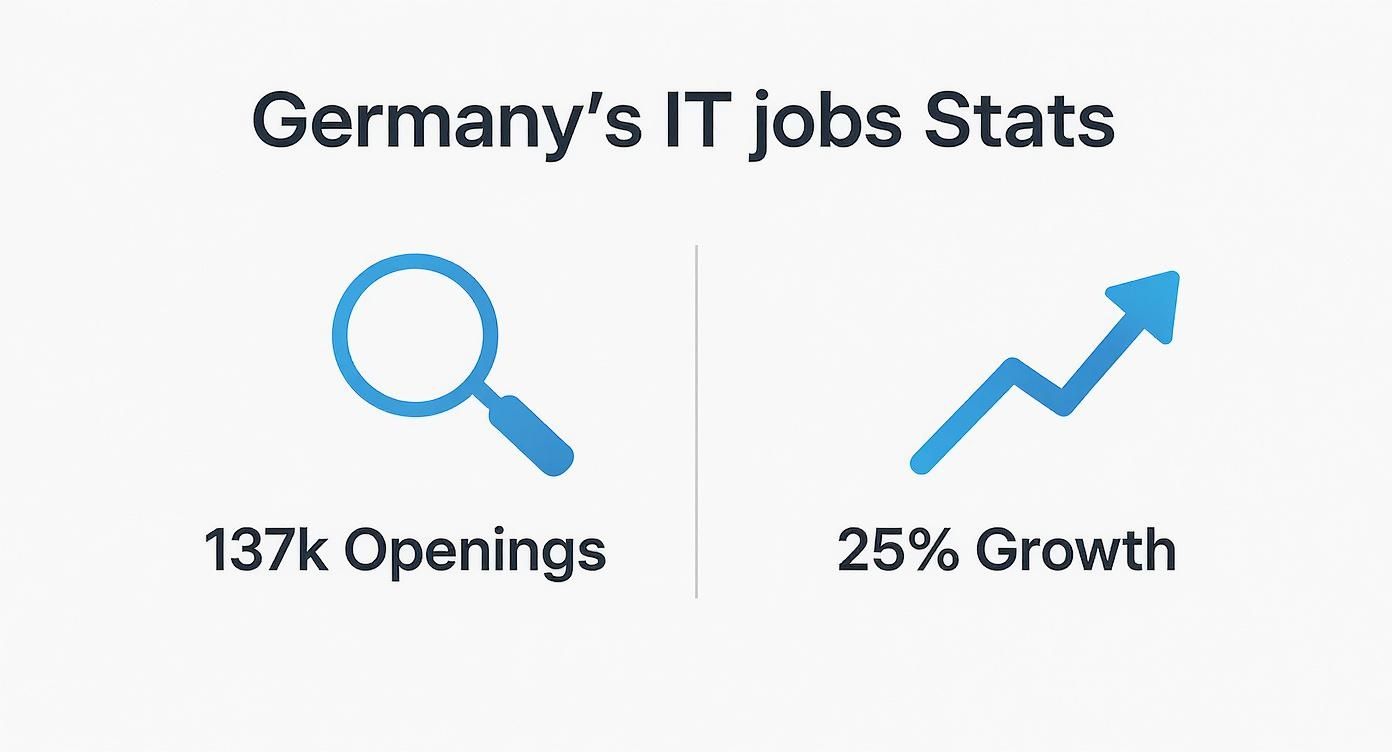
The data clearly points to a market with strong demand and serious momentum, which is fantastic news for anyone looking for a job. As of early 2025, there are over 137,000 IT job openings across Germany, and a huge chunk of them offer remote work. Better yet, this demand is forecast to jump by another 25% through mid-2024 and beyond, largely driven by the need for skills in cloud computing and cybersecurity.
To give you a clearer picture, here’s a quick breakdown of the key trends shaping the remote IT job market in Germany right now.
Key Trends in Germany's Remote IT Job Market
This table summarises the most important trends and statistics shaping the remote IT support job landscape in Germany, giving you a quick, data-driven overview.
| Trend | Key Statistic | Implication for Job Seekers | | :--- | :--- | :--- | | High Overall Demand | 137,000+ open IT positions | A wide pool of opportunities means less competition for each role and more options to choose from. | | Rapid Sector Growth | 25% projected growth rate | The market is expanding, ensuring long-term job security and opportunities for career progression. | | Shift to Remote Work | Increasing number of "remote-first" policies | More companies are open to hiring talent regardless of location, widening your search radius significantly. | | Focus on Specialised Skills | High demand for cloud & cybersecurity | Certifications and experience in these areas will make your profile stand out and command a higher salary. |
These figures aren't just abstract numbers; they represent real, tangible opportunities for qualified candidates to build a successful and stable career in Germany’s thriving tech industry, all without leaving their home office.
Finding and Targeting the Right Remote Opportunities
Landing a great remote IT job isn't about blasting your CV everywhere. It’s about being smart and strategic. A scattergun approach will just leave you scrolling for hours. You need to know exactly where to look and what to search for, especially if you're targeting the German market.
This means looking beyond the usual suspects and digging into the platforms where German tech companies are actually hiring. Combining the big international players with local favourites is the key to getting full coverage and finding those hidden gems. It’s about working smarter, not harder, to find a role that’s a perfect fit.
Where to Look for Remote IT Support Jobs
Your job hunt should be a mix of the major international platforms and German-specific job portals. Each has its own vibe and gives you access to a different slice of the market.
- LinkedIn: Honestly, this is your non-negotiable starting point. Its search filters are brilliant for narrowing down roles by "remote," location (Germany), and specific job titles. More importantly, it’s the best place for networking. You can connect directly with recruiters and hiring managers at German tech firms, which is a huge advantage.
- Xing: Think of Xing as the German-speaking world's answer to LinkedIn. It's incredibly popular in the DACH region (Germany, Austria, Switzerland), and many local recruiters live on it. A polished profile here is a must if you want to be seen by the right people.
- StepStone.de: As one of Germany’s biggest and most trusted job boards, StepStone.de is a goldmine. You'll find listings from massive corporations and the famous "Mittelstand" – the small and medium-sized businesses that are the engine of the German economy.
- Indeed.de: Being a global aggregator, Indeed casts a wide net, pulling in listings from all over. Its interface is clean and simple, making it easy to set up daily alerts for it support remote jobs.

As you can see, filtering is your best friend. Being able to specify "Remote" while setting a geographical focus is crucial for cutting through the noise and finding the right opportunities.
Mastering Your Search with German Keywords
Just searching for "IT support" in English will get you some results, but you'll be missing out on a massive part of the market. To really tap into local opportunities, you have to think and search in German. Companies often post job descriptions in their native language, so getting these keywords into your alerts is vital.
Here are a few powerful search terms to get you started:
- IT-Support Homeoffice: This one is direct, common, and highly effective.
- Fernwartung: Translating to "remote maintenance," this term often brings up more technical, hands-on support roles.
- IT-Helpdesk Remote: A classic phrase for first-level support positions.
- Systemadministrator Homeoffice: Use this when you're looking for more advanced infrastructure roles.
Pro Tip: Don't just pick one. Set up alerts on each platform using a mix of English and German keywords. For instance, have one alert for "remote IT support" and another for "IT-Support Homeoffice." It’s a simple trick, but I've seen it double the number of relevant jobs people find.
Networking Your Way to a Job Offer
In Germany, relationships and professional connections can make a real difference. Don't just be a faceless applicant sending out CVs into the void. Get active and engage with people in the industry.
A great first step is to identify recruiters at German tech companies you'd love to work for. You can find them on LinkedIn or Xing by searching for titles like "Talent Acquisition," "Tech Recruiter," or "HR Manager." Send them a polite, personalised connection request. A quick note mentioning your interest in remote IT roles at their company goes a long way.
Another fantastic strategy is to join relevant online communities. Look for German IT professional groups on LinkedIn or tech forums where you can contribute to discussions. When you offer helpful advice, you start to build a reputation. Suddenly, you're not just another CV in a pile; you're a known name.
Tracking Your Applications
When you're applying for dozens of jobs, it’s incredibly easy to lose track of who you've spoken to and what you've applied for. An application tracker is your secret weapon for staying organised. You can build a simple one in a spreadsheet or use a dedicated tool.
At a minimum, your tracker should include columns for:
- Company Name: Who you applied to.
- Job Title: The specific role.
- Date Applied: Helps you keep track of timelines.
- Application Link: So you can easily find the job spec again.
- Status: (e.g., Applied, Interviewing, Rejected).
- Contact Person: The recruiter's or hiring manager's name.
- Next Steps: A quick note to yourself about follow-ups.
This simple system keeps you from fumbling when a recruiter calls and ensures you always know when it's the right time to send a follow-up email. It turns a potentially chaotic process into a manageable and strategic job hunt, putting you firmly in control.
Crafting a CV That Gets You Noticed
Think of your CV as your digital handshake. When you're applying for IT support remote jobs, it needs to be more than just a dry list of past duties. It’s your best shot at making a compelling case for why a German company should hire you to work from a distance. A generic, one-size-fits-all CV just won't make the cut.
It's a good time to be looking, too. The German IT market is grappling with a major skills shortage. In 2023, around 149,000 IT jobs were left vacant, with positions staying open for an average of 7.7 months. This spells a huge opportunity for skilled people, but you still need to stand out from the crowd. You can get a deeper dive into the tech job market in Germany from Nucamp's guide.
The trick is to tailor your CV to spotlight the very qualities that make someone a fantastic remote employee. You need to show not just what you've done, but how you got it done.
Structuring Your CV for Remote Roles
German recruiters appreciate clarity and logic. The standard reverse-chronological format is still the way to go, but you have to frame everything through the lens of remote work. This means deliberately highlighting the skills that prove you can be trusted to perform brilliantly without a manager looking over your shoulder.
Your CV needs to be organised to immediately signal that you're ready for remote work.
Professional Summary: Kick things off with a sharp, two or three-sentence summary right at the top. Ditch the vague objectives. Instead, state exactly who you are and the value you bring. For instance: "Proactive IT Support Specialist with 5 years of experience in remote environments, highly skilled in ticket management with Zendesk and providing seamless user support via TeamViewer."
Skills Section: This is prime real estate, so put it right after your summary. I always recommend splitting it into two parts: "Technical Skills" (think Active Directory, Office 365, Jira) and "Remote Work Competencies" (like Asynchronous Communication, Self-Management, Proactive Problem-Solving).
This structure makes it impossible for a recruiter to miss the fact you understand the unique demands of a remote position.
A classic mistake I see all the time is burying remote-specific skills deep inside job descriptions. Pull them out and put them front and centre in a dedicated section. You want the hiring manager to see your suitability for a home office role within the first few seconds.
Quantify Your Achievements, Don't Just List Duties
Every recruiter has read "responsible for troubleshooting user issues" a thousand times. It means nothing. To actually make an impact, you have to show the results of your actions. Using numbers and metrics is the best way to turn a boring responsibility into a compelling achievement.
Think about the real impact you had. Did you make a process faster? More efficient? More secure?
Before (Duty-Focused):
- Handled user support tickets
- Assisted users with software problems
- Maintained IT equipment
After (Achievement-Focused):
- Reduced average ticket resolution time by 15% by creating a new troubleshooting knowledge base.
- Achieved a 95% user satisfaction rating over 500+ support interactions in Q3.
- Managed and tracked a hardware inventory of over 200 remote-employee laptops, ensuring zero losses during annual audits.
Quantifying your accomplishments proves you're a results-oriented professional—a golden trait for anyone working remotely.
Writing a Cover Letter That Connects
In Germany, the cover letter, or Anschreiben, isn't just a formality. It's your chance to show genuine interest and prove you're a good cultural fit. For a remote job, it’s even more important because it’s your main tool for building a personal connection when you can't meet face-to-face.
Keep your cover letter short and sharp, focusing on three things:
- Your Motivation: Why this company and this role? Show you’ve done your homework. Mention a recent project they launched or a company value that you genuinely connect with.
- Your Remote Fitness: Address head-on why you excel in a remote setting. Talk about your disciplined work ethic, your comfort with remote collaboration tools, or your ability to communicate clearly across different time zones.
- Your Key Contribution: Draw a direct line from your best achievement on your CV to a problem mentioned in the job description. For example: "My experience in reducing ticket resolution times aligns perfectly with your goal of improving support efficiency."
If you want to be sure your application is perfectly polished, getting professional feedback can make a real difference. Exploring expert CV and cover letter consulting services can give you that crucial edge. This personalised approach shows you aren’t just spraying applications everywhere; you are specifically interested in contributing to their team, from wherever you happen to be.
Building the Right Skillset for Remote IT Success
Landing a great remote IT support job in Germany isn't just about having a polished CV. While your application gets your foot in the door, it’s your actual skillset that proves you can handle the job without someone looking over your shoulder. Hiring managers are searching for a specific blend of technical expertise and personal discipline—someone who can solve tricky problems on their own and be a reliable part of a team they might rarely see in person.
This means you need the hard skills to fix what’s broken and the soft skills to explain the solution clearly and manage your day effectively. Let’s get into the core competencies that German employers really care about for their remote IT support teams.
Core Technical Competencies
Your technical foundation is the price of admission. Employers need to know you can confidently navigate a range of systems and tools, often without any hands-on guidance. You absolutely need to be proficient in these areas.
Operating Systems: You have to be comfortable troubleshooting on different platforms. This means knowing your way around Windows and macOS for the end-users, but also having a solid grasp of server environments like Windows Server or Linux.
Networking Fundamentals: A strong understanding of TCP/IP, DNS, DHCP, and VPNs is non-negotiable. You’ll be the go-to person for diagnosing connectivity problems for remote colleagues, which often means talking them through complex network settings over chat or a call.
Ticketing Systems: Experience with helpdesk software is a must. Most German companies rely on platforms like Jira Service Management, Zendesk, or ServiceNow to keep support requests organised and resolved efficiently.
Remote Access Tools: Being skilled with tools such as TeamViewer, AnyDesk, or Microsoft Remote Desktop is critical. You’ll need to securely access and control remote devices to provide direct, hands-on support from afar.
Given Germany's robust digital infrastructure and strict data privacy laws, employers place a huge emphasis on secure, compliant technologies. Companies invest heavily in solid remote access solutions to keep business running smoothly, making your skills in this area especially valuable. You can get more insights into Germany's remote work trends on Splashtop.com.
The Soft Skills That Define Success
In a remote role, your soft skills carry just as much weight as your technical prowess. Honestly, they’re what separate a decent technician from a truly great remote team member. When you don't have the structure of a shared office, your ability to self-manage and communicate is everything.
When a system goes down and your entire team is spread across different locations, it’s not just about fixing the problem. It’s about communicating proactively, managing expectations, and documenting the solution clearly so everyone stays informed. That’s where soft skills make all the difference.
Make sure you can demonstrate these key traits:
Proactive Communication: Don't just sit back and wait for questions. You need to be the one giving regular updates on tickets, thinking ahead about user needs, and breaking down technical jargon for non-technical colleagues.
Disciplined Time Management: Without a manager down the hall, you are the master of your own schedule. That means prioritising tasks smartly, hitting your service-level agreements (SLAs), and staying focused.
Autonomous Problem-Solving: More often than not, you'll be on your own when a tough issue pops up. The ability to research problems independently, think critically, and find a fix without constant hand-holding is a hugely valuable skill.
High-Impact Certifications for Remote IT Support Roles
Certifications are a fantastic way to formally validate your skills and show you're serious about your career. In the German market, a few specific credentials can really make your application pop.
Here’s a look at some of the most valuable certifications and why they matter for remote positions.
High-Impact Certifications for Remote IT Support Roles
| Certification | Focus Area | Why It's Valued for Remote Roles | | :--- | :--- | :--- | | CompTIA A+ | Core hardware and software technologies | It proves you have a solid, vendor-neutral foundation in troubleshooting, which is perfect for supporting diverse remote setups. | | CompTIA Network+ | Network configuration and troubleshooting | This validates your ability to solve the connectivity issues that are common pain points for remote workforces. | | ITIL Foundation | IT service management (ITSM) best practices | It shows you understand process-driven support, which is vital for maintaining organised service delivery in a distributed team. |
Having one or more of these certifications tells a potential employer that you have the formal knowledge to back up your hands-on experience. It makes you a much more reliable and attractive candidate for a position that requires a high degree of trust.
Acing Your Remote Interview and Onboarding
Navigating the interview and onboarding for a remote IT support role is a whole different ball game. Forget the firm handshake and the walk to the conference room. Here, every single interaction happens through a screen, which means your technical setup, your background, and your communication style are all under a microscope.
The goal isn't just to prove you know your stuff technically. It's about showing you're a disciplined, self-motivated professional who can excel without someone looking over your shoulder. This is your final test, a chance to prove you have what it takes to be a valuable part of a distributed team.
Preparing for the Virtual Interview
Acing a remote interview starts well before you click that "Join Meeting" link. Your environment is now part of your professional presentation, and you'd be surprised how quickly a messy background or a shaky connection can create a bad first impression.
Think of your setup as your virtual suit and tie. It needs to be polished and professional.
- Curate Your Background: Find a quiet spot with a clean, uncluttered backdrop. A plain wall or a well-organised bookshelf is perfect. If you opt for a virtual background, test it beforehand to make sure it looks sharp and doesn't glitch out around your head.
- Test Your Tech: Technical difficulties are the fastest way to derail an interview. The day before, do a full run-through. Check your camera, test your microphone, and make sure your internet connection is solid. Have the right software installed—whether it's Teams, Zoom, or Google Meet—and familiarise yourself with the basic functions.
- Get Your Lighting and Framing Right: Position your camera at eye level. It feels much more like a natural conversation. Make sure you're well-lit from the front, not from behind, so you don't appear as a silhouette. It’s a small detail that makes a world of difference.
Demonstrating Your Remote Work Aptitude
Interviewers for remote roles are looking for something specific. They need to know you can handle the freedom and the unique challenges of working from home. So, get ready for questions designed to test your remote-readiness. You'll need more than just theoretical answers; they want to hear real-world examples.
Imagine they ask, "How would you handle a system-wide outage when your team is in different time zones?"
A killer answer goes beyond the technical fix. You might say: "My first move would be to verify the outage and ping the on-call lead through our emergency channel. Simultaneously, I’d post a quick, clear update in the main team chat to let everyone know we're on it. As I investigate the cause, I'd commit to posting concise updates every 15-20 minutes. This keeps everyone in the loop, manages expectations, and cuts down on duplicate support tickets from anxious colleagues."
This response shows you're not just a tech whiz; it proves you can think methodically under pressure and understand that proactive communication is everything in a remote team.
Making a Strong Impression During Onboarding
You got the offer—fantastic! Now the hard work really starts. Those first few weeks are crucial. They set the tone for your entire time with the company. Since you can't rely on bumping into people at the coffee machine, remote onboarding demands that you be incredibly proactive.
Focus on being visible, curious, and helpful. Introduce yourself on team channels. Schedule a few 15-minute virtual coffees with your new teammates. Don't ever hesitate to ask questions—it shows you're engaged, not that you're clueless. Your goal is to become a known, trusted face as quickly as you can.
For a deeper dive into this critical period, check out our comprehensive guide to nailing your professional onboarding process. It’s full of practical strategies for getting settled in a new remote role.
Building relationships takes deliberate effort. If you're assigned an onboarding buddy, lean on them. Ask about the team's unwritten rules, the company culture, and who the go-to person is for different issues. This kind of initiative is the hallmark of a successful remote employee and will help you get up to speed far faster than just waiting for information to find you.
Answering Your Top Questions About Remote IT Jobs

As you start looking into the world of remote IT support jobs, you’re bound to have questions. Moving to a home office changes everything from salary expectations to how you climb the career ladder, so it's smart to get the full picture before you jump in.
This section tackles the most common questions we hear from people hunting for IT roles in Germany. Getting these answers upfront helps you plan your next move with a bit more confidence. Knowing what to expect financially, which skills really matter, and what your future could look like will put you in a much stronger position.
What Is the Typical Salary Range?
Let's start with the big one: money. It's often the first thing on everyone's mind, and for good reason. Salaries for remote IT support roles in Germany are competitive, but they do shift depending on your experience and the type of company you're looking at.
Here’s a rough breakdown of what you can expect:
- Entry-Level (1-2 years' experience): If you're starting out in a role like a Helpdesk Analyst, you're typically looking at an annual salary between €38,000 and €45,000.
- Mid-Level (3-5 years' experience): Once you've got a few years under your belt as a Technical Support Specialist, your earnings often climb to the €45,000 to €60,000 range.
- Senior/Specialist Roles: For those with deep expertise in high-demand areas like cloud infrastructure or cybersecurity, salaries can easily push past €60,000.
Keep in mind, these are just ballpark figures. It’s always worth doing your own homework on platforms like Glassdoor or StepStone to get the most accurate, up-to-date data for specific companies and regions.
Do I Need to Speak German?
This is a huge question, especially for international applicants. The short answer is: it helps. A lot. While it’s not always a deal-breaker, being proficient in German is a massive advantage. You’ll find plenty of international start-ups, particularly in tech hubs like Berlin, that operate almost entirely in English.
However, your pool of potential employers expands significantly if you have at least a professional working proficiency (think B1/B2 level). For any role where you'll be directly supporting German-speaking customers or colleagues, fluency is almost always non-negotiable.
Even if a company's main language is English, showing that you're willing to learn German demonstrates a commitment that German employers really value. It can be the small detail that sets you apart from a crowd of otherwise similar candidates.
What Equipment Do Companies Usually Provide?
One of the great things about a proper remote job is the home office setup. Any reputable German company knows you need the right tools to work effectively and securely, and they'll typically provide all the essentials.
You can almost always expect a standard package that includes:
- A powerful company laptop
- One or two external monitors
- A high-quality headset for calls
- A keyboard, mouse, and other necessary peripherals
On top of that, more and more companies are offering a home office stipend. This might be a one-off payment or a recurring allowance you can use to buy an ergonomic chair, a proper desk, or other bits to make your workspace more comfortable. Make sure you ask about the company’s specific equipment policy during the interview.
Are There Good Career Growth Opportunities?
Absolutely. Starting in remote IT support is a fantastic launchpad for a long-term tech career. You get a brilliant ground-level view of how a company's entire IT infrastructure hangs together. From there, you have a lot of different paths you can take.
Many people advance to more specialised support tiers (Level 2 or 3) or branch out into entirely new roles. It's quite common to see people move into positions like:
- System Administrator
- Network Engineer
- Cybersecurity Analyst
- Cloud Specialist
Good companies in Germany actively support the development of their remote teams. They often provide access to training platforms and will even sponsor you to get valuable certifications. They want to see you grow with them, helping you build a lasting career, not just a job.
Ready to stop searching and start interviewing? Acquispect uses AI to automate your job hunt, finding the best roles and crafting personalised applications in minutes. Save time and get noticed by top German companies. Start your free 30-day trial and accelerate your career today.