Finding a remote job as a student in Germany isn't just a possibility anymore; it's a realistic way to earn money and gain experience while keeping up with your studies. This isn't some fleeting trend, either. It’s a genuine shift in how German companies operate, opening up a world of opportunities for students who don't want to be tied to a physical office.
The New Standard: Flexible Student Work in Germany
Forget the old idea that student jobs are limited to on-campus roles or shifts at the local café. Today, companies across Germany are actively looking for students to fill roles that can be done entirely from home.
This kind of setup is a perfect fit for a student's life. It helps you juggle a packed lecture timetable, cuts out the commute, and lets you start building a professional portfolio long before you even graduate.
The COVID-19 pandemic really sped things up, making remote work normal in almost every industry. Businesses that were once reluctant to offer flexible working now see the huge benefits, like tapping into a much larger pool of talent—including motivated and tech-savvy students from all corners of the country. This isn't a temporary fix; it's become a core part of the modern workplace.
It’s Here to Stay: The Post-Pandemic Reality of Remote Work
The numbers back this up. A 2023 report from the Statistisches Bundesamt (the Federal Statistical Office) showed that 23.5% of all employed people in Germany worked from home. That's nearly double the pre-pandemic figure of 12.9% in 2019.
What's really interesting for students is that this trend is strongest among those with higher education. A massive 48.9% of professionals and academics were working from home, which shows that remote and hybrid models are now widely available for university-educated individuals. You can dive deeper into these German remote work trends on destatis.de.
This means finding a remote student job isn't about getting lucky anymore. It’s about knowing where to look and how to sell yourself for roles that prize independence and digital fluency—skills many students already have in spades.
Industries Leading the Charge
Some sectors have been much quicker than others to bring student remote workers on board. These industries often need skills that are a natural match for what you're already learning at university. If you're just starting your search, focusing on these high-demand areas can give you a real advantage.
Here's a quick look at the top sectors offering remote roles perfectly suited for students.
Top Remote-Friendly Sectors for Students in Germany
This table summarises key industries offering flexible, remote positions that are a great fit for students, highlighting common roles and the skills you should be emphasising.
| Sector | Example Remote Roles for Students | Key Skills to Highlight | | :--- | :--- | :--- | | IT & Software Development | Junior Developer, QA Tester, IT Support | Basic coding knowledge (Python, Java), problem-solving, attention to detail. | | Digital Marketing & Content | Social Media Manager, Content Writer, SEO Assistant | Strong writing skills, familiarity with social platforms, basic SEO knowledge. | | Customer Support & Services | Customer Service Rep, Technical Support Agent | Excellent communication, empathy, patience, problem-solving abilities. | | E-Commerce | Online Shop Manager, Product Data Entry | Organisational skills, data accuracy, familiarity with platforms like Shopify. |
By targeting these industries, you’re not just looking for a job that pays the bills. You’re finding an opportunity to build real-world experience that will be incredibly valuable for your future career.
Finding Remote Roles That Fit Your Student Life
The secret to landing a great remote job while you're still studying isn't about firing off hundreds of applications. It's about being clever and finding roles that genuinely fit your skills, your interests, and, most importantly, your already packed academic schedule. A scattergun approach is a fast track to burnout; a targeted one gets you interviews.
First, take a look inwards. What are you actually good at, both in your studies and outside of them? Don't write off your coursework as just 'academic'. That market research project you did for your business class? That's real data analysis experience. The personal blog you run for fun? That’s content creation and SEO management right there.
Jot down a quick list of these skills. You’ll probably be surprised how many are directly transferable to the working world.
Decoding What Employers Really Want
Job descriptions can be a bit of a minefield. A company might say they want "excellent time management," but what they often mean for a remote student role is, "Can you deliver your work on time without a manager physically watching you?" They need to know you're independent and reliable.
Keep an eye out for certain phrases that give you clues:
- "Flexible hours" is a great sign. It usually means the company values finished tasks over a rigid 9-to-5, which is perfect for slotting work around your lectures.
- "Proactive communicator" tells you they expect you to be active on tools like Slack or Teams, giving updates without needing to be chased.
- "Werkstudent" or "Working Student" roles are gold. These are designed specifically for university students in Germany, so they come with built-in flexibility and an understanding of exam periods.
Reading between the lines like this helps you spot positions where you're more likely to succeed. It also tells you exactly which skills to emphasise in your application to show you’re a perfect fit for an autonomous role.
Targeting Your Search with the Right Keywords
Once you know your strengths and what to look for, you need to use the right search terms. Vague searches like "remote job" will just drown you in irrelevant listings. You have to be specific.
Try combining your skill area with keywords that signal remote work and a student focus. This will instantly narrow down your results to employers who are actively looking for students to work from home.
Here are a few practical examples to get you started:
Werkstudent Remote MarketingJunior Content Creator Home OfficePart-Time Social Media Assistant RemoteStudentischer Mitarbeiter IT-Support (Remote)
This targeted approach is absolutely crucial. Right now, the German job market has a massive skills gap, with over 770,000 open positions in high-demand fields like IT, digital marketing, and customer support, according to insights from accessfuture.net on the German job market. These are precisely the areas where companies are offering remote job student roles because they need to be more flexible to find the right talent.
Remember, every application you send should feel intentional. You're not just looking for any remote job; you're looking for the right one that complements your student life, not complicates it.
By taking a bit of time to assess your skills, decode job ads, and use precise search terms, you shift from being just another applicant to a strategic job seeker. And if you really want to step up your strategy, tools that help automate and track your search can be a lifesaver. You might be interested in seeing the features of a modern job application tool on our website, which can free up valuable time you need for your studies.
Crafting Your Application for Remote Success
When you're applying for a remote job, your application is your handshake, your first impression, and your sales pitch all rolled into one. It’s got to do more than just list your qualifications; it needs to tell a story about who you are as a remote worker. For a student, this means proving you can thrive without someone looking over your shoulder.
Recruiters for remote roles are scanning for clues that you're a self-starter. Can you manage your own schedule? Can you figure things out on your own? Are you comfortable communicating online? Just saying you have these skills won't cut it. You need to show them with real examples from your studies and personal projects.
Translating University Work into Professional Experience
A lot of students get hung up on not having "real" work experience. But here's the secret: you do. You just need to learn how to frame it correctly. That big group project where you had to coordinate everyone's schedules and chase up deadlines? That wasn't just coursework—that was genuine project management.
Think about the software you're already using. If you've organised a society event using Trello or collaborated on assignments via Slack, that's direct, hands-on experience with the exact tools many remote companies rely on every single day. Don't hide that experience; put it front and centre.
A classic mistake I see is students simply listing their university modules. Recruiters don't care about the module title; they care about what you did. Focus on your contribution and the outcome. If you can put a number on it, even better.
Let's break down the process. Before you even start writing, you need to think strategically about what you bring to the table.
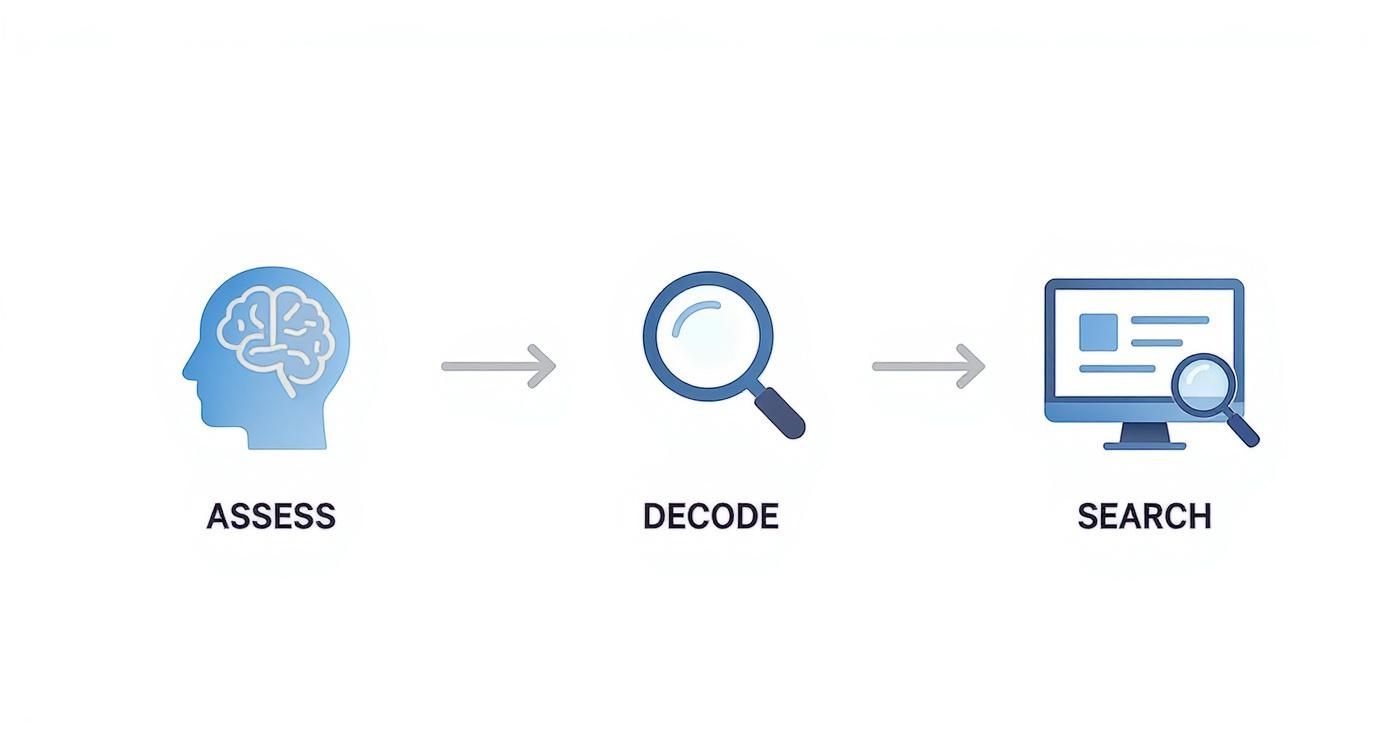
This workflow really nails it. You have to start by assessing your own skills before you can effectively search for roles and apply.
Before-and-After CV Bullet Points
Here's a practical example of how to rephrase your experience to make a recruiter sit up and take notice.
- Before: "Completed a group marketing project."
- After: "Coordinated a 4-person team for a semester-long marketing strategy project, managing all tasks and deadlines using Trello and resulting in a final grade of 1.3."
See the difference? The "after" version is packed with proof. It screams teamwork, project management, and tech-savviness, all backed up by a concrete result. This simple tweak turns a flat statement into a powerful example of your capabilities.
Let's try another one.
- Before: "Wrote essays for my literature course."
- After: "Independently researched and authored four 5,000-word analytical essays under strict deadlines, consistently meeting all submission requirements without supervision."
This reframing tackles a huge concern for remote employers head-on: can you work on your own and deliver on time? It highlights your autonomy and reliability—two of the most critical traits for any remote job student role.
The Power of a Professional CV
How you present this information is just as important as the information itself. Your CV needs to be clear, professional, and easy to scan. You want to make the recruiter's job as simple as possible.
Many students in Germany and across the EU use the Europass CV format to create a standardised, professional document.
Using a widely recognised format like this shows you're serious and ensures your skills and experiences are presented in a way that recruiters can quickly understand. Your goal is to remove any friction and make it incredibly easy for them to see your value.
Mastering Your Job Search on German Platforms
Knowing where to look is half the battle. You can spend hours scrolling through generic job boards and feel like you’re getting nowhere. The key is to focus your search on the platforms that are actually popular in Germany and then use them strategically to unearth the best remote roles for students.
Big professional networks are a natural place to begin. A platform like LinkedIn is so much more than just a digital CV. Its job search engine is incredibly powerful, but only if you master the filters. Get into the habit of immediately filtering for "Remote" locations and setting the experience level to "Internship" or "Entry-level"—this simple step alone will cut through most of the noise.
Drilling Down with Specific Keywords
Beyond the basic filters, the real magic happens when you start thinking like a German recruiter. To find those hidden gems, you need to combine the right keywords.
Try mixing job functions with German terms for remote work. For example:
Werkstudent Homeoffice MarketingRemote Praktikum IT(Praktikum is the German word for internship)Studentische Hilfskraft (remote)
Running these specific searches will give you far more targeted results than just typing in "student job." Big German job portals like StepStone.de and Indeed.de also have excellent filtering options that let you pinpoint part-time, remote, and student-specific positions. And don't forget your own university's career portal—companies often post there to find students just like you.
A proactive approach on these platforms really does pay off. An optimised LinkedIn profile, complete with a professional photo and a headline that clearly states what you're looking for (e.g., "Business Student Seeking Remote Marketing Werkstudent Role"), can bring recruiters straight to your inbox.
Staying Safe in Your Search
It's an unfortunate reality, but the boom in remote work has also led to a rise in job scams. These fake postings often promise fantastic pay for very little effort and can be tricky to spot if you're not careful.
Keep an eye out for these red flags:
- Vague Job Descriptions: Real companies are specific about what the role involves. If it's all fluff and no substance, be suspicious.
- Unprofessional Communication: Look out for poor grammar and spelling mistakes, or emails coming from personal accounts like Gmail or GMX.
- Requests for Money or Personal Data: You should never have to pay for an application or give out sensitive bank details before you've signed an official contract.
Ultimately, trust your gut. If an offer feels too good to be true, it almost always is. For more insights on refining your job hunt and avoiding pitfalls, you can find more in-depth guides over on the JobCoPilot blog. By pairing smart search tactics with a bit of healthy caution, you can navigate the German job market confidently and land a remote role that genuinely works with your student life.
How to Ace the Virtual Interview and Onboarding

Getting that virtual interview is a fantastic milestone, but it’s a whole different ball game when you can’t shake hands in person. For a remote student job, the hiring manager isn’t just looking at your skills. They’re trying to gauge if you have the self-discipline and communication chops to thrive without someone looking over your shoulder. Nail this, and you’re in.
First impressions happen in seconds, and on a video call, your tech setup and background are your digital handshake. Glitching audio or a messy room in the background can scream "unprepared." Before any interview, I always recommend a full tech rehearsal. Call a friend to test your camera, check your microphone quality, and make sure your internet connection is stable.
Your background says a lot about you. It doesn't need to look like a Silicon Valley headquarters, but it must be professional and distraction-free. A clean, tidy space with a neutral wall or a well-organised bookshelf works wonders. A big mistake is sitting with your back to a window—the backlighting turns you into a mysterious silhouette.
Preparing for Remote-Specific Questions
Interviewers for remote roles will definitely probe into how you manage your own time and workload. Expect questions designed to see if you're a self-starter. The key is to have concrete examples ready to go that prove you can work independently.
Draw from your university experiences. How did you organise your study schedule during a hectic exam season? How did you coordinate with a group on a major project when you couldn't meet on campus? These are perfect, real-world examples that demonstrate your remote work potential.
Be ready for questions like, "How do you stay motivated without direct supervision?" A strong answer describes your personal system. Maybe you use a planner to map out your week, set daily micro-goals, or use a tool like Trello to manage academic projects. This shows you're already operating with a high degree of autonomy.
To help you feel fully prepared, I've put together a quick checklist. Running through this before your call can make all the difference.
Remote Interview Preparation Checklist
| Category | Checklist Item | Why It Matters | | :--- | :--- | :--- | | Technology | Test your camera and microphone 15 minutes before the call. | Avoids last-minute panic and shows you're organised. | | Environment | Choose a quiet location with a clean, professional background. | Minimises distractions for both you and the interviewer. | | Appearance | Dress professionally, just as you would for an in-person interview. | Signals that you are taking the opportunity seriously. | | Practice | Prepare answers to common remote work questions. | Helps you provide confident, example-based responses. | | Logistics | Confirm the time zone and have the meeting link ready to go. | Prevents simple but costly mistakes like missing the interview. |
This checklist isn't exhaustive, but it covers the essentials that often trip people up. A little preparation goes a long way to calming nerves and letting your personality shine through.
From Interview to Integration
You got the job—congratulations! Now for the next hurdle: starting a new role without ever stepping into an office. Remote onboarding can feel a bit surreal, but being proactive from day one is the secret to a smooth start.
Unlike an office where you can bump into people in the kitchen, you have to consciously build those connections. Here are a few things that have worked for me and others I've coached:
- Be Seen (Literally): Keep your camera on during team meetings. It's much easier to build rapport when people can see your face.
- Ask Smart Questions: Don't hesitate to reach out to your new colleagues on platforms like Slack or Microsoft Teams. It shows you're engaged and keen to get up to speed.
- Schedule 'Virtual Coffees': Ask your manager or a teammate if they have 15 minutes for a quick introductory chat. It's a relaxed way to get to know them beyond work tasks.
A strong start sets the foundation for your entire tenure. To get more in-depth advice on making your first few weeks a success, check out our complete guide on what to expect during your onboarding. By being intentional with your communication, you’ll become a valued part of the team in no time.
Legal Rules for International Students Working Remotely
Landing a remote job as an international student in Germany is a fantastic opportunity, but it’s really important to get the legal side of things right from the start. This isn’t just about ticking boxes; understanding the rules means you can focus on your work and studies without any stress. Your student visa has clear work regulations, and they apply just as much to your remote job from your flat as they would to a job on campus.
The absolute key rule you need to remember is the 120 full-day limit. This means you can work up to 120 full days or 240 half-days within a single calendar year. A half-day is generally considered four hours of work, and anything more than that counts as a full day. Even though you’re working remotely, this rule is non-negotiable, so you’ll need to be meticulous about tracking your hours.
Understanding Your Employment Type
When you take on a remote student job, your contract will usually fall into one of two categories. It’s crucial to know which one applies to you, as it affects your taxes, social security, and how much money you actually take home.
Minijob: This is a popular option for students. It's a marginal employment contract where you can earn up to €538 per month. The best part? This income is typically free from taxes and social security contributions, so what you earn is what you get.
Werkstudent (Working Student): If you're working more regularly, you might be classified as a Werkstudent. This status allows you to work up to 20 hours per week during the semester (you can often work more during the holidays). You’ll pay into the pension fund, but you're usually exempt from other big social security payments for health, nursing, and unemployment insurance.
No matter what, always make sure you get a formal work contract, even for a remote role. This document is your legal safety net. It should lay out everything clearly: your title, tasks, hours, and pay, and specify whether you're on a Minijob or a Werkstudent contract.
Visa and Contractual Obligations
The number of international students choosing Germany has been on the rise, and this has definitely shaped the remote job scene. Between the winter semesters of 2019/20 and 2023/24, the international student population grew from around 411,601 to 469,485.
With a massive 69.2% of these students wanting to stay and work in Germany after they graduate, getting a remote student job is a smart way to earn money and get a foot in the door of the German job market. You can dig deeper into these international student statistics in Germany to see the full picture.
This growing trend makes it even more important to stick to the rules of your visa. Your residence permit is the final word on what you can and can't do. Going over your work-hour limits can lead to serious trouble, potentially putting your student status and your future in Germany at risk.
By staying on top of the regulations and tracking your time carefully, you can enjoy the freedom and flexibility that a remote job student position offers, completely worry-free.
Stop wasting time and start getting interviews. With Acquispect, you can automate your job search, generate personalised applications in minutes, and track your success with powerful analytics. Find the right remote job faster. Try it for free at https://acquispect.com.