Landing a remote data analyst job in Germany has gone from being a long shot to a very real possibility. Companies across the country are not just open to flexible work; they're actively hunting for skilled professionals who can work from anywhere. It's a massive shift, driven by a nationwide push for digitalisation and a newfound appreciation for what a distributed workforce can achieve.
Understanding the German Remote Data Job Market
The scene for remote data analyst roles in Germany has completely transformed in just a few years. What used to be a niche perk is now a standard career path, thanks to better technology and a major shift in how we think about the workplace. It just makes sense—data-driven roles rely on digital tools and independent, focused work, which is a perfect fit for a remote setup.
This isn't just a fleeting trend. It's a reflection of something much bigger happening in the German economy. Major industries, from slick fintech start-ups and e-commerce giants to traditional manufacturing powerhouses, are all going through huge digital overhauls. They're churning out mountains of data and need sharp analysts to make sense of it, no matter where they're logging in from. This has created the perfect environment for building a successful remote career in data.
The Numbers Fuelling the Remote Work Boom
You can really see the surge in remote work when you look at the employment stats. This infographic gives a great snapshot of the growth and demand for remote roles among data professionals in Germany.
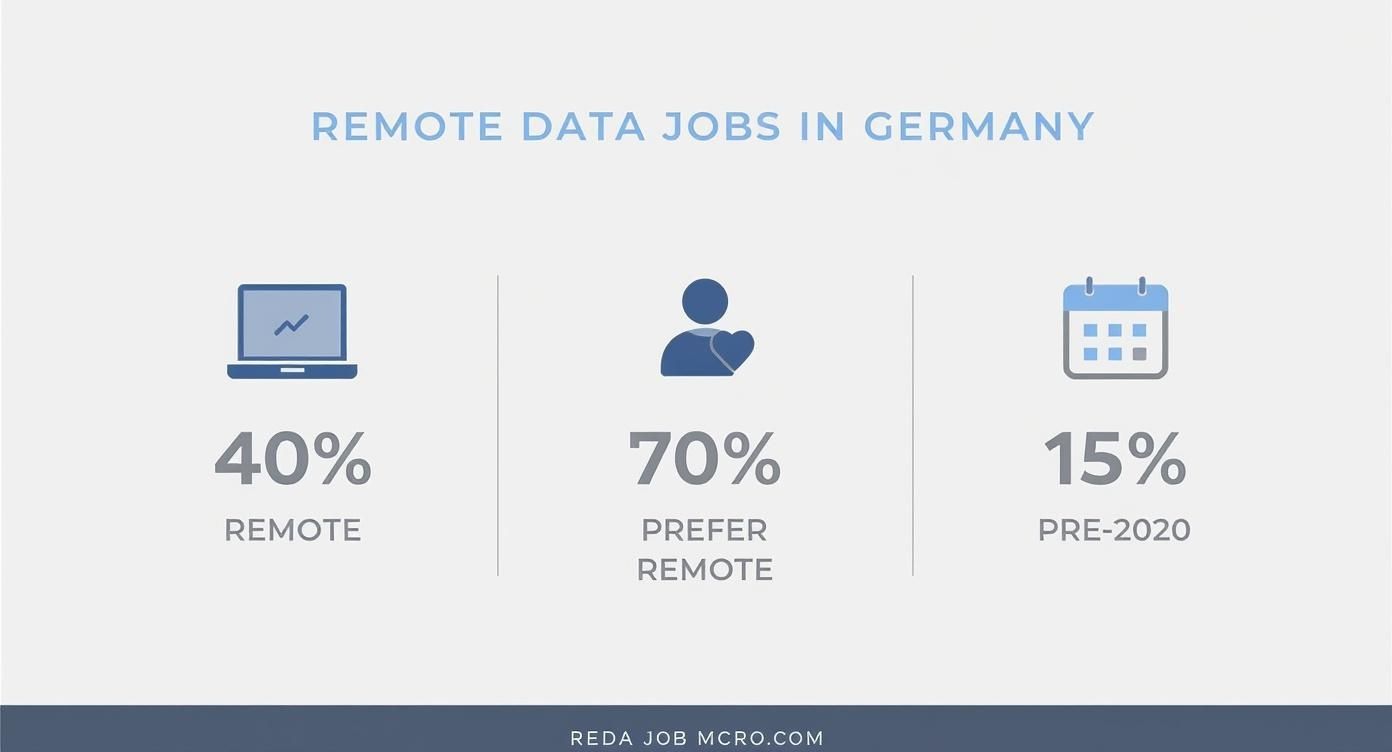
The data makes it crystal clear: there's been a huge jump in the availability of remote jobs, and it’s what the vast majority of the workforce actually wants.
These numbers are telling a story that's unfolding across the entire job market. As of late 2024, about 40% of all data analyst roles in Germany are listed as remote or hybrid. That's a massive leap from the roughly 15% we saw before 2020. What's behind it? Employers have realised that remote work boosts efficiency, especially for roles that live in the cloud anyway.
Plus, with around 70% of German data analysts saying they prefer remote work, companies have to adapt if they want to attract—and keep—the best people. You can find more details about these employment trends by exploring current open positions and salary ranges for various careers in the data field.
Key Skills and Tools for Remote Data Analyst Roles in Germany
To succeed as a remote data analyst in Germany, you need a solid grasp of specific tools and skills. Employers are looking for candidates who can hit the ground running without needing in-person supervision. The table below summarises the must-haves that frequently pop up in job descriptions.
| Skill Category | Essential Tools & Technologies | Why It's Critical for Remote Work | | --------------------------- | --------------------------------------------------- | ------------------------------------------------------------------------------------------------------------------------------- | | Data Visualisation | Tableau, Power BI, Looker Studio | You need to communicate complex findings clearly to stakeholders you may never meet in person. Visuals bridge that gap. | | Programming & Databases | SQL (PostgreSQL, MySQL), Python (pandas, NumPy) | Core of the job. You must be self-sufficient in querying databases and manipulating data from your home office. | | Cloud Platforms | AWS (S3, Redshift), Google Cloud Platform, Azure | Data increasingly lives in the cloud. Familiarity shows you can work within a modern, distributed data infrastructure. | | Collaboration & Comms | Slack, Microsoft Teams, Jira, Confluence | Without the ability to just walk over to a colleague's desk, proficiency in these tools is essential for staying aligned. | | Data Warehousing | Snowflake, BigQuery | Experience with modern data warehouses is a huge plus, showing you can handle large-scale analytics in a cloud environment. | | Soft Skills | Self-discipline, proactive communication, time management | Without a manager physically present, you have to be your own boss. Proving you can manage your time and communicate is key. |
Mastering these skills not only makes you a more attractive candidate but also demonstrates that you have what it takes to thrive in an autonomous, remote role.
What About Your Salary as a Remote Analyst?
A big question I always get is whether taking a remote job means taking a pay cut. In Germany, that’s largely a myth. Most forward-thinking companies have moved to role-based pay, meaning your salary is tied to your skills and experience, not your address.
Remote work often levels the playing field. Companies are competing for the best talent nationally, not just locally. This means your value is defined by the expertise you bring, allowing you to command a competitive salary regardless of where you live.
For example, an entry-level remote data analyst can usually expect to start somewhere between €45,000 and €55,000. After a few years in the field, that number often rises to between €55,000 and €75,000. Senior analysts, especially those with in-demand specialisations, can easily earn salaries well over €80,000.
These figures are right on par with what you’d expect for an in-office position. It proves that pursuing a remote data analyst job is a smart financial move.
Crafting an Application That Speaks for Itself

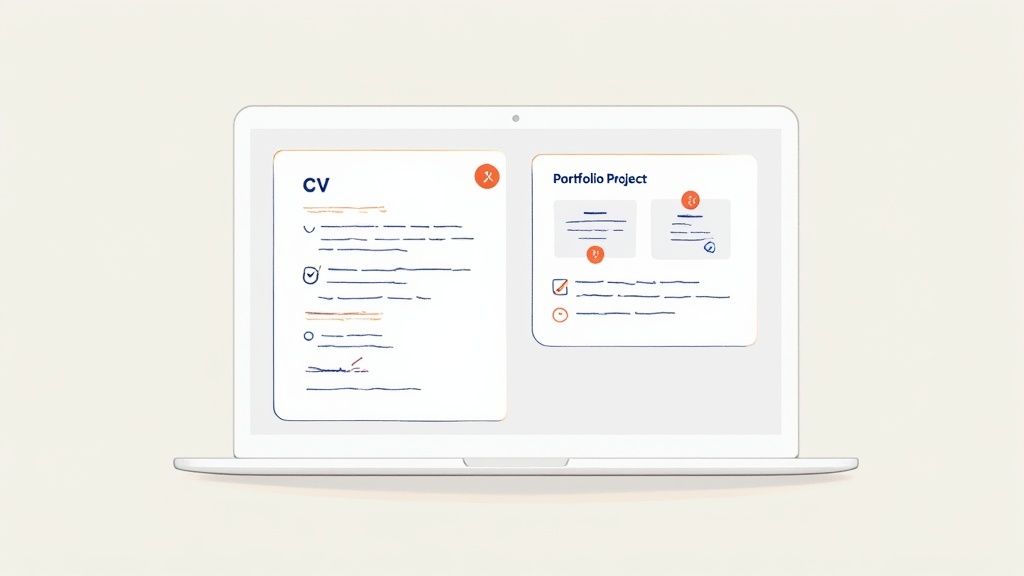
Long before you get the chance to speak with a hiring manager, your CV, cover letter, and portfolio are doing the talking for you. When you're applying for a remote role, these documents have an extra job to do: they have to prove you can deliver exceptional work without someone looking over your shoulder.
Your application needs to tell a story of independence, crystal-clear communication, and tangible results delivered from anywhere. It's your first and best chance to eliminate any doubt that you can thrive outside the traditional office environment.
This means your CV and portfolio can't just be a list of your technical skills. They have to be meticulously built to highlight your readiness for a data analyst job remote position, showcasing the soft skills that are absolutely essential for any distributed team.
Making Your CV Remote-Ready
Generic CVs are the fastest way to get overlooked. To make a real impression, you need to explicitly show you have what it takes to be a successful remote employee. And no, that doesn't just mean listing Python or SQL.
It's all about framing your experience through the lens of autonomy. Don't just list your tasks; describe how you handled them independently.
- Show, Don't Tell Autonomy: Use action verbs that scream self-sufficiency. Phrases like, "Independently managed a project from conception to final report..." or "Solely responsible for the end-to-end analysis of..." signal to a recruiter that you don't need hand-holding.
- Speak the Language of Remote Work: Are you comfortable with the tools of the trade? Mentioning platforms like Slack, Jira, or Confluence shows you're already integrated into the asynchronous communication style that makes remote teams work.
- Focus on Impact, Not Just Duties: Quantify your achievements to show you deliver real value. Instead of a vague "Analysed sales data," try "Analysed sales data to identify a critical bottleneck, directly contributing to a 15% increase in process efficiency."
This subtle shift in focus proves you get it. You understand the unique demands of working from a distance and have already built the right habits. It’s a powerful way to build trust before you've even had a conversation.
Think of your remote job CV less as a historical document and more as a piece of evidence. It's proof that you're a self-starting professional who can deliver quality work, no matter your location.
Building a Portfolio That Shouts "I'm a Self-Starter"
If your CV is the evidence, your portfolio is the live demonstration. It's your single best asset for showing a hiring manager not just what you can do, but how you think and manage a project from start to finish on your own.
A truly compelling remote-focused portfolio project should tell a complete story. Here’s what it needs:
- A Clear Problem Statement: What business question were you trying to solve? This demonstrates you can connect your analysis to real-world goals without needing a manager to point you in the right direction.
- A Detailed Process Breakdown: Document your journey. Explain why you chose certain tools, how you approached data cleaning, and the steps you took to validate your findings. This level of transparency mirrors the kind of documentation essential in a remote setup.
- Visualisation with a Purpose: A dashboard is great, but a dashboard with context is better. Don't just show the chart; explain the "so what?" behind it. A simple narrative like, "This Tableau dashboard was built for the marketing team to track campaign ROI in real-time and inform budget allocation," shows you think about your stakeholders.
This approach elevates your portfolio from a simple gallery of your skills into a collection of case studies on your independent problem-solving abilities. It gives a hiring manager a peek into how you'd operate as a trusted member of their distributed team.
The demand for these skills isn't just a feeling; it's a fact. The market for remote data analyst jobs in Germany has seen consistent growth, with a compound annual growth rate (CAGR) of roughly 12% between 2020 and 2025. While total data analyst vacancies grew by about 20% in that time, remote roles grew disproportionately, making up nearly 60% of all new job postings by late 2025.
As you polish your application, remember that a bit of strategic guidance can go a long way. Getting expert advice on how to position yourself can make all the difference. You can learn more about fine-tuning your job search with our specialised career https://jobcopilot.de/consulting services. By combining a powerful, remote-focused application with smart insights, you’ll be in a prime position to land a top-tier data analyst job remote role in Germany's booming market.
Finding the Best Remote Job Opportunities
Knowing how to sell yourself is half the battle; the other half is knowing where to look. Mindlessly scrolling through massive job boards is a fast track to burnout. To land a quality data analyst job remote role, you need a smarter, more targeted game plan, focusing on places where genuine remote positions actually live.
The trick is to look beyond the big-name aggregators and tap into niche communities and specialised job sites. While the usual platforms have their place, the real gems often surface on remote-first boards or within German tech circles where companies are actively hunting for talent comfortable with a remote setup. This laser-focused approach saves a ton of time and puts you in front of employers who are already bought into the distributed work model.
Pinpointing the Right Job Platforms
Don't put all your eggs in one basket. Relying on a single source means you’re guaranteed to miss out on great opportunities. The best approach is to mix broad-reach platforms with those that are highly specific to remote work.
Here’s where you should be concentrating your search:
- Remote-First Job Boards: Sites like Remotive and We Work Remotely are goldmines. They only list location-independent roles, so you won’t waste time sifting through "hybrid" or "flexible" jobs that secretly want you in the office.
- German Tech Hubs: Platforms such as GermanTechJobs and Berlin Startup Jobs are fantastic for finding roles in Germany's buzzing tech scene. A lot of these companies, especially the start-ups, have gone remote-first to attract top talent.
- LinkedIn with Precision: Stop just browsing—use LinkedIn's filters like a pro. Set your location to "Germany" and then hit the "Remote" filter. Combine that with sharp keyword searches, and you'll cut through the noise in no time.
This strategic mix ensures your energy is spent on applications for roles that are genuinely remote, which massively improves the quality of your entire job search.
Mastering Your Keyword and Alert Strategy
Once you’ve picked your platforms, the next move is to let them work for you by setting up powerful job alerts. But here’s the thing: these alerts are only as good as your keywords. A generic search for "Data Analyst" will just flood your inbox with irrelevant junk.
To filter out the noise, you need to get specific and combine your search terms.
Your goal isn't just to find jobs; it's to find the right jobs with minimal effort. Think of your keywords as a high-precision filter that brings ideal opportunities directly to you, saving you hours of manual searching each week.
For example, instead of a broad search, create alerts for more detailed phrases.
Effective Keyword Combinations
"remote data analyst" AND "Germany""Datenanalyst" AND "Home Office""SQL" AND "Tableau" AND "remote"
Setting up these tailored alerts across a few different sites acts like your personal job scout, making sure you’re one of the first to see a new, relevant opening for a data analyst job remote position.
The Art of Remote Networking
When you're searching for a remote job, networking matters more than ever, but it looks a little different. You can't just show up at a local meetup. Instead, it’s all about building your digital presence and making authentic connections in online communities.
Jump into virtual events, webinars, and online forums that are relevant to data analytics in Germany. Get involved in conversations on LinkedIn or in specialised Slack communities for data professionals. The idea is to get on the radar of recruiters and hiring managers before a job is even posted. For more ideas on building a winning job search strategy, check out the tips on the JobCoPilot blog.
By actively contributing your thoughts and expertise, you’re not just another applicant; you’re building a reputation as a smart, engaged professional in your field. This proactive approach can open doors to opportunities you’d never find through a traditional search alone.
Getting Through the Remote Interview Gauntlet
This is it. The remote interview is where all your hard work on your CV and portfolio pays off. It's your moment to prove you’re not just a skilled analyst on paper, but also the kind of self-sufficient, communicative professional who can knock it out of the park from a home office.
Think of it this way: the interview isn't just about answering questions. It’s a live demonstration of how you’ll operate as a remote employee. Every detail, from your video setup to how you handle a conversation lag, tells the hiring manager whether you have what it takes to thrive in a distributed team.
Setting the Scene: Your At-Home Studio
Before you utter a single word, your environment is already making an impression. A messy, poorly lit room can scream "unprepared," while a clean, professional setup shows you take this seriously. You don’t need a film set, just a quiet corner where you can focus and look your best.
Your goal is to make it easy for the interviewer to forget you're on a video call and just focus on your brilliant answers.
Here’s a quick-and-dirty checklist to nail your setup:
- Find Your Light: Face a window or a lamp. Simple as that. If the brightest light is behind you, you’ll look like an anonymous source on a news programme.
- Declutter Your Background: A neutral wall or a tidy bookshelf works wonders. If your space is chaotic, a tasteful virtual background is okay, but a real, neat space is almost always better.
- Get the Angle Right: Pop your laptop on a stack of books so the camera is at eye level. No one needs that "up-the-nostrils" view.
- Sound Like a Pro: Use headphones with a built-in mic. It’s a small thing that makes a massive difference, cutting out echo and background noise so they hear every word clearly.
Mastering the Tech and the Talk
Most remote interview processes have a few stages, from a casual chat with HR to a technical grilling with the team lead. And somewhere in there, you’ll likely face a take-home challenge.
This isn’t just a pop quiz on your SQL or Python skills. It's a dress rehearsal for an actual work assignment. They’re watching to see how you structure your code, document your thought process, and present your findings. Can you run with a project and deliver something great without someone looking over your shoulder? That's the real test.
But beyond the code, the interview itself is a test of your remote communication chops.
Hiring managers aren't just looking for another analyst; they're looking for a great remote teammate. Your ability to explain complex data findings clearly over a video call, listen without interrupting, and project energy through the screen can be just as critical as your technical skills.
This shift to remote hiring is also having a fantastic impact on the workforce. A 2024 survey from German employment agencies found that it's significantly boosting diversity. In Germany, the participation of women in remote data analyst roles has jumped from around 27% in 2018 to nearly 38% in 2024. What’s more, 45% of remote hires by German firms now come from outside major cities, proving that talent truly is everywhere. You can learn more about how remote work is diversifying the German data workforce and creating new opportunities.
Tackling Remote-Specific Questions
You should absolutely expect questions designed to see if you can handle working alone. Hiring managers need reassurance that you won’t disappear into the ether. They want to hear real stories that prove you're autonomous, a solid communicator, and a creative problem-solver.
Get ready for questions like, “How do you stay on track when you don't have a manager physically present?” or “Tell me about a time you were stuck on a problem and your team was in a different time zone. What did you do?”
Here is a simple framework to help you structure your answers with concrete evidence, not just vague claims.
Remote Interview Question and Answer Framework
| Common Question Category | Example Question | STAR Method Answer Framework |
| :--- | :--- | :--- |
| Autonomy & Self-Management | "How do you manage your time and stay motivated without direct supervision?" | Situation: "In my last role, we had flexible hours and a globally distributed team."
Task: "I was responsible for delivering a weekly customer churn report by Monday morning, my time."
Action: "I blocked out my calendar for 'deep work' on Thursdays and Fridays, used a project management tool to track my progress with checklists, and set personal deadlines ahead of the official one."
Result: "I never missed a deadline in two years and was often able to deliver the report early, giving my manager in another time zone a head start on their week." |
| Communication & Collaboration | "Describe how you'd collaborate with a team on a complex data project from different locations." | Situation: "We needed to build a new sales forecasting model, and the team was spread across three countries."
Task: "My job was to pull and clean the historical data while a colleague built the initial model."
Action: "We started with a kickoff video call to define roles. We used a shared Slack channel for quick questions, documented our entire process in a shared Confluence page, and held a daily 15-minute sync to report progress and roadblocks."
Result: "This clear communication structure prevented duplicate work and allowed us to complete the project 10% faster than projected. The documentation became the go-to resource for the sales team." |
| Problem-Solving & Resourcefulness | "Tell me about a time you hit a technical roadblock and couldn't immediately reach your manager." | Situation: "I was working on a query for a critical report and it kept timing out, blocking the entire data pipeline."
Task: "I needed to fix it before the end of the day, but my manager was in a workshop."
Action: "First, I searched our internal documentation for similar issues. Finding nothing, I posted a detailed question in our team's tech support channel, including the query and the error message. While waiting, I tried breaking the query into smaller, more manageable parts to isolate the problem."
Result: "A senior engineer saw my post and pointed out an inefficient join. By applying their feedback and using my own troubleshooting, I fixed the query within an hour, well before the deadline." |
The key is to use specific stories. Anyone can say they're a "self-starter," but a concrete example proves you've actually done it. This is how you show you're not just qualified for a data analyst job remote—you're built for it.
Negotiating Your Remote Offer with Confidence

Finally, the offer lands in your inbox. It’s a great feeling, but don't rush to sign just yet. That offer is a starting point, not the final word. This is your moment to make sure the role isn't just a job, but a great career move that genuinely fits your life.
When it's a data analyst job remote position, the negotiation is about more than just the salary. It’s a chance to build out a complete package that includes everything you need to thrive while working from home.
To do this right, you need to walk into that conversation armed with solid data, a dose of confidence, and a clear picture of what a competitive remote package actually looks like in the German market. This isn't about being greedy; it’s about securing the resources you need to be productive and happy from day one.
Researching Location-Independent Salary Benchmarks
One of the most common traps candidates fall into is pegging their salary expectations to their local cost of living. That’s old-school thinking. Forward-thinking German companies, particularly in tech, are shifting towards role-based pay, not location-based. What matters is your skill set and the value you bring, not your postcode.
So, your first move is to become a data analyst for your own career. Head over to platforms like Glassdoor, Levels.fyi, and other German salary comparison sites. Your goal is to find out what data analysts with your experience are actually earning across the country.
- Think Nationally, Not Locally: Search for salary data for "Germany" as a whole. Make sure you filter by your experience level and core skills like SQL, Python, and Tableau.
- Consider the Industry: A fast-paced fintech in Berlin will likely have a different salary scale than a traditional manufacturing firm in Bavaria. Fine-tune your research to match the company's sector.
- Build Your Case: Don't just glance at the numbers. Collate your findings into a simple document. Having concrete figures from a few different sources makes your request feel less like an ask and more like a statement of fact.
When you bring up your desired salary, frame it around the market rate for the role itself. For example: "Based on my research for data analyst roles in Germany that require advanced Python and Power BI skills, a salary in the range of €XX,XXX to €YY,XXX appears to be the competitive standard." An approach backed by data is one that any good hiring manager will appreciate.
Remember, you are being hired for your expertise, not your address. Your negotiation should centre on the national market value for your specific skill set, ensuring you are compensated fairly regardless of where your home office is located.
Advocating for Remote-Specific Perks
A truly fantastic remote offer extends well beyond the payslip. The best employers get it—supporting a distributed team means more than just paying for a Zoom subscription. These extra benefits aren't just "nice-to-haves"; they are fundamental tools for your productivity, well-being, and long-term success.
Before you talk to the hiring manager, make a short list of perks that are particularly important for remote employees.
Essential Remote Work Benefits to Negotiate
- Home Office Stipend: This could be a one-time payment or an annual allowance to cover essentials like a proper ergonomic chair, a good desk, or a second monitor.
- Monthly Internet/Utilities Allowance: A small, recurring payment to help offset the cost of the high-speed internet and electricity you'll be using for work.
- Truly Flexible Working Hours: This is one of the biggest draws of remote work. Clarify that you can structure your workday in a way that makes sense for you, rather than being tied to a rigid 9-to-5.
- Professional Development Budget: Ask for funding for online courses, certifications (like those on Coursera or edX), or virtual conference tickets to keep your skills sharp.
When you bring these up, position them as part of the total compensation package. This shows you're thinking strategically about how you can deliver your best work. You might say something like, "Along with the base salary, I'd also like to discuss a home office stipend to ensure I have a productive and ergonomic workspace from the get-go."
This simple framing turns your requests into a win-win. These thoughtful additions can elevate a good offer into a great one and set you up for success in your new data analyst job remote position.
Common Questions About Remote Data Analyst Jobs
Diving into the remote job market can feel a bit like navigating uncharted territory, especially when you're looking at a new country. It’s completely normal to have questions about everything from language barriers and pay cheques to how you can possibly prove you’re the right person for the job without a single handshake.
Let's clear the air and tackle some of the most common uncertainties people face when searching for a data analyst job remote in Germany. Getting solid answers to these questions will give you the confidence to move forward and make smarter moves during your job hunt.
Do I Need to Speak German for a Remote Role?
This is probably the number one question on everyone’s mind, and the answer isn't a simple yes or no. The truth is, it's a massive advantage, but it’s not always a complete deal-breaker. It really boils down to the kind of company you're aiming for.
Plenty of international tech companies and start-ups, particularly those clustered in hubs like Berlin, run their daily operations in English. These are going to be your best bet if your German isn't quite there yet. For them, top-tier technical talent often trumps local language skills.
That said, you have to read the job descriptions like a hawk. They will almost always be crystal clear about their language needs.
A few things to keep in mind:
- International vs. Traditional Firms: Zero in on international scale-ups or companies that go out of their way to mention an "English-speaking environment." The more traditional German "Mittelstand" companies will almost certainly expect fluent German.
- Customer-Facing Data: If the role means digging into data from German-speaking customers or stakeholders, you'll likely need the language skills to grasp the context and nuance.
- Team Culture: Even a little German goes a long way. It signals a real commitment to fitting in with the team and the local culture, which employers always see as a huge plus.
So, while you can absolutely land a great English-speaking data analyst job remote, picking up some German will only swing more doors open for you.
Are Remote Salaries Lower Than In-Office Salaries in Germany?
There's this stubborn myth floating around that if you work from home, you should get paid less. Thankfully, for skilled roles in the German market, that’s just not the case. Most forward-thinking companies have shifted to a pay structure based on the role itself, not where your desk is located.
Your salary is tied to the value and skills you bring to the table, not your postcode. Think about it: companies save a fortune on office space and utilities with a remote team, which can actually give you a bit more leverage in negotiations.
The trick is to benchmark what you ask for against the German national average for a data analyst, not against what's common in your home country. You're delivering value to the German market, so your compensation should reflect that reality.
As a ballpark, a junior data analyst in Germany can expect somewhere in the €45,000 to €55,000 range, whether they’re based in Munich or working from their home office somewhere else. Mid-level and senior analysts, naturally, command much higher salaries based on their experience.
How Can I Prove I'm Remote-Ready Without Prior Remote Experience?
Ah, the classic chicken-and-egg dilemma. It feels tricky, but it's more straightforward to solve than you might think. You don’t need a previous remote job title on your CV to prove you have what it takes to thrive on your own. It's all about highlighting the right transferable skills.
Hiring managers are really looking for proof of three things:
- Autonomy and Self-Discipline: Can they trust you to manage your time and deliver quality work without someone looking over your shoulder?
- Proactive Communication: Will you speak up, give updates, and collaborate with the team without being physically present?
- Resourcefulness: When you hit a roadblock, is your first instinct to try and figure it out yourself?
Instead of just listing these as skills on your CV, you need to show them in action through real-world examples from your past work or personal projects.
For instance, when you're walking them through a project in your portfolio, don't just talk about the final numbers. Explain how you got there. Maybe you coordinated a big university project with classmates scattered across different schedules, using nothing but digital tools. Or perhaps you took a personal data project from an idea to a finished dashboard all on your own, setting your own deadlines and solving problems as they came up.
These stories are hard evidence. They show, rather than tell, that you have the independent, self-starting mindset needed to succeed in any data analyst job remote position.
Ready to stop scrolling and start applying smarter? Acquispect uses AI to find the perfect remote data analyst jobs for you, automatically generates personalised cover letters, and tracks your application success. Set it up in minutes and let our platform give you the data-driven edge you need to land more interviews. Start your free 30-day trial at acquispect.com and see the difference for yourself.