Germany's booming economy and rapid move towards digitalisation have turned the country into a magnet for data professionals. It's a fantastic place for analysts to build a career, with a clear path from internships all the way up to senior management. A quick search for data analyst jobs germany on any major job board will show you just how strong the demand is.
Why Germany Is a Hotspot for Data Analysts
As an economic giant in Europe with a powerhouse industrial sector, Germany is the perfect breeding ground for data-driven careers. Companies here aren't just collecting data; they're actively hunting for people who can translate that raw information into smart business moves. This isn't just a passing trend—it's a core change in how German businesses are run.
The real driver behind this is the digital shift happening in classic German industries like manufacturing, automotive, and finance. These sectors are churning out unprecedented amounts of data and desperately need skilled analysts to make sense of it. What this means for you is that the jobs aren't just in the big tech hubs; they're spread all across the country's economic backbone.
A Look at the Job Market Structure
The job market for data analysts in Germany is quite structured, offering clear pathways for career growth. As of early 2025, it’s clear the demand isn't slowing down. Job sites show a thriving ecosystem with over 500 entry-level roles and more than 300 senior positions. On top of that, there are hundreds of openings for related specialities like data science and business intelligence, plus around 100 internships—a critical first step for many. You can explore more about what the German data analyst market looks like over on terratern.com.
This variety is great news. It means that whether you're fresh out of university or a seasoned pro, there are relevant data analyst jobs germany waiting for you.
The sheer range of roles, from intern to senior leader, tells you this is a mature and stable market. It shows that German companies are thinking long-term and building their data capabilities from the ground up.
This infographic paints a picture of where data analyst jobs are clustered, pointing you to the main hubs.
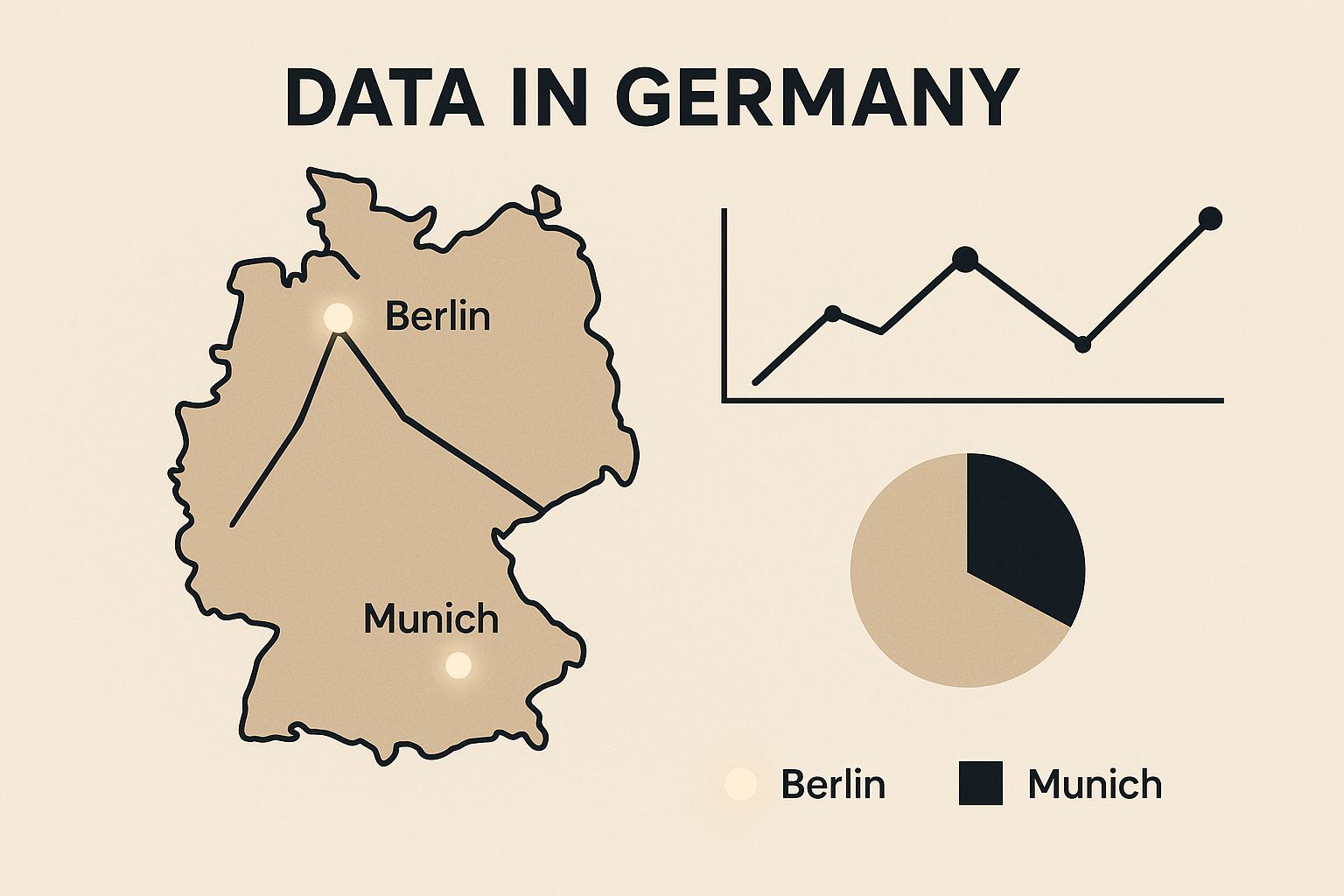
As you can see, while you'll find opportunities everywhere, the big cities like Berlin, Munich, Hamburg, and Frankfurt are still the hiring hotspots.
To give you a clearer picture, here's a snapshot of the roles you'll find at different stages of your career.
Data Analyst Career Path Opportunities in Germany
This table illustrates the progression opportunities available in the German job market, from entry-level to senior roles.
| Role Level | Approximate Openings | Common Responsibilities | | :--- | :--- | :--- | | Intern/Junior Analyst | ~100+ | Assisting with data collection, cleaning data, creating basic reports, and learning from senior team members. | | Data Analyst | ~500+ | Performing data analysis, developing dashboards, querying databases (SQL), and presenting findings to stakeholders. | | Senior Data Analyst | ~300+ | Leading complex projects, mentoring junior analysts, developing advanced analytical models, and advising on data strategy. |
As you can see, there’s a solid structure for growth, allowing you to move up as you gain experience and expertise.
The Skills and Industries in Demand
To really make it here, you need a mix of hard technical skills and sharp business sense. German employers are looking for people who can do more than just run queries.
- Technical Proficiency: A solid grip on SQL is non-negotiable for working with databases. You'll also need to be comfortable with Python or R for more complex statistical analysis and data wrangling.
- Visualisation Tools: You have to be able to tell a story with data. Experience with tools like Tableau or Power BI is crucial for building dashboards and reports that business leaders can actually understand and act on.
- Business Acumen: This is what separates a good analyst from a great one. You need the ability to see the bigger picture and connect your data insights to real-world business challenges. It’s all about understanding the why behind the numbers.
The need for these skills isn't just in the tech world. In fact, some of Germany's most traditional industries are now the biggest recruiters for data talent.
- Automotive: Giants like Volkswagen and BMW rely on data analytics for everything, from optimising their supply chains to figuring out what kind of cars people will want next.
- Finance and Insurance: Banks and insurance companies use analysts for critical tasks like assessing risk, detecting fraud, and creating personalised services for customers.
- E-commerce and Retail: Whether it's an online shop or a brick-and-mortar store, data is used to get inside the customer's head, manage stock, and set the right prices.
- Healthcare and Pharmaceuticals: In this sector, data analysis is vital for running clinical trials, studying patient outcomes, and making hospitals run more smoothly.
This broad industrial base means you'll have a wide variety of fascinating problems to solve, making a data analytics career in Germany both rewarding and stable. The ongoing need for skilled people ensures this field will keep growing for a long time to come.
The Skills German Employers Are Hiring For

If you're hoping to land one of the many data analyst jobs Germany has available, you need to know exactly what hiring managers are looking for. It’s not about having a laundry list of tools on your CV; it's about mastering the specific skills that pop up again and again in German job descriptions.
Success here boils down to a blend of rock-solid technical skills and sharp business thinking. German companies aren't just looking for people who can wrangle data; they want analysts who can connect that data directly to business goals. Your technical toolkit is crucial, but your ability to explain its value is what will set you apart.
Foundational Technical Competencies
The absolute bedrock of any data analyst role in Germany is a strong command of the core technologies for data manipulation and visualisation. Think of these as the non-negotiables that get your application past the first filter. Without them, you'll struggle to even get a foot in the door for an interview.
It all starts with SQL. Being able to write clean, efficient queries to pull and work with data from relational databases is the single most fundamental skill. From day one, you'll be expected to handle everything from basic SELECT statements to complex JOINs and subqueries.
Next up, you need to be comfortable with a scripting language for more sophisticated analysis. Python has firmly established itself as the industry standard in Germany. It’s prized for its versatility and powerful libraries like Pandas for data wrangling and Matplotlib or Seaborn for building visualisations. While R still has its place, especially in academia and research, Python's broader business applications give it a definite edge in the corporate world.
A recent analysis of German job postings showed that over 85% of data analyst roles listed both SQL and Python as mandatory requirements. These are no longer just "nice-to-haves"—they're the baseline expectation.
Mastering these tools is your entry ticket. A typical task might be using SQL to pull quarterly sales figures, using Pandas in Python to clean and analyse that data, and then whipping up some initial charts to spot trends before presenting your findings.
Data Visualisation and BI Tools
In Germany, there’s a huge emphasis on turning raw data into clear, actionable insights. Numbers in a spreadsheet are useless if stakeholders can't make sense of them. This is where your expertise in Business Intelligence (BI) and visualisation tools becomes mission-critical. These platforms are where your analysis truly comes to life.
You absolutely must be proficient in at least one of the major BI tools. In the German market, two names dominate the landscape:
- Tableau: Loved for its user-friendly, drag-and-drop interface and stunning interactive dashboards. It's often the tool of choice for companies that want to empower non-technical staff to explore data themselves.
- Power BI: Microsoft's powerhouse is deeply integrated with the entire MS ecosystem (think Excel, Azure), which makes it an incredibly popular choice in larger, more established German corporations.
Knowing how to use these tools goes way beyond just making a pretty chart. It’s about designing dashboards that tell a compelling story, highlight key performance indicators (KPIs), and let decision-makers see the big picture at a glance.
The Importance of Soft Skills and Business Acumen
Your technical skills might land you the interview, but it’s your soft skills that will ultimately land you the job. German employers are laser-focused on hiring analysts who can be the bridge between the data team and the rest of the business.
Communication is everything. You have to be able to explain complex analytical findings to people who aren't data experts—from marketing managers to the C-suite—without getting bogged down in technical jargon. Your ability to present data in a clear, concise, and persuasive way is a core part of the job.
But what truly separates a good analyst from a great one is business acumen. This is about understanding the company's strategic goals, the challenges facing the industry, and exactly how your analysis helps the bottom line. It’s the difference between asking "What does the data say?" and asking "What does this mean for our business, and what should we do about it?"
This kind of commercial awareness allows you to be a proactive partner, not just a service provider. When you can frame your insights within a business context, you become an invaluable asset. That combination of technical expertise and strategic thinking is the real key to building a successful career here.
Understanding Data Analyst Salaries in Germany

Let's talk about the money. It's a critical part of any job search, and when it comes to data analyst jobs germany offers some pretty attractive compensation. But your potential salary isn't just one magic number. It’s a mix of things: your years in the field, the city you're based in, and even the type of company you join.
Getting a handle on these factors is the key to knowing your worth and negotiating with confidence. A data analyst role at a massive automotive company in Munich, for example, is going to have a very different pay scale than a similar gig at a scrappy tech start-up in Berlin.
Typical Salary Bands by Experience Level
More than anything else, your experience level will dictate your paycheque. German companies really value seasoned professionals, and they're willing to pay a premium for the strategic insights and leadership that come with years of practice. The salary growth is quite clear, which is a great incentive to stick with it.
Entry-Level (0-2 years): Fresh in the field? You can expect to start somewhere between €45,000 and €55,000 per year. At this stage, it's all about learning the ropes, honing your core skills, and showing what you can do.
Mid-Career (3-7 years): Once you've got a few years under your belt, your value shoots up. Mid-level analysts typically pull in €55,000 to €75,000 as they start tackling more complex projects and taking on more ownership.
Senior/Lead (8+ years): If you're a seasoned pro with deep expertise and leadership skills, you can command salaries of €75,000 and up. It's not uncommon to see principal or lead roles in hot sectors pushing past the €90,000 mark.
Think of these numbers as a solid starting point, but remember they can swing depending on a few other important details.
How Location and Industry Impact Your Earnings
In Germany, where you work can be almost as important as what you do. The major economic hubs like Munich and Frankfurt tend to offer higher salaries, partly to offset the higher cost of living, but also because that's where the biggest companies are headquartered.
The industry you're in matters a lot, too. A data analyst at a big bank in Frankfurt will almost certainly earn more than someone with the same title at a non-profit, just because of the different financial realities of those sectors.
Here’s a quick look at how things can differ from city to city:
| City | Cost of Living Index | Typical Salary Range (Mid-Level) | Key Industries | | :--- | :--- | :--- | :--- | | Munich | High | €65,000 - €80,000 | Automotive, Tech, Insurance | | Frankfurt| High | €60,000 - €75,000 | Finance, Banking, Consulting | | Berlin | Moderate | €55,000 - €70,000 | Start-ups, E-commerce, Media | | Hamburg | Moderate | €58,000 - €72,000 | Logistics, Media, Aviation |
As you can see, Munich might flash the biggest numbers, but Berlin’s buzzing start-up scene offers very competitive pay with a much more manageable cost of living.
It's crucial to look beyond the gross salary. A higher salary in Munich might not stretch as far as a slightly lower one in Berlin once you factor in rent and daily expenses.
Beyond the Paycheque: The German Benefits Package
One of the best things about working in Germany is the fantastic benefits package that comes with most full-time contracts. When you look at the whole picture, the total compensation is often worth much more than the base salary alone.
The demand for data analysts is strong. Recent data shows over 1,000 openings just for English speakers, with competitive salaries often ranging from €58,000 to €127,000. You can explore the current job landscape for English-speaking data analysts in Germany on ZipRecruiter to see for yourself.
On top of your salary, you can usually expect:
- Health Insurance: This is a big one. Comprehensive public health insurance is mandatory, and your employer typically pays for about half of it.
- Retirement Plan (Betriebliche Altersvorsorge): Many companies offer a pension scheme and will contribute to it, helping you build a nest egg for the future.
- Paid Time Off: Germany is famous for its generous holiday policies. The legal minimum is 20 days, but 25-30 days is the standard at most companies.
- Professional Development: German companies place a real emphasis on continuous learning. It's common for employers to provide a budget for courses, certifications, and conferences to help you stay ahead of the curve.
When you get an offer, make sure to evaluate the entire package. These benefits add serious financial value and are a huge part of what makes for a healthy work-life balance in Germany.
Where to Hunt for the Best Data Analyst Openings
Knowing where to look is half the battle when you're on the hunt for a data analyst role in Germany. The right platforms will put you in front of top employers, but the wrong ones will have you endlessly scrolling through irrelevant listings. Your best bet is a smart strategy that blends the big-name job boards with some niche, tech-focused sites.
Your first stops should be the heavy hitters: LinkedIn and StepStone. LinkedIn is obviously great for listings, but its real power lies in networking and getting a feel for a company's culture. StepStone, on the other hand, is a dominant force in the German market and has a massive inventory of roles across every industry imaginable. Getting job alerts set up on both is non-negotiable.
But don't just stop there. To really tap into the local market, you need to be on Xing, which is Germany’s home-grown professional network. You'll find a lot of German recruiters and companies are much more active there than on LinkedIn. And if you're drawn to the buzzing start-up scene in places like Berlin, a specialised board like Berlin Startup Jobs is an absolute goldmine.
Zeroing In on Key Companies and Industries
Beyond just browsing job boards, it pays to be proactive. This means directly targeting companies that are known for having a strong data culture. Many of Germany's most established firms are constantly searching for data talent, offering stable careers and clear paths for growth. And it’s not just the big tech players anymore—data analytics is now the backbone of traditional sectors, too.
Take a look at the landscape: Top employers actively recruiting data analysts include giants like Landesbank Baden-Württemberg, Deutsche Bank AG, and Hubert Burda Media Holding GmbH & Co. KG. The variety here—from banking and finance to media and even major retailers like EDEKA—tells you everything you need to know. Data skills are in demand everywhere. You can get a better sense of the roles these employers are offering over on devjobs.de.
These positions often involve a compelling mix of responsibilities, from data optimisation and designing KPIs to building forecasts and automating reports. It’s a sign of the real-world impact you'll be expected to make.
To give you a clearer picture, here's a look at some of the top industries hungry for data analysts in Germany.
Top Industries Hiring Data Analysts in Germany
| Industry Sector | Example Companies | Typical Data Analyst Focus | | :--- | :--- | :--- | | Finance & Banking | Deutsche Bank, Commerzbank, N26 | Fraud detection, risk assessment, customer segmentation, algorithmic trading support. | | E-commerce & Retail | Zalando, Otto Group, REWE Digital | Customer behaviour analysis, supply chain optimisation, personalised marketing, sales forecasting. | | Automotive | Volkswagen, BMW, Daimler | Predictive maintenance, production efficiency, connected car data analysis, market trend analysis. | | Healthcare & Pharma | Bayer, Siemens Healthineers, BioNTech | Clinical trial data analysis, patient outcome research, operational efficiency in hospitals, drug discovery. | | Tech & Start-ups | SAP, Delivery Hero, Celonis | Product analytics (A/B testing), user engagement tracking, SaaS metric analysis, growth hacking. |
This table just scratches the surface, but it highlights how diverse the opportunities are. Your skills can be applied to solve fascinating problems in almost any field you can think of.
What to Actually Look for in a Job Description
Once you start finding interesting openings, you need to learn how to read between the lines of the job description. This is where the company reveals its data maturity and what it really values.
- The Tech Stack: Do they explicitly mention BI tools like Tableau or Power BI? Are they name-dropping cloud platforms like AWS or Azure? This isn't just a list of buzzwords; it tells you exactly what skills they expect you to have on day one.
- The Team Setup: Will you be part of a central data team that serves the whole company, or will you be embedded in a specific department like marketing or finance? Your answer determines who your daily collaborators will be and the kinds of problems you'll be solving.
- The Real Responsibilities: Look past the generic duties and focus on the action verbs. Are they looking for someone to "build," "optimise," and "innovate"? Or is it more about "maintaining," "monitoring," and "reporting"? The former suggests you'll have strategic input, while the latter points to a more operational role.
A great job description won't just list tasks; it will describe the problems you'll be hired to solve. That’s the hallmark of a company that truly understands how data drives its business forward.
Getting a handle on these details will help you customise your application and ask sharp, insightful questions during your interviews. To make the entire process smoother, you might want to look into tools built to help you find and apply for jobs more efficiently. For instance, our guide on how JobCopilot can streamline your application process is a great place to start. A strategic approach like this—mixing broad searches with targeted research—will dramatically improve your odds of landing that perfect data analyst job in Germany.
How to Create a Standout Application That Gets Noticed
Getting your foot in the door for one of the many data analyst jobs Germany has to offer isn't just about having the right skills. It’s about presenting those skills in a way that clicks with German recruiters. Your application needs to speak their professional language.
This goes beyond a simple translation. You need to frame your story—from your CV to your cover letter—to align with local expectations and professional standards. A thoughtfully crafted application package immediately signals that you're a serious, organised candidate who has done their homework.
Nailing the German CV (Lebenslauf)
In Germany, your CV, or Lebenslauf, is your most critical marketing tool, and it comes with its own set of unwritten rules. The standard German format is more detailed and conservative than you might be used to, with a heavy emphasis on clarity and completeness.
You’ll structure it in reverse-chronological order, placing your most recent role at the top. And while it’s becoming less common, don't be surprised that including a professional headshot is still a widespread practice. A high-quality photo—friendly yet professional—can help build an initial connection with the hiring manager.
Think of your Lebenslauf less as a creative story and more as a factual report of your career. German recruiters want to see clear, data-driven proof of your skills and accomplishments. Aim for a clean, professional document, typically no longer than two pages.
To make your data analyst CV stand out, make sure these sections are rock-solid:
- Contact Information: All the basics—name, address, phone, email—plus a link to your LinkedIn profile.
- Professional Experience: Go beyond just listing your duties. Focus on achievements and quantify them whenever possible. For example, instead of "Responsible for reports," try "Optimised database queries, reducing report generation time by 20%."
- Education: Clearly list your degrees, the institutions you attended, and your graduation dates.
- Skills: This is huge for a data analyst. Create a dedicated section listing your technical toolkit (SQL, Python, R, Tableau, Power BI) and your language skills, making sure to note your fluency level for each.
Writing a Cover Letter (Anschreiben) That Actually Gets Read
Your cover letter, or Anschreiben, is your chance to draw a direct line between your experience and the company's specific needs. A generic, copy-paste letter is a one-way ticket to the "no" pile. In Germany, the Anschreiben is seen as a formal document that proves you've thought seriously about the role.
Do a little digging on LinkedIn to find the hiring manager's name and address them directly. This small touch makes a big difference. Keep the entire letter to a single, concise page that makes a clear case for why you're the perfect fit.
A simple, powerful structure works best:
- The Opener: Get straight to the point. State the exact position you're applying for and where you found it. Follow up with a genuine line about your enthusiasm for the role or the company.
- The Core Argument: This is where you make your case. In two or three short paragraphs, highlight your most relevant skills and past projects. Directly connect your achievements to the requirements in the job description. If they mention A/B testing, talk about a time you used it to drive a specific outcome.
- The Closing: Reiterate your strong interest and state that you're looking forward to an interview. End with a classic formal closing like "Mit freundlichen Grüßen" followed by your typed name.
Getting Ready for the Interview Gauntlet
If your application makes the cut, congratulations! Now it's time to prepare for the interview. The German process is often quite thorough, potentially involving several rounds, technical tests, and meetings with various team members. Being well-prepared is the only way to walk in with confidence.
Interviews for data analyst jobs in Germany will almost certainly test you on multiple fronts.
Technical Challenges
You need to be ready to prove your skills on the spot. This could come as a take-home case study, a live coding session, or a data visualisation task.
- The SQL Gauntlet: It's common to be given a sample database schema and asked to write queries that solve specific business problems.
- The Case Study: You might get a raw dataset and be asked to clean it, analyse it, and present your findings. This is their way of seeing your entire analytical process from start to finish.
- Tool Proficiency Test: Don't be surprised if they ask you to share your screen and walk them through how you'd build a dashboard in Tableau or Power BI.
Behavioural and Situational Questions
German employers value stability and clear thinking. They'll use behavioural questions to dig into your past experiences, believing they are the best predictor of your future performance. Get ready for questions like:
- "Tell me about a time you had to present a complex data insight to a non-technical manager. How did you do it?"
- "Describe a project where the data led to a surprising or difficult conclusion. What was your process?"
- "How do you ensure the quality and accuracy of your work when you're on a tight deadline?"
For more practical career advice and tips on mastering your job search, feel free to check out other articles on the JobCopilot blog. By carefully tailoring every piece of your application, you’re showing a level of professionalism and attention to detail that every top company is looking for in a data analyst.
Your Top Questions Answered
Stepping into the German job market, especially in a field like data analytics, can feel like navigating a maze. A lot of questions pop up, and getting clear answers is the first step to building a solid job search strategy. Let's clear the air on some of the most common hurdles you might be thinking about.
A big one is always language. "Do I have to be fluent in German?" The short answer is no, not necessarily. While knowing German is a fantastic asset, it's not a deal-breaker, particularly in the big tech hubs like Berlin, Munich, or Hamburg.
You'll find hundreds of international companies and ambitious start-ups where English is the language of the office. A quick look at job boards often turns up over 1,000 data analyst positions specifically for English speakers. The key is to let your technical skills do the talking—in the data world, a sharp SQL query often speaks louder than perfect German grammar.
What Visa Do I Need to Work as a Data Analyst?
If you're coming from outside the EU/EEA, the visa question is probably top of your mind. The good news is that Germany has a pretty clear path for skilled workers, knowing just how much tech talent is in demand.
Your most likely route will be the EU Blue Card. It’s specifically designed for highly-qualified professionals from outside the EU. To get one, you'll generally need two things:
- A university degree that's recognised in Germany.
- A firm job offer that meets a minimum salary threshold (this figure gets updated yearly, so always check the latest).
Another possibility is the Job Seeker Visa. This gives you up to six months to come to Germany and find a job on the ground. Once you land that offer, you can apply for your work permit without having to leave the country, which is a huge plus.
A bit of practical advice: start the visa paperwork the moment you get a job offer. These things take time, sometimes several weeks. Most German companies that hire internationally know the drill and will give you all the documents you need to support your application.
Being prepared here makes the whole transition so much smoother.
Can I Get a Data Analyst Job Without a Degree?
It's a common myth that you need a traditional computer science or maths degree to break into data analytics. While that's a well-trodden path, it’s far from the only one. German companies, especially in the tech sector, are increasingly focused on what you can do, not just what you've studied.
This is where your portfolio becomes your most powerful tool. A collection of projects that showcases your real-world problem-solving abilities can easily outshine a diploma. If you can walk a hiring manager through a project that shows you've mastered SQL, Python, and a BI tool like Tableau or Power BI, you're in a very strong position.
How Much Experience Is Needed for an Entry-Level Role?
"Entry-level" can be a tricky term. In the German data market, it typically refers to someone with 0 to 2 years of relevant experience. And that "experience" doesn't have to be from a full-time job. It can come from internships, freelance work, or even the in-depth projects you completed in a tough certification programme.
For these junior roles, nobody expects you to be a seasoned expert. What they're really looking for is potential. They want to see:
- You have a solid grasp of the core technical skills.
- You genuinely love digging into data and solving puzzles.
- You're eager to learn and can work well with a team.
A killer portfolio can make up for a thin CV. It's tangible proof of your skills and initiative, giving you concrete examples to talk about in an interview. You’re not trying to show perfection; you’re trying to show you have the drive and the foundation to contribute from day one.
Ready to stop scrolling and start interviewing? Acquispect uses AI to find the perfect data analyst jobs for you, creates tailored applications in minutes, and tracks your success so you can land your dream role faster. See how Acquispect works.