Working in social media from anywhere you want isn't just a dream anymore; it’s a booming career path. More and more companies are realising they need skilled people to manage their online presence, which has kicked the door wide open for talented strategists, creators, and community managers to build a career from home.
The Soaring Demand for Remote Social Media Experts

Gone are the days when social media was just an add-on for a business. Now, it's right at the heart of how companies grow, talk to customers, and build their brand. This shift has directly fuelled a huge spike in remote social media jobs.
Companies have figured out they can find the best person for the job, not just the best person in their city. Why limit the search to a 30-kilometre radius when the perfect content strategist could be living on the other side of the country? It’s a win-win, creating a much more vibrant job market for everyone involved.
What's Driving the Growth?
This isn't just a feeling; the numbers back it up. Take Germany’s digital marketing market, for example. It was valued at around $14.5 billion in 2024. But forecasts predict it could explode to nearly $28.87 billion by 2034. That kind of growth creates a steady stream of jobs for people who know their way around social media.
One of the biggest reasons remote work fits so well with social media roles is because the job itself is entirely digital. Your success isn't measured by the hours you spend at a desk, but by real-world metrics like engagement, reach, and conversions.
Finding Your Fit: The Different Types of Roles
"Social media job" is a broad term. It’s not just about scheduling posts. The field has become specialised, and knowing where your skills shine is key to landing the right role. You could be the big-picture thinker, the creative genius, or the person who loves chatting with the community.
To help you figure out where you fit, here's a breakdown of the most common roles you'll find out there.
Common Remote Social Media Roles and Key Duties
This table outlines the typical remote social media jobs and what each one actually involves day-to-day. It’s a great way to see how your skills line up with what companies are looking for.
| Job Title | Primary Responsibilities | Common Platforms | | :--- | :--- | :--- | | Social Media Strategist | Creates the overarching plan, analyses campaign data, and ensures social efforts align with business objectives. They're the architects. | All platforms, with a focus on analytics tools (e.g., Sprout Social, Hootsuite) | | Content Creator | Designs graphics, writes copy, and produces video content. They're the creative force behind the posts. | Instagram, TikTok, Pinterest, YouTube | | Community Manager | Engages directly with the audience by responding to comments, moderating groups, and building a loyal follower base. The voice of the brand. | Facebook Groups, Discord, Reddit, LinkedIn | | Social Media Analyst | Dives deep into the data to track performance, measure ROI, and deliver insights that shape future strategies. | Platform-native analytics, Google Analytics, data visualisation tools |
Understanding these distinctions is the first step. Once you know the kind of role you're after, you can start targeting your search more effectively.
Trying to keep up with all the openings can feel overwhelming. This is where a modern approach really helps. Using AI-powered tools like JobCopilot can cut through the noise, helping you find the right jobs faster and even assisting with your applications. With the right strategy, you'll be well on your way to a great career in a field that's only getting bigger.
Developing the Skills That Get You Hired
 Landing one of the many remote social media jobs out there takes more than just being good at posting. Companies aren't just looking for someone who can craft a witty caption; they need professionals who can deliver real business results, all from a home office.
This means you need a blend of creative talent, sharp analytical thinking, and the kind of self-discipline that remote work demands. It’s about proving you can get the job done without a manager physically looking over your shoulder.
Mastering the Essential Hard Skills
Let’s start with the hard skills—the tangible, technical abilities that form the bedrock of any social media role. These are the things employers will be actively looking for on your CV and in your portfolio. Without them, even the best ideas for a social media strategy will fall flat.
To really make an impression, you need to show you’ve moved beyond the basics. Think about how you can prove your expertise in these critical areas:
- Data Analysis and Reporting: You have to be comfortable diving deep into the numbers to figure out what’s working. This isn't just about pulling reports; it's about tracking KPIs, understanding why one post took off while another didn't, and turning that data into a clear plan for the next campaign.
- Content Creation with Modern Tools: Proficiency with tools like Canva, Adobe Express, or video editors like CapCut is non-negotiable now. Hiring managers expect you to create slick, on-brand content without needing a lot of hand-holding.
- Social Media SEO (SSO): This is a huge differentiator. Optimising profiles and content for search—using the right keywords in bios, captions, and alt text—can dramatically increase a brand's visibility. It shows you're thinking strategically.
The most valuable remote social media professionals are those who can clearly connect their daily activities—like content creation and community engagement—to the company’s bottom-line goals, such as lead generation or sales.
The Soft Skills That Make Remote Work Possible
While your technical skills might get you the interview, it’s your soft skills that will convince a company you can succeed in a remote setting. These are the personal traits that govern how you communicate, collaborate, and manage your own work when you're part of a distributed team.
These aren't just buzzwords to sprinkle on your CV. They are the practical skills that prevent the classic remote work pitfalls, like miscommunication, isolation, and missed deadlines. For more on how to frame these skills in your application, check out the career advice on the JobCopilot blog.
Communication and Self-Discipline
In a traditional office, you can just pop over to someone's desk to ask a quick question. When you're remote, communication has to be much more deliberate.
- Proactive Communication: This means you're the one giving updates before you're asked. You're clear about your progress in public Slack channels, and you aren't afraid to ask for clarification where everyone can see. It builds trust and keeps projects moving.
- Independent Time Management: You are your own boss, in a way. You need the discipline to juggle priorities, hit deadlines without a nudge, and build a daily routine that works for you, especially if you’re coordinating across different time zones.
Ultimately, companies want to see a portfolio that showcases fantastic work, but they also need the confidence that you're a self-starter who can be trusted to deliver, no matter where you're logging in from.
How to Build a Portfolio That Stands Out
Let's be blunt: your CV gets you on the list, but your portfolio gets you the interview. This is doubly true for remote social media roles. When a hiring manager can’t meet you in person, they need solid, tangible proof that you can get the job done without someone looking over your shoulder. Your portfolio is that proof.
It’s your chance to show, not just tell. Think of it less like a scrapbook of pretty posts and more like a highlight reel of your greatest strategic wins. It’s where you connect the dots for them, showing exactly how your creativity drove real, measurable success.
Showcase Results, Not Just Responsibilities
Anyone can write "managed an Instagram account" on their CV. It's a forgettable line. What makes a hiring manager sit up and take notice is seeing how you managed it and what came from your efforts. You need to frame your work around tangible business outcomes.
Don't just show a graphic you made. Turn it into a bite-sized case study.
- The Challenge: What was the problem or goal? Maybe it was boosting ticket sales for an online event or getting more sign-ups for a newsletter. Keep it brief.
- Your Solution: This is where you show the content. But more importantly, explain why you made certain creative choices. Why that colour scheme? Why that specific call-to-action?
- The Outcome: Here’s the knockout punch. Hit them with the numbers. Did your post crush the account's average engagement rate by 15%? Did it bring in 50 fresh leads?
This approach works even if you're just starting out. You can apply the exact same formula to personal projects, volunteer work, or even a concept project for a brand you admire. The principle is universal: show your impact.
A great portfolio doesn’t just show off your best work; it explains why it was your best work. It’s all about the 'before and after'—translating your creative skills into language that businesses understand: value.
What to Pack Into Your Social Media Portfolio
A truly effective portfolio gives a 360-degree view of what you bring to the table. You want to demonstrate that you're not just a creative mind but also a sharp, analytical thinker.
Make sure your portfolio includes a solid mix of the following:
- Campaign Case Studies: Walk them through 2-3 of your most successful campaigns from start to finish.
- Content Variety: Show your range. Include video clips, slick carousel posts, and examples of copy that truly pops.
- Hard Data: Nothing speaks louder than results. Include screenshots from analytics dashboards that clearly show growth—followers, reach, clicks, conversions, you name it.
- Strategic Thinking: Add a sample content calendar or a brief strategy document you've put together. This shows you're a planner, not just a poster.
This level of detail is crucial, especially in a competitive landscape. Take Germany, for instance. Remote social media manager roles are in high demand, with typical salaries falling between €40,000 and €70,000. Job descriptions there almost always ask for proven experience in multi-channel strategy, and a portfolio like this validates your claims immediately. You can get a better sense of the market by looking into social media strategist roles in Europe on remoterocketship.com.
When it comes down to it, your portfolio is your story. It’s your opportunity to take control of your professional narrative and prove you’re the solution they’ve been looking for.
Using AI to Supercharge Your Job Search
Let's be honest, hunting for a remote social media job can feel like a draining, full-time gig on its own. The endless scrolling on job boards, constantly tweaking your CV, and trying to make your application pop in a crowded inbox... it's exhausting. But what if you could put the most repetitive, mind-numbing parts on autopilot and save your energy for what really matters?
That's where AI tools enter the picture. Think of them as your personal recruitment assistant, working 24/7. Instead of you hunting for jobs, intelligent agents can scan thousands of new listings daily, dropping only the best-fit opportunities right into your inbox. It’s all about working smarter, not harder.
Automating the Discovery Process
The single biggest time-drain in any job hunt is, without a doubt, the search itself. AI-powered platforms can completely flip that script by doing the heavy lifting for you. They move way beyond basic keyword searches, using smart algorithms to actually understand the nuances of a job description and how it lines up with your specific skills and career goals.
So, you're no longer just plugging "remote social media manager" into a search bar. Instead, you're telling your AI assistant to find you roles that specifically ask for TikTok video editing skills, are focused on B2B tech clients, and offer a truly flexible schedule. Everything else just gets filtered out.
Using an automated job search tool isn't about losing control; it's about gaining precision. It frees you from the noise of irrelevant listings so you can invest your time in crafting high-quality applications for the jobs that are a perfect fit.
Crafting Customised Applications at Scale
Once you've found that perfect role, the next big challenge is the application. We all know how infamous Applicant Tracking Systems (ATS) are for kicking out perfectly good CVs that aren't formatted just right. AI is your secret weapon here, helping you tailor your application documents for each specific role in minutes, not hours.
Before you start, you need your core assets ready. This simple workflow shows how to get your best work organised and ready to go.
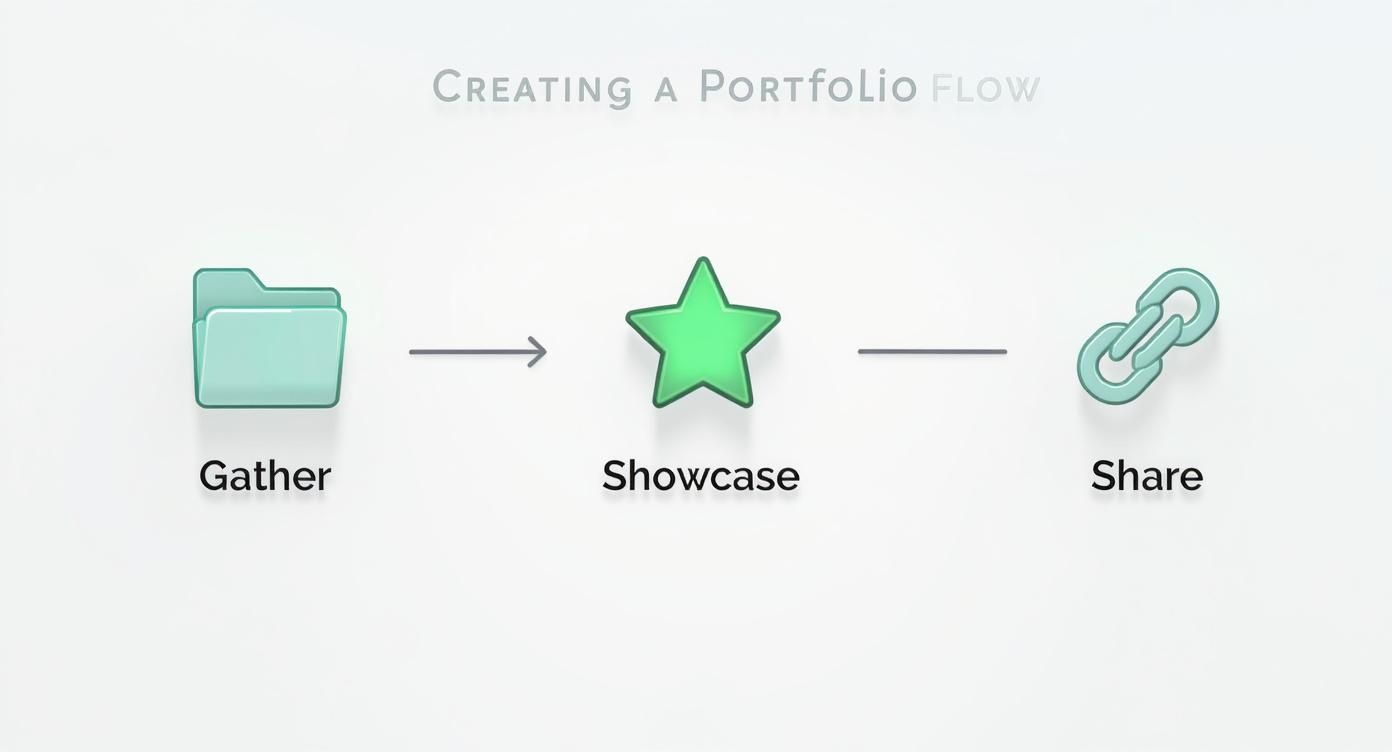
With your best work prepped, you can let the AI help you adapt it for each application, ensuring your strongest evidence is always front and centre.
AI tools can scan a job description, pull out the most important keywords and skills, and then show you exactly how to rephrase the bullet points on your CV to make a perfect match. Some really slick platforms, like Acquispect, can even generate a solid first draft of a cover letter that highlights your most relevant projects. This saves a massive amount of time and seriously boosts your odds of getting past that first screening.
AI Tool Comparison for Modern Job Seekers
Building your own job-seeking "tech stack" is a game-changer. Different tools are built for different parts of the process, so it pays to know what's out there. Here’s a side-by-side look at some popular AI tools that can help with everything from building your resume to preparing for tough interview questions.
| AI Tool | Primary Use Case | Key Feature | | :--- | :--- | :--- | | Acquispect | Automated job searching and application creation | Scans job boards, matches jobs to your profile, and generates customised cover letters automatically. | | Jobscan | CV optimisation against a job description | Provides a match score and detailed feedback on how to improve your CV to pass ATS scans. | | Vmock | Instant CV and career path feedback | Uses AI to give you detailed, score-based feedback on your CV's impact, presentation, and competencies. |
The real magic happens when you combine these tools into a seamless workflow. You can use an automated platform to find the opportunities, then run your application materials through an optimiser like Jobscan to make sure they’re perfectly tuned before you hit "submit." It's a strategic approach that gives you a genuine advantage in a very competitive field.
Acing the Remote Interview and Salary Negotiation
https://www.youtube.com/embed/PpbhaVjV2QI
Getting the interview for a remote social media role is a huge win, but it’s really just getting your foot in the door. The real test is how you handle the video call and the money talk that follows. This is what separates the candidates from the new hires.
Think of it this way: a remote interview isn't just a regular interview on a screen. It's an audition to prove you're ready for the unique demands of working from home.
Your first hurdle is your tech. Honestly, nothing screams "unprepared" louder than a call dropping out or your mic cutting off. A day or two beforehand, do a full tech rehearsal. Check your internet speed, make sure your camera and microphone are crystal clear, and get comfortable with whatever video platform they’re using, be it Zoom, Google Meet, or another tool.
Presenting Yourself as a Remote Pro
Once the tech is sorted, your main goal is to show them you’re a disciplined, proactive professional who doesn't need someone looking over their shoulder. You have to come armed with solid examples from your portfolio that prove you can manage projects and get things done on your own.
A simple framework for your answers works wonders:
- The Scenario: Quickly set the scene. What was the project or the problem you were facing?
- Your Action: Walk them through exactly what you did to solve it. This is where you highlight your independent thinking and initiative.
- The Result: Share the concrete, measurable outcome. Connect what you did to a real business win.
This method stops you from just making empty claims. Instead of saying, "I'm organised," you can share a story about how you successfully managed a content calendar across different time zones, leading to a 15% spike in engagement. That’s a story they’ll remember.
Remote interviews are your chance to prove you’re a self-starter. Hiring managers are looking for signs that you can communicate clearly, manage your time effectively, and take ownership of your work from day one.
Navigating Salary and Benefits
When the offer finally lands in your inbox, the conversation naturally turns to money. This is where a bit of homework pays off big time. You can't just wing a salary negotiation.
The market for remote social media roles is all over the place, but one thing is clear: demand is high.
Take Germany, for example. The need for skilled remote social media pros has exploded. A quick look shows over 1,300 open positions right now. A Social Media Specialist might expect a monthly salary between $2,900 and $3,800, whereas a more senior Social Media Associate could be looking at an annual salary between $67,000 and $70,000. You can dig into more detailed figures on sites like indeed.com for remote job salaries.
Use this kind of data to build your case. When you state your desired salary, back it up by reminding them of specific achievements from your portfolio. And don’t forget that negotiation is about more than just the base pay. Think about the other perks that could make a real difference:
- A budget for professional development, like courses or conferences.
- An allowance to set up your home office properly.
- Guaranteed flexible working hours.
These extras can massively improve your day-to-day work life and help you grow in your career. By preparing for both the interview and the negotiation, you're not just another applicant—you're a strategic partner ready to deliver results, no matter where your desk is.
Got Questions About Remote Social Media Jobs? We Have Answers.
Jumping into the world of remote social media work can feel like navigating a maze. If you’re wondering where to start or how to make your next move, you’re not alone. Let's clear up some of the most common questions that pop up.
First off, many people want to know what hiring managers really care about. Your CV is important, sure, but what truly gets their attention is proof you can do the job. A killer portfolio that highlights successful campaigns and real, measurable results isn't just nice to have—it's essential. They need to see you can create great content and connect it back to what the business actually wants to achieve.
What Kind of Salary Can I Expect?
Ah, the money question. It's on everyone's mind. When it comes to remote social media jobs, salaries can be all over the map. It really depends on your experience level, the exact role, and the company itself.
In Germany, for example, the pay scale looks something like this:
- Just Starting Out? For an entry-level role like a Social Media Coordinator, you’re likely looking at something in the €35,000 to €45,000 range per year.
- Got Some Experience? As a Social Media Manager with a few solid years under your belt, that figure typically climbs to €45,000 to €60,000.
- Leading the Strategy? If you're in a senior or strategic position, your salary could start at €60,000 and go up to €75,000 or more, especially if you have specialised skills.
Keep in mind, these are just ballpark figures. The smartest candidates I've seen use their portfolio as leverage. They walk into negotiations with proof of their impact and aim for the top end of the salary bracket.
Want to justify a higher salary? Don't just show them pretty posts. Tell a story with your data. Showcasing how you grew an account's followers by 20% or boosted engagement by 35% gives them a concrete reason to pay you what you're worth.
What Are the Essential Tools of the Trade?
To really nail a remote role, you have to be fluent in the right digital tools. Showing up to an interview already proficient with the industry-standard software proves you can get started without a lot of hand-holding.
Employers will expect you to have a good handle on a few key categories:
- Scheduling & Management: You absolutely need to know your way around platforms like Hootsuite, Sprout Social, or Buffer. They’re the backbone of planning content and keeping multiple accounts organised.
- Content Creation: Being a wizard in Canva or Adobe Express for graphics is pretty much a given. Some basic video editing skills are also becoming a standard expectation.
- Analytics & Reporting: It’s not enough to post—you have to track performance. That means being comfortable with native tools like Meta Business Suite and TikTok Analytics, and ideally, knowing how to use Google Analytics to see how social media is driving website traffic.
Being able to casually mention—and show—your expertise with these tools is a simple way to stand out from the crowd.
Ready to stop scrolling and start landing interviews? Acquispect uses AI to find your ideal remote jobs, crafts customised applications for you, and tracks your success so you can focus on what matters. Start your free 30-day trial and supercharge your job search today at acquispect.com.