The hunt for a remote job anywhere in the world isn't some fringe activity anymore. It's become a standard career move for millions, marking a real, lasting change in how we think about work. This isn't a fluke; companies are finally seeing the power of a global team, and professionals are, quite rightly, demanding more control over their lives.
The Global Shift to Remote Work Is Here to Stay
Sure, the massive push to remote work was kicked off by world events, but it’s now a core strategy for a huge number of businesses. Companies that were once pioneers, like Automattic and GitLab, have been joined by countless others in ditching the old office-first mindset. They’ve all realised the same thing: incredible talent isn't limited to a 30-mile radius around a city centre.
And let's be clear, this isn't just about making things easier. It's a smart business move. When you can tap into a worldwide talent pool, you can hire the absolute best person for the job, whether they’re in Berlin, Bali, or Boston. That variety of backgrounds and viewpoints is what sparks real innovation and gives a company its edge.
Why Remote Work Isn't Going Anywhere
This whole movement is sticking around because it just works—for everyone involved. The technology was obviously a huge piece of the puzzle; tools for collaboration have made it feel like your team is right there with you, even if they're a dozen time zones away. But the shift in attitude has been just as important.
People have proven that they can be trusted to get their work done without someone looking over their shoulder. This has forced a much-needed change in how we measure success—it's not about the hours you put in, but the results you deliver. That performance-first mentality is what makes the best remote companies tick.
Here’s what’s really locking this trend in place:
- Access to a World of Talent: Businesses are no longer fishing in a small local pond. They can find niche experts and brilliant minds from literally anywhere.
- Happier, More Loyal Teams: Giving people the freedom to blend their work and personal lives is a game-changer for morale, and it makes them want to stick around.
- Smarter Spending: Who needs a massive, expensive office lease? The savings on overhead are a huge plus for companies, big or small.
A truly modern company is built to be flexible. The winners are the ones organising themselves around amazing people and what they create, not around a physical address. That's the engine powering the whole global remote work scene.
At the end of the day, searching for remote jobs worldwide is about plugging into this new way of working. It’s a system founded on trust, great tech, and a common drive to do incredible work, regardless of location. This isn't just a phase; it's the future of work unfolding before our eyes.
Building Your Personal Strategy for a Global Job Hunt
Jumping into the vast pool of remote jobs worldwide without a plan is like setting sail without a map. You'll get somewhere eventually, but it probably won't be where you intended. A targeted strategy is your best bet for saving time and, more importantly, landing a role that genuinely fits your life.
This all starts with a bit of honest self-reflection. Before you even open a single job board, you need to define what "remote work" actually means to you. Are you dreaming of being a digital nomad, hopping from country to country? Or is it about the simple, priceless flexibility of being home with your family? Get clear on your why.
Pinpoint Your Remote-Ready Skills
Next up, take a hard look at your professional skills, but see them through a remote-first lens. In a distributed team, certain abilities are pure gold. It's not just about your core job functions; it's about proving you can thrive without someone looking over your shoulder.
Your most valuable assets here are often things you take for granted:
- Asynchronous Communication: How good are you at explaining progress or asking questions in writing? Think about your experience with tools like Slack or Asana. Clear, concise written communication is everything.
- Proactive Problem-Solving: Do you wait to be told what to do, or do you take the initiative to find solutions on your own? This shows autonomy and is a huge green flag for remote hiring managers.
- Time Management Mastery: How do you structure your day? If you've used tools like Toggl or have your own bulletproof productivity system, that’s something to highlight.
Think back to a specific project where you had to coordinate with people across different teams with minimal direct supervision. That’s a perfect story to drop into your cover letter or an interview to demonstrate you've got what it takes.
Research Companies That Fit Your Style
Once you have a clear picture of your skills and what you need from a job, you can start digging into potential employers. Don't just scan for open positions; really investigate the company culture. Some fully remote companies, like GitLab, even have public handbooks that spell out exactly how they work.
The goal is to find a company whose operational rhythm matches your own. If you thrive on spontaneous brainstorming video calls, a company that lives and breathes asynchronous deep work might feel like a straitjacket.
And don't forget the practical stuff. A company in San Francisco might post a job as "remote," but do they expect you to be online during their core Pacific Time hours? Getting clarity on time zone expectations from the get-go will save you a world of headaches.
Navigating Global Team Dynamics
Finally, get ready for the nuances of working on a global team. Cultural awareness isn't just a corporate buzzword here; it's a fundamental skill for making remote work… work. People from different backgrounds have wildly different approaches to communication, feedback, and deadlines.
Showing you've thought about this—maybe by mentioning your experience with international clients or your flexibility in adapting your communication style—presents you as a thoughtful, globally-minded candidate. This strategic groundwork turns your job search from a mindless scroll through listings into a proactive campaign to find your ideal place in the world of remote work.
Discovering the Best Platforms for Remote Jobs
Finding your next role in the vast sea of remote work can feel a bit overwhelming. While big-name job boards are packed with listings, the real secret to a successful search for remote jobs worldwide is knowing where to look. You need to go beyond the usual suspects.
Many generalist sites are a mixed bag. You'll often find "remote" jobs that are actually hybrid or, worse, geographically locked to a specific country. This is where specialised, remote-first job boards become your best friend. Platforms like Remote.co, We Work Remotely, and Dynamite Jobs are brilliant starting points because they do the hard work for you, vetting their listings to ensure the roles are genuinely location-independent.
Targeting Niche and Speciality Platforms
Once you've got the lay of the land, it's time to narrow your focus. Digging into platforms dedicated to your specific industry can uncover some real gems.
For those in tech, sites like Arc.dev and Turing are goldmines, offering vetted roles with top international companies. If you're a creative professional, you might find your next great gig on a board like Working Nomads, which regularly features fantastic design, writing, and marketing positions.
Getting the most out of these platforms means becoming a master of their search filters. Don't just tick the "remote" box and call it a day. Dive into the advanced settings to specify time zones, contract types (full-time vs. freelance), and even the company's funding stage. This is how you stop wading through irrelevant roles and start focusing your energy where it actually counts.
This infographic lays out a simple, three-step approach to give your job search some much-needed structure.
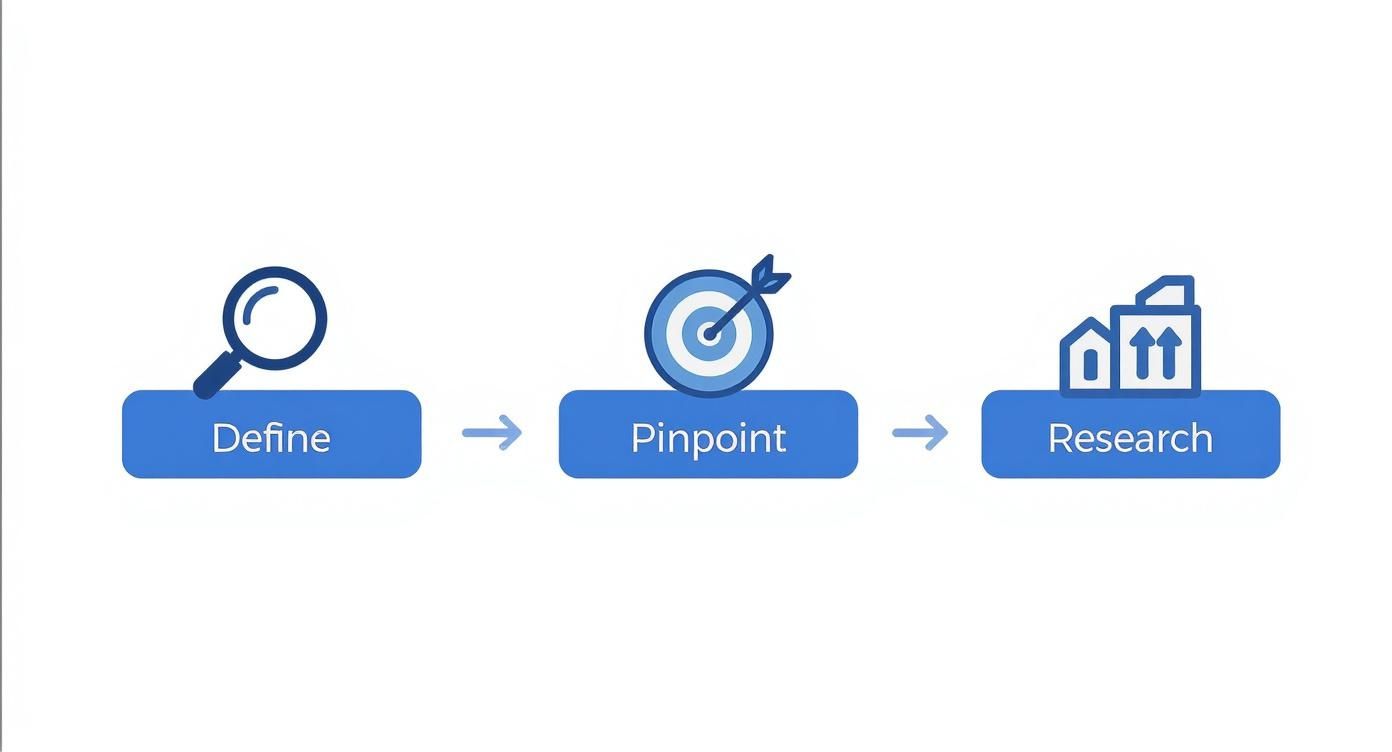
It really highlights the importance of being methodical: know what you want, find the right opportunities, and do your homework on companies before you even think about applying.
Leveraging Professional Networks and Hidden Opportunities
Let's be honest: some of the best remote jobs worldwide never even get advertised. This is where your professional network, especially LinkedIn, becomes invaluable for uncovering those hidden opportunities.
Start by optimising your LinkedIn profile. Weave in keywords like "remote," "distributed teams," and "global collaboration" to pop up in searches by international recruiters.
More importantly, get active. Follow and engage with content from well-known remote-first companies like GitLab, Doist, and Zapier. By commenting on their pages and interacting with posts from their employees, you put yourself directly on their radar. It’s a proactive strategy that shows you’re genuinely interested and helps you build connections that can turn into referrals down the line.
Remember, networking in a remote world is all about adding value, not just asking for a job. Share insightful comments, join relevant group discussions, and build relationships based on genuine professional respect.
If you’re looking to make your search even more efficient, automated tools can be a lifesaver. For example, a job search assistant from JobCopilot can help you discover and apply for roles far more quickly, freeing up your valuable time.
Top Platforms for Sourcing Remote Jobs Worldwide
To help you decide where to invest your time, I've put together a quick comparison of the leading job boards. Each has its own strengths, so it's smart to use a mix of them in your search strategy.
| Platform Name | Primary Focus | Key Features | Best For | | :--- | :--- | :--- | :--- | | LinkedIn | Professional Networking & General Jobs | Massive user base, company insights, direct recruiter contact | Uncovering hidden jobs and building industry connections. | | We Work Remotely | Tech & Digital Roles | High-quality, curated listings from reputable companies | Developers, marketers, and designers seeking vetted remote roles. | | Remote.co | Wide Range of Industries | Hand-curated job lists, company Q&As, remote work resources | Job seekers who want a broader industry scope beyond just tech. | | Dynamite Jobs | Established Remote Businesses | Focus on roles with 100% remote companies, salary transparency | Experienced professionals wanting to join mature remote teams. | | Arc.dev | Vetted Software Developers | Rigorous vetting process, matches developers to long-term roles | Senior software engineers looking for high-paying, verified opportunities. |
Choosing the right platform is half the battle. By diversifying your approach and focusing on the boards that align with your career goals, you can navigate the global job market with much more confidence and precision.
Spotting Scams and Ensuring Legitimacy
As you explore all these different platforms, you absolutely have to keep your guard up. The remote job market, unfortunately, attracts its share of scams.
A huge red flag is any company asking you for payment. A legitimate employer will never ask you to pay for equipment or background checks before a formal offer is on the table. Always take a minute to verify a company's existence. Look for their official website, check their LinkedIn presence, and see if they have a real digital footprint. A little due diligence goes a long way.
How to Craft an Application That Truly Stands Out Globally
Think of your CV and cover letter as your digital handshake. When you're applying for remote jobs worldwide, there’s no office to walk into, no firm handshake to offer. These documents are your first and often only chance to make an impression on a hiring manager who could be thousands of miles away.
Generic applications are the fastest way to get ignored. To even have a chance, your application has to be built from the ground up to answer the unspoken questions that come with global remote hiring. It’s not about just listing what you did in past jobs; it's about proving you have the discipline, autonomy, and communication skills to excel without someone looking over your shoulder.
A great remote application tells a story. It convinces the reader that you're not just qualified, but that you're specifically wired for the unique challenges and freedoms of working in a distributed team.
Building a Remote-Ready Resume
Your resume needs to practically scream 'remote-ready'. This is about shifting your mindset from listing duties to showcasing achievements that prove you can handle an autonomous work environment.
For instance, instead of saying you "managed social media," reframe it. Try something like: "Independently managed and grew social media accounts by 35% in six months, coordinating campaigns across three different time zones using tools like Asana and Slack." See the difference? One is a task, the other is a remote-friendly accomplishment.
Here are the key things to spotlight:
- Autonomy and Initiative: Highlight projects you spearheaded with little to no supervision.
- Communication Skills: Don't just say you're a good communicator. List the collaboration tools you live and breathe in—Slack, Microsoft Teams, Trello, you name it.
- Tech Fluency: Mention your experience with project management software and other technologies that make remote work possible.
The best remote resumes are basically a portfolio of your self-management skills. Every bullet point should reinforce that you're a proactive professional who delivers top-notch results without constant oversight. That’s precisely what international hiring managers are hunting for.
Don't forget to think about international formatting. A two-page CV might be standard in parts of Europe, but a punchy one-pager is king in North America. A quick search on resume norms in the company's home country can give you a surprising advantage. For a deeper dive on perfecting your approach, check out the great tips on our JobCopilot blog.
Writing a Global Cover Letter That Connects
This is where you connect the dots. Your cover letter is the place to tackle any potential red flags a hiring manager might have about hiring someone from another country or time zone. Be upfront about it.
Directly mention your experience with asynchronous work and your comfort with navigating different time zones. A simple sentence can make a huge impact: "Having worked with teams in both the US and Asia, I’m highly skilled in asynchronous collaboration and managing deadlines across international schedules."
A line like that instantly puts a manager at ease. It shows them you've already considered the practical side of global teamwork and you're ready to hit the ground running.
In the end, your CV and cover letter need to team up to build a rock-solid case for you. They must prove that distance is just a geographical detail, not a barrier to your ability to be a valuable part of their team from anywhere in the world.
Acing the Remote Interview and Onboarding Process

Getting that email for a remote interview is a big deal. Now it's time to prove you're as great on screen as you are on paper. When you're not in the room, making a genuine connection is everything. You need to show them your confidence and skill through a webcam.
First things first, get your tech sorted. This goes way beyond just making sure your webcam works. You’re crafting a professional first impression. Test your internet connection, check your audio for clarity, and find a spot with decent lighting and a simple, uncluttered background. Nothing kills the vibe of a great answer faster than a lagging video or crackly sound.
Mastering the Video Interview
With the tech handled, it’s all about how you come across. Video interviews demand a bit more effort with your non-verbal cues. Try to look directly into the camera when you're speaking—it’s the virtual equivalent of making eye contact. Sit up straight and don't be afraid to use hand gestures as you normally would; it helps project energy and engagement.
Expect questions geared specifically towards your remote work capabilities. They need to know you won't just disappear into the ether.
- Have your stories ready: Think of a time you owned a project without a manager breathing down your neck or when you solved a tricky problem all on your own.
- Talk about your tools: Explain how you keep everyone in the loop using platforms like Slack or Asana. Show, don't just tell.
- Get ahead of time zone concerns: If you’re interviewing for a global team, mention your flexibility and any experience you have working across different time zones.
Remember, you're interviewing them, too. This is your chance to dig into their remote culture. Ask specific questions about how they communicate, what they do to build team camaraderie, and what the first few weeks look like for a new remote hire.
Navigating Remote Onboarding Successfully
Those first few weeks are your chance to set yourself up for success. A solid remote onboarding shouldn't leave you feeling like you're on an island. Take the initiative here—don't wait for people to come to you.
Put some time on the calendar for short, 15-minute intro calls with your new teammates. These are the virtual "water cooler" chats that help you build real rapport and understand how the team actually works. Making this effort early on shows you're eager to be part of the crew.
When you're starting out, over-communicating is always better than under-communicating. It's far better to ask a potentially obvious question than to make a wrong assumption. It shows you care about getting things right and aligning with their established workflows. By being proactive and building these connections from day one, you're building a solid foundation for a successful career with the company, no matter where you're logging in from.
Got Questions About Working Remotely Around the World? We've Got Answers.
The idea of landing a remote job anywhere in the world is exciting, but it’s natural to have a few big questions swirling around. How does pay work? What's the deal with taxes? Can I really work from a beach in Bali?
Let's clear up some of the most common uncertainties people have when they start looking for a global role. Getting a handle on these details will help you navigate your job search with a lot more confidence.
How Do Companies Decide on Salaries for Global Roles?
This is probably the number one question on everyone's mind, and frankly, there's no single answer. Most companies fall into one of three camps when it comes to setting pay for their international teams.
- Pay is tied to your location. This is the most common approach. Companies adjust your salary based on the cost of living and local market rates where you are. So, a software developer in Zurich will likely earn more than a developer doing the exact same job from Lisbon.
- One global rate for the role. A smaller but growing number of companies, especially remote-first pioneers like GitLab, have a single pay scale for each role. Your salary is based on your skills and the job's responsibilities, not your postcode.
- A blended or regional approach. Some companies meet in the middle. They might have different salary bands for broad regions, like North America, Western Europe, or Southeast Asia, to create a bit more consistency without ignoring local economics completely.
Don't be shy about this during interviews. Ask directly about their compensation philosophy. Knowing how they calculate pay from the get-go saves everyone from awkward surprises down the line.
What’s the Story with Taxes and Legal Status?
This is where things can feel a bit tangled, but it usually comes down to a couple of standard setups.
Often, companies will hire international staff as independent contractors. For them, it’s simpler. For you, it means you're self-employed. You're responsible for sorting out your own taxes, social security, and benefits like health insurance. Think of yourself as a one-person business providing services to a client.
Another common route is using an "Employer of Record" (EOR) service. You've probably heard of platforms like Remote or Deel. These companies act as the legal employer in your country on behalf of the company you're actually working for. They handle all the local payroll, tax compliance, and legal stuff, so you can be a full-fledged employee with all the standard benefits, even if your company has no office in your country.
A great question to ask a potential employer is: "How would I be legally employed by your company from my country?" A company that has its act together will have a straightforward answer ready. It’s a good sign they have a solid process for their global team.
Can I Genuinely Work from Anywhere on the Planet?
The dream of a laptop on a tropical beach is powerful, but the "work from anywhere" promise often has an asterisk. While many remote jobs worldwide give you amazing freedom, there are usually a few practical limits.
For tax and legal reasons, many companies will require you to be a legal resident in a specific country. Others might need you to be available during certain time zones to make sure the team can actually collaborate effectively. Always check the fine print in the job description for any location or time zone requirements before you hit "apply."
Tired of endlessly scrolling through job boards? Acquispect uses AI to automate your search, find roles that are a perfect match, and even writes personalised application letters for you in minutes. Get a handle on your career search and start your free trial at https://acquispect.com.