Germany's job market for data analytics professionals is red-hot right now. Driven by a huge push towards digitalisation and a powerhouse tech economy, the country is crying out for skilled analysts. For anyone with the right skills, this means fantastic demand, great salaries, and a clear path for career growth. It’s no wonder Germany has become a magnet for data talent from all over the globe.
Why Is the German Data Analytics Market So Strong?

Think of Germany’s economy as undergoing a massive upgrade, with data as the new engine. This isn't just a random trend; it's a deliberate shift powered by major economic policies and a strong industrial base finally jumping headfirst into technology. It’s created a modern-day gold rush, where data is the treasure and sharp analysts are the ones who know how to find it.
The "Industry 4.0" Effect
A big part of this story is Industry 4.0, Germany's national game plan to bring its famous manufacturing and industrial sectors into the digital age. This initiative is all about connecting machines, supply chains, and entire production lines, which, as you can imagine, generates an avalanche of data.
Companies are now desperate for data analysts who can sift through all this information to streamline operations, slash costs, and dream up new products. And it's not just manufacturing—this need has spilled over into finance, healthcare, e-commerce, and just about every other sector you can think of.
This widespread move to data-backed decisions has built a seriously stable job market. Even as we look towards late 2025, the need for skilled people isn't slowing down. A quick search on platforms like Indeed shows plenty of live openings for English-speaking Data Analysts, proving that international talent is very much in the picture.
In 2024, Germany's Federal Employment Agency (Bundesagentur für Arbeit) reported that vacancies for data analytics roles jumped by 25% compared to the previous year. That growth is blowing past the rest of the IT sector, which tells you just how urgent the need for data experts really is.
Germany's Data Analytics Job Market At A Glance
To give you a clearer picture, here's a snapshot of the key numbers and trends that are making Germany such a hotspot for data careers.
| Metric | Statistic | Source/Context | | :--- | :--- | :--- | | Vacancy Growth (YoY) | 25% increase | German Federal Employment Agency, 2024 | | Key Tech Hubs | Berlin, Munich, Hamburg | Major centres for start-ups and tech giants | | Primary Economic Driver | Industry 4.0 Initiative | National strategy for industrial digitalisation | | International Demand | High for English-speakers | Multinational companies and start-ups |
These figures aren't just abstract numbers; they represent real, tangible opportunities for professionals looking to build a career here.
Key Drivers Fuelling the Demand
So, what’s really behind this boom? A few powerful forces are working together to create this perfect storm of opportunity. Getting a handle on these will help you position yourself perfectly for a move.
- Huge Investment in Digitalisation: Both the German government and private companies are pouring billions into digital infrastructure. This creates the perfect environment for data-focused roles to flourish.
- A Rock-Solid Economy: As Europe's biggest economy, Germany offers a level of job security and a high standard of living that's hard to beat.
- Booming Tech Hubs: Cities like Berlin, Munich, and Hamburg are buzzing with energy. They're packed with innovative start-ups and global corporations, all fighting to hire the best data analysts.
- An Obsession with Innovation: German companies are world leaders in R&D. They constantly rely on data insights to stay ahead of the competition, keeping analysts at the centre of their strategy.
For more insights on navigating these trends and sharpening your career strategy, you can find a wealth of information on our blog at https://jobcopilot.de/blog.
Understanding Data Analytics Roles And Career Paths
Trying to get a handle on data analytics jobs in Germany can feel a bit like figuring out who does what on a bustling film set. You know everyone's working towards the same goal, but each role is distinct, specialised, and crucial for the final product. Getting to know these roles is your first step in charting a career path in this exciting field.
Let's run with that film crew analogy. Imagine a data team is tasked with creating a blockbuster movie from heaps of raw, unedited footage. To turn that chaos into a compelling story, you need a crew of specialists.
The Core Data Professional Roles
In Germany's tech scene, you’ll find four main characters pop up again and again. While their jobs can sometimes bleed into one another, especially at smaller companies and start-ups, each has a fundamentally different focus.
The Data Engineer (The Set Builder): These are the people who build the entire stage. Just like a film crew needs a solid set, proper lighting, and reliable sound equipment, a data team needs a rock-solid infrastructure. Data Engineers design, build, and maintain the systems that collect, store, and get data ready for everyone else. Without them, there's no set for the story to unfold on.
The Business Intelligence (BI) Analyst (The Cinematographer): Think of the BI Analyst as the cinematographer, whose job is to frame the shots and create a clear visual narrative. They take the prepared data and turn it into dashboards, reports, and visualisations using tools like Tableau or Power BI. Their work helps business leaders see exactly what's happening at a glance.
The Data Analyst (The Film Editor): The Data Analyst goes a level deeper, acting as the film editor. They sift through the captured footage (the data), find the important patterns, and weave them into a coherent story. They're the ones answering pointed business questions like, "Why did our sales dip last quarter?" or "Which marketing campaign actually worked?" by cleaning data and digging for real insights.
The Data Scientist (The Director): Finally, you have the Data Scientist, who is very much the director. They’re not just looking at what happened; they're shaping the plot and even predicting what will happen next. Using advanced statistics and machine learning, they build models to forecast customer behaviour or create recommendation engines, guiding the entire business strategy with a view of the future.
Your Career Trajectory In Germany
The path from an entry-level gig to a leadership role is pretty well-trodden in the German market. Your career will likely follow a clear progression, but with plenty of room to specialise as you go. Most people start in a junior role, getting their hands dirty, learning the company’s data, and mastering the essential tools.
A typical career ladder might look something like this:
- Junior Data Analyst/Scientist: You'll start by handling specific tasks under guidance, learning the ropes of the company's data systems and getting comfortable with the core tech stack.
- Mid-Level Data Analyst/Scientist: With some experience under your belt, you’ll start running your own projects, maybe mentoring junior colleagues, and your findings will begin to shape business decisions.
- Senior Data Analyst/Scientist: At this stage, you’re leading complex projects, creating new analytical models from scratch, and becoming the go-to expert for your domain within the company.
- Lead/Principal Analyst or Head of Analytics: The final step often involves moving into management. You'll be leading a team, setting the data strategy, and making sure all the analytical work aligns with the company's biggest goals.
The growth here has been nothing short of explosive. Between 2020 and 2024, data analytics employment in Germany shot up by 35%, adding over 150,000 new jobs to the market. This massive demand means that if you have the right skills, you can climb the ladder surprisingly quickly. You can explore more detailed job market stats and see what's out there right now on platforms covering data careers in Germany.
What You Can Earn: A Realistic Look At Data Analytics Salaries In Germany
Let's talk money. Figuring out what you can realistically earn is a huge part of planning any career move. When it comes to data analytics jobs in Germany, the salaries are competitive, but the number on the job offer is just the starting point. Your final pay packet is shaped by your experience, which city you call home, and the kind of company you join.
This section will give you a clear, no-nonsense breakdown of what to expect, from your first role right up to a senior position. We’ll also cut through the confusion of the German tax system so you know what you’ll actually take home.
Salary Benchmarks By Experience Level
In Germany, your salary grows as you do. The market rewards professionals who evolve from simply running reports to shaping business strategy. As a junior, you're paid to learn and build your foundation. As a senior, you're compensated for the direct impact your insights have on the bottom line.
Here’s a rough guide to what you can expect at each stage:
- Junior Data Analyst (0-2 years): Just starting out? You can generally expect a salary from €45,000 to €55,000 a year. Your main job is to get comfortable with the company's data, handle cleaning tasks, and produce basic reports.
- Mid-Level Data Analyst (2-5 years): Once you've got a few years under your belt, your salary should jump to between €55,000 and €75,000. You’ll be trusted to manage your own projects and deliver more meaningful insights.
- Senior Data Analyst (5+ years): With deep experience leading complex projects, your earning potential shoots up. Senior roles often pay from €75,000 to over €100,000.
The demand for skilled analysts is consistently pushing these numbers up. Fresh data for 2025 shows the average annual pay for a Data Analyst hitting €70,000—that's a full 15% above the national median salary. As you find your niche and specialise, bonuses can add another 10-15% on top. You can explore more salary trends on platforms like Built In.
It's also worth remembering that "data" isn't just one job. The field has distinct specialisations, each with its own career path and salary expectations.
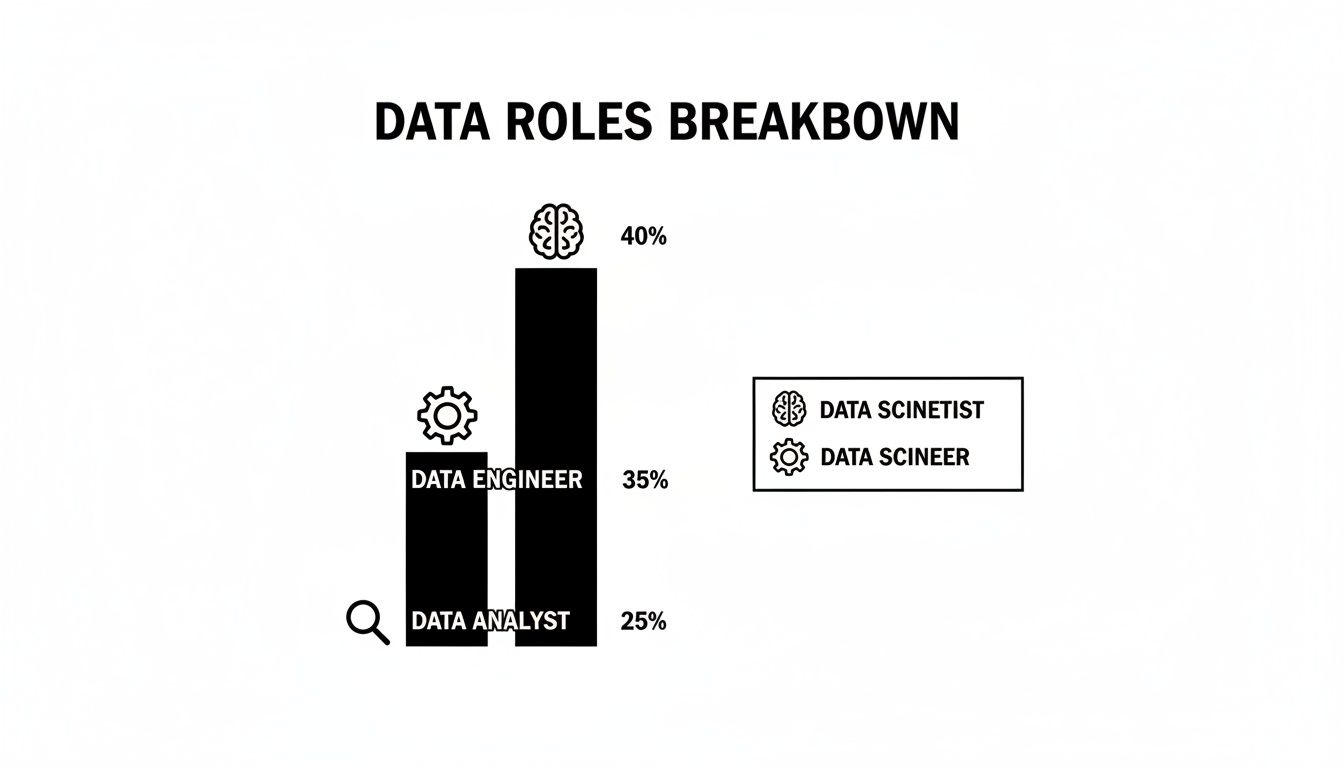
Whether you're an Engineer building the pipelines, an Analyst interpreting the data, or a Scientist creating predictive models, your role's complexity directly influences your pay.
How Location Affects Your Paycheck
Where you work in Germany really does matter. Big tech hubs like Munich, Berlin, and Frankfurt don’t just have more jobs; they also offer higher salaries to offset a steeper cost of living. This regional difference is something you absolutely have to factor into your job search.
Munich usually leads the pack, with salaries often 10-15% higher than elsewhere. Berlin, while having slightly lower averages, is a hotbed for start-ups where exciting equity options can sweeten the deal.
To give you a clearer picture, here’s a breakdown of average salaries across Germany's major cities, taking into account experience levels.
Average Gross Annual Salaries For Data Roles In Germany
The table below provides a snapshot of what you might earn based on your role, experience, and location. Keep in mind these are typical gross figures and can vary.
| Role/Experience Level | Berlin | Munich | Hamburg | Frankfurt | | :--- | :--- | :--- | :--- | :--- | | Junior (0-2 Yrs) | €48,000 | €52,000 | €49,000 | €50,000 | | Mid-Level (2-5 Yrs)| €62,000 | €68,000 | €64,000 | €66,000 | | Senior (5+ Yrs) | €80,000 | €88,000 | €82,000 | €85,000 |
While Munich and Frankfurt might look most appealing on paper, it's crucial to balance those higher salaries against rent and other living expenses. Berlin's dynamic start-up culture, for example, could offer faster career progression that makes up for a slightly lower starting salary.
Understanding Gross vs. Net Salary (Brutto vs. Netto)
This is a big one for anyone new to the German system. The salary you see on a job ad is the Brutto (gross) figure. Your Netto (net) salary—the money that actually lands in your bank account—will be quite a bit lower once deductions are made. It's a surprise you don't want.
Your gross salary is reduced by mandatory contributions for:
- Income Tax (Lohnsteuer): A progressive tax system where higher earners pay a higher rate.
- Solidarity Surcharge (Solidaritätszuschlag): A small, additional tax.
- Health Insurance (Krankenversicherung): This is compulsory for everyone living in Germany.
- Pension Insurance (Rentenversicherung): Your contribution towards the state pension.
- Unemployment Insurance (Arbeitslosenversicherung): A safety net contribution.
All in, these deductions can easily take 35% to 45% of your gross income, depending on your salary and tax class (Steuerklasse).
To get an accurate picture, use an online Brutto-Netto-Rechner (gross-to-net calculator). Plugging in your offer details will show you exactly what to expect each month. It's an essential step for budgeting properly and truly understanding your earning potential.
The Essential Skills German Employers Want
Landing a top data analytics job in Germany isn’t just about having the right degree. It’s about walking in with a specific, practical blend of skills that German employers are actively looking for. Think of it like a professional toolkit. To really build something lasting, you need both the heavy-duty power tools and the delicate instruments for the finishing touches.
In Germany's data-focused market, this means you need to be fluent in the core technologies while also developing the softer skills that turn raw numbers into real business strategy. Let’s unpack this toolkit into its two most important trays: the hard skills that get your CV past the first filter, and the soft skills that ultimately land you the job.
Your Technical Toolkit
This is your foundation. German companies are world-renowned for their precision and efficiency, and they expect their data professionals to have a rock-solid command of the tools that turn messy, raw data into clean, actionable insights. Honestly, without these, you’re not even in the running.
SQL for Database Mastery: This one is absolutely non-negotiable. Structured Query Language (SQL) is the universal language for talking to databases. It’s how you’ll pull, manage, and start making sense of the massive amounts of information that companies collect. More often than not, SQL proficiency is the very first technical skill a recruiter checks for.
Programming with Python or R: If SQL is how you talk to data, languages like Python or R are how you command it. Python, with its incredible libraries like Pandas for data wrangling and Matplotlib for plotting, has pretty much become the industry standard. That said, R is still a major player, particularly in more academic or heavily statistical roles.
Data Visualisation Tools: Let’s face it, a spreadsheet full of numbers doesn't inspire anyone. Tools like Tableau and Power BI are the paintbrushes you’ll use to turn your findings into a picture that people can actually understand. The ability to build clear, interactive dashboards is crucial for sharing your work with colleagues who aren't data experts. You have to know at least one of these well.
These three pillars—SQL, a programming language, and a visualisation tool—are the technical bedrock for nearly every data analyst role you'll come across in Germany.
An analysis of recent job postings shows that candidates with proven experience in Tableau can expect to earn up to 8% more than their peers, while strong SQL skills can provide a 5% salary boost. This highlights the direct financial benefit of mastering these core tools.
Beyond The Code: Soft Skills That Matter
Having the technical chops is only half the battle. Seriously. German employers put an enormous amount of value on professionals who can act as the bridge between the data and the decision-makers. It’s these skills that separate a good analyst from a great one.
The Art of Data Storytelling
This might just be the most sought-after soft skill of them all. It’s the ability to take a complex analytical result and weave it into a clear, compelling narrative that anyone in the business can follow. It’s not about just showing a chart; it’s about explaining what that chart means and, more importantly, why it matters.
Imagine you've found a 15% dip in customer retention. A technician just reports the number. A data storyteller, on the other hand, explains the "who, what, and why" behind that drop, proposes a data-backed plan to fix it, and shows the potential financial upside of taking action.
Essential Communication and Business Acumen
To tell a good story, you have to know your audience and the bigger picture. This really comes down to two things:
- Sharp Communication: You have to be able to articulate your findings clearly to very different groups, from the marketing team to the C-suite. That means dropping the technical jargon and focusing on what the results mean for their part of the business.
- Strong Business Acumen: You need to understand what the company is trying to achieve. An effective analyst always ties their work directly back to key business goals, whether that's growing revenue, cutting costs, or making customers happier.
At the end of the day, German companies aren't just hiring people to run queries. They're looking for strategic partners who can use data to solve real problems and guide the business forward. Showcasing this blend of technical expertise and commercial awareness is your key to success.
Getting Your Paperwork And Language Skills In Order
For anyone outside the EU, the thought of visas and language barriers can feel like a huge roadblock to landing a data analytics job in Germany. Let's be honest, German bureaucracy has a certain reputation. But the good news is that the government has made a real effort to simplify things for skilled tech professionals because, frankly, they need you.
Let's break down what you actually need to know about visas and the big "do I need to speak German?" question.
Your Ticket To The German Job Market: The Right Visa
If you're a non-EU citizen, you'll need a work permit. It’s the key that unlocks your career here. For data analytics roles, there are two main paths you'll want to look at.
- The EU Blue Card: Think of this as the VIP pass for highly qualified professionals. If you've got a university degree and a German job offer that pays above a certain amount (this figure is updated each year), the Blue Card is your go-to. It's a fantastic option because it fast-tracks you to permanent residency and simplifies the process of bringing your family over.
- The Skilled Worker Visa: This is a more general, but equally effective, visa for professionals with recognised qualifications. It's the perfect route if you have a solid job offer but the salary doesn't quite hit the Blue Card threshold.
The process for both usually follows a clear sequence: get the job offer, gather your documents (degree, contract, health insurance proof), and then apply at the German consulate or embassy in your home country.
A lot of people assume the visa process is a nightmare. The reality is, when you're in an in-demand field like data analytics and have a signed contract from a German company, the path is surprisingly clear. The company wants you there, and the government has created specific routes to make it happen.
So, Do You Really Need To Speak German?
Can you get a data analyst job in Germany without speaking a word of German? Yes, you absolutely can. Especially in the big international tech hubs like Berlin, where many start-ups and big tech firms use English as their official working language.
But here's the catch: only looking for "English-only" jobs cuts you off from a huge portion of the market. It's much more helpful to think of the opportunities in three different buckets:
- English-Only Roles: These are most common in the start-up scene or at large multinational corporations. The whole team works and socialises in English. No German is required.
- German-Preferred Roles: Here, your data team might be fully international and speak English, but you'll need to interact with other departments—like sales or marketing—that operate in German. Having some German gives you a massive leg up.
- German-Required Roles: You'll find these in more traditional German companies, often part of the famous Mittelstand, or in roles that deal directly with local clients. For these, fluency is non-negotiable.
While you can definitely get your foot in the door with just English, starting to learn German is the single best long-term career move you can make. It’s not just about unlocking more job postings. It shows employers you're serious about staying, and it makes every part of life—from renting a flat to making friends at a local pub—so much easier and richer. Getting to a conversational B1 level will do wonders for your career and your life in Germany.
How To Find and Win Your Data Analytics Job
Okay, you've got the skills. Now comes the exciting part: turning those qualifications into a signed contract. Landing your ideal data analytics job in Germany isn't just about what you know; it's about having a smart strategy.
This means knowing exactly where to look, how to package your experience for German hiring managers, and what to expect when you finally get that interview call. Think of it as your personal campaign plan. Moving beyond just casually browsing job boards is key—you need a targeted approach that combines digital savvy with classic networking.
The Best Places To Hunt for Opportunities
Don't put all your eggs in one basket. Relying on a single platform means you’ll inevitably miss out on some fantastic openings. Your job search should be a multi-channel effort, starting with a strong presence on the portals that matter most in the German market.
- German-Specific Job Portals: Platforms like StepStone.de and Xing are the home turf for German recruiters. Xing is essentially the German answer to LinkedIn and is crucial for professional networking, especially if you're targeting more traditional German companies (Mittelstand).
- International Platforms: Of course, you can't ignore the global giants. LinkedIn is incredibly powerful, particularly for roles in international companies and the vibrant start-up scenes in cities like Berlin. Make sure your profile is fully optimised with keywords like "data analytics jobs Germany."
- Niche Tech and Data Boards: Websites focused purely on tech roles can be absolute goldmines. These often feature specialised jobs you won't find elsewhere and attract recruiters looking for your exact skillset.
To work smarter, not harder, set up automated job alerts on each platform. Use specific search terms like "Data Analyst English," "BI Analyst Munich," or "Python SQL Berlin" to filter out the noise. This ensures only the most relevant roles land directly in your inbox. For a more organised approach, you can explore the career resources on platforms like Job Copilot to track your applications.
Crafting Your Application the German Way
One of the most common mistakes international candidates make is submitting a generic, one-size-fits-all CV. German recruiters have specific expectations, and tailoring your application to meet them can dramatically boost your chances of getting noticed.
The German CV, or Lebenslauf, is typically more detailed and conservative than its counterparts in other countries.
Your CV is your first impression. In Germany, that means it needs to be clear, factual, and complete. Small details, like including a professional headshot and structuring your experience in reverse chronological order, aren't just suggestions—they're standard practice.
And don't treat the cover letter (Anschreiben) as an afterthought. Here, it’s a critical document. This is your chance to directly connect the dots between your skills and the specific requirements listed in the job description.
Preparing To Ace the Interview Process
Once your application catches their eye, get ready for a multi-stage interview process. German companies are known for being thorough and methodical. You can expect a series of conversations designed to test your technical chops, problem-solving skills, and, importantly, your cultural fit.
A typical interview sequence often looks like this:
- Initial HR Screening: A brief introductory call to chat about your background, why you want the job, and your salary expectations.
- Technical Challenge or Take-Home Test: Time to prove your skills. You might be given a dataset to analyse, asked to solve some SQL queries, or tasked with building a small dashboard.
- Hiring Manager Interview: This is a deeper dive into your experience. Be ready to walk through specific projects, discussing the challenges you faced and the impact your work had.
- Final Team or "On-Site" Interview: You'll meet potential colleagues and senior leaders. This stage is often about assessing your communication style and seeing if you'll click with the team culture.
A great tip is to practise explaining your thought process out loud. For the technical tests, it’s not just about getting the right answer; it’s about showing how you got there. Prepare concrete examples that demonstrate your ability to turn raw data into real business value, and you'll walk into every interview with confidence.
A Few Common Questions Answered
Jumping into a new job market, especially in a different country, naturally brings up a lot of questions. Let's tackle some of the most frequent ones I hear about landing a data analytics role in Germany.
Do I Absolutely Need a University Degree?
Not necessarily, but it helps. While many German companies still value a degree in fields like computer science, maths, or statistics, the tide is definitely turning. What they really want to see is what you can do.
A killer portfolio packed with real-world projects can easily outperform a fancy degree on its own. If you can show you’ve mastered essential tools like SQL, Python, and a visualisation tool like Tableau, you're in a strong position. Practical skills often speak louder than academic credentials.
What's the Typical Hiring Timeline?
Patience is a virtue here. The German hiring process is known for being thorough, not fast. From the moment you hit "apply" to getting a final offer, you should probably budget for anywhere between four to eight weeks.
The usual flow involves an initial chat with HR, a technical test or a take-home case study, and then a couple of interview rounds with the hiring manager and your potential future colleagues. They're not just filling a seat; they're looking for someone who will be a great long-term addition to the team.
A quick tip: While it's good to be patient, a polite follow-up email after a week or so of silence is perfectly acceptable. It shows you're still keen and professional.
For more specific advice on navigating the application process, our support page has some great resources.
What's the Work-Life Balance Really Like?
It's one of Germany's biggest selling points, and the reputation is well-deserved. A standard work week is typically between 38 and 40 hours. Working late isn't the norm, and any overtime is usually compensated with either extra pay or time off in lieu.
On top of that, you can expect a generous amount of paid time off. The legal minimum is 20 days, but most companies offer 24 days or more per year, plus all the public holidays. People here value their free time, and employers respect that.
Ready to accelerate your job search in Germany? Acquispect uses AI to find the perfect roles for you, crafts tailored application documents in minutes, and tracks your success automatically. Start your free 30-day trial today!