Germany has become a real hotspot for data science professionals, and it’s not hard to see why. The country’s powerful industrial base is colliding with a booming tech sector, creating a massive demand for people who can make sense of data. If you're looking for an impactful, well-paid role, Germany is definitely a place to watch.
Why Germany Is a Top Destination for Data Scientists
Picture this: historic industrial giants—think automotive, engineering, and manufacturing—are in the middle of a huge digital makeover. This is the reality in Germany today. This fusion of old-school industry and new-school tech is precisely what's fuelling the incredible, ongoing demand for data professionals, turning the country into a magnet for data scientists from all over the world.
This big shift is what people call Industry 4.0, but it's more than just a trendy phrase. It’s a genuine change in how German companies work. They're actively using data to rethink everything, from fine-tuning factory assembly lines and predicting machine failures to creating personalised customer journeys and making global supply chains run smoother.
The Driving Forces Behind the Demand
So, what makes Germany such a compelling place for data scientists? For starters, the country’s rock-solid economy provides a stable environment for innovation. Plus, its world-famous engineering heritage creates a unique setting where data science has immediate, practical applications. We're not just talking about analysing website clicks here; it’s about making real-world physical processes smarter.
Here are a few key reasons:
- A Booming Tech Scene: Cities like Berlin, Munich, and Hamburg have transformed into energetic tech hubs, full of everything from agile startups to the R&D labs of major international companies.
- Strong Industrial Core: Well-known companies in sectors like automotive (BMW, Volkswagen) and manufacturing (Siemens, Bosch) are pouring money into data analytics and machine learning.
- High Value on Expertise: The German work culture really respects deep technical knowledge and a methodical approach to problem-solving. This creates a great environment for data scientists to do their best work and see their findings directly shape business decisions.
Germany's economy is a unique blend of established industrial might and fast-paced technological growth. For a data scientist, this means a chance to work on projects that have a tangible, global impact.
More Than Just a Job
Taking on a data scientist job in Germany means you’re stepping into a position of real influence. Companies aren’t just hiring number-crunchers; they’re looking for strategic thinkers who can turn raw data into smart business moves. This focus on data-driven decisions has made the country a fantastic place for professionals who want to tackle important challenges.
And this demand isn't going anywhere. As more German businesses—from the famous Mittelstand (small and medium-sized enterprises) to massive corporations—push forward with their digital transformations, the need for talented data scientists will only increase. This creates a competitive and stable job market with fantastic opportunities for career growth, paving the way for a truly rewarding professional journey.
Navigating Data Scientist Salaries in Germany
Let's talk money. When you're looking at data scientist jobs in Germany, figuring out the salary isn't always straightforward. It's not just a single number; it's a whole financial picture that depends on a few key things. Think of it less as a fixed price tag and more as a landscape with different peaks and valleys.
Your final take-home pay is a mix of your own background, the kind of company you work for, and even the city you decide to live in. All these pieces come together to create a pretty wide salary range, which is why it’s so important to know what shapes those numbers.
Key Factors That Influence Your Pay
No two data scientist jobs are paid the same. The biggest levers pulling your salary up or down are your experience, the company's size and industry, and where in Germany you're based. A junior data scientist getting their start at a Berlin startup will be in a completely different financial ballpark than a senior expert leading projects at a massive automotive firm in Munich.
Here's a closer look at what really moves the needle:
- Experience Level: This is the big one. An entry-level data scientist fresh out of university will naturally start lower than a mid-level professional with a few successful projects under their belt, or a principal data scientist who's steering the whole team.
- Company Size and Type: Big, established corporations usually have larger, more defined salary bands than a startup that's still finding its feet. That said, a startup might sweeten the deal with stock options or other creative perks.
- Industry: Some fields just pay more. Sectors like finance, automotive, and pharmaceuticals often have deeper pockets because the data problems they're solving are incredibly complex and high-stakes.
- Location: Major business hubs like Munich, Frankfurt, and Hamburg tend to offer higher salaries. Of course, that's often balanced out by a higher cost of living compared to equally great but more affordable cities like Leipzig or Dresden.
This infographic paints a great picture of why Germany is such a hotspot, highlighting its powerful industrial base, a huge appetite for tech talent, and the chance to work on projects that really matter.
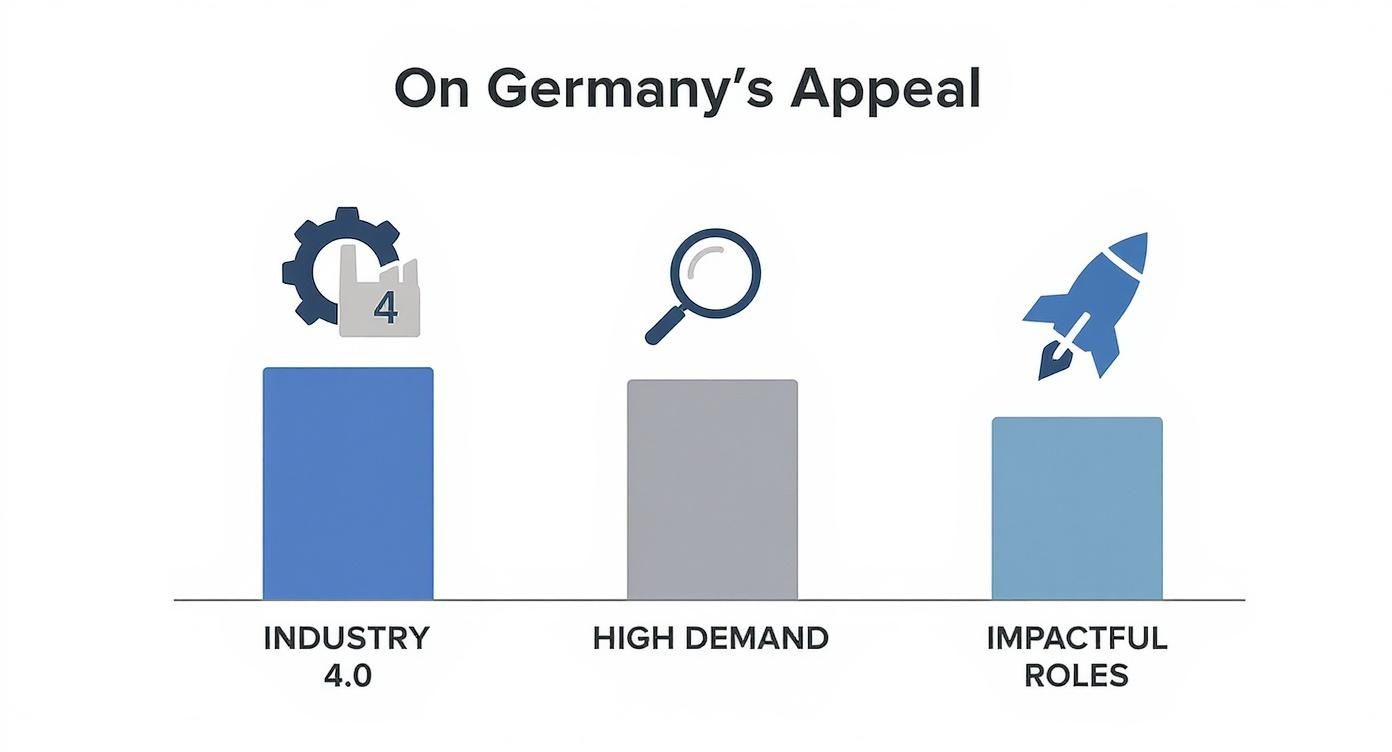
It's this blend of factors that makes the German job market so exciting and financially rewarding for data professionals.
Realistic Salary Ranges in Germany
So, what can you actually expect to earn? Germany has firmly established itself as one of Europe's top markets for data science talent. As of 2025, the average salary, once you factor in bonuses, is around €78,000 per year.
Of course, that's just an average. The full spectrum is quite broad, generally running from €62,000 on the lower end to well over €83,000 for seasoned experts in hot demand. In a major tech hub like Munich, for example, the median base salary hovers around €67,700, but total compensation often pushes closer to €72,600. For a broader perspective, you can dive into detailed compensation studies to see how Germany compares globally.
Data Scientist Salary in Germany by Experience Level
To give you a clearer picture, here’s a rough breakdown of what you might earn based on how many years you've been in the field.
| Experience Level | Estimated Annual Salary Range (€ EUR) | | :--------------- | :------------------------------------ | | Junior (0-2 years) | €55,000 - €65,000 | | Mid-Level (2-5 years) | €65,000 - €80,000 | | Senior (5+ years) | €80,000 - €100,000+ |
These are, of course, estimates. Your actual offer will depend on the specific role, your skillset, and the other factors we've discussed. But this gives you a solid starting point for any negotiation.
A quick pro-tip: Don't just focus on the base salary. The total compensation package often includes performance bonuses, excellent benefits, and sometimes even stock options, which can really bump up your overall earnings.
Beyond the Base Salary
When you get a job offer, it's tempting to look straight at the monthly salary and make a decision. But in Germany, you really need to look at the whole package to understand what's truly on the table.
Keep an eye out for these other valuable components:
- Performance Bonuses: It's common for German companies to offer annual bonuses based on your performance and the company's success. This can add a healthy chunk to your base pay.
- Benefits: The standard benefits package is usually excellent, with comprehensive health insurance, solid pension contributions, and generous paid holidays (think 25-30 days a year).
- Professional Development: Many employers are happy to invest in your growth, offering a budget for online courses, certifications, or tickets to industry conferences.
- Work-Life Balance: This is a big one. Germany is famous for its focus on a healthy work-life balance, with strong regulations around working hours and a culture that encourages you to switch off after work. This is a non-financial perk that many people find priceless.
By keeping all these elements in mind, you can size up job offers with confidence, negotiate more effectively, and make sure your expectations are grounded in the reality of the German market. It’s all about finding a role that not only pushes you professionally but also rewards you properly for your skills.
Key Skills German Employers Are Looking For
When you're trying to land a data scientist job in Germany, it's easy to get lost in a long list of technologies. But here's the reality: German employers aren't just looking for someone who knows a specific tool. They're looking for a craftsman—someone with a well-rounded toolkit who knows precisely how to use those tools to solve real business problems.
The most sought-after candidates are a unique blend of coder, statistician, and business strategist. This combination is prized because it’s what allows you to turn messy, raw data into clear, actionable insights—a skill that’s highly valued in Germany's results-driven work culture.
The Technical Foundation You Cannot Ignore
Let's start with the basics. Some technical skills are simply non-negotiable; they're the price of entry. Without these, it's almost impossible to get a serious look from a hiring manager.
At the very top of that list is Python. It has cemented its place as the language of data science, and for good reason. It's relatively easy to learn, yet it's backed by a massive ecosystem of powerful libraries that can handle almost any task you throw at it.
Python and its Core Libraries: You need to be fluent in libraries like NumPy for number-crunching, Matplotlib and Seaborn for bringing data to life through visualisations, and especially Pandas for slicing, dicing, and cleaning up datasets. This is your day-to-day workhorse.
SQL for Data Access: Before you can analyse anything, you need to get the data. SQL is the universal key to unlocking databases. German companies will expect you to write clean, efficient queries to pull exactly the information you need from their relational databases.
Think of these skills as your ticket to the game. They prove you can handle the fundamental mechanics of working with data.
Advanced Skills for High-Impact Roles
Once you've got the fundamentals down, it's the advanced skills that make you stand out from the crowd. This is where you show you can go beyond simple analysis and tackle the complex challenges that truly move the needle for a business.
Machine learning is, of course, a huge piece of this puzzle. But it's not about knowing every algorithm under the sun. Employers in Germany want to see that you have practical, applied experience. In fact, research shows a staggering 214 different skills are frequently mentioned across data scientist jobs, which gives you an idea of the depth required. Competence in frameworks like scikit-learn for traditional ML, Pandas for getting your data ready, and even deep learning libraries like PyTorch is becoming a standard expectation. You can explore which specific skills are trending across different German industries and how they're being used on our blog at https://jobcopilot.de/blog.
In the German job market, it's not enough to know the theory behind an algorithm. Employers want to see evidence that you can apply it to solve a real-world business problem, measure its impact, and explain the results clearly.
And as more and more companies shift their operations to the cloud, knowing your way around these platforms is a massive advantage.
Cloud Computing (AWS, Azure, GCP): Hands-on experience with at least one of the big three is a huge plus. This means knowing how to use services for data storage (like Amazon S3), managed databases (like RDS), and machine learning platforms (like SageMaker or Azure ML).
Big Data Technologies: For roles at larger companies, you'll inevitably run into massive datasets. This is where tools like Apache Spark become essential for processing data at a scale that a single machine just can't handle.
The Soft Skills That Seal the Deal
All the technical skill in the world won't land you the job if you can't work effectively with people. In Germany, how you work is often just as critical as what you know. The culture values clarity, structure, and reliability.
These soft skills are frequently the tie-breaker between two equally qualified candidates:
Structured Thinking and Problem-Solving: German hiring managers love a methodical approach. You need to show you can take a fuzzy, complex business problem, break it down into a logical sequence of data-driven tasks, and execute a clear plan to find a solution.
Communication and Stakeholder Management: Let's be honest—most of your colleagues won't be data experts. Being able to explain your complex findings to product managers, marketers, or C-level executives in simple, compelling terms is probably the most valuable soft skill you can have.
Business Acumen: A great data scientist doesn't just build models in a vacuum. They understand the bigger picture—the industry, the company's goals, and how their work directly contributes to the bottom line.
By consciously developing this mix of hard and soft skills, you present yourself as the kind of well-rounded, effective professional that German companies are eager to hire.
Exploring Germany's Top Tech Hubs
Choosing where to put down roots is a massive part of any job search. Germany isn't just one big, uniform job market; it’s a mosaic of vibrant tech ecosystems, each with its own personality, industry focus, and career rhythm. The key is to find the city that syncs up with your professional goals and the lifestyle you want to live.
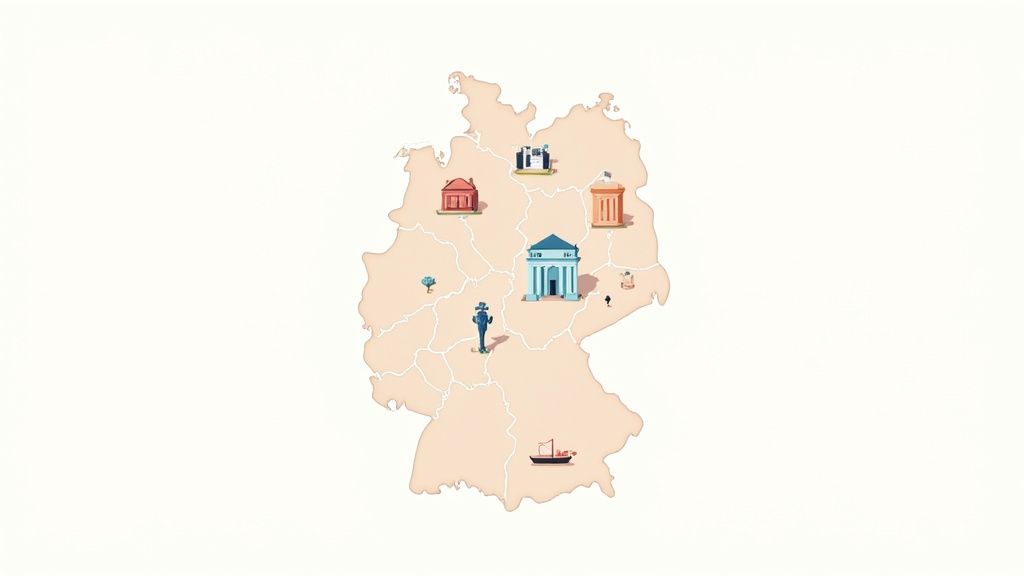
From the scrappy, fast-moving startup scene in Berlin to the corporate giants of Munich, every hub serves up a different flavour of opportunity. Getting to know these differences will help you zero in on the perfect place to build your data science career.
A quick look at job boards in late 2025 backs this up, showing over 440 listings for data science roles scattered across the country. Hubs like Berlin and Munich are clear front-runners, with Munich alone posting around 94 open positions—a testament to its huge demand for data talent. To get a feel for what's out there, you can explore the current market and find more details about data science roles in Germany.
Berlin: The Energetic Startup Capital
Think of Berlin as Germany's creative engine room. It’s a city buzzing with an international crowd, a relentless pace, and a professional culture that’s all about innovation and shaking things up. The data science scene here is dominated by startups and scale-ups, particularly in e-commerce, SaaS, and digital media.
If you thrive in an agile environment where you get to wear multiple hats and see your work make an immediate impact, Berlin is the place for you. Companies here are often looking for data scientists who aren't just technical wizards but are also creative problem-solvers. The work culture is usually casual, with flat hierarchies and a big emphasis on teamwork.
Munich: The Corporate and Automotive Powerhouse
In sharp contrast to Berlin’s organised chaos, Munich is all about stability, tradition, and industrial strength. As the economic heart of Bavaria, the city is home to some of Germany’s biggest names, including automotive titans like BMW and industrial leaders like Siemens.
The data scientist jobs in Germany you'll find here are typically within large, established R&D departments. The work revolves around applying data science to thorny engineering problems, fine-tuning manufacturing processes, and pushing innovation forward in the automotive and insurance sectors. The vibe is more formal and structured, offering clear career ladders and the chance to work on massive, high-impact projects.
The professional landscape in Germany is incredibly diverse. While Berlin offers a dynamic and fast-paced startup culture, Munich provides a more structured environment within global corporate giants, giving data scientists a real choice in their career trajectory.
Frankfurt: The FinTech and Finance Hub
Frankfurt is, without a doubt, Germany's financial capital. Home to the European Central Bank and a massive cluster of major banks and financial firms, its professional world runs on money, markets, and technology. It’s no surprise the city has become a major centre for FinTech innovation.
Data scientists in Frankfurt tackle some of the industry's toughest challenges, including:
- Algorithmic Trading: Crafting models to predict market shifts.
- Fraud Detection: Building real-time systems to spot and stop fraudulent transactions.
- Risk Management: Using data to evaluate credit risk and stay on the right side of regulations.
The work environment here is professional, high-stakes, and deeply analytical. It’s a perfect fit for someone with a strong quantitative background and a genuine interest in how financial markets tick.
Hamburg: The Media and Logistics Centre
With its iconic port, Hamburg has been a major player in global trade and logistics for centuries. Today, that legacy blends with a booming media and tech scene, creating a truly unique professional ecosystem.
Data science roles here often involve optimising global supply chains, making shipping routes more efficient, and forecasting demand. At the same time, the city’s strong media presence—with big names in publishing and gaming—opens up opportunities in areas like content personalisation and user behaviour analysis. This mix of old-school industry and new-age tech gives Hamburg a distinct character, ideal for those who love working where the physical and digital worlds collide.
To help you get a clearer picture, here’s a quick breakdown of what makes each city tick.
Germany's Top Tech Hubs for Data Scientists
| City | Primary Industry Focus | Key Employers | Professional Vibe | | :--- | :--- | :--- | :--- | | Berlin | Startups, E-commerce, SaaS, Media | Zalando, N26, Delivery Hero, countless startups | Creative, fast-paced, international, informal | | Munich | Automotive, Insurance, Engineering, Tech | BMW, Siemens, Allianz, Google, Apple | Corporate, structured, high-tech, formal | | Frankfurt | Finance, Banking, FinTech, Consulting | Deutsche Bank, Commerzbank, ECB, FinTech startups | Analytical, professional, high-stakes, fast-paced | | Hamburg | Logistics, Media, Gaming, E-commerce | Hapag-Lloyd, Otto Group, InnoGames, Airbus | Blended (traditional & modern), collaborative |
Ultimately, whether you're drawn to the creative energy of Berlin or the corporate stability of Munich, Germany offers a rich and varied landscape for any ambitious data scientist. The best fit comes down to what you want from your career and your life outside of work.
A Practical Guide to Landing Your First Role
Breaking into the German job market takes more than just top-notch technical skills; it demands a smart, targeted approach. Everything from the structure of your CV to the way you present yourself in an interview needs to be tuned to local expectations. Let's walk through a practical playbook to get you from application to job offer.
Think of your application as your opening argument. You're not just listing facts about yourself—you're building a case for why you are the right person for the job. And in Germany, that case needs to be structured, compelling, and crystal clear.
Crafting a CV That Gets Noticed
The German CV, or Lebenslauf, is famously direct and fact-based. Forget the fluff. It should be concise (two pages max) and present your experience in reverse chronological order. Professionalism and a clean layout are non-negotiable.
But a good format is just the starting point. The real key is framing your experience to resonate with German hiring managers. Focus on measurable achievements, not just a list of duties. For instance, instead of saying you "developed machine learning models," try "developed a machine learning model that improved forecast accuracy by 15%." Numbers speak volumes.
To really make your CV stand out for data scientist jobs in Germany, remember these tips:
- Include a professional photo. While it's becoming less common elsewhere, a high-quality, professional headshot is still a standard expectation on many German CVs.
- Keep it factual and direct. Let your results do the talking. Avoid flowery language and stick to the facts about what you've accomplished.
- Tailor it for every single application. Go through the job description and highlight the skills and projects from your past that are a direct match.
Building a Portfolio That Tells a Story
Your portfolio is where you prove you can walk the walk. It needs to do more than just list your skills; it has to show your problem-solving process in action. Each project should tell a complete story: what was the business problem, how did you use data to tackle it, what was the result, and what did you learn along the way?
A powerful portfolio might feature a mix of work, like a deep-dive analysis in a Jupyter Notebook, a deployed machine learning model with a simple user interface, or even a detailed blog post explaining a tricky data concept. The goal is to showcase your technical chops, your structured thinking, and your ability to communicate complex ideas clearly.
Your portfolio is your professional narrative. It's the tangible proof that you can take a messy, real-world problem, apply a methodical data-driven approach, and deliver a valuable outcome.
Mastering the German Interview Process
Get ready for a two-part challenge. Interviews in Germany typically test both your technical depth and your cultural fit, and both are taken very seriously.
The technical interview will be tough. Expect coding challenges, deep dives into statistics, and case studies designed to see how you solve problems on your feet. On the other side is the "fit" interview. German companies place a huge premium on reliability, directness, and a structured working style. Be ready to talk about how you manage deadlines, work in a team, and approach complex projects. They want to see a methodical thinker who can thrive in their environment.
To make sure your application materials are fully optimised, using tools that offer data-driven feedback can be a game-changer. For a great resource on perfecting your job search strategy, check out the guide at JobcoPilot.de.
Navigating Visas and Networking for International Candidates
If you're coming from outside the EU, the job offer is your golden ticket to a work visa. Germany has several options for skilled professionals, most notably the EU Blue Card, which is a well-defined path for qualified data scientists. Once you have a signed contract in hand, the visa process is generally straightforward. Just be sure to start early and get all your documents organised.
Finally, never underestimate the power of networking. LinkedIn is a must for connecting with recruiters, but don't overlook Xing, which is still a very popular professional network in German-speaking countries. It's well worth keeping an active profile there. By joining discussions, sharing your portfolio, and reaching out to people at companies you admire, you can open doors that you'd never find on a standard job board.
Answering Your Top Questions About Data Science Careers in Germany
As you start seriously looking at data scientist jobs in Germany, you’ll naturally have some questions. It's one thing to see the job specs, and another to understand what it's really like to work there. This section tackles the big questions we hear all the time, from language barriers to career paths, so you can move forward with a clear head.
Let's cut through the noise and get you the practical answers you need for a smooth transition into the German tech scene.
Is Speaking German a Must for Data Scientists?
This is probably the number one question for anyone moving to Germany, and the honest answer is: it depends. If you're targeting the buzzing tech hubs like Berlin, you can absolutely get by with just English. The startup world there is incredibly international, and English is often the official language in the office.
However, limiting yourself to English-only roles will shrink your pool of opportunities. While you can land a great job without it, knowing even conversational German opens up a whole new world of data scientist jobs in Germany. This is especially true if you’re interested in working for the famous Mittelstand (Germany's world-class small and medium-sized enterprises) or in roles where you need to chat with non-tech stakeholders who might not be fluent in English.
Think of it this way: English can get you the job, but German will build you the career. It shows employers you're serious about putting down roots and makes everyday life a whole lot richer.
Understanding German Work-Life Balance
Germany's reputation for a healthy work-life balance is well-earned, and it’s a massive plus. The culture here genuinely respects your time outside of work. You won't find many people bragging about pulling all-nighters or answering emails on a Sunday – in fact, it’s often frowned upon.
This isn’t just a nice idea; it's baked into the system with strong labour laws. Most full-time contracts come with a generous 25-30 days of paid holiday, and the standard workweek is just that: a week. The expectation is that you’ll work hard and focus while you’re on the clock, then completely switch off when you're done. It leaves you with plenty of energy to explore the country, pick up a new hobby, or just relax.
Career Progression and Growth Opportunities
The career ladder for a data scientist in Germany is sturdy and full of rungs to climb. Because the demand for data talent is so high, you can move up pretty quickly if you're good at what you do.
Here’s what that progression typically looks like:
- Junior Data Scientist: This is where you cut your teeth. You'll spend your time on data cleaning, running analyses, and learning from the senior members of your team.
- Mid-Level Data Scientist: After a few years, you'll start owning projects from start to finish. You’ll be building more sophisticated models and presenting your insights directly to decision-makers.
- Senior or Principal Data Scientist: Now you’re the go-to expert. You'll be mentoring others, shaping the data strategy for major projects, and solving the company's toughest problems.
- Managerial Roles: If you’ve got a knack for leadership, you can move into roles like Data Science Manager or Head of Data. Here, your job shifts to guiding the team and making sure its work pushes the entire company forward.
Common Challenges for International Applicants
While the opportunities are fantastic, it helps to go in with your eyes open. The biggest headache for many is German bureaucracy. Getting your visa and residence permit sorted can feel like a slow, paper-heavy process, so patience and good organisation are your best friends.
The other hurdle can be adapting to the workplace culture. The German communication style is famously direct. People say what they mean, which can come across as blunt if you’re not used to it. Getting comfortable with this directness and understanding the local professional etiquette will help you settle in much faster and build great working relationships. If you know about these things ahead of time, you can prepare for them and keep your focus on what matters: landing an incredible data scientist job in Germany.
Ready to stop scrolling through job boards and start landing interviews? Acquispect uses AI to find your ideal roles, craft personalised cover letters in minutes, and track your application success. Save time, get data-driven feedback, and increase your interview chances. Find your next job faster by visiting us at https://acquispect.com.