The demand for skilled data analysts who can work from anywhere is absolutely exploding. As companies lean more heavily on data to steer their decisions, they're realising that the best talent isn't always within commuting distance. The core of a data analyst's job—deep, focused work on a computer—is tailor-made for a remote setup.
This guide is your roadmap to finding and landing one of these high-paying remote data analyst jobs, no matter where you're based.
The World Is Your Office: Data Analytics Goes Remote
The traditional nine-to-five has been turned on its head, and data analytics is leading the charge. Companies have woken up to the fact that talent is global, and they're now competing for the best analysts regardless of their postcode. This is great news for both sides: employers get access to a wider pool of experts, and analysts get the flexibility and work-life balance they've been looking for.
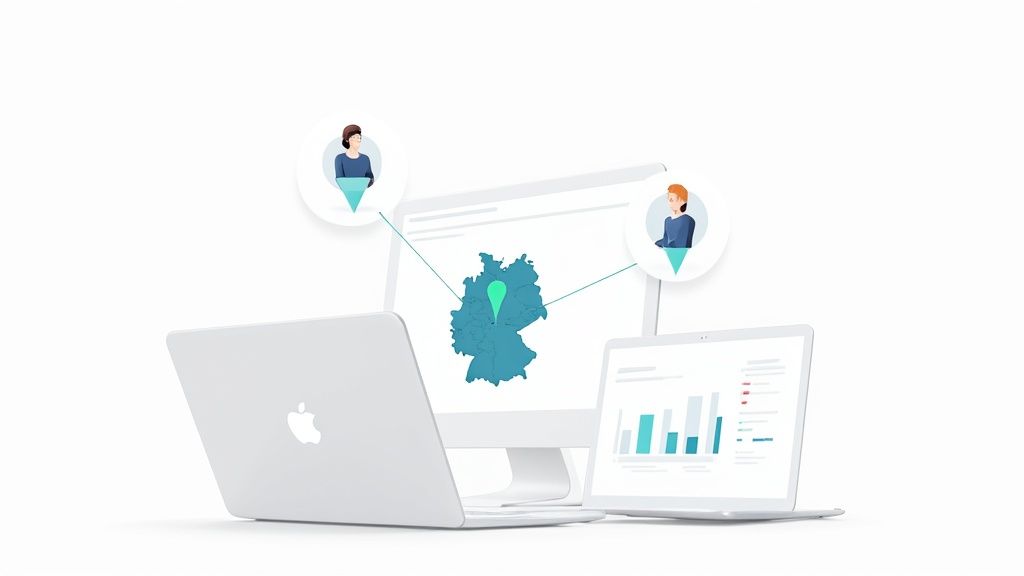
This isn't just a fleeting trend; the numbers paint a clear picture. In Germany, for example, the remote job market has seen massive growth. A 2022 survey revealed that 24% of German employees were already working remotely at least some of the time. Projections show that figure climbing to 30% by 2026. You can dig deeper into these trends over at Himalayas.app's report on Germany's remote market. This creates a huge opportunity for data professionals.
Why Data Analysis and Remote Work Are a Perfect Match
Think about the day-to-day of a data analyst. Most of the heavy lifting—running queries, building models, creating visualisations—happens independently at a computer. Once the project goals are clear, a lot of the work is heads-down, focused analysis.
This inherent autonomy is precisely why so many companies are eager to hire remote analysts. They need people who are self-motivated, can manage their own time, and deliver high-quality work without someone looking over their shoulder. The key activities just fit the model perfectly:
- Independent Problem-Solving: A huge part of the job is simply exploring datasets, testing theories, and debugging code on your own.
- Asynchronous Collaboration: Modern teams thrive on tools like Slack and project management software. Communication doesn't have to happen in real-time or in the same room.
- Digital Deliverables: Your final product—whether it's a report, a dashboard, or a presentation—is digital and can be shared with a single click.
The surge in remote data analyst jobs isn't a fluke. It's the natural next step for a profession that relies on digital tools and independent thinking. Your ability to work autonomously is now just as critical as your technical skills.
Before we dive into the job-hunting strategies, it's worth taking stock of the skills that are most in-demand for these remote roles. The table below breaks down the essentials.
Key Skills for Today's Remote Data Analyst
| Skill Category | Essential Skills | Why It Matters for Remote Roles | | :--- | :--- | :--- | | Technical Proficiency | SQL, Python/R, BI Tools (Tableau, Power BI), Excel, Cloud Platforms (AWS, Azure) | These are your core tools. You must be self-sufficient in using and troubleshooting them without immediate IT support next to you. | | Communication | Clear written communication (email, Slack), effective virtual presentations, documentation | Without face-to-face interaction, your ability to write clearly and present findings virtually becomes paramount. You can't rely on body language. | | Self-Management | Time management, prioritisation, focus, proactive problem-solving | No one is there to manage your schedule. You have to be your own boss, stay on task, and anticipate problems before they escalate. | | Business Acumen | Understanding business goals, translating data into actionable insights | You need to connect your analysis to the company's bottom line, even from a distance. This shows you're a strategic partner, not just a technician. |
Having a solid grasp of these skills will make you a far more compelling candidate in the remote job market.
What This Shift Means for Your Job Search
Knowing why companies are hiring remote analysts gives you a massive leg up. You can stop just applying for jobs and start positioning yourself as the perfect remote candidate. It’s not just about listing SQL or Tableau on your CV; it's about showcasing your communication skills, your discipline, and your proactive mindset.
In the next sections, we'll get into the practical steps for building a remote-ready profile, uncovering the best opportunities, and mastering the virtual interview. The demand is there, and the jobs are waiting. With the right strategy, you can build an incredible career in data analytics—all from the comfort of your own home.
Building Your Remote-Ready Skill Set
Sure, you've got the technical chops. Expertise in SQL, Python, and Tableau is the bedrock of any data analyst role. But when you’re hunting for data analyst jobs remote, those skills are just the price of admission. To really thrive in a distributed team, you need to prove you can deliver outstanding work without someone looking over your shoulder.
Hiring managers for remote positions aren't just looking at your charts and queries. They're trying to figure out if you can be a self-sufficient, proactive, and clear-thinking partner from afar. Your success will depend less on your raw technical ability and more on your talent for disciplined self-management and stellar communication, especially when your team is scattered across different time zones.
Master the Art of Asynchronous Communication
In an office, you can just pop over to a colleague's desk when you need something. That luxury vanishes in a remote setup. Communication shifts to being almost entirely asynchronous—you send a message and don’t expect an instant reply. This change demands a much more deliberate and thoughtful approach.
A vague message like, "Can we chat about the Q3 report?" just creates more work for everyone. You have to anticipate the follow-up questions and provide all the necessary context from the get-go.
Think about it this way. A much better message would be: "Regarding the Q3 sales report, I've spotted a discrepancy in the customer acquisition cost for the DACH region on slide 7. My analysis points to X, but the raw data suggests Y. Could you look over my attached query when you have a moment and share your thoughts?"
This kind of detailed, upfront communication respects your colleagues' time and focus. It allows them to give you a meaningful answer without a frustrating game of email tag. For remote work, this isn't just a nice-to-have skill; it's absolutely essential.
Prove You’re Remote-Ready with a Great Project
A well-documented project is easily the most powerful way to show off your remote capabilities. It’s not just about the flashy final dashboard. It's about showcasing your entire thought process in a way that anyone can pick up, understand, and even replicate.
Set up a public project on GitHub or write a detailed post on a personal blog. This is more than a portfolio piece; it's concrete proof of your professional habits.
- Document Everything: Use a
README.mdfile to clearly explain the project's purpose, data sources, your methodology, and the key insights you uncovered. - Write Clean, Commented Code: Make sure another analyst could easily read and understand your SQL queries or Python scripts. Use comments to explain any complex logic.
- Visualise the Story: Don't just show the chart. Include a link to an interactive dashboard (Tableau Public is great for this) and explain the narrative your visualisations are telling.
A project with crystal-clear documentation and well-commented code tells a hiring manager more about your remote readiness than any CV bullet point ever could. It proves you can think, work, and communicate with clarity and precision, even when no one is watching.
This transforms your portfolio from a simple gallery of your work into a compelling case study of your professionalism. For more practical career advice, you can find a lot of useful resources on our JobcoPilot blog.
Cultivate Rock-Solid Self-Management
Without the daily rhythm of an office, your ability to manage your own time and priorities is put to the test. Remote-first companies are always on the lookout for candidates who show a high degree of autonomy and personal accountability.
This comes down to building routines and systems that keep you focused and productive. It means setting clear goals for your day and week, prioritising tasks based on what will make the biggest impact, and spotting potential problems before they become fires that need putting out.
Key Self-Management Habits to Build
- Time Blocking: Carve out specific blocks in your calendar for deep work, meetings, and admin. It’s the best defence against the constant pull of multitasking.
- Proactive Problem-Solving: When you hit a roadblock, don't just sit and wait for help. Spend some time trying to solve it yourself and document what you've tried before reaching out.
- Setting Boundaries: The line between work and personal life can get blurry fast when you work from home. Define your working hours and do your best to stick to them to avoid burnout.
Hiring managers will often use behavioural questions to dig into these skills. Make sure you're ready with real examples of how you've managed complex projects with little supervision or taken the initiative to improve a process. When it comes to landing competitive data analyst jobs remote, showing off these "soft" skills is every bit as important as acing the technical interview.
Making Your Application Remote-Ready
When you're applying for remote data analyst jobs, a standard application just won't cut it. It needs to do more than list your skills; it has to prove you’re built for remote work. Hiring managers are scanning for clues that you're a self-starter who can deliver fantastic work without someone looking over your shoulder.
They’re looking for evidence of clear communication, project ownership, and the ability to manage your own time effectively. This means every piece of your application—from your CV to your online presence—needs to tell a consistent story. You're not just a data analyst; you're an autonomous, impactful professional who thrives in a distributed team. It's time to stop listing duties and start showcasing accomplishments.
Tweak Your CV to Highlight Remote Strengths
Your CV is your first impression, so it has to immediately signal that you have what it takes to succeed remotely. The trick is to shift the focus from your responsibilities to your impact and independence.
For instance, a typical CV bullet point might read:
- "Responsible for creating weekly sales reports using Tableau."
That's fine, but it doesn't exactly jump off the page. A remote-ready version, however, tells a much more compelling story:
- "Independently designed and automated a weekly sales dashboard in Tableau, giving key stakeholders actionable insights that led to a 5% increase in regional sales."
See the difference? This version screams autonomy ("independently designed"), technical skill (Tableau), and, most importantly, a measurable business outcome (the "5% increase"). You've gone from being someone who follows instructions to someone who solves problems and creates value.
A Few Quick CV Wins
- Lead with Action: Kick off every bullet point with a strong verb. Think "automated," "optimised," "spearheaded," or "analysed."
- Numbers Talk: Quantify your achievements whenever you can. How many hours did you save the team? By what percentage did you increase efficiency? Metrics are your best friend.
- Mention Your Toolkit: Don't forget to include the collaboration tools you've used. Naming things like Slack, Jira, or Asana shows you’re already familiar with the remote work ecosystem.
Build a Digital Footprint That Works for You
In the remote world, your online presence is your handshake, your office, and your reputation all rolled into one. Before a hiring manager ever speaks to you, they've likely already looked you up online. A polished digital footprint provides the social proof they need. This really boils down to two things: your professional network and your portfolio.
First off, an optimised LinkedIn profile is non-negotiable. Your headline should be packed with relevant keywords like "Data Analyst," "SQL," "Python," and "Tableau." Think of your summary as your personal elevator pitch—it should quickly convey your passion for data and highlight the very skills remote employers crave, like self-management and proactive communication.
Your online portfolio is easily the most powerful asset you have for landing remote data analyst jobs. It’s more than just a gallery of your work; it’s a living testament to your ability to execute, document your process, and communicate complex ideas clearly—all without direct supervision.
A solid portfolio shows what you can do instead of just telling someone. It proves you can wrangle a messy dataset, find the story within it, and present it compellingly, all on your own initiative.
Create Portfolio Projects That Recruiters Can't Ignore
Your portfolio needs to feature projects that solve the kinds of problems actual businesses face. A purely technical exercise is interesting, but a project that answers a real-world question shows you have business sense, which is a massive plus for any analyst.
Here are a few project ideas that tend to catch a hiring manager's eye:
- Build an Interactive Public Dashboard: Grab a public dataset—think city bike-share data, public health stats, or e-commerce trends—and build a dashboard using a tool like Tableau Public or Power BI. The key here is to document your entire journey in a blog post or a detailed
README.mdfile on GitHub, from data cleaning to the final insights. - Analyse an A/B Test: Find a public A/B test dataset and run your own analysis. Write up a report explaining your methodology, what you discovered, and what you’d recommend the business do next. This is a direct showcase of a skill that is in high demand.
- Write a Deep-Dive Blog Post: Pick a meaty topic like customer lifetime value or churn prediction and write an article that breaks it down for a less technical audience. Weave in your own code snippets (SQL or Python) and charts to make your points crystal clear.
Remember, the final output is only half the story. Your documentation—the clean, commented code and the clear, logical write-up of your process—is what truly demonstrates your ability to work transparently and collaborate effectively from anywhere. When you deliberately craft your application to showcase these remote-ready traits, you stop being just another applicant and become the obvious choice.
Finding the Best Remote Opportunities
Alright, so you’ve got your application materials polished and ready for a remote role. Now comes the real challenge: finding the right places to actually use them. Just spraying your CV across every generic job board you can find is a fast track to burnout. A much better game plan is to be strategic, targeting the platforms where top-tier data analyst jobs remote are actually posted and learning a few tricks to find those hidden gems.
The remote job market is its own little world. Some sites are flooded with listings from huge corporations, while others are carefully curated spaces for remote-first startups and tech companies. Knowing where to invest your time is half the battle. It’s about building a search system that brings you quality leads, not just a mountain of rejection emails.
This graphic sums up the key documents you’ll need to have ready.
Think of these three—your tailored CV, a compelling portfolio, and a sharp LinkedIn profile—as the foundation for a successful remote job hunt.
Where to Look for Remote Data Analyst Jobs
Don't waste time scrolling endlessly. Let's break down the best platforms so you can focus your energy where it counts. Each one has its own vibe, and using a mix of them will give you the best shot.
Top Platforms for Finding Remote Data Analyst Jobs
I've put together a quick comparison of the job boards and platforms I've found most useful. This table highlights what makes each one unique and the kind of companies you're likely to find there.
| Platform | Best For | Key Features | | ------------------ | --------------------------------------------------------------- | ----------------------------------------------------------------------------------------------------------------------------------------- | | LinkedIn | Networking and roles at established, large corporations. | Powerful search filters, direct access to recruiters, and company-specific job alerts. | | Indeed | The sheer volume of listings across all industries and sizes. | Aggregates jobs from thousands of sources; useful for gauging overall market demand in specific regions. | | Himalayas.app | Curated roles at genuinely remote-first companies. | Focuses on company culture and tech stacks; provides detailed insights into how a company operates remotely. | | AI-jobs.net | Specialised roles in AI, machine learning, and data science. | Niche focus means higher quality, more relevant listings for those with specialised skills. | | Big Data Jobs | Positions requiring expertise in big data technologies. | Caters specifically to roles involving Hadoop, Spark, and other large-scale data processing frameworks. | | Jobgether | Matching with companies based on your work-life preferences. | Unique algorithm that considers your preferred work style, not just your skills, to find a good cultural fit. |
This isn't an exhaustive list, of course, but it’s a solid starting point. The goal is to find a few platforms that consistently post the kinds of roles you're excited about and then check them regularly.
The demand for remote talent is definitely there, especially in tech-savvy regions. A quick search on Indeed, for example, shows over 160 remote data analyst job postings in Germany right now. This is a clear sign that German companies are actively seeking skilled analysts, which is great news for job seekers.
Beyond Job Boards: Networking in the Digital Space
Relying only on job applications is playing on defence. The real power move is to build connections within the data community, which can lead you to opportunities that never even get posted publicly. This is where that optimised LinkedIn profile you worked on really starts to shine.
Start engaging with content from data leaders and companies you admire. Join a few specialised LinkedIn groups or Slack communities for data analytics professionals. Don't just lurk—participate in conversations, ask smart questions, and share your own projects or insights.
Networking for remote roles isn't about collecting a massive list of contacts. It’s about building a reputation as someone who is knowledgeable and genuinely engaged. When a hiring manager has already seen your name pop up in a community discussion, your application immediately stands out from the pile.
This approach turns you from just another applicant into a familiar name. It's a long game, for sure, but it pays off by getting you on the radar of the very people doing the hiring.
Creating Your Job Search System
An organised job hunt is a sane job hunt. Seriously. Use a simple spreadsheet or a tool like Trello to keep track of everything you apply for. This tracker will become your central command for managing your search for data analyst jobs remote.
Here’s what I recommend tracking for each application:
- Company Name: Obvious, but essential.
- Job Title: The specific role you went for.
- Date Applied: So you know when to follow up.
- Application Link: Keep a direct link to the job description for easy reference.
- Status: A simple dropdown (e.g., Applied, Interviewing, Rejected, Offer) works wonders.
- Notes: Any key details, like the hiring manager's name or specific requirements you noted.
This simple system keeps you from accidentally applying for the same job twice and makes following up way less of a headache. For those looking to take their efficiency to the next level, you can explore tools designed to automate parts of this process, like the one we've covered at https://jobcopilot.de/.
By combining smart platform targeting, active networking, and a disciplined tracking system, you can transform what feels like a daunting task into a manageable—and much more effective—process.
Acing the Remote Interview Process
Landing a remote data analyst job is as much about how you interview as it is about your skills. Unlike a face-to-face chat where your personality can shine through, a virtual interview puts everything under a microscope: your preparation, how clearly you communicate, and even your tech setup.
Hiring managers aren't just checking if you know your way around an SQL query. They're trying to figure out if you can work professionally and effectively on your own, as part of a distributed team. Every little detail, from your background to the stability of your internet, becomes part of your first impression. This is your first real test of remote-readiness.
Setting the Stage for Success
Your interview environment speaks volumes before you even say a word. A messy, poorly lit room can come across as disorganised, whereas a clean, professional background suggests you’re serious about your work. You don’t need a state-of-the-art home office, but you do need to be thoughtful about your space.
Find a quiet spot where you’re unlikely to be interrupted. This is crucial. Next, position your camera at eye level—nobody looks great when they’re looking down at a laptop, and it creates a weird dynamic with the interviewer. Good lighting is also key, so try to have a light source in front of you to avoid being hidden in the shadows.
And please, do a full tech rehearsal. Test everything: your microphone, your camera, and the specific video conferencing tool the company uses. Fumbling with technology right at the start is a surefire way to knock your own confidence.
Mastering On-Camera Communication
Talking to a camera just isn't the same as talking to a person. It's much harder to pick up on non-verbal cues, which means you have to be more deliberate in how you present yourself.
- Make "Eye Contact": Look into the camera lens when you're speaking, not at your own picture on the screen. It feels a bit unnatural at first, but for the person on the other end, it creates a sense of direct eye contact and shows you're engaged.
- Speak Clearly: Articulate your words and speak just a touch slower than you normally would. This helps overcome any potential audio lag or quality issues.
- Gesture with Purpose: Small, controlled hand gestures can help you make a point, but try not to overdo it. Big, fast movements can be really distracting on a small screen.
This is also where your ability to break down complex topics is put to the test. Before the interview, practice explaining a technical project as if you were talking to someone from the marketing department. Can you turn a complicated statistical model into a simple, clear business insight?
Remote hiring managers are looking for more than just the right answer. They want to see your thought process, how you communicate your approach, and solid proof that you can solve problems on your own.
Deconstructing the Interview Stages
The hiring process for a remote data analyst role is usually a multi-step affair, designed to test everything from your technical skills to your business sense.
It often starts with a screening call from a recruiter, which is mostly about checking for a basic culture fit and verifying your qualifications. After that, you'll likely have a technical interview with the hiring manager or a senior analyst. This is where you might get into some live coding or a deep dive into projects from your portfolio.
There's a growing demand for this kind of talent, particularly from companies in Germany who are actively recruiting for remote positions. You can find dozens of remote data roles on specialised platforms from companies like Canonical and Bitfinex. This shows a healthy mix of big international tech firms and local start-ups embracing remote work. You can find a curated list of remote data analyst jobs in Germany on Jobgether.
Tackling Technical Challenges Remotely
The take-home assignment is a classic part of the data analyst interview process, and for good reason. It gives you a chance to show what you can do without the pressure of someone watching over your shoulder. You’ll typically get a dataset and a business problem to solve within a specific timeframe.
Here’s a solid way to approach it:
- Clarify the Objective: Before you write a single line of code, read the instructions carefully. If anything is unclear, don't hesitate to ask for clarification. It shows you're thorough.
- Show Your Work: Your submission should be more than just the final answer. Provide clean, well-commented code (whether it's SQL or Python) and a brief write-up explaining your methods, assumptions, and key findings.
- Tell a Story with the Data: The final deliverable, whether it's a dashboard or a presentation, needs to tell a compelling story. Don't just show off a bunch of charts; explain what they mean and offer clear, actionable recommendations based on your analysis.
This documented, transparent approach is exactly what managers are looking for. It proves you can not only do the work but also communicate your findings effectively in an asynchronous environment—the hallmark of a great remote data analyst.
Got Questions About Remote Data Analyst Jobs? We’ve Got Answers.
As you get closer to the finish line in your job hunt, it's natural for a few specific questions to pop up. You can have the perfect CV and ace the interviews, but sometimes it’s the small uncertainties that can make you hesitate. Let’s clear up some of the most common questions I hear from aspiring remote data analysts.
Getting these things straight helps you manage your own expectations and fine-tune your job search strategy. After all, knowing what's realistic when it comes to salary, degrees, and previous experience is half the battle.
What's a Realistic Entry-Level Salary in Germany?
If you're just breaking into the field, a typical salary for an entry-level remote data analyst in Germany lands somewhere between €45,000 and €55,000 a year. Of course, that’s not a hard and fast rule.
A few things can nudge that number up or down. The company's size, its industry, and the specific tech stack you'll be using all make a difference. For instance, a big international tech company might offer a bit more from the get-go, while a startup could offer a slightly lower salary but sweeten the deal with shares or other benefits. It’s always smart to check out sites like Glassdoor to see if an offer lines up with the current market rate.
A strong portfolio is your secret weapon for negotiation, even at the entry-level. When you can show tangible projects that prove your skills, you have a much stronger case for a salary at the higher end of that starting range.
Do I Absolutely Need a Specific Degree?
Having a degree in something like Computer Science, Statistics, or Economics is great, but it’s rarely a deal-breaker for remote data analyst roles. The tech industry, especially, tends to care a lot more about what you can do than what your degree says.
What really counts is your ability to get the job done. That's why your portfolio is so incredibly important.
- Real-World Projects: This is your chance to show you can tackle messy, real-world data problems from beginning to end.
- Good Certifications: Credentials from well-known names like Google or Microsoft can go a long way in backing up your technical skills.
- Tool-Kit Mastery: Proving you're a pro with core tools like SQL, Python, or Tableau often says more to a hiring manager than a university diploma.
At the end of the day, companies want to see evidence that you can find valuable insights. A single, impressive project that solves a genuine business problem is far more convincing than a line on your CV.
How Do I Stand Out if I've Never Worked Remotely?
Don't worry, a lack of direct remote experience isn't the end of the world. You just need to be smart about how you frame your background. The goal is to highlight skills that show you’ve got the self-discipline and communication chops to thrive on a distributed team.
Think about past projects where you had to work on your own initiative. Did you ever run a project from start to finish without much supervision? Or coordinate with different people mostly over email and video calls? Those are the exact experiences you need to bring to the forefront.
In your CV and cover letter, talk about being a "self-starter," a "proactive communicator," and "skilled with collaborative tools." And once again, your portfolio is your best proof. It's a concrete example of your ability to manage your own time and deliver quality work independently—which is precisely what remote hiring managers are looking for.
Ready to put your remote job search on the fast track? Acquispect uses AI to automate the hunt, pinpointing the best-fitting roles and creating customised applications for you in minutes. Start your free 30-day trial and find your next job faster.