Staring at a blank page when you need to write a German job application can be daunting. Thankfully, using AI to craft your application—what Germans call bewerbung schreiben mit ki—is no longer a futuristic concept. These tools act as a personal co-pilot, helping you get past writer's block and master the unique formalities of the German job market.
The New Reality of Job Applications in Germany
The way people apply for jobs in Germany is definitely changing. The old-school, manual process of painstakingly writing the perfect Anschreiben (cover letter) and Lebenslauf (CV) is now getting a major assist from artificial intelligence. This isn't just a fleeting trend; it's a smart way to stay efficient and produce high-quality applications in a really competitive environment.
Let's be honest, the hardest part is often just getting started. AI gives you a structured first draft, so you have a solid foundation to work from instead of a blinking cursor on an empty screen. That initial push is a huge time-saver and makes the whole job-hunting process feel less stressful.
- Beating Writer's Block: AI can generate that first batch of text, giving you the momentum you need when you’re stuck.
- Getting the Tone Right: It's great at maintaining the formal, professional language and structure that German recruiters expect.
- Optimising for Applicant Tracking Systems (ATS): A good AI tool will weave in crucial keywords from the job description, helping your application get past the initial automated screening.
We're seeing this shift in the numbers, too. In Germany, the adoption of AI for job applications is on a clear upward trajectory. A 2023 survey revealed that around 18% of job seekers are now using AI writing assistants. That's a huge jump from just 5% back in 2020. You can find more details in a study on AI in the application process from the German Federal Employment Agency.
This visual really captures how AI can take you from a blank page to a strong first draft.
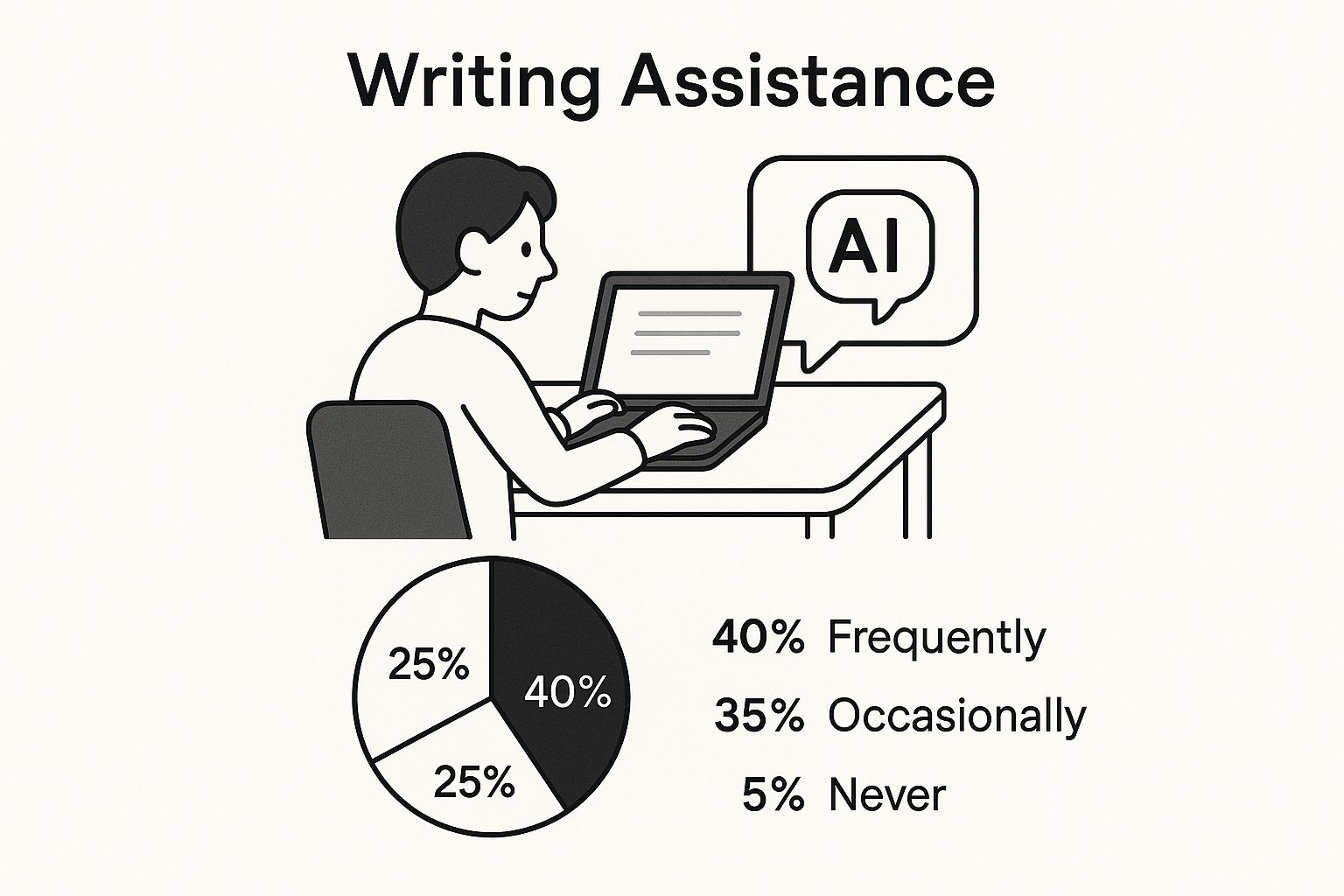
As the infographic suggests, it's a partnership. The AI assists; it doesn't take over.
The real magic of using AI is letting it handle the boring, structural parts of the application. This frees you up to focus on what really counts: injecting your unique personality and career story into the final document.
At the end of the day, your goal is an application that’s both professional and authentically you. Using AI as a launchpad is a brilliant strategy, but those final, personal touches have to come from you. Platforms like JobCopilot are built to help with exactly this, making it easier to create polished applications in less time. This modern approach means you can apply for more jobs with better documents, ultimately boosting your odds of landing that interview.
When it comes to using AI to write your application, picking the right tool is more than just grabbing the most popular name off the shelf. Not every AI is built to handle the specific quirks and expectations of the German job market. You've got to think about language subtleties, data privacy, and how specialised the tool really is.
A general-purpose AI like ChatGPT can be a brilliant brainstorming partner or help you get your initial thoughts down. It’s a jack-of-all-trades and can whip up text on pretty much anything. The catch? Its understanding of German application norms might be a bit generic. It won't automatically know the specific formatting and phrasing that German recruiters are trained to look for.
This is where specialised application writers come in. These tools are designed from the ground up for one job: creating standout applications. They often come packed with templates and advice based on what’s working in Germany right now. They get the difference between a proper German Lebenslauf and a standard CV and can help you nail tricky details like DIN 5008 formatting.
Generalists vs. Specialists
So, how do you choose? It really boils down to what you need most. Are you looking for a creative assistant to help you get past a blank page, or do you need a meticulous guide to make sure every single detail of your German application is spot-on?
Your own confidence level is a huge factor here. If you're new to the German job market, a specialised tool is like having a safety net. It walks you through the cultural and formal hoops. But if you're a seasoned pro, a generalist AI might be all you need for a quick polish and some fresh ideas.
Don't forget about data privacy, either. It’s a big deal. Broad, general models might use your input to train their algorithms, which isn't ideal when you're uploading your entire career history. Specialised services, particularly those based in the EU, usually offer much stronger data protection that aligns with GDPR.
To help you see the differences more clearly, let's compare some of the top AI tools that are well-suited for crafting German applications.
Comparison of AI Tools for Application Writing
Here’s a look at how some of the most popular options stack up against each other, giving you a better feel for which one might be the right fit for your specific needs.
| Tool | Best For | German Language Proficiency | Key Features | Pricing |
| :--- | :--- | :--- | :--- | :--- |
| ChatGPT (GPT-4) | Brainstorming ideas, overcoming writer's block, and drafting initial versions of your cover letter and CV. | Excellent. Produces natural, high-quality German text, but requires precise prompting for cultural specifics. | - Versatile text generation
- Creative idea suggestions
- Can summarise job descriptions | Freemium (GPT-3.5) & Subscription (GPT-4) |
| Jasper | Professionals who need to create high-quality, polished application documents quickly and efficiently. | Very Good. Trained for marketing and business writing, so the tone is often very persuasive and professional. | - Brand voice features
- Multiple templates for different document types
- Strong grammar and style checker | Subscription-based |
| DeepL Write | Perfecting the language, style, and tone of your existing drafts. It’s more of a sophisticated editor than a generator. | Native-level. Unsurpassed for German-language nuances, idioms, and professional phrasing. | - Alternative phrasing suggestions
- Tone adjustment
- Excellent grammar and spelling correction | Free (limited) & Subscription (Pro) |
Choosing the right AI is a balancing act. You're weighing creative freedom against the need for structured, culturally tuned documents. In the end, the goal is to produce an application that isn't just well-written, but one that lands perfectly with German hiring managers.
Crafting Prompts That Generate Winning Applications
Here's a hard truth: the quality of your AI-generated application is a direct reflection of the instructions you feed it. Think of your AI tool as an incredibly capable assistant who knows absolutely nothing about you or the job you want. If you give it vague requests, you’ll get vague, forgettable text that a hiring manager will spot from a mile away.
Your prompt is the foundation. A weak prompt like, "Write a cover letter for a marketing job," is basically asking for a generic template. The AI has to invent skills and experiences, resulting in a hollow and impersonal document—the fastest way to land your application in the 'no' pile.
The Anatomy of a Powerful Prompt
To get real value when you bewerbung schreiben mit ki, you need to give the AI a rich, detailed blueprint. Your goal is to provide all the raw materials it needs to construct a compelling story that perfectly aligns with the job description.
A truly effective prompt should always layer in these core elements:
- Define the Persona: Tell the AI who it should be. For instance, "Act as an experienced project manager with five years of experience in the tech industry."
- State the Goal: Be explicit about what you need. "Write a professional cover letter (Anschreiben) for the Junior Data Analyst position at [Company Name]."
- Provide Key Details: This is the most crucial part. Feed it your specific skills, bullet points of your relevant work history, and the full job description you're targeting.
- Set the Tone: Guide the feel of the writing. Using phrases like "confident but humble," "professional yet approachable," or "formal and concise" makes a massive difference in the final output.
By feeding the AI structured data points—like your exact achievements and the specific requirements from the job ad—you turn it from a creative guesser into a precision tool. It stops inventing and starts assembling your story with the facts you’ve provided.
From Vague to Valuable: A Real-World Example
Let's see this in action. A typical, vague prompt might be: "Create a CV for a software developer." The AI will spit out a generic list of tech skills, but there's no story, no impact. It's just noise.
Now, let's build a much stronger prompt:
"You are a professional career coach. Your task is to create a modern, achievement-oriented CV (Lebenslauf) for a software developer applying to a fintech startup. The tone should be innovative and results-driven. Here is my information:
- Experience: 3 years at [Previous Company], where I led a team that developed a mobile banking app. This increased user engagement by 15%.
- Skills: Proficient in Swift, Kotlin, and AWS.
- Target Job: The role requires experience with agile methodologies and secure payment gateway integration."
See the difference? This detailed instruction gives the AI everything it needs: a specific persona, a clear goal, quantifiable results, and crucial context about the target company. The CV it produces will be far more targeted and impressive because it showcases tangible business outcomes, not just a list of skills.
Getting this level of detail right is what turns a generic draft into a document that actually gets you interviews. If you're looking for more practical advice on optimising your job search, you can find some great resources on the JobCopilot blog.
Giving the AI Draft a Human Touch
Think of the AI-generated draft as a solid, but soulless, blueprint. It gives you the structure, but it’s missing the most crucial ingredient: you. The machine can’t replicate your unique experiences or your personality, which are the very things that will make a hiring manager remember you. This is where you step in to turn the AI's generic output into something that is genuinely and authentically yours.
Your first job is to go on a search-and-destroy mission for any robotic or overly formal language. AI tools have a habit of falling back on tired clichés like "highly motivated professional" or "proven track record." These are just empty fillers. It's up to you to swap them out for specific, compelling achievements that tell your professional story.
Swap Robotic Phrases for Real Stories
Don't just say you have a skill—prove it with a quick example. This is how you close the gap between a bland, machine-written draft and an application that truly stands out.
Here’s a simple before-and-after:
- The AI Draft: "I possess strong project management skills."
- Your Version: "By introducing a new agile workflow for my team, I cut our project delivery times by 20% in a single quarter."
See the difference? That small change transforms a vague claim into a hard, quantifiable result. You're not just telling them you're good at something; you're showing them the impact you made.
The best applications don't just list skills; they narrate accomplishments. Weaving in brief, powerful anecdotes about your professional journey is the key to making your bewerbung schreiben mit ki feel human and impactful.
Match Your Tone to the Company's Vibe
Another place where the AI will need your guidance is in getting the tone right. A corporate law firm and a scrappy tech start-up speak very different languages, and your application needs to reflect that.
Spend a few minutes on the company’s website, check out their social media, and read their "About Us" page. You're looking for clues about their culture.
- Is their communication style formal and buttoned-up?
- Do they use more casual, high-energy language?
- What company values do they keep mentioning?
Once you have a feel for their voice, you can adjust the AI's draft. For a more laid-back company, you might change a stiff opening like "I am writing to express my interest" to something more natural, like "I was excited to see the opening for..." This isn't just about changing words; it shows you've done your research and you're a candidate who genuinely gets what they're all about.
Avoiding Common AI Pitfalls in Your Final Review
So, you've used an AI to help draft your application. The documents look sharp, but don't hit that 'send' button just yet. This final, human-led review is probably the most critical part of the entire process. AI tools are fantastic assistants, but they're far from perfect and can leave behind little traps that might torpedo your chances.
https://www.youtube.com/embed/rGiNeRjYn14
One of the biggest things to watch out for is what the industry calls AI hallucinations. This is a fancy way of saying the AI just makes stuff up. It might confidently state you boosted sales by 30% when the real number was 15%, or that you led a team of ten when it was really five. You absolutely have to go through and verify every single number, date, and claim. Treat it like a fact-checking mission.
Then there's the language itself. AI has gotten remarkably good at German, but it can still produce sentences that just sound... off. Maybe the phrasing is a bit clunky or the word choice feels unnatural for your specific industry. Your job is to read it all aloud and smooth out any of those robotic-sounding wrinkles, making sure it sounds like you.
Polishing for Cohesion and Accuracy
Think of your CV and cover letter as two parts of the same story. An AI is great at creating individual pieces, but it doesn't always see the bigger picture or ensure they connect seamlessly.
Here’s a quick checklist for your final once-over:
- Skill Consistency: If your cover letter raves about your project management skills, does your CV actually back that up with concrete examples? Any mismatch looks sloppy.
- Tone Alignment: Is the tone consistent? You don't want a super formal CV paired with a casual, chatty cover letter unless that's a very deliberate choice for that specific company's culture.
- Formatting Harmony: This is a small detail that makes a big difference. Check that your fonts, margins, and even the way you write dates are identical across every document. It shows you care about the details.
Think of it as quality control. When you use AI for your application—bewerbung schreiben mit ki—it gives you the raw materials. You're the editor-in-chief who ensures the final product is accurate, polished, and truly represents you.
This careful review is what elevates a good AI-assisted draft into a great application. It's the final step that gives you the confidence to know your submission is flawless and ready to make a real impression.
Got Questions About AI in Your Application?
It's smart to have questions when you start using AI for something as important as your job application, or bewerbung schreiben mit ki. Let's clear up some of the most common concerns so you can use these tools with confidence.
Can Recruiters Actually Tell I've Used AI?
Honestly, if you do it right, probably not. There are AI detectors out there, but they aren't perfect. More importantly, recruiters are way more interested in the content of your application than the tools you used to write it. They're looking for a clear connection between your skills and their job opening.
Think of AI as your co-pilot, not the pilot. Once you take the draft it gives you and inject your own voice, specific achievements, and personal stories, it stops being an AI document and starts being your document. That’s what gets you the interview.
Is It Okay to Use AI for My Application? Am I Cheating?
Using AI is perfectly fine, as long as you stick to one golden rule: every single thing in your application must be 100% true.
See the AI as a high-powered spellchecker or a brainstorming partner. It's there to help you sound professional and structure your thoughts, not to make things up for you. The skills, the jobs, the accomplishments—those have to be genuinely yours. The ethical line is only crossed if you use AI to invent qualifications you don't have.
The smart way to use AI is to help articulate the value you already possess. It’s not about faking it. The heart of your application—your real professional story—must remain authentic.
What’s the Safest Way to Handle My Personal Data?
This is a big one, and you're right to be cautious. The safest approach is simple: never feed sensitive personal data into a public AI tool. This means things like your full address, phone number, date of birth, or any financial information.
Instead, use placeholders. When you write your prompt, just type things like "[My Street Address]" or "[My Phone Number]". The AI will work with the placeholder, and you can fill in the real details later in your private document. If you’re using a dedicated job application tool, always take a minute to check its privacy policy before uploading your CV. You need to know exactly how your information is being stored and used.
Ready to speed up your job search and create applications that truly stand out? Acquispect uses smart automation to find the right jobs for you and crafts personalised cover letters in minutes. It's a game-changer for landing more interviews. Take control of your career and learn more at https://acquispect.com to start a free trial.