Let’s face it, staring at a blank document when you need to write a German job application is daunting. That feeling of "where do I even start?" is all too common. This is exactly where AI tools have stepped in, fundamentally changing how we approach job applications—a concept many in Germany now call "Bewerbung schreiben lassen KI." It's not about cheating the system; it's about using smart technology to craft compelling documents that actually get noticed.
How AI Is Reshaping German Job Applications
The German job market, like many others, is leaning heavily on automation. A huge number of companies now use Applicant Tracking Systems (ATS) to manage the flood of applications they receive. These systems act as digital gatekeepers, scanning your documents for specific keywords and qualifications. If your CV doesn't hit the right notes, a human hiring manager might never even see it.
This is the big problem AI solves. Instead of spending hours agonising over every word and trying to guess what the recruiter wants, you can use an AI tool to analyse the job description for you. It helps you pinpoint the most crucial skills and phrases and weave them naturally into your CV and cover letter. You’re no longer just sending out a generic document; you’re creating a highly targeted application for each and every role, and doing it efficiently.
The Rise of AI in German Recruiting
This shift isn't just happening on the applicant's side of the table. German companies are actively integrating AI into their hiring workflows to find the best candidates faster. The German labour market in 2025 is set to be deeply influenced by this trend. We're seeing AI software that can scan CVs, match applicants to job profiles, and even conduct preliminary screenings.
A revealing 2025 report highlighted that a staggering 92% of HR leaders in Germany are planning to increase their use of AI in recruitment and other HR functions. You can discover more about how these key recruitment challenges are being met with AI on CombineGR. With such widespread adoption, an application that's been optimised with AI isn't just a nice-to-have—it's quickly becoming essential to compete.
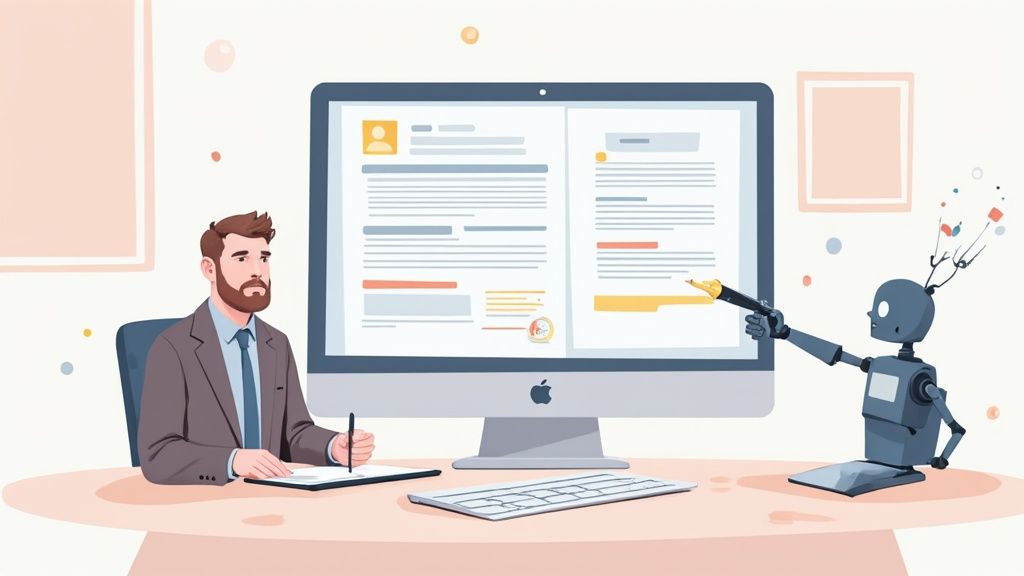
This infographic captures the journey perfectly, showing the move from a frustrating, manual process to a much smoother, AI-driven one.
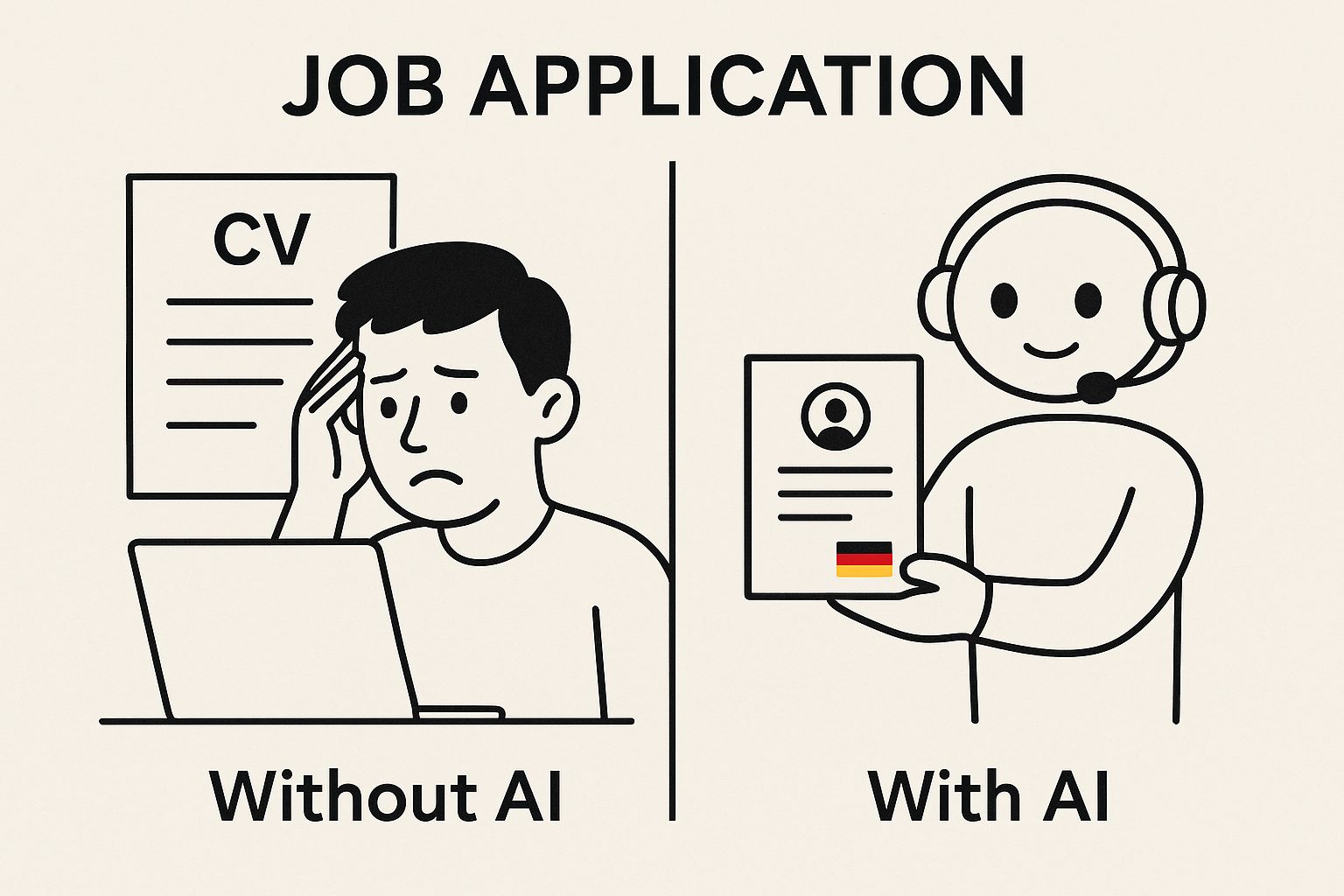
As you can see, AI acts as a bridge, taking you from the initial confusion of a blank page to a polished, complete application that’s ready to impress.
Key Benefits of an AI-Powered Approach
So, what are the tangible benefits of letting AI help with your application? It's not about letting a robot write for you, but rather about enhancing your own experience and qualifications to meet modern hiring standards.
A quick look at the practical differences makes the value clear.
Manual vs AI-Assisted Application Writing
| Aspect | Manual Application Writing | AI-Assisted Application Writing | | :--- | :--- | :--- | | Time Investment | Hours per application, slow and repetitive. | Minutes per application, allowing for more submissions. | | ATS Optimisation| Guesswork, often misses critical keywords. | Pinpoints and integrates keywords from the job description. | | Consistency | Tone and quality can vary with fatigue. | Maintains a consistent, professional tone every time. | | Grammar & Style| Prone to human error and typos. | Polishes language for perfect grammar and style. |
This comparison shows it's not just about speed, but about quality and effectiveness.
Here’s a breakdown of the core advantages you gain:
- ATS Optimisation: This is the big one. AI scans the job ad and tells you exactly which keywords the employer's software is looking for. This dramatically increases your chances of getting past that first digital hurdle.
- Time Efficiency: Think about it. You can generate a custom-fitted cover letter and CV for several different jobs in the time it used to take to do just one. This means you can apply to more of the right opportunities, faster.
- Professional Language: AI helps you sound your best. It polishes your phrasing, catches sneaky grammar mistakes, and makes sure your tone is perfectly suited for the professional German workplace.
Think of AI as your co-writer. It handles the technical optimisation for the software, so you can focus on making sure your personality and experience shine through for the human who will ultimately make the decision.
Understanding these benefits is the first real step toward building a smarter, more effective job search strategy. For more practical advice on navigating the modern application process, feel free to check out our other articles on the JobCopilot blog. Now, let's dive into how you can pick the right tools and put them to work.
How to Choose the Right AI Application Tool
With so many AI tools flooding the market, all promising to help you write the perfect application, picking the right one can feel impossible. But here’s the thing: they aren't all the same. The tool you choose has a direct impact on the quality of your application and, frankly, your shot at getting that interview. Let's cut through the noise with a practical approach.
First, look past the flashy marketing and focus on what actually matters for the German job market. Any decent tool should be able to generate a Lebenslauf (CV) and an Anschreiben (cover letter). That’s just the baseline. The real difference-maker is how intelligent and specific the tool is.
Key Features for the German Market
The best AI tools are more than just fancy text spinners; they act as a strategic partner in your job search. They get the small details of German professional culture and know how to beat the automated systems that filter applications.
Here's what you should be looking for:
- ATS Optimisation: Your documents need to get past the Applicant Tracking Systems first. A good tool will analyse the job description, pull out the essential keywords, and help you weave them naturally into your CV and cover letter.
- Industry-Specific Language: An application for a Berlin tech start-up needs a completely different tone than one for a traditional engineering firm in Munich. The AI has to understand this and adapt its language accordingly.
- Customisation and Control: The AI should give you a fantastic first draft, but you always need the final say. The platform must be easy to edit, allowing you to add your own voice and specific experiences to make the documents truly yours.
A huge mistake I see people make is using a generic AI writer not built for job applications. The text often sounds unnatural or misses key industry terms, which is a dead giveaway to recruiters that you didn't put much effort in.
Evaluating Your Options: A Practical Checklist
Data privacy is a massive deal, especially in the EU. Always check where the company is based and read its data protection policy. You're handing over your entire career history, so make sure the provider is GDPR-compliant.
Think about a real-world example: an automotive engineer applying to a major German car manufacturer. They need a tool that understands highly technical jargon and can adopt a formal corporate tone. A generic tool just won't cut it.
Use this checklist to size up your options:
- Does it create a complete application? You need a platform that builds both a CV and a cover letter that meet German standards.
- How good is the ATS analysis? Does it actively scan the job ad and give you keyword suggestions, or is it just spitting out generic templates?
- Is it easy to use? You shouldn't need an IT degree to figure it out. A clean, intuitive interface saves a ton of time and frustration.
- What’s the deal with data privacy? Stick with tools that are upfront and transparent about how they handle your personal information.
By thinking through these points, you can make a much smarter choice. Specialised tools like JobCopilot are built from the ground up for the German job market, with features designed to give you a genuine edge. Choosing the right tool means you're not just writing an application—you're engineering it for success.
Crafting a Cover Letter That Actually Sounds Human
Let's be honest: a generic cover letter is the fastest way to get your application ignored. When you bring AI into the picture for your Bewerbung, the real trick isn't just getting it to write something—it's getting it to write something that sounds like a real, compelling person. The best approach is to stop thinking of AI as a ghostwriter and start treating it like a brilliant but clueless assistant you need to brief properly.
If you just ask an AI to "write a cover letter for a marketing job," you'll get a bland, forgettable mess. It’s a guaranteed recipe for robotic text. To coax something genuinely you out of the machine, you have to feed it the right ingredients: the full job description, your polished CV, and those unique personal details that a template can't guess, like your proudest achievements or a relevant quick story.
From Basic Prompts to Powerful Instructions
Let’s get practical. Say you're gunning for a Junior Project Manager position. A basic prompt like, "Write a cover letter for a junior project manager job," is a dead end. The AI will spit out a word salad of clichés about being organised and a great team player. Yawn.
Now, let’s build a prompt that actually works. A much better approach involves giving the AI context, setting the right tone, and pointing it towards your personal highlights. This is what turns a generic draft into something sharp and specific.
This is especially true in Germany, where generative AI is being adopted at different speeds. A recent YouGov survey highlighted a huge age gap: 43% of Germans aged 18-29 are using these tools regularly, while only 8% of people over 65 are doing the same. With younger candidates jumping on the AI bandwagon, it's more important than ever that your AI-assisted work has a distinctly human feel. You can dive deeper into the research on how German demographics are shaping AI use over on PPC.land.
An Adaptable Prompt You Can Steal
Here’s an advanced, adaptable prompt you can tweak for yourself. Pay attention to how it gives the AI a persona, hands it source material, and dictates the style.
You are a German career coach. I need you to write a professional yet enthusiastic cover letter for the [Job Title] role at [Company Name]. Use my attached CV as the main source of information. It's crucial that you highlight my experience in [Skill 1] and [Skill 2]. I also want you to work in my key achievement from the [Project Name], where I helped [describe your impact, e.g., increase team efficiency by 15%]. The tone should be formal but engaging, perfectly suited for a German corporate environment.
See the difference? This kind of detailed instruction forces the AI to connect your specific experience to what the employer actually wants. It’s no longer just listing skills; it’s starting to tell your professional story.
By layering in these specific details—the job ad for keywords, your CV for the hard facts, and personal anecdotes for the personality—you're not just asking for a letter; you're directing the creation of a draft that sounds like you. The aim is to get a document that's 90% of the way there, leaving you to add that final 10% of human polish. It's this blend of AI efficiency and your personal touch that makes a cover letter truly stand out.
Optimising Your CV to Beat the Bots
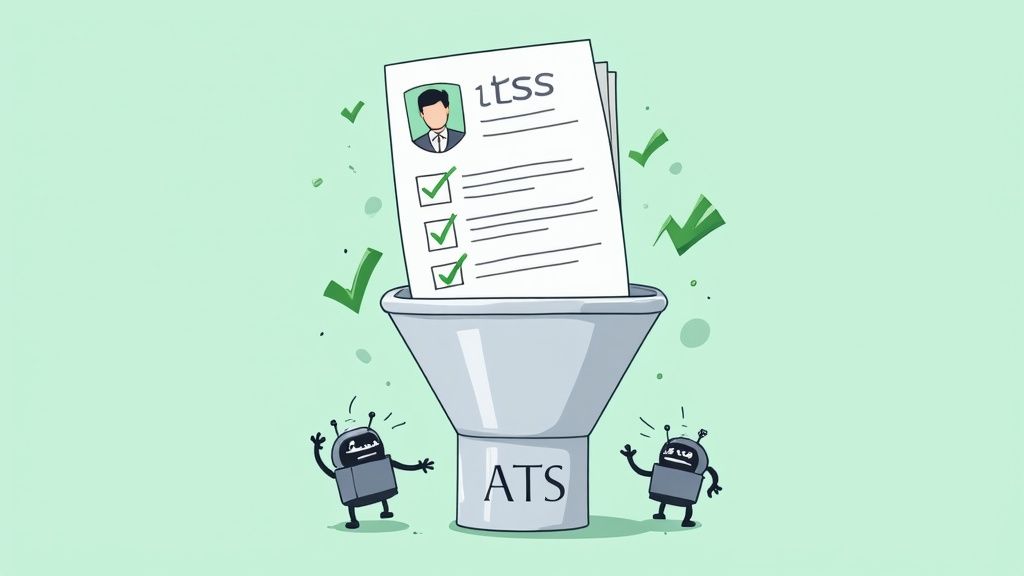
Here's a hard truth: the first "person" to read your CV probably won't be a person at all. Before your carefully crafted experience ever reaches a hiring manager, it has to get past the digital gatekeepers known as Applicant Tracking Systems (ATS). Think of them as bouncers for the recruiting world, and learning their rules is your ticket inside.
These software systems aren't looking for nuance or personality. They're programmed to do one thing: scan your CV for specific keywords, skills, and job titles that match the job description. If your document doesn't hit a certain keyword threshold, it gets automatically rejected. It's a tough game, and it explains why a recent survey found that 43% of applicants are now turning to AI to even the odds.
Letting AI Find the Keywords for You
This is where a specialised AI tool can give you a serious advantage. Instead of staring at a job description and guessing which words matter most, you can get a data-driven analysis. The process is surprisingly straightforward: you give the AI the job ad, and it reverse-engineers the hiring manager's checklist, pinpointing the exact terms and skills the ATS is hunting for.
For example, you might see that a Marketing Manager role mentions "SEO strategy" and "lead generation." That's obvious. But the AI might also flag related terms like "performance metrics," "A/B testing," and "marketing automation" that are equally important but easier to miss.
Here’s a quick look at how the optimisation process plays out:
- Gap Analysis: The AI cross-references the job description with your CV, instantly showing you which critical terms are missing.
- Smart Suggestions: It then recommends how to naturally work these keywords into your experience descriptions so they don't sound forced or clunky.
- Format Sanity Check: The tool also ensures your CV is "robot-friendly." Many people don't realise that complex tables, fancy fonts, or images can completely confuse an ATS, causing it to misread or discard your file.
Turning Vague Duties into Impressive Achievements
Keyword optimisation is only half the battle. Once your CV is past the bot, a human needs to be impressed. This means showing impact, not just listing duties. AI is fantastic at helping you reframe your responsibilities as powerful, data-backed achievements.
Let's take a common example from a Marketing Manager's CV.
The 'Before' Version:
"Responsible for managing social media campaigns and creating content."
It’s not wrong, but it’s weak. It tells the reader what you did, but not how well you did it.
The 'After' Version (with AI's help):
"Spearheaded a data-driven social media strategy across three platforms, resulting in a 45% increase in engagement and a 20% growth in qualified leads over six months."
See the difference? This version is a knockout. It seamlessly includes keywords like "social media strategy" and "leads" while showcasing quantifiable results (45% increase, 20% growth). That's the kind of language that makes a hiring manager stop scrolling and pay attention.
"I wouldn’t let generative AI write my entire CV, but you can use it to find small things you might have overlooked—small areas for optimisation." - Mona Khalil, Data Science Manager at Greenhouse
In the end, using AI is about playing the game strategically. You're creating a document that is technically tuned to get past the initial software screening but still reads as an authentic and compelling story of your career for the person who makes the final call. It’s about making sure your hard work gets seen.
The Final Polish: Your Human Touch is Non-Negotiable
It’s tempting, isn’t it? After letting an AI like Acquispect do the heavy lifting, your documents look polished and packed with all the right keywords. You’re ready to fire it off and move on. But hold on a minute. This is actually the most crucial part of the entire process – where you need to step back in.
Think of the AI as a brilliant, incredibly fast junior assistant. It’s amazing at gathering information and structuring it, but it’s not the one who has to show up for the interview. You are. Skipping a thorough personal review is a gamble you can't afford to take. AI tools can occasionally make up facts, what some people call 'hallucinations,' or use bland, generic phrases that sound professional but lack any real punch. Your final review is what turns a technically sound document into a genuinely compelling application.
Your Final Quality Control Checklist
The AI gets you 90% of the way there, which is a massive head start. But that last 10% is entirely on you, and frankly, it’s the part that makes all the difference. This is where you inject your personality, double-check every single detail, and make sure the tone is a perfect fit for the company you’re trying to impress. You're transforming the AI’s draft into your story.
The German job market is shifting rapidly, with AI being a major factor. A 2025 ifo Institute survey revealed that 27.1% of German companies anticipate AI will lead to job cuts within five years. This competitive pressure is exactly why so many professionals are turning to AI for help. Your final, human touch is what will make you stand out. You can dive deeper into these AI-driven shifts in Germany's labour market in this detailed analysis.
Here’s a practical checklist to run through before you even think about hitting 'send':
- Fact-Check Everything: Did the AI get your previous job title exactly right? Are the employment dates, project names, and technical skills listed 100% correct? Don't just skim it – verify every single claim.
- Tune the Tone: Read the entire application out loud. Seriously. Does it sound like you? And just as important, does it sound like it belongs at that specific company? A conservative financial institution needs a very different voice than a scrappy tech start-up.
- Weave in Your Stories: AI can list your achievements, but it can’t share the story behind them. Look for a place in your cover letter to add a quick anecdote that brings a skill to life. Instead of just listing "project management," you could mention a specific time you successfully navigated a tough deadline on a key project.
AI drafts, you finalise. Remember that. Your personal stamp on the final document is what ensures it feels authentic and memorable, not just perfectly optimised.
Ultimately, you want an application that sails past the automated screening systems but still resonates with the human who makes the final call. This thoughtful, final review is what connects those two worlds, making sure your unique value and personality are impossible to ignore.
Answering Your Questions About AI in Job Applications
Stepping into the world of AI for your job search can feel a bit like exploring new territory. Naturally, you'll have questions. Is it ethical? Does it even work? And what about my privacy? These are all valid points, so let's tackle some of the most common concerns people have when they decide to let an AI help with their application (Bewerbung schreiben lassen KI).
One of the biggest fears is ending up with an application that sounds like a robot wrote it. It’s a reasonable worry. If an AI tool spits out a cover letter that’s flat and impersonal, it’s usually a sign that your initial instructions—the prompts you gave it—were too vague. The trick is to think of the AI as a partner in the process, not just a content vending machine.
If the output feels generic, simply go back and feed it more specific details. Give it stories about your accomplishments, mention a recent project the company launched that you admire, and spell out the exact tone you want to achieve. The more of your own personality and experience you put in, the more personalised and compelling the result will be.
Can Recruiters Tell I Used AI?
Ah, the million-dollar question. The honest truth? It really depends on how you use it. If you just copy and paste the first thing an AI generates, a sharp recruiter will probably spot it. That kind of text often lacks a unique voice and can be stuffed with overused corporate buzzwords. While a recent survey found that 62% of hiring managers see AI as a helpful tool for finding great candidates, they’re still hunting for genuine human connection.
But here’s the thing: when you use AI as a tool for brainstorming and fine-tuning, and then you put in the work to edit and personalise the final draft, it becomes almost impossible for anyone to tell. The goal isn’t to deceive anyone; it's to create an application so polished and true to you that the question of its origin doesn't even matter. Your final pass is where you merge the AI's efficiency with your irreplaceable human touch.
“I wouldn’t let generative AI write my entire CV, but you can use it to find small things you might have overlooked—small areas for optimisation.” - Mona Khalil, Data Science Manager at Greenhouse
Is My Personal Data Safe?
Uploading your entire professional life to an online platform is a big step, and you're right to be cautious, especially with the EU's strict GDPR rules in place. When you're picking an AI tool for your job search, data privacy has to be a top concern.
Before you give it any of your information, do a quick bit of due diligence:
- Scan the Privacy Policy: Look for straightforward language explaining how they handle your data—where it’s stored, how it's used, and what security measures are in place.
- Check the Company's Location: Companies based in the EU are generally a solid choice because they have to comply with GDPR.
- Look for Transparency: A good platform will be open and honest about its security practices.
A trustworthy tool will handle your personal information with the respect it deserves. Don't ever trade your data security for a little convenience. Your privacy is not something to be compromised, and any platform worth its salt will agree.
Ready to see how smart technology can help you build applications that truly stand out? Acquispect uses AI to analyse job descriptions, help you craft perfectly tailored documents, and even track your progress, giving you a serious advantage in your search.
Start your free trial at Acquispect