Using AI for your job application—what we call a Bewerbung mit KI—is no longer just a clever trick. It's become a core strategy for anyone serious about landing a great role. This isn't just about cranking out applications faster; it’s about crafting smarter, more targeted documents that actually get noticed in today's crowded, algorithm-driven job market.
Why AI Is Your New Co-Pilot in the Application Process
The German job market is changing fast. More and more companies are using intelligent systems to sift through the mountains of applications they receive daily. What this means for you, as a job seeker, is that your CV and cover letter are often first seen by an algorithm, not a person. This is exactly where a well-executed Bewerbung mit KI gives you a serious edge.
In fact, AI-powered recruitment platforms are already handling up to 80% of initial CV screenings at some large German companies. By early 2025, it's predicted that around 37% of organisations worldwide, including many in Germany's forward-thinking tech scene, will be actively using generative AI in their hiring. The takeaway is clear: your application needs to impress the machine before it ever gets a chance to impress a human.
This simple workflow shows how it's done: AI provides a strong draft, you bring the human touch to refine it, and then you hit send.
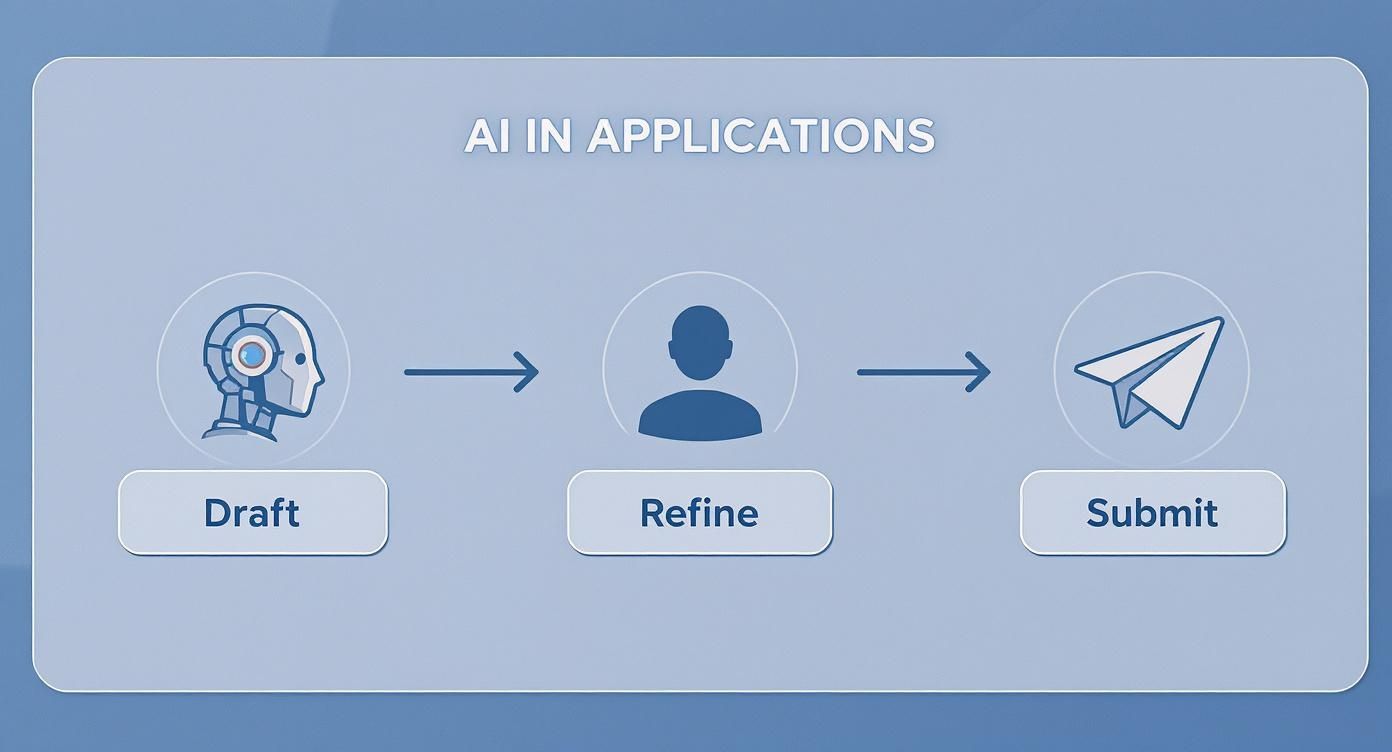
The real magic happens when you see AI as your starting point. It’s a powerful tool, but your personal oversight is what ensures the final application is authentic and high-quality.
What AI Can—and Can't—Do for You
It's helpful to think of AI not as a ghostwriter but as a really smart assistant. It's brilliant at the repetitive, data-heavy tasks that slow you down, freeing you up to focus on what truly matters: strategy, networking, and personalising your story.
Here's a breakdown of how you can put it to work:
- Getting Started: Stuck staring at a blank page? AI is fantastic for generating initial ideas and structures for a cover letter, instantly beating writer's block.
- Keyword Optimisation: It can scan a job description in seconds, pulling out the exact keywords and phrases that Applicant Tracking Systems (ATS) are programmed to look for.
- Polishing Your Language: You can use it to tighten up your phrasing, catch sneaky grammatical errors, and make sure your tone is consistently professional.
- Tailoring at Speed: Need to apply for several similar roles? AI lets you quickly adapt your core CV and cover letter for each one, without having to start from scratch every single time.
The goal is to create an AI-assisted application, not an AI-generated one. The best results always come from blending the speed of technology with your unique experience, personality, and insights.
This hybrid approach ensures your application is both technically optimised for the algorithms and genuinely compelling to the hiring manager who reads it next.
If you're looking to take this process even further and streamline your entire job search workflow, a dedicated platform can make all the difference. You might want to check out the tools available on https://jobcopilot.de/.
Die Wichtigsten KI-Tools für Ihre Bewerbung
With so many tools out there, it's easy to get overwhelmed. This table offers a quick comparison of the most common AI tools, helping you see which ones are best for different stages of your application process.
Ein schneller Vergleich gängiger KI-Tools, die Sie in verschiedenen Phasen Ihrer Bewerbung unterstützen können, mit Fokus auf ihre jeweiligen Stärken.
| Tool-Kategorie | Beispiel-Tools | Optimal für | | :--- | :--- | :--- | | Textgeneratoren | ChatGPT, Gemini, Claude | Erstellung von Entwürfen für Anschreiben, Formulierung von Schlüsselqualifikationen, Überwindung von Schreibblockaden. | | CV-Optimierer | Kickresume, Enhancv, Resume.io | Analyse von Stellenanzeigen, ATS-Keyword-Optimierung, Design und Formatierung von Lebensläufen. | | Grammatik & Stil | Grammarly, LanguageTool, ProWritingAid | Korrekturlesen, Verbesserung der Lesbarkeit, Sicherstellung eines professionellen und fehlerfreien Tons. | | Job Search Plattformen | LinkedIn (AI Features), StepStone | Personalisierte Job-Vorschläge, Abgleich von Fähigkeiten mit offenen Stellen, Vorbereitung auf Vorstellungsgespräche. |
Ultimately, the best tool is the one that fits your specific needs. Don't be afraid to experiment with a few different options to find the combination that works best for you and helps you put your best foot forward.
Ein Überzeugendes Anschreiben Mit KI-Unterstützung Erstellen
Your cover letter is the narrative behind your résumé. In it, you weave together past achievements and future ambitions. During your Bewerbung mit KI, AI supplies a first sketch—but you remain the storyteller.
Think of the tool as a sparring partner. It hands you a structure so you skip that blank-page panic. Yet only you can breathe life into the draft by adding anecdotes, hard facts and the right tone for German recruiters.
Crafting The Perfect Prompt
A strong prompt is the heart of every effective draft. Ambiguous input leads to generic output. To steer the AI in the right direction, include:
- Job Description: Paste the complete text so the AI understands required skills and company culture.
- Your CV: Share every section. This lets the AI highlight experiences that resonate with the role.
- Personal Story: Describe a concrete success—say, “I redesigned our onboarding process and achieved a 15% rise in customer retention.”
A well-crafted prompt isn’t just a request; it’s a briefing that sets clear expectations and context.
With these ingredients, you’ll get an outline that already feels tailored to your profile.
From Draft To Authentic Story
The AI gives you a scaffold—now it’s your turn to build. Focus on three key refinements:
Infuse Your Voice
Read each sentence aloud. If it doesn’t sound like you, rephrase it in your natural style.Zoom In On Details
Swap “managed projects” for “led the Project Phoenix launch, coordinating five team members and delivering two weeks ahead of schedule.”Respect Cultural Nuances
German cover letters favour precision and a professional tone. Tweak any overly casual greetings or closings to match local expectations.
Current data underlines where AI roles concentrate: Berlin accounts for 48% of all AI developer postings in Germany, Munich follows with 29%. Interestingly, the share of AI positions asking for a university degree slipped from 47% in 2019 down to 41% in 2024—proof that hands-on skills carry real weight. Demonstrating your capacity to integrate AI tools into your Bewerbung mit KI can give you a decisive edge. Discover more insights about Germany’s AI job market from Agency Partners.
By meticulously refining the AI’s output, you end up with a cover letter that is both strategically sharp and unmistakably personal.
Optimising Your CV for Algorithms and People
When you send off your CV, it's not just one person you need to impress. It actually has two very different audiences: first, the automated screening software, and second, the human reviewer on the other side. A smart Bewerbung mit KI approach needs to win over both. One is looking for data and keywords; the other is looking for personality and real-world impact.
Your first challenge is getting past the initial digital gatekeeper, the Applicant Tracking System (ATS). These systems are programmed to scan for specific terms from the job description, and if your CV doesn't have them, it often gets filtered out before a person ever sees it. This is where a little AI analysis can make a huge difference.
Finding the Keywords That Matter
Before you even think about writing, take the entire job advertisement and pop it into an AI tool. I find a simple prompt works best, something like: "Analyse this job description and pull out the top 10 keywords, technical skills, and soft skills an ATS would be searching for."
In seconds, the AI will give you a targeted list of essential terms. This isn't about just cramming these words into your CV. It’s about placing them strategically. For instance, if you see "Projektmanagement" and "agile Methoden" are high on the list, you'll want to make sure they appear naturally in your professional summary, your skills section, and within the descriptions of your relevant work experience.
Getting this right is what gets your foot in the digital door. It's a critical first hurdle where so many otherwise qualified candidates fall.
From Everyday Duties to Standout Achievements
Here’s a common mistake I see all the time: CVs that just list job duties. "Managed social media accounts" tells a hiring manager what you were supposed to do, but not how well you did it. They're looking for quantifiable achievements, and AI is fantastic at helping you reframe your experience to show your actual impact.
Try taking a standard-issue bullet point from your work history and ask an AI to give it some punch.
For example:
- Your Original Point: "Responsible for customer support tickets."
- Your AI-Powered Prompt: "Rewrite this CV point to highlight achievement: 'Responsible for customer support tickets.' I used a new ticketing system that helped us respond faster."
- The Powerful Result: "Spearheaded the implementation of a new ticketing system, cutting average customer response time by 25% within the first quarter."
See the difference? You've gone from a passive task to a powerful, data-backed accomplishment. That's what catches a recruiter's eye.
The goal is to shift your CV from a simple list of tasks into a portfolio of your successes. AI is brilliant at finding the right words to frame the value you brought to your past roles.
Customising Your CV Without Losing Your Mind
We all know we should tailor our CV for every job application, but who has the time? Re-writing it from scratch for every single role is a recipe for burnout. This is where you can work smarter, not harder.
Start by using AI to help you build a comprehensive "master CV" that includes every skill, project, and achievement you can think of. Then, for each new application, you can use AI as your personal assistant to quickly tailor it.
Feed the AI your master CV along with the new job description. Then, ask it to:
- Spot the Overlaps: Have it pinpoint which of your experiences and skills are the most relevant for this specific role.
- Suggest Smart Edits: Ask for recommendations on which bullet points to feature more prominently, which to rephrase, and which to leave out this time.
- Check the Vibe: Get it to ensure your tone and language match the company culture that comes through in the job ad.
This approach lets you create a highly targeted, customised CV in a fraction of the time it would take manually. You can apply for more jobs, increase your chances of success, and do it all without sacrificing quality. That’s how you truly make a Bewerbung mit KI work for you.
Mit KI Souverän ins Vorstellungsgespräch Gehen
 A successful Bewerbung mit KI doesn't stop once you've sent off your documents. The real test is usually the interview, and AI can be an incredibly useful partner for getting ready. We're moving past just creating documents here; these tools can help you build the confidence and deep knowledge you need to really make an impression.
Think of it this way: you can use AI to simulate the real thing and do some serious research. By treating a chatbot like your personal interview coach, you can walk into that conversation feeling ready for almost anything they throw at you.
Creating a Realistic Interview Simulation
Practice makes perfect, right? It's one of the best ways to get ready for an interview. You can turn a good AI chatbot into a surprisingly realistic interview simulator by giving it the right information. This straightforward approach lets you rehearse your answers and spot any weak points before the big day.
To get started, you just need to feed the AI the key documents from your application.
- First, the Job Description: Copy and paste the entire job ad you responded to. This tells the AI exactly what the role needs and what kind of language the company uses.
- Next, Your CV and Cover Letter: Give it the exact documents you sent in. This helps the AI connect your specific background and skills to the job's requirements.
- Finally, the Prompt: Use a clear command to kick things off. Something like: "Act as a hiring manager for this Senior Marketing Manager role. Based on the provided job description and my CV, conduct a practice interview with me. Start by asking me the first question."
The AI will then start asking relevant, role-specific questions. You'll get everything from the classic icebreakers ("Tell me about yourself") to tricky behavioural questions ("Describe a time you managed a difficult stakeholder"). It's a fantastic, low-pressure way to get your thoughts in order and polish your answers.
Use this simulation to get comfortable telling your professional story. The goal isn't to memorise scripts, but to practise connecting your experience directly to the needs of the company.
Going through this process a few times builds a kind of muscle memory, so when you're in the actual interview, your answers will come out sounding much more natural and confident.
Conducting Deep-Dive Company Research
Besides practising your own story, showing you have a genuine interest in the company is what really sets great candidates apart. Vague compliments just don't cut it anymore; you need to prove you've done your homework. AI can make this research process much faster and more effective.
Don't just skim the company's "About Us" page. Use AI to dig deeper and find unique talking points.
Try asking specific questions like these:
- "Summarise the key points from [Company Name]'s most recent quarterly earnings call."
- "Find recent news articles about [Company Name]'s expansion into the European market."
- "What are the biggest challenges currently facing the logistics industry, and how might they affect [Company Name]?"
This level of preparation gives you the material to ask truly insightful questions when it's your turn. Imagine asking something like, "I saw your CEO mentioned a focus on sustainability in the last earnings call; how does this role contribute to that initiative?" That shows you're not just looking for any job—you're genuinely invested in where the company is headed. It's a seriously powerful way to stand out from the crowd.
Häufige Fehler und Ethische Aspekte beim KI-Einsatz
Using AI to help with your job applications can be a game-changer, but it’s crucial to know where the potential traps lie. Getting this right is about more than just avoiding a robotic-sounding cover letter; it’s about using these powerful tools responsibly, without sacrificing your authenticity or crossing ethical lines.
Think of it as a balancing act. You want to tap into the efficiency of a Bewerbung mit KI while making sure your unique voice and integrity remain front and centre. This means being mindful of data privacy, the temptation to rely too heavily on the tech, and the fine line between getting help and misrepresenting yourself.
Die Falle der Übermäßigen Abhängigkeit
Easily the biggest mistake I see is people letting the AI completely take the wheel. When an application is stripped of its personal touch, recruiters can spot it a mile away. Those generic phrases and the absence of real, personal stories are dead giveaways that a human wasn't truly behind the words.
It’s interesting to see how this plays out across different age groups. A 2025 YouGov survey in Germany found that 35% of workers aged 18–29 are using AI tools several times a week. On the other end of the spectrum, 70% of employees aged 50–64 have never used them for work. This suggests younger applicants might be more at risk of overusing these tools, while more experienced professionals could be missing out on a real advantage. You can learn more about the generational AI gap in the German workplace and what it means for job seekers.
At the end of the day, your application has to be a genuine reflection of you.
- Always check the AI’s work. AI models aren't perfect and can make things up—sometimes called "hallucinations." They might invent a "fact" or describe your experience in a way that isn't quite right. Your job is to fact-check every single claim it makes for you.
- Bring your personality to the forefront. Let the AI build the basic structure, but you need to provide the heart. Weave in a personal anecdote, let your natural voice come through, and make sure your genuine excitement for the role is impossible to miss.
Your personality should always be the star of the show; AI's role is strictly that of a supporting actor. Make sure the final document sounds like you, not like a machine.
Ethische Grenzen und Datenschutzbedenken
There’s a clear ethical line you can’t cross. Using AI to polish your experience is one thing; using it to deceive is another entirely. This could be anything from slightly exaggerating your skills to completely fabricating work history or qualifications. It's a surefire way to get yourself blacklisted.
Data privacy is another huge piece of the puzzle. You have to be incredibly careful about what personal details you feed into public AI platforms.
Information you should never share:
- Personal identification numbers
- Any bank or financial details
- Contact information for your references (unless you have their explicit permission)
- Confidential details or trade secrets from previous employers
Here’s a simple rule of thumb: if you wouldn't feel comfortable posting it on a public website, don't put it into a generic AI tool. For the most part, stick to the kind of information that's already on your public CV. This smart approach lets you get all the benefits of a Bewerbung mit KI without taking on needless risk.
Frequently Asked Questions About Using AI in Your Application

Jumping into AI for your job search naturally brings up a lot of questions. People wonder about everything from ethics to how well these tools actually work. Let's clear up some of the most common uncertainties so you can use AI in your job application (Bewerbung mit KI) with confidence.
Do Recruiters Know If I Used AI?
An experienced recruiter can often tell. A dead giveaway is text that feels a bit too perfect, overly generic, or just lacks a human touch. AI has certain patterns and phrases it tends to fall back on, and a sharp hiring manager will pick up on that unnatural, robotic feel.
The trick is to use AI as your starting block, not the finish line. Let it generate a first draft, but then it's your job to go in and make it yours. Infuse it with your personality, weave in specific stories from your career, and make sure it sounds like you. It's an AI-assisted application, not an AI-written one.
Is Using AI for an Application Considered Cheating?
Not at all, provided you use it correctly. Most people in recruitment see AI as just another productivity tool, like using a spellchecker or a grammar assistant. As long as everything you write is true and accurately represents you and your skills, you're in the clear.
The ethical line is crossed when you use AI to invent experiences or claim skills you do not possess. The goal is to present your qualifications more effectively, not to fabricate them.
Using AI to help you find the right words or structure your thoughts is perfectly fine. But creating a deepfake video of a manager who doesn't exist giving you a glowing reference? That's fraud, plain and simple.
Which AI Tool Is Best for Applications?
There’s no single "best" tool—the right one really depends on what you're trying to do. A smart approach to your Bewerbung mit KI involves using a few different platforms for what they do best.
- For brainstorming and drafting: Big names like ChatGPT, Gemini, or Claude are fantastic for getting past writer's block. They can help you outline your cover letter or come up with different ways to phrase your experience.
- For CV optimisation: This is where specialised tools shine. They can analyse a job description and help you pepper your CV with the right keywords, making sure you get past those initial Applicant Tracking Systems (ATS).
- For grammar and style: Tools like Grammarly or the Duden-Mentor have powerful AI features that are great for that final polish, ensuring your documents are professional and error-free.
By mixing and matching, you get the best of all worlds, resulting in a much stronger application package.
Can AI Help Me Adapt My Application for the German Market?
Absolutely, and this is one of its most powerful uses. You can feed an AI specific instructions to follow the norms of a German CV (Lebenslauf) or to craft a formal cover letter. For example, you could prompt it to write an introduction that would be appropriate for a traditional German engineering company.
Just be careful. You still need to double-check its suggestions against reliable sources. AI can sometimes pull from outdated information or lean on cultural stereotypes. For more detailed tips and strategies, you might find the resources over on the JobCopilot blog at https://jobcopilot.de/blog helpful. Always use your own judgment to make sure the final documents are accurate and culturally on point.
Ready to stop writing applications and start getting interviews? Acquispect uses AI to find your perfect job, create tailored application documents, and send them for you—all while you focus on what matters. Start your free 30-day trial and supercharge your job search today.