Think of programmatic job advertising as the smart, automated way to get your job ads in front of the right people. It swaps the old ‘post and pray’ method for a data-driven approach that buys, places, and tweaks your ads in real-time. The goal is simple: show your roles to the most relevant candidates, right when and where they're most likely to see and act on them.
What Is Programmatic Job Advertising
Let's use an analogy. The old way of posting a job is like buying a billboard on a single, busy motorway. You pay a flat fee for a set time, and you just have to hope the right person drives by and sees it. You're paying for everyone to see it, regardless of whether they're a qualified engineer or a student on their way to a lecture.
Programmatic advertising works more like a fleet of targeted digital ads on wheels. Instead of one static billboard, you have ads that follow potential candidates wherever they go online. Using real-time data, the system knows if your ideal candidate is browsing a niche tech forum, scrolling through LinkedIn, or reading an industry blog. It then shows them your ad at the perfect moment, ensuring your budget is spent only on reaching people who actually fit the bill.
It’s all about precision. This data-first strategy means your job ad gets delivered directly to qualified professionals, cutting out the waste and guesswork.
From Manual Effort to Automated Intelligence
At its heart, this is a move from a static, one-and-done task to a living, breathing campaign. You're no longer just guessing which job board will give you the best return. Instead, programmatic platforms are making thousands of tiny, intelligent decisions every second. This frees up your recruitment team from repetitive admin, allowing them to focus on what humans do best—building relationships with great candidates.
This shift is a game-changer in tough talent markets like Germany's, where finding niche skills demands more than just a standard job board post. The technology takes over the heavy lifting:
- Smart Budgeting: It automatically moves your money to the channels that are delivering the best results.
- Wider Reach: Your jobs appear across a huge network of sites, all based on performance data.
- Real-Time Bidding: The system automatically bids for ad space in live auctions, getting you the best placement for the best price.
The real power of programmatic is replacing guesswork with certainty. By automating the ad buying process, it makes sure the right person sees the right job ad at precisely the right time.
Traditional vs Programmatic Job Advertising At a Glance
To really see the difference, a side-by-side comparison makes it clear. The table below breaks down the old way versus the new, showing the fundamental shifts in how we approach, manage, and measure job advertising.
| Feature | Traditional Job Posting | Programmatic Job Advertising | | :--- | :--- | :--- | | Process | Manual, one-time placement per job board. | Automated, real-time bidding across many sites. | | Targeting | Broad and based on the general audience of a site. | Hyper-specific, based on candidate behaviour and data. | | Budgeting | Fixed cost per post, regardless of performance. | Flexible, performance-based spending (e.g., pay-per-click). | | Optimisation | Minimal; requires manual analysis and reposting. | Continuous and automatic, based on real-time results. |
Looking at it this way, it’s easy to see why programmatic advertising isn't just another option anymore—it’s becoming essential for any serious talent acquisition strategy.
How the Programmatic Ecosystem Actually Works
To really get your head around programmatic job advertising, it helps to pull back the curtain and see what's happening behind the scenes. Let's forget the complex jargon for a minute. Instead, picture a super-fast, highly organised digital marketplace. Your job ad is the product, and qualified candidates are your ideal customers.
This whole process—from your job ad leaving your system to popping up in front of the right candidate—happens in the blink of an eye. The old, sluggish method of posting an ad and hoping for the best is gone. It's replaced by an automated, intelligent system built for speed and pinpoint accuracy.
The image below shows this shift perfectly, moving away from the old "post and pray" approach to the smarter, programmatic method.
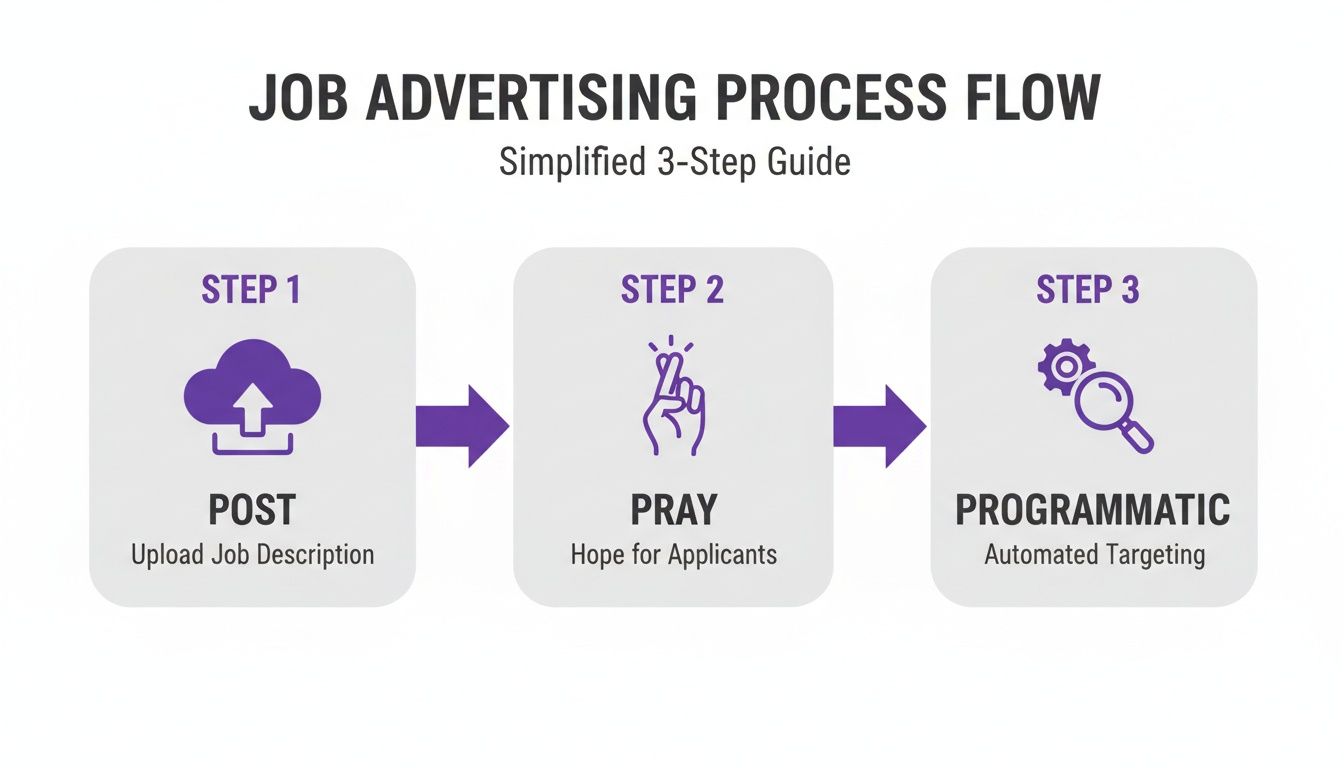
As you can see, programmatic advertising adds a layer of intelligent analysis. It turns recruitment from a game of chance into a calculated strategy. Now, let’s meet the key players who make all this automation possible.
The Key Players in the Programmatic Marketplace
Think of this whole system as having three main actors working together: the buyer (that’s you), the seller (websites with ad space), and the auction house connecting them.
Demand-Side Platform (DSP): This is your company's expert purchasing agent. You feed your campaign goals into the DSP—things like the specific job role, required skills, location, and of course, your budget. The DSP then goes to work on your behalf, hunting for the best possible ad placements to hit those goals.
Supply-Side Platform (SSP): This is the agent working for the sellers. Job boards, niche industry blogs, and countless other websites use an SSP to put their available ad space on the market. The SSP's main job is to help these publishers get the highest price for their ad inventory.
Ad Exchange: This is the big, central auction house where the DSP and SSP meet to do business. It's a massive digital marketplace where ad space is bought and sold in real-time.
These three parts work in perfect harmony to create an incredibly efficient market. You tell your agent what you need, their agent lists what's for sale, and the auction house makes the deal happen instantly.
The Magic of Real-Time Bidding
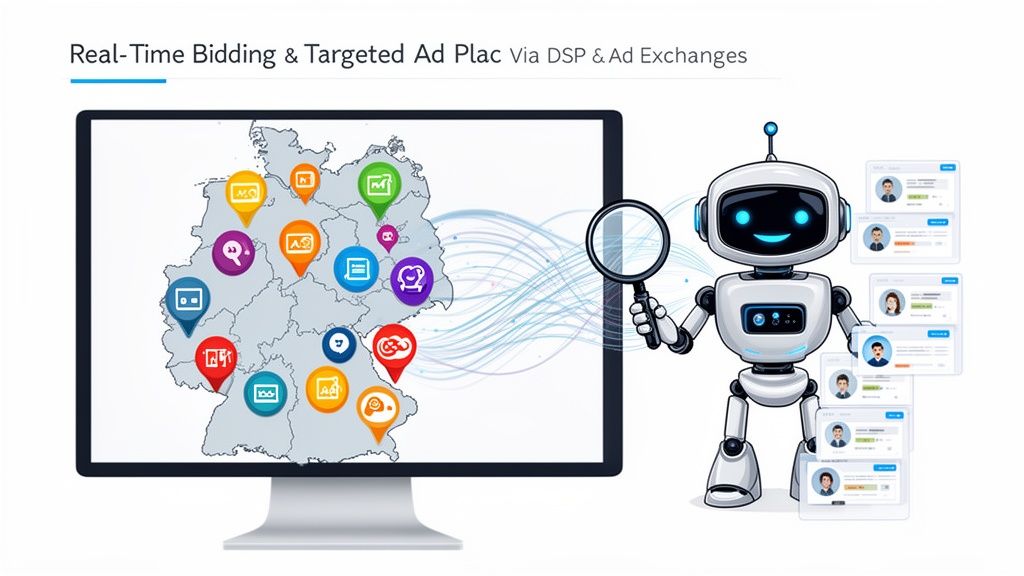
The engine that drives this entire ecosystem is Real-Time Bidding (RTB). It’s an automated, split-second auction that takes place every single time a relevant candidate visits a webpage with ad space available.
Here’s a simple, step-by-step look at how it all unfolds:
- Step 1: A Candidate Arrives: A potential candidate—let's say a software developer in Berlin—visits a tech news website. As the page starts to load, the SSP sends out a bid request to the ad exchange.
- Step 2: The Auction Begins: The ad exchange immediately shouts out that an auction is happening to multiple DSPs. It shares key (but anonymised) details about the user and the ad space up for grabs.
- Step 3: Bids Are Placed: Your DSP spots this opportunity. Its algorithms analyse the data and decide this developer is a perfect match for your open role. It then submits a bid based on the budget and targeting rules you set earlier.
- Step 4: A Winner is Chosen: In milliseconds, the ad exchange sifts through all the incoming bids. The highest bidder wins the auction.
- Step 5: The Ad is Served: Your job ad instantly appears on the tech website for that software developer, just as the page finishes loading. The entire auction takes less than 200 milliseconds.
This isn't just about being fast; it's about being smart. The system doesn't just bid on any old ad space. It specifically targets impressions that are most likely to lead to a qualified application, making every euro of your budget work harder.
This level of targeting means you’re not wasting money showing your senior developer role to a marketing intern. Sophisticated algorithms analyse behavioural data, search history, and professional interests to find high-potential candidates wherever they are online—whether they're actively looking for a job or just passively browsing. This precision is the real power of programmatic job advertising.
What This Actually Means for Your Hiring Team
Let's get past the technical jargon for a moment. The real question is: what does all this programmatic stuff actually do for you and your hiring goals? It’s about making a strategic shift from the old "post and pray" method to a far smarter, data-led approach to finding talent. You're swapping guesswork for genuine insight and getting better results, often without increasing your budget.
This isn't just about using fancy new tech. It's about fundamentally improving how you recruit by tackling the three biggest headaches in hiring today: cost, quality, and speed.
Drive Down Costs and Squeeze More Out of Your Budget
The first, and most noticeable, perk of programmatic job advertising is how much more efficient it is with your money. With the traditional model, you pay a flat fee to post a job on a single job board. It doesn't matter if you get a hundred great applicants or zero—that money is gone.
Programmatic turns that entire idea on its head. You stop paying for a posting and start paying for performance. Your budget isn’t locked into one place; it flows to wherever it will do the most good. If a small, niche tech forum is suddenly bringing in top-notch applications for your engineer role in Munich, the system automatically sends more money that way. If a big, expensive job board isn't delivering, it pulls the budget right back.
This smart allocation makes a huge difference. For instance, with flexible work now being so important, programmatic tools can slash wasted ad spend by up to 30-40%. They do this through real-time bidding, reacting instantly to where the right candidates are. This isn't just about saving money; it aligns perfectly with the current hiring climate in Germany, which is all about building trust and efficiency in online recruiting. You can explore more on German recruiting trends to see how well this fits the local market.
Raise the Bar on Candidate Quality with Laser-Focused Targeting
Anyone can get more applications. The real trick is getting more of the right ones. This is where programmatic truly shines, using incredibly specific targeting to reach people with the exact skills and background you're looking for.
This is worlds away from the broad categories you find on a typical job board. You can target candidates based on things like:
- Skills and Experience: Your ads can find people whose online footprints show they’re experts in a certain programming language or have used specific software.
- Professional Interests: You can place your ads on industry blogs, forums, and news sites that your ideal candidates are already visiting.
- Career Intent: The system can even spot passive candidates—those who aren't actively job hunting but are showing subtle signs they might be open to a new role.
Think about it. Say you need a specialised automotive engineer in Munich. Instead of just posting on a general engineering site, your programmatic campaign could find that person while they're reading a technical journal online or contributing to a niche engineering forum. These are places you’d never think to look manually.
A programmatic strategy doesn't just find more candidates; it finds better-matched candidates. By focusing on relevance, you reduce screening time and increase the quality of your talent pipeline from the very first step.
Widen Your Net and Get Smarter with Data
Finally, programmatic massively expands your reach while giving you the data to make better decisions next time. Your job ads are no longer stuck on a handful of big-name job boards. They’re automatically sent out across a huge network of thousands of sites, including niche platforms you’ve probably never even heard of.
The best part? This massive reach is all managed from one dashboard. You get a single, clear view of how everything is performing. The analytics show you in real-time which channels are working, what ad copy gets the most clicks, and where your best people are coming from. This continuous feedback loop means you’re always getting smarter, ensuring every recruitment euro is spent for maximum impact.
Connecting Programmatic Ads to Merit-Based Hiring
Programmatic job advertising is a phenomenal engine for getting your roles in front of countless people. But like any engine, its performance depends entirely on the quality of its fuel. For years, the standard fuel has been things like resume keywords and browsing history—data points that are useful, but are often just shallow proxies for real skill.
Imagine this: instead of targeting someone just because they've listed "Java Developer" on their LinkedIn profile, you could target candidates with verified, undeniable proof of shipping high-quality Java code. This is where programmatic reach and merit-based hiring come together, and it’s a genuine game-changer for recruitment.
When you connect your programmatic campaigns to platforms that offer objective, verifiable credentials, you stop targeting claims and start targeting competence. It’s a fundamental shift. Your advertising budget is no longer spent on people who are just good at writing resumes; it's spent finding people who can demonstrably do the work. This moves recruitment away from potential bias and squarely towards proven ability.
Shifting from Keywords to Verifiable Skills
The idea is actually quite simple, but its impact is profound. Programmatic tech is brilliant at finding needles in a vast digital haystack. Merit-based credential systems, like Acquispect, act as powerful magnets, helping the technology pinpoint exactly which of those needles are the right ones. These platforms can analyse a developer's code, a designer's portfolio, or a project manager's actual contributions and then issue a cryptographically signed credential as concrete proof of their work.
This objective data becomes a brand-new, incredibly powerful targeting signal for your programmatic campaigns. Suddenly, your targeting criteria can move beyond broad categories and become highly specific and evidence-based:
- Target developers with verified contributions to open-source security projects.
- Reach UX designers with audited proof of creating user flows that achieved high conversion rates.
- Find engineers whose code has a verified test coverage of over 90%.
This approach transforms your ad spend from a speculative bet on self-reported skills into a smart investment in audited, proven talent. You're not just reaching a wider audience anymore; you're reaching a pre-vetted, higher-quality audience automatically.
The Power of AI-Audited Credentials
The engine driving this new wave of credentials is often AI. An AI auditor, for example, can scan a GitHub repository to assess code quality, complexity, and adherence to best practices. From that analysis, it can generate an unforgeable credential that certifies the holder's real-world abilities. This is precisely how Acquispect’s Proof Engine operates, turning raw work outputs into trusted hiring signals.
This verifiable data is then fed directly into the programmatic ecosystem. Your Demand-Side Platform (DSP) can now use these credentials as a primary targeting parameter, making sure your job ads are shown almost exclusively to individuals who possess the specific, proven skills you need.
The process of turning raw work into verified credentials, which then fuel smarter programmatic targeting, can be visualised like this:
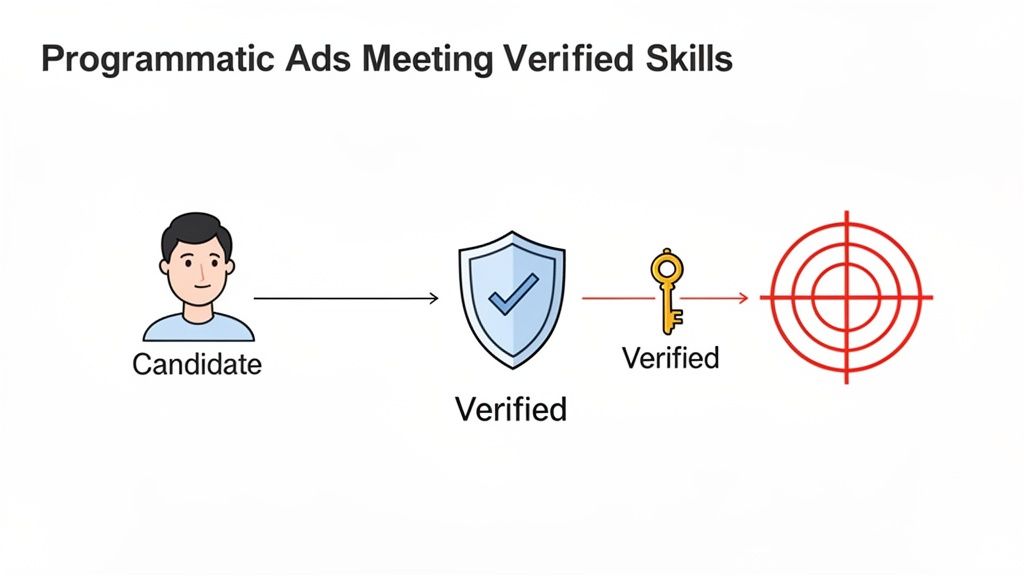
The key takeaway is the shift from subjective claims to objective evidence. It creates a much more solid foundation for fair and effective hiring.
An Advantage for Germany's SMEs
This combination of programmatic reach and merit-based data offers a particularly strong advantage for small and medium-sized enterprises (SMEs). In Germany, where over 55% of job ads come from SMEs, these tools help democratise access to top talent. Smaller firms often struggle to get noticed, but programmatic advertising levels the playing field by finding qualified candidates wherever they are online.
When you add skill verification into the mix, SMEs can compete based on the quality of their roles, not the size of their brand. The rising mention of AI in 8% of German job ads highlights a growing demand for tech-savvy hires—a trend that fits perfectly with using verifiable, AI-audited credentials to find them. You can explore more about digital hiring trends in Germany from Bitkom's study.
By pairing these two technologies, companies of any size can ensure their programmatic job advertising doesn't just find more people, but systematically finds the best people, regardless of their background or how well they can write a CV. It’s a more efficient, equitable, and ultimately more effective way to build a world-class team.
Measuring the Success of Your Campaigns
A great programmatic job advertising strategy is only as powerful as your ability to measure it. To really get a handle on your return on investment, you have to look past surface-level numbers like clicks and impressions. These "vanity metrics" can be seriously misleading; a high click count means very little if none of those clicks ever turn into qualified candidates.
The real value is found when you start tracking the metrics that actually drive hiring outcomes. By focusing on the right key performance indicators (KPIs), you can draw a straight line from your ad spend to the quality of your talent pipeline. This data-first approach lets you prove the value of your work and constantly tweak your campaigns for even better results.
Moving Beyond Clicks to Conversions
The best way to measure success is to follow the candidate's journey from start to finish—from the moment they first see your ad all the way to accepting a job offer. This means you need to connect your programmatic platform to your Applicant Tracking System (ATS). That integration is the key to unlocking the meaningful, bottom-of-the-funnel metrics that tell the whole story.
Here are the essential KPIs you should be watching:
Cost Per Application (CPA): This is your foundational metric. It tells you exactly how much you're spending, on average, to get one person to hit "submit" on an application. You calculate it by dividing your total campaign spend by the number of applications you received.
Cost Per Qualified Applicant (CPQA): Now we're getting smarter. Not all applications are created equal, right? CPQA measures the cost to bring in an applicant who actually meets the minimum qualifications for the role. This gives you a much clearer picture of your campaign's quality.
Cost Per Hire (CPH): This is the ultimate metric for proving ROI. It calculates the total advertising cost that went into a single successful hire. A low CPH is a sure sign that your programmatic strategy is efficiently finding and converting the right people.
By shifting focus from Cost Per Click (CPC) to Cost Per Hire (CPH), you align your advertising goals with your business goals. You stop paying for traffic and start investing in talent.
Optimising Your Campaigns with Data
These KPIs aren't just for end-of-month reports; they're powerful tools for optimisation. By digging into this data, you can pinpoint which channels, ad creatives, and targeting strategies are delivering not just applicants, but your future employees.
For instance, you might find that a niche industry blog has a higher CPA but a significantly lower CPQA than a major job board. That's a crucial insight. It gives you the confidence to shift your budget towards the channel that delivers higher-quality candidates, even if it brings in fewer applications overall. This level of granular control is one of the core strengths of programmatic advertising.
This shift towards data-driven recruitment is fuelling growth across the board. The advertising agencies industry in Germany, a key player in this space, is projected to hit €26.5 billion in revenue by 2025, growing at a steady clip of 5.8% annually. Much of this expansion is tied directly to the adoption of programmatic methods, as agencies increasingly rely on AI to run highly targeted job campaigns in Germany’s digital-first recruitment market. You can dive deeper into Germany's advertising agency sector on ibisworld.com.
Tracking the Source of Your Best Hires
At the end of the day, effective measurement answers one critical question: where are our best hires coming from? A well-organised programmatic campaign gives you crystal-clear source-of-hire data. This information is invaluable for future planning, letting you build a recruitment strategy based on what you know works.
Armed with this knowledge, you can double down on your most successful channels and cut the wasteful spending. It creates a continuous feedback loop that ensures your programmatic efforts become more efficient and effective over time, turning your recruitment advertising into a predictable and powerful engine for growth.
How to Get Started With Programmatic Job Advertising
Diving into programmatic advertising might seem daunting, but it’s actually a straightforward process when you break it down. Think of it less as a technological overhaul and more as a strategic shift. Following a clear roadmap will get you from planning to launch without the guesswork.
The journey doesn't start with software; it starts with strategy. A great campaign is always built on a solid foundation of clear goals and a real understanding of what success looks like for your team.
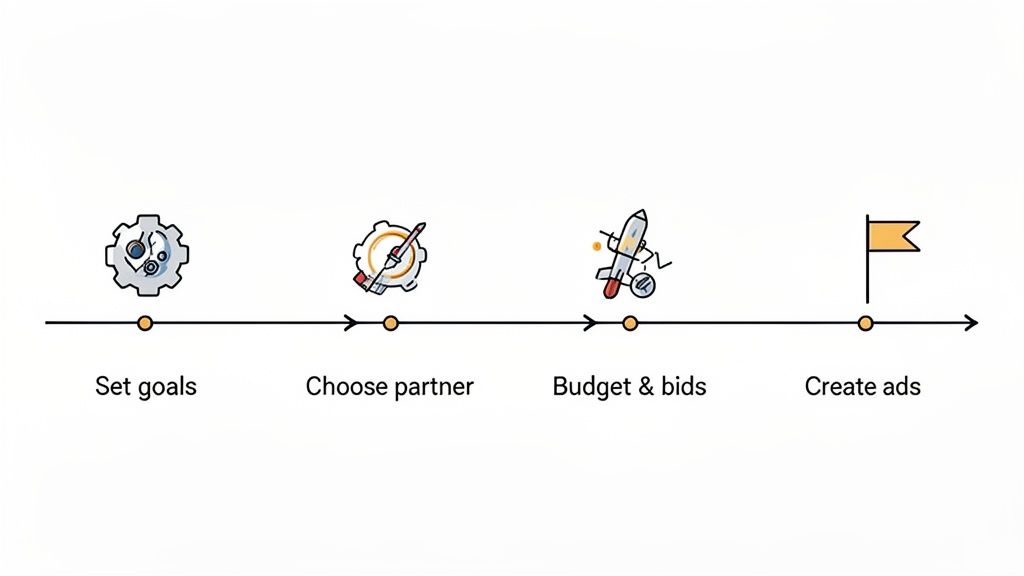
This structured approach ensures every decision—and every euro spent—is intentional and directly tied to your hiring objectives. It’s the best way to avoid common missteps like mismatched expectations or a blown budget.
Define Your Hiring Objectives
Before you spend anything, you have to define the win. Are you trying to fill 50 customer service roles by the end of the quarter, or are you hunting for that one senior data scientist with a rare specialisation? Your answer changes everything.
Set specific, measurable goals for the campaign. For instance:
- A target Cost Per Hire (CPH) to keep your recruitment budget in the black.
- A specific number of qualified applicants needed within a set timeframe.
- Hard time-to-fill deadlines for business-critical positions.
Having these objectives upfront gives you a yardstick to measure performance. It’s what turns ad spend from a simple expense into a strategic investment.
Choose the Right Technology Partner
Your programmatic platform is mission control. Picking the right partner is absolutely critical because their technology, network reach, and support team will make or break your results. They aren't all the same, so do your homework.
When evaluating vendors, focus on these key areas:
- Platform Reach: Can they get your ads onto the niche job boards and industry-specific sites where your ideal candidates actually are?
- Analytics and Reporting: How easy is it to get the data you need? You want an intuitive dashboard that tracks the KPIs that matter to you, from CPA to CPH, without needing a data science degree to understand it.
- Support and Expertise: Will you have a dedicated person or team to help you with strategy, setup, and ongoing optimisation? Technology is only half the battle.
Choosing a partner isn't just about buying software; it's about gaining an extension of your team. The right provider offers not only a powerful tool but also the human expertise to help you get the most out of it.
Set Your Budget and Bidding Strategy
With programmatic, your budget isn't static. It's fluid. You set the financial guardrails, and the platform’s algorithms automatically shift your spend to the channels delivering the best candidates for the lowest cost.
Start with a clear overall budget, then work with your partner to set an initial bidding strategy. This usually means establishing a maximum Cost Per Application (CPA) you’re willing to pay. The system uses that number to bid on ad placements, keeping your spending efficient. You can—and should—adjust these rules as the performance data starts rolling in.
Craft Compelling Ad Creative
Finally, remember that the best targeting in the world can't rescue a dull job ad. Your creative is the final handshake; it’s what actually convinces someone to click. It needs to be sharp, persuasive, and speak directly to the person you're trying to hire.
What makes your company a great place to work? Highlight that unique value proposition. Talk about the benefits, the culture, and the opportunities that will actually matter to your target audience. Don't be afraid to test different headlines and calls to action to see what works—let the data tell you what your candidates want to hear.
Frequently Asked Questions
Jumping into any new technology brings up a few questions. Let's tackle some of the most common ones we hear from recruiters and hiring managers in Germany to clear things up and help you get started with programmatic advertising.
Is Programmatic Advertising Only for Large Companies?
Not at all. That might have been true years ago, but today the technology is just as accessible for small and medium-sized businesses (SMEs). In many ways, it's the ultimate equaliser.
Programmatic helps smaller companies punch above their weight and compete for top talent by making every single euro of their budget work harder. Many providers now have flexible pricing and services tailored specifically for businesses that don't have massive hiring volumes or bottomless budgets.
How Does This Comply With GDPR in Germany?
This is a big one, and rightly so. Any reputable programmatic platform built for the European market has GDPR compliance baked into its very foundation. These systems are designed from the ground up to respect data privacy and avoid using sensitive personal information.
The magic is in the targeting. It relies on anonymised data or non-personally identifiable information (non-PII). Think things like a person's browsing habits on industry-specific websites or the type of content they're reading, not their name or personal details.
The key is to partner with a vendor who is completely transparent about their privacy policy. They should be able to walk you through exactly how their technology complies with both GDPR and Germany's specific data protection laws.
This gives you peace of mind that your recruitment campaigns are not just effective, but also fully above board.
Can Programmatic Advertising Really Reduce Hiring Bias?
Yes, and this is one of its most powerful benefits. When you set it up thoughtfully, programmatic can significantly reduce the unconscious bias that often creeps into the hiring process. Its real strength is that it runs on objective data, not human assumptions.
The algorithms identify potential candidates based on real-world signals like proven skills, professional interests, and relevant online behaviour. This data-first approach casts a much wider, more impartial net.
You can take this even further by feeding these campaigns with verified, objective proof of someone's skills. When you do that, the entire process becomes meritocratic by design, ensuring your job ads get in front of a more diverse and genuinely qualified group of people.
At Acquispect, we believe the future of hiring is built on verifiable proof, not just claims. Our platform transforms raw work into cryptographically signed credentials, providing the objective fuel for smarter, fairer, and more effective programmatic campaigns. Discover how to target competence, not keywords, by visiting us at https://acquispect.com.