We’ve all been there: staring at a blank screen, trying to summon the perfect words for a cover letter. It’s a classic job-seeker’s nightmare. But what if you could turn that dreaded task into one of your biggest strengths? Using AI to create your cover letter (anschreiben erstellen ki) does exactly that, helping you get past writer's block, customise applications in a fraction of the time, and showcase your skills in the best possible light.
Why AI Is Your New Secret Weapon for Job Applications
Today's job market is incredibly crowded. A generic, one-size-fits-all cover letter is the fastest way to get your application tossed aside. Recruiters are known to spend just a few seconds on each application, so making a sharp, personal impression right away is absolutely crucial. This is where artificial intelligence comes in—not to replace your unique voice, but to amplify it.
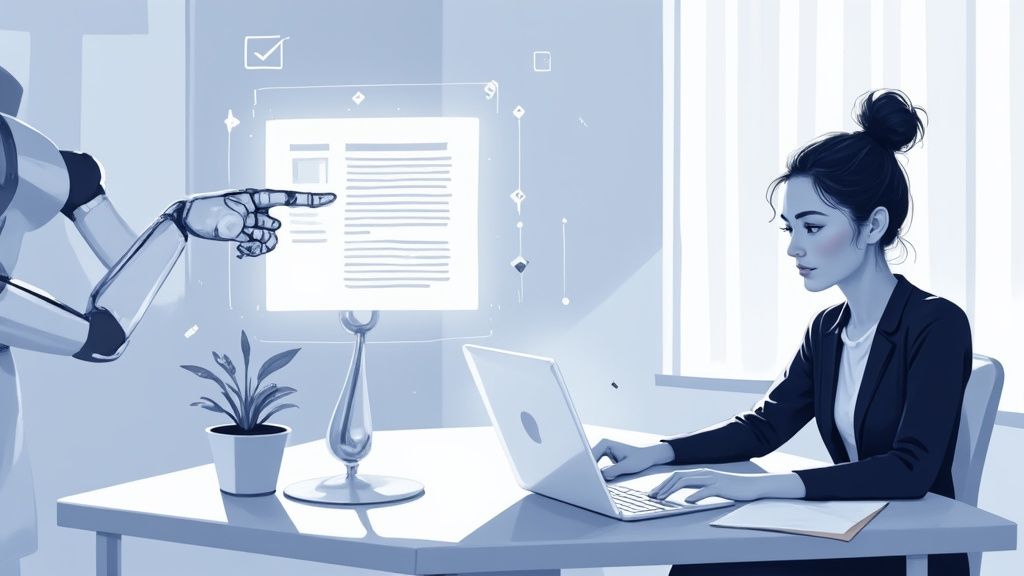
Think of an AI tool as your personal assistant. It can scan a job description in seconds, pull out the most important keywords, and help you build a narrative that directly connects your experience to what the company is looking for. Instead of labouring over every single letter from scratch, you get a strong, relevant draft to work from. This frees you up to focus on the human touch: weaving in your personal stories, fine-tuning the tone, and getting ready to ace the interview.
Save Time and Apply for More Opportunities
The most obvious win here is the time you get back. Let's say you want to apply for ten different roles. The old-fashioned way, that's easily a full day of writing, editing, and stressing. With a good AI tool, you could have ten solid, customised drafts ready for your review in less than an hour.
This isn't just about speed; it's about opportunity. When you can apply more efficiently, you can target more relevant positions, which dramatically boosts your odds of getting that interview call. It’s a complete shift from a slow, painstaking process to a smarter, more effective strategy.
This infographic captures that very shift—from the frustration of a blank page to a flow of great ideas for your cover letter.
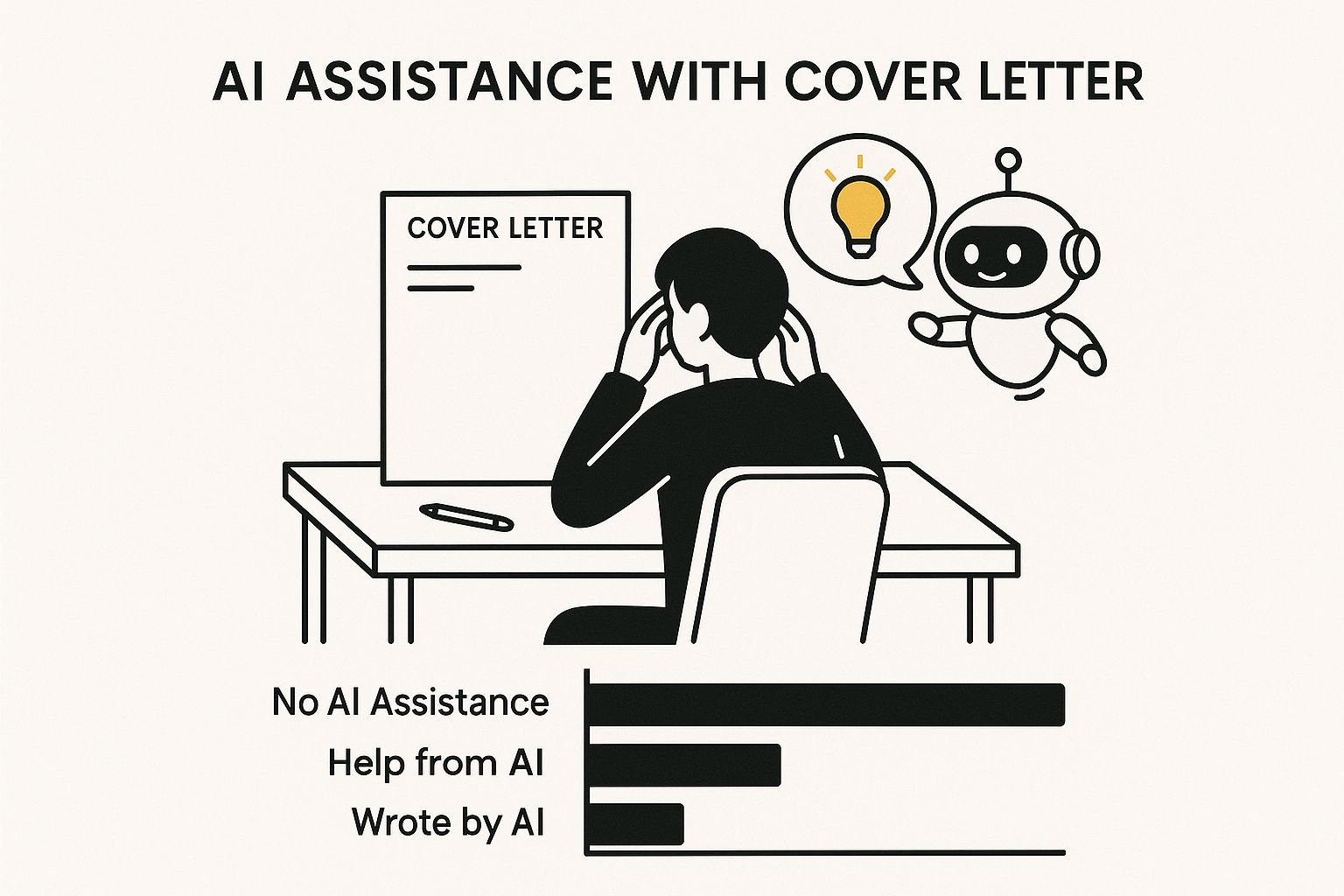
It’s a perfect illustration of how AI turns a creative block into a productive partnership, which is the whole point of using it for your job search.
Beat Writer's Block and Polish Your Message
Writer's block doesn't care how qualified you are; it can hit anyone. AI gives you a launchpad. It can suggest different opening hooks, unique ways to phrase your skills, and structures you might not have thought of on your own. It's fantastic for helping you find more powerful language to describe what you've achieved.
The real magic happens when you stop thinking of AI as a writer and start treating it as a brainstorming partner. It can feed you strong action verbs, help you frame your experience with more impact, and make sure your most important skills are impossible to miss.
You end up with a better final product because you're not starting from zero. You’re building on a solid foundation, which makes it easier to add your own personality and detailed career examples. The result is a cover letter that feels both professional and genuinely you. This efficiency is more important than ever. For instance, the German AI job market is in constant flux; AI-related job postings fell by nearly 25% from a peak of 197,000 over two years. As you can learn from this dynamic German AI job market analysis on pwc.com, being agile and efficient in your job search gives you a clear advantage.
Choosing the Right AI Tool for Your Cover Letter
Deciding to use AI for your cover letter is a bit like picking a vehicle for a road trip. You could go for a powerful, all-terrain SUV that can handle any request you throw at it, or you could choose a sleek, purpose-built campervan designed specifically for life on the road. Both will get you there, but the experience and the effort required will be very different.
When it comes to AI writing assistants, you’re looking at a similar choice. On one side, you have the big, versatile large language models (LLMs) like ChatGPT, Google Gemini, and Anthropic's Claude. On the other, you have specialised platforms built from the ground up for job applications.
General-Purpose AI Models: The Flexible Powerhouse
Think of models like ChatGPT as a brilliant, endlessly adaptable creative partner. They have an incredible command of language and can mimic almost any style you can imagine. You can feed them a job description and your CV, and they’ll produce a very respectable draft in seconds.
Their greatest asset is their flexibility. Need a formal, corporate tone for a blue-chip company? Done. Want to switch gears to something energetic and quirky for a tech startup? Just ask. This is where your ability to write clear, detailed prompts really shines.
But that flexibility is also their main challenge. These models don't have an innate understanding of what makes a cover letter work. They need you to provide all the context and guidance. If your instructions are too vague, the output can feel a bit generic. You'll also find yourself doing a lot of copying and pasting between your documents and the chat window, which can get tedious.
Specialised Job Application Tools: The Focused Expert
In contrast, specialised platforms are designed with a single, clear objective: to help you get hired. These tools don't just offer an AI writer; they embed it within a structured workflow that understands the job application process.
For instance, you might upload your CV once, and the tool will use that information to auto-draft personalised cover letters for every job you're interested in. The advantages here are all about efficiency and relevance.
- Integrated Workflow: All your application materials live in one place, so there's no more jumping between tabs and documents.
- Optimised for Success: The AI often works from templates proven to perform well, ensuring the formatting and key sections are always on point.
- ATS-Ready: Many of these tools are specifically designed to create documents that sail smoothly through Applicant Tracking Systems (ATS).
Platforms like the one found when you explore tools from JobCopilot often take this a step further, helping to automate parts of the job search and application process itself. The AI becomes part of a complete system aimed at making your job hunt faster and more effective. The trade-off? You might have less creative leeway than with a general-purpose model, as you're working within the platform's optimised framework.
A quick but crucial note on data privacy: Whenever you use an AI tool for your job search, you're handing over sensitive personal information from your CV. Always take a moment to check the platform's privacy policy. Reputable services will be upfront and clear about how they store and protect your data.
Comparison of Popular AI Tools for Cover Letter Writing
To help you decide which path is right for you, it's useful to see the options side-by-side. Different tools are built for different needs, from maximum creative freedom to maximum efficiency.
| Tool/Platform | Best For | Key Features | Pricing Model | | :--- | :--- | :--- | :--- | | ChatGPT (by OpenAI) | Creative control, tone customisation, and brainstorming initial ideas. | Highly flexible text generation, conversational interface, ability to handle complex prompts. | Powerful free tier; paid plans for advanced models (GPT-4) and features. | | Google Gemini | Researching companies, integrating with other Google services, and multimodal inputs. | Strong real-time web integration for up-to-date info, conversation memory, data analysis. | Free to use; advanced features available in paid Google One AI Premium plans. | | JobCopilot | Speed and efficiency in applying for multiple roles with personalised documents. | Direct integration of CV data, ATS-optimised templates, automated personalisation based on job ads. | Subscription-based model, often with a free trial or limited free plan. | | Anthropic's Claude | Writing longer, more nuanced documents and handling large amounts of text (e.g., long CVs). | Large context window (can process more text at once), focus on natural conversation and safety. | Free tier with usage limits; paid plans for higher volume and faster access. |
Ultimately, there's no single "best" tool—only the best tool for your specific situation and goals.
If you enjoy the process of crafting the perfect prompt and want total control over every word, a general-purpose model like ChatGPT or Claude will be a fantastic co-writer. But if your main goal is to apply to more relevant jobs, faster, without letting quality slip, then a specialised platform is almost certainly the more effective choice.
How to Craft Prompts That Actually Get You the Perfect Cover Letter
The secret to getting a great AI-generated cover letter isn't the AI itself—it's you. More specifically, it's the quality of the prompt you give it.
Just asking an AI to "write a cover letter for a marketing job" is like telling a brilliant chef to "make some food." You'll get something, sure, but it will be generic and bland. The real art of anschreiben erstellen ki (creating cover letters with AI) is in giving the tool detailed, context-rich instructions.
Think of it this way: you're the director, and the AI is your actor. The more background, motivation, and specific lines you provide, the better the performance. Your prompt is the script that guides the AI to produce something compelling, personal, and genuinely effective.
The Power of a "Master Prompt"
Here’s a pro tip: instead of feeding the AI small, disconnected bits of information, build a single, comprehensive "master prompt." This is one detailed instruction set that contains everything the AI needs to understand the role, your background, and the exact tone you're aiming for.
A master prompt isn't just a command; it's a complete briefing. It stops the AI from guessing or falling back on those robotic, seen-it-a-thousand-times phrases. This approach is what separates a sterile, obviously AI-written draft from one that feels authentic and lands with impact.
To build one, you’ll layer a few key components together:
- The Persona: Tell the AI who it should be. For instance, "Act as an expert career coach writing a cover letter for a high-achieving client."
- The Goal: Be crystal clear about what you want. "The objective is to secure an interview by perfectly matching the candidate's skills to the job requirements."
- Your Raw Materials: This is the core data. You’ll provide the full job description and the most relevant bits of your CV.
- Specific Directives: Get granular here. Mention the tone of voice, key skills to spotlight, and any specific achievements or metrics you absolutely want to include.
By putting all these pieces together, you create a powerful framework that steers the AI toward exactly what you need.
The Must-Have Ingredients for a Powerful Prompt
Let's break down what goes into a prompt that truly works. Each of these elements adds a crucial layer of detail, massively improving the final letter. I treat this like a checklist every single time.
1. The Full Job Description
Don't just give the AI the job title. Seriously, copy and paste the entire job description into the prompt. This lets the AI analyse every required skill, responsibility, and even the specific language the company uses. It will pick up on keywords and echo the terminology from the ad, which is a massive advantage for getting past automated Applicant Tracking Systems (ATS).
2. Your Relevant Experience
Next up, give it the most relevant parts of your CV. You don't need to dump the whole thing in there. Just pull out the work experience, projects, or skills that directly speak to what the company is looking for in their job ad.
For example, if you're applying for a software developer role that calls for "Agile methodologies," make sure to include the bullet points from your CV where you talk about your experience with Scrum or Kanban. It's all about making that direct connection for the AI.
3. The Desired Tone and Style
This is the one detail most people completely forget, but it makes all the difference. Every company has a unique culture, and your cover letter needs to reflect that. Are they a stuffy, old-school financial firm or a vibrant, fast-paced tech startup?
Give the AI clear instructions on the vibe you're going for:
- "Write this in a professional, formal, and corporate tone."
- "I want an enthusiastic, energetic, and slightly informal tone."
- "The tone should be confident and data-driven, focusing on hard numbers and measurable results."
A simple instruction like this stops the AI from defaulting to its standard, one-size-fits-all style and helps the letter sound like it was written by a real person—you.
Putting It All Together: A Real-World Example
Let's look at the difference between a weak prompt and a powerful one.
The Vague Prompt (What to Avoid): "Write me a cover letter for a Senior Product Manager role at a tech company. I have 7 years of experience."
This will get you a template. It will be boring and instantly forgettable.
The Master Prompt (The Gold Standard):
"Act as a professional career advisor. Your task is to write a compelling cover letter for a Senior Product Manager position. The tone must be confident, professional, and data-driven, perfect for a fast-growing SaaS company.
Here is the full job description: [Paste the entire job description here]
Here are the most relevant sections from my CV: [Paste 2-3 of your most relevant job experiences and your skills section here]
Key points to highlight:
- Emphasise my experience in leading cross-functional teams to launch two major products, which led to a 25% increase in user engagement.
- Mention my deep expertise in A/B testing and using data analysis to drive product decisions.
- Specifically link my background in B2B SaaS to the company's focus on enterprise clients.
Draft a concise and impactful three-paragraph cover letter. Kick it off with a strong hook that references the company's recent product launch."
See the difference? This master prompt provides context, raw data, and clear creative direction. It turns the AI from a simple text generator into a strategic partner, ensuring the final letter isn't just well-written, but perfectly engineered to land you that interview.
Turning an AI Draft into Your Personal Masterpiece
https://www.youtube.com/embed/5LUX29sr8Ck
Getting that first draft from your AI assistant is a great starting point. It's structured, well-worded, and probably landed in your lap in under a minute. But it’s absolutely critical to see this draft for what it is: a foundation, not the finished product. The real magic in creating a cover letter with AI (anschreiben erstellen ki) happens when you add your human touch.
Think of the AI's output as raw material—a solid block of clay ready for you to shape. Without your personal insights, stories, and personality, the text will stay generic. It won't have that spark of authenticity that genuinely connects with a recruiter. This next phase is all about taking the draft from merely competent to truly compelling.
Your First Move: The Critical Review
Before you start adding your own flair, you need to put on your editor's hat. AI tools are incredibly capable, but they aren’t perfect. They can sometimes misread the context, come up with slightly awkward phrasing, or even get facts about your own experience wrong if your prompt wasn't crystal clear.
A simple trick I always recommend is to read the draft out loud. It’s surprisingly effective for catching anything that sounds robotic or just plain unnatural. If a sentence makes you stumble while reading it, you can bet it will feel off to a hiring manager, too.
Here’s a quick mental checklist to run through:
- Spot the "AI-isms": Is the text littered with overly formal words or cliché phrases like "I am confident in my ability to..."? Swap them out for your own, more natural language.
- Fact-Check Your Wins: Did the AI represent your accomplishments accurately? Double-check that all numbers, project names, and outcomes are correct and presented with real impact.
- Check the Tone: Does the tone fit the company culture you've researched? A stuffy, formal letter for a playful startup is just as out of place as an overly casual one for a major bank.
This review is non-negotiable. It makes sure the letter is factually sound and starts to align with your personal voice, paving the way for the real customisation work ahead.
Adding Your Unique Story and Personality
Now that the basic structure is solid, it's time for the most important part: making the letter undeniably yours. This is where you inject the details, anecdotes, and passion that an AI simply can't invent. Your goal here is to weave your personal and professional narrative into the framework the AI has provided.
One of the most powerful things you can do is add a short, relevant anecdote. For instance, if you're applying to a company known for its user-centric design, you could briefly mention a time you championed a customer-requested feature that resulted in a 15% jump in satisfaction. A specific story like that provides hard proof that you share their values.
The best cover letters tell a story. An AI can give you the plot points, but only you can provide the compelling narrative that shows why you are the right person for the role, not just that you have the right skills.
This is also your chance to mention a specific company project, a recent product launch, or even a quote from their CEO that really resonated with you. It shows you’ve done your homework and have a genuine interest. This single act can transform you from just another applicant into an engaged candidate who truly gets their mission. As you work on these details, you can find more great tips on our JobCopilot blog.
Fine-Tuning the Language to Sound Like You
The last step is to polish the language until it genuinely reflects your voice. Go through the draft line by line and tweak the wording. If the AI used a word you'd never say in a professional conversation, change it. The aim is for the recruiter to read your letter and feel like they’re getting a real preview of who you are as a professional.
This personal touch is only becoming more important as AI becomes more common in the business world. In Germany, 37% of companies are already using AI, with a focus on improving quality and supporting complex decisions. As businesses use AI to get more efficient, they'll place an even higher value on the human qualities you bring—like personality, storytelling, and genuine connection. You can learn more about AI as a competitive factor for the German economy on iwkoeln.de.
By meticulously reviewing, personalising with your stories, and fine-tuning the language, you can transform the AI's generic output into a powerful, personal masterpiece that truly represents you.
Taking Your AI Cover Letter to the Next Level (and What Not to Do)
 Once you've got the hang of the basics, it's time to use AI in a smarter way that gives your application a real advantage. The process of anschreiben erstellen ki can be so much more than just generating a block of text; it can be your secret weapon for analysis.
Think of the AI as a job description analyst. Before you even ask it to write, tell it to break down the job posting for you. A prompt like, "Analyse this job description and pull out the top five soft skills and top five hard skills the company wants," is a game-changer. This simple step gives you a clear blueprint for what really matters to the hiring manager.
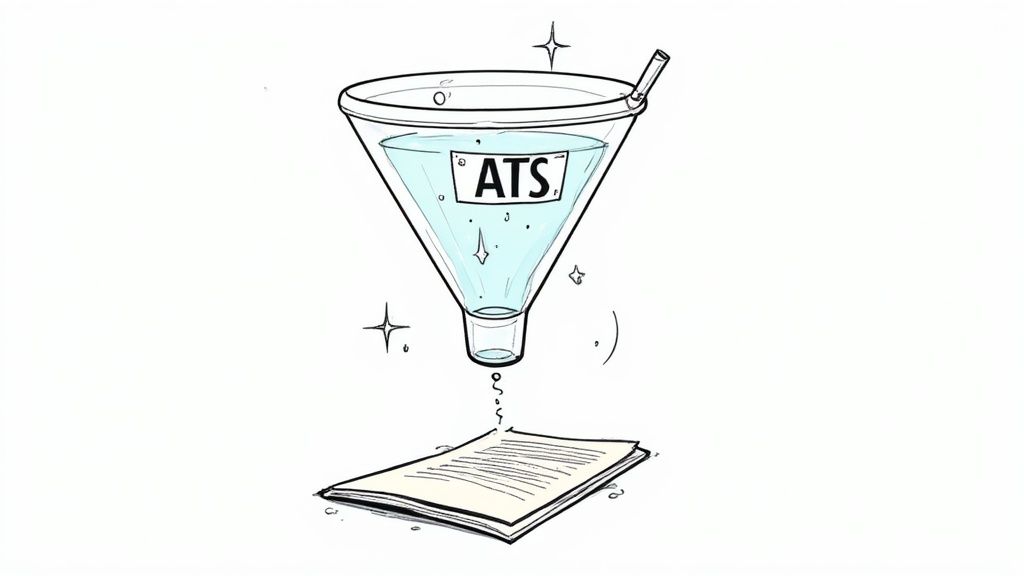
This strategy forces you to address the recruiter's most pressing needs head-on. It's also a fantastic way to uncover those "hidden" keywords that are absolutely vital for getting past Applicant Tracking Systems (ATS).
Getting Past the Robot Gatekeepers (ATS)
Let's be honest, an ATS is the first hurdle. It's just software scanning your application for keywords and qualifications, and it decides if a human ever gets to see your hard work. To beat this system, your cover letter needs to be packed with the right language.
Here's how you can get your AI to help you optimise for it:
- Keyword Weaving: Once the AI has identified the key skills, your next prompt should be, "Now, weave these keywords naturally into a cover letter draft."
- Gap Analysis: This is a brilliant move. Feed it your CV and ask, "Compare my attached CV to the job description and point out any skill gaps I should address or maybe not draw attention to."
- Simple Formatting: While no AI can promise perfect ATS compliance, you can guide it. Ask it to, "Format this cover letter in a clean, ATS-friendly layout. No columns, tables, or fancy headers."
This approach turns the AI from a simple writing tool into a strategic partner in your job search, dramatically increasing the chances your application lands in human hands.
Common Mistakes That Will Weaken Your AI-Generated Cover Letter
For all its strengths, leaning too heavily on AI can lead to some serious missteps that can sink your application before it even gets read. I see job seekers fall into the same traps all the time, but they're surprisingly easy to sidestep once you know what they are.
The number one mistake? Blindly trusting the AI's output. Never, ever just copy, paste, and send. Doing so almost guarantees a generic, soulless letter that screams, "a robot wrote this!" You absolutely must treat the AI's draft as a first pass—a starting point that needs your personality and verification.
Another classic error is feeding the AI lazy, generic prompts. Something like, "Write a cover letter for a project manager," is going to get you a bland, cookie-cutter response. Your prompts need layers and context. Include the job ad, your CV, and the specific accomplishments you want to show off.
A cover letter is a marketing document, and you are the product. An AI can't know your unique selling points unless you provide them in detail. The quality of the output is a direct reflection of the quality of your input.
Forgetting to fact-check is another major pitfall. AI models can sometimes "hallucinate" or just plain make things up, especially when summarising your achievements. Always double-check that every number, project result, and metric in the draft is 100% accurate before it goes out.
Finally, people often forget to tweak the tone to match the company's culture. An AI's default setting is often a bit formal and corporate. Sending that to a cool, modern startup can immediately make you seem like you just don't get them.
This level of detail is what separates a good application from a great one. The job market is changing fast, and showing you know how to work with AI can be a big plus. A recent survey of German companies found that only 27.1% expect AI to reduce jobs in the next five years, with that number changing a lot depending on the industry. This shows that knowing how to adapt and tailor your application with AI-driven insights is crucial for your career. You can learn more about the German companies' expectations on job cuts on ifo.de. By steering clear of these common mistakes, you ensure your AI-assisted cover letter is sharp, professional, and authentically you.
Got Questions About AI Cover Letters? We've Got Answers
Diving into AI for your job applications can feel like a game-changer, but it’s natural to have a few questions. As brilliant as these tools are for tasks like "anschreiben erstellen ki," it pays to know what you're working with. Let's clear up some of the most common concerns so you can use this tech smartly and with confidence.
Think of this as your go-to guide for using AI as a strategic partner, not just a shortcut.
Can Recruiters Tell if I've Used AI?
The short answer is yes, they often can—if you just copy and paste. A purely AI-generated letter has a certain generic flavour. It might feel a bit stiff, overly formal, and almost always misses the specific, personal stories that make you memorable. It lacks a human touch.
That's exactly why this guide is all about using AI as your co-pilot, not the autopilot. Your job is to take that first draft and make it your own. Once you've infused it with your personality and real-world examples, it becomes undetectable because it's no longer just an AI's output. It’s your professional story, simply sharpened with technology.
Is It Unethical to Use AI for My Cover Letter?
Not at all. Using an AI assistant to help you write is no different from using a grammar checker or a thesaurus. It's a tool. Where you could run into trouble is if you use it to mislead someone—by inventing skills, making up experiences, or passing off a generic draft as something you poured your heart into.
The ethical way to use AI is to lean on its strengths:
- Brainstorming when you’re staring at a blank page.
- Structuring your thoughts logically.
- Getting started when writer's block hits.
Your final cover letter must be a truthful reflection of who you are and what you can do. The real work—the anecdotes, the passion, and the final polish—has to come from you. It’s about getting assistance, not practicing deception.
This way, you keep your integrity while still getting a helpful efficiency boost.
What’s the Best AI for German Cover Letters?
There's no single "best" tool, because the right one really depends on what you need. The market is full of great options, each with its own strengths for the "anschreiben erstellen ki" process.
If you’re looking for raw power and flexibility, big names like ChatGPT (specifically GPT-4), Claude 3, and Gemini are fantastic. They’re brilliant with multiple languages and handle German nuances really well, giving you a ton of control over the tone and content. They are perfect if you like getting hands-on with detailed prompts.
On the other hand, you have specialised job-seeking platforms popping up. These tools are built specifically for the application grind, often with pre-made templates, ATS-friendly formatting, and features that link directly to your CV.
My advice? Try out the free versions of a few different tools. Get a feel for their style, how easy they are to use, and the quality of the drafts they produce. This is the quickest way to find the AI partner that clicks with your workflow and helps you create compelling cover letters that actually land interviews.
Ready to stop writing and start interviewing? Acquispect uses advanced AI to automate your job search, create tailored cover letters in minutes, and track your application success. Set it up in under five minutes and let our platform find and apply for the best jobs for you. Start your free 30-day trial at Acquispect