Yes, you can absolutely use ChatGPT to give your German Lebenslauf a serious boost. This guide isn't just about writing faster; it's about writing smarter. We'll walk through how to craft prompts that pull powerful, targeted language from the AI, specifically tailored to German job descriptions, helping you create a chat gpt lebenslauf that genuinely stands out.
Why Use AI for Your German Lebenslauf
Bringing ChatGPT into your CV-writing process is more than a simple shortcut; it’s a strategic move in a fiercely competitive market. The trick is to stop thinking of the AI as a writer and start treating it like a highly skilled assistant. It can do the heavy lifting—drafting, structuring, and refining—which frees you up to focus on the bigger picture: your career strategy and personal narrative.
This shift turns what is often a draining task into a much more efficient and even creative process. Instead of getting stuck staring at a blank page, you begin with a solid, well-organised draft that's ready for you to polish and perfect.
Moving Beyond Generic Templates
The real magic of a chat gpt lebenslauf is how deeply it can be personalised. When you feed the AI detailed information about your career history and the specific role you’re targeting, it can generate content that is laser-focused and highly relevant. This is how you sidestep the stale, generic phrases that recruiters have seen a thousand times.
Consider it your secret weapon for making a memorable first impression. You can also explore powerful tools designed to automate and personalise your job search, as seen in our guide to JobCopilot.
When you use AI effectively, you're not just filling out a template; you're co-creating a strategic document. You bring the career story and the context, and the AI supplies the powerful language and structure needed to make an impact.
To get a clearer picture of where ChatGPT shines and where your expertise is essential, have a look at this quick breakdown.
ChatGPT Capabilities for Your Lebenslauf
| Task | ChatGPT's Strength | Human Input Required | | :--- | :--- | :--- | | Drafting a Professional Summary | Excellent at summarising skills and experience into a concise, impactful paragraph. | You must provide your career goals, key achievements, and the target job description. | | Writing Bullet Points | Great for turning your responsibilities into achievement-oriented bullet points using action verbs. | You need to supply the raw data: your duties, projects, and quantifiable results (e.g., increased sales by 15%). | | Tailoring to a Job Description | Can analyse a job ad and suggest keywords and skills to include in your Lebenslauf. | You must provide the exact job description and your existing CV for comparison. | | Formatting and Structuring | Can suggest a logical layout and standard German CV format. | The AI's formatting can be basic. You'll need to transfer the text to a proper document and handle the design yourself. | | Checking Grammar and Spelling | Strong at catching errors and suggesting more professional phrasing. | It might miss nuances or industry-specific jargon. A final human proofread is always necessary. |
Ultimately, ChatGPT is a powerful collaborator, but you are the director. Your insights and personal touch are what will truly make your Lebenslauf shine.
Tapping Into a Thriving Job Market
Germany’s job market is buzzing. With projected GDP growth and low unemployment rates, there are fantastic opportunities for skilled professionals. This economic climate makes it the perfect time to integrate smart tools like ChatGPT into your job search, especially if you're targeting high-paying sectors.
For example, professionals with AI skills are in high demand in tech hubs like Berlin and Munich, where companies are actively scouting for talent. A well-crafted, AI-assisted CV can open doors to some of the highest-paying jobs in Germany.
By mastering AI for your application materials, you immediately position yourself as a modern candidate who knows how to use technology to get results—a trait that's highly valued in any industry. This guide will show you exactly how to do it.
Gathering Your Career Story for ChatGPT
Before you even think about writing a prompt, you need to become the lead investigator of your own career. The simple truth about getting a great chat gpt lebenslauf is this: the quality of what you get out is directly proportional to the quality of what you put in. A vague request will get you a bland, forgettable CV. Guaranteed.
Think of it this way. You wouldn't ask an architect to design your dream house without giving them the specifics—the number of rooms, the style, the materials. To build a compelling CV, ChatGPT needs the raw materials of your professional life: hard numbers, specific skills, and detailed stories of your experience.
This prep work is, without a doubt, the most important part of the whole process. I’ve seen people rush this step, and it’s the single biggest mistake they make. It forces the AI to invent details or fall back on tired clichés, which is the last thing you want. A little effort here ensures the final document is sharp, accurate, and actually sounds like you.
Creating Your Master Career Document
First things first, you need to create a single, comprehensive "master document." This isn't your CV. Think of it as your career's brain dump—all the raw, unfiltered information that ChatGPT will draw from. Don’t get hung up on perfect grammar or fancy formatting at this stage. Just get it all down.
For every job you’ve had, write down not just what you were responsible for, but what you accomplished. Recruiters skim past job duties; they stop and read about your impact. This is where quantifiable results become your secret weapon.
For example, instead of just saying "Managed social media," you'll want to give ChatGPT something much richer, like "Grew Instagram engagement by 45% in six months by launching a new video content strategy using HubSpot and Canva." See the difference? The second version gives the AI specific actions, tools, and results to work with.
The most powerful CVs tell a story of achievement, not just a list of duties. Your master document should be a collection of mini-success stories, each backed by numbers, percentages, or specific project outcomes.
Organising Your Information for Clarity
Once you have your stories, it's time to organise them. A logical structure helps you spot any gaps and makes it much easier for ChatGPT to understand the context of your career.
Here’s a straightforward way to structure your master document:
- Work Experience: For each role, list the company, your job title, and the dates you worked there. Underneath, add 5-7 bullet points that highlight your key achievements. A great way to frame these is using a "Problem-Action-Result" model.
- Education and Certifications: Note the institution, your degree or certificate, and when you graduated. Don't forget to include any major academic projects or honours that are relevant to the jobs you're targeting.
- Hard Skills: Be specific and exhaustive. List every piece of software, programming language, and technical tool you know. For instance:
Python (Pandas, NumPy),Salesforce CRM,Adobe Creative Suite (Photoshop, InDesign). - Soft Skills: This is where you avoid clichés. Instead of just writing "team player," give a concrete example. Something like, "Led a cross-functional team of five to deliver the Q3 marketing project two weeks ahead of schedule" is far more powerful.
By laying out your career story like this, you create a rich, structured dataset. When you start writing your prompts later, you can just copy and paste the relevant sections. You're giving ChatGPT everything it needs to build a powerful, customised chat gpt lebenslauf that will actually get noticed.
Crafting Prompts That Get Results
Alright, you've got your master document ready. Now for the fun part: putting ChatGPT to work. This is where all that prep really pays off, turning that collection of career facts into a polished and convincing CV.
The real secret isn't just asking the AI to "write a CV." Anyone can do that. The magic lies in guiding it with a series of smart, specific prompts. A generic request will always get you a generic, forgettable result. But a well-crafted prompt? That's like giving a creative brief to a highly skilled assistant who's ready to make you look good.
Think of yourself as a film director. You wouldn't just tell your actors to "act." You give them context, motivation, and specific lines. We'll do the same here, starting with your professional summary and then moving on to the meat of your CV: turning your day-to-day duties into powerful, achievement-based bullet points that make recruiters sit up and take notice.
From Vague Ideas to Specific Instructions
The gap between a weak prompt and a strong one is all about the details. A weak prompt is a simple command. A strong prompt, on the other hand, gives ChatGPT a role to play, context to work with, and a clear picture of the desired outcome.
Let's walk through a real-world example.
The "Before" (A weak, generic prompt): "Write a professional summary for a marketing manager."
This is far too broad. The AI has no clue about your experience level, your industry, or what makes you special. It's going to spit out something bland and full of tired business clichés.
The "After" (A strong, specific prompt): "Act as a professional German CV writer. Create a compelling, three-sentence professional summary for a Marketing Manager with 8 years of experience in the B2B SaaS industry. I'm applying for a senior role at a tech startup in Berlin. Make sure to highlight my expertise in demand generation, marketing automation using HubSpot, and leading a team to exceed lead targets by over 30% year-on-year. The tone should be confident and professional."
See the difference? This prompt gives the AI everything it needs: a persona, your experience, your target role, key achievements (with hard numbers!), and the exact tone you're going for. The result will be a summary that feels custom-built for you, because it is.
Prompting for Achievement-Based Bullet Points
One of the best ways to use ChatGPT for your CV is to transform a boring list of job duties into compelling, achievement-focused bullet points. This is where that master document you created becomes your secret weapon.
Your goal is to show a hiring manager not just what you did, but the impact you had. You can feed ChatGPT a simple duty from your notes and ask it to reframe it using a classic "Problem-Action-Result" structure.
For instance, give ChatGPT this information from your notes:
- Original Duty: "Responsible for the company newsletter."
- Context: "The newsletter had low open rates (around 15%) and wasn't generating any leads."
- Action: "I implemented A/B testing for subject lines, segmented the audience, and started creating more valuable content."
- Result: "Open rates shot up to 40% and it now generates 20 new MQLs per month."
Now, you can build a powerful prompt around that data:
"Rewrite this duty: 'Responsible for the company newsletter.' Transform it into three powerful, achievement-based bullet points for a Lebenslauf. Use strong action verbs and make sure to include these results: increased open rates from 15% to 40% and generated 20 new MQLs per month through A/B testing and audience segmentation."
This simple technique forces the AI to focus on quantifiable success, which is precisely what gets a recruiter's attention.
Tailoring Your Skills to the Job Description
Finally, let's make sure your skills section is perfectly aligned with the job you actually want. This is a brilliant way to use ChatGPT to give you an edge. Find a job description that you're excited about and use it to guide the AI.
Here’s a prompt template you can easily adapt:
"Analyse the following job description for a [Job Title]. Based on my master skills list provided below, identify the top 5 most relevant skills for this specific role and present them in a 'Hard Skills' section.
[Paste the job description here]
[Paste your master list of hard skills here]"
This ensures the skills you highlight aren't just a random list but a direct, strategic response to what the employer is asking for. As using AI tools becomes more common, this level of customisation is what will set you apart.
Globally, ChatGPT already has over 180 million users, and its use in professional settings across Germany is definitely on the rise. It’s a clear sign that people are using AI to get ahead in their careers. You can find more insights on these trends by exploring the latest ChatGPT statistics. For more in-depth career strategies, be sure to check out our other articles on the JobCopilot blog.
How to Personalise Your AI-Generated Draft
Getting that first draft from ChatGPT can feel like a massive weight off your shoulders. But let's be clear: this is your starting block, not the finish line. An unedited AI-generated CV often comes across as generic and lacks the personal touch that German recruiters are trained to spot. Now, the real work begins—transforming that solid foundation into a document that is undeniably you.
This is where the magic of creating a chat gpt lebenslauf really lies. The AI does the heavy lifting, the initial drafting, which frees you up to focus on the high-impact job of refining and polishing. The goal is to weave your personality into the text, double-check every single detail, and make sure the final version feels human-led, not machine-made. Think of yourself as a skilled editor, taking a good manuscript and making it great.
Your Essential Review Checklist
Before you even think about fonts or layouts, your first pass needs to be a rigorous content audit. AI can sometimes misinterpret context or even "hallucinate" details, especially if your initial prompts weren't crystal clear. It's on you to catch these little errors and tweak the language until it perfectly mirrors your professional story.
Here’s a quick checklist to run through:
- Fact-Check Everything: Did the AI get your employment dates right? Are the job titles and project names spot-on? Pull up your master document and compare every line.
- Refine the Tone: Does this actually sound like you? Go through and adjust any phrases that feel too stuffy, too casual, or just don't ring true to your professional voice.
- Quantify Vague Statements: ChatGPT might spit out a line like, "Significantly improved team efficiency." It's your job to turn that into a concrete achievement, something like, "Improved team efficiency by 25% by introducing a new project management tool." Numbers talk.
- Add Your Narrative: Look for gaps where you can connect the dots between your roles. A simple sentence showing a clear career progression or a consistent theme running through your work can make a huge difference.
The best AI-assisted CVs are the ones where the human touch is obvious. Your unique career path, your specific wins, and your professional voice are things that only you can bring to the table.
Adhering to German Formatting Standards
Once your content is sharp and accurate, it's time to tackle the presentation. The German job market has its own set of rules—some written, some not—for what a Lebenslauf should look like, and ChatGPT won't always get these details right automatically. Nailing the formatting shows recruiters you've done your homework.
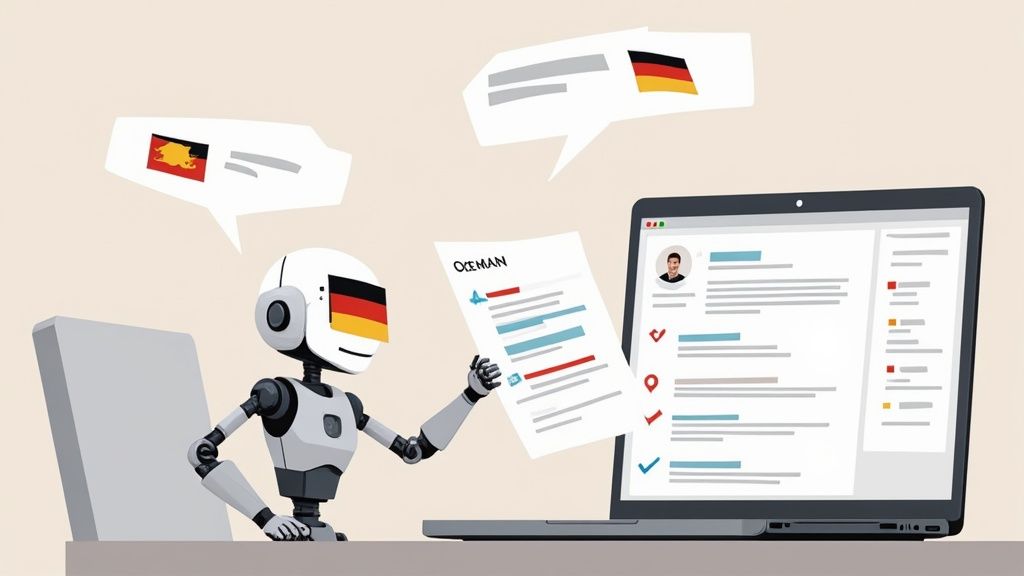
This visual guide shows how raw data is shaped into a polished final product through careful prompting.
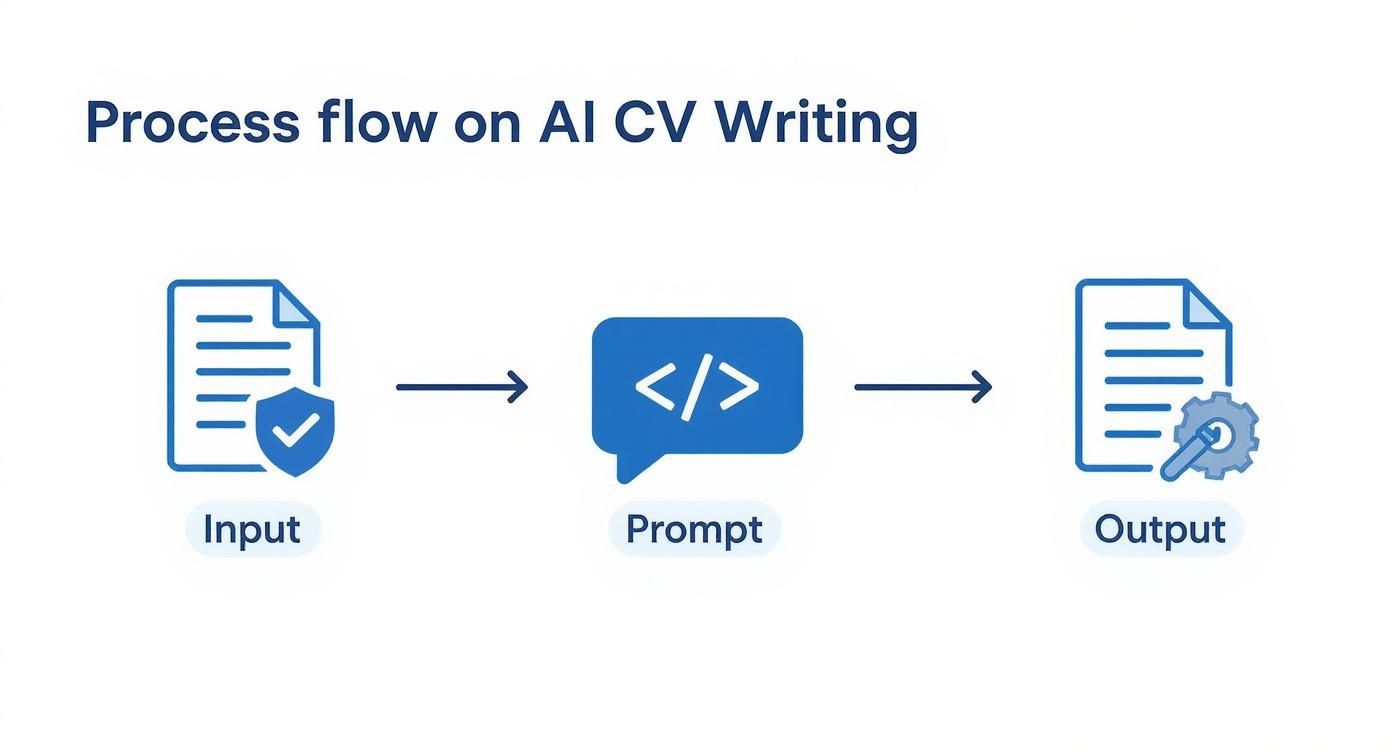
The key takeaway here is that the quality of your initial input and the specificity of your prompts have a direct impact on how good the final document is.
Here are the key formatting points you'll want to implement:
- Structure and Order: The standard German CV is chronological, meaning your most recent experience comes first. Make sure your sections are clearly labelled: Persönliche Daten, Berufserfahrung, Ausbildung, and Kenntnisse und Fähigkeiten.
- Professional Photo: This is a big one. Unlike in many other countries, a professional headshot is still very much expected on a German Lebenslauf. It needs to be high-quality and is usually placed in the top right corner.
- Length and Signature: Keep it concise—two pages is the absolute maximum. It’s also customary (though becoming less strict) to add your city, the date, and a handwritten or digital signature at the very end.
It's also interesting to see how AI tools like ChatGPT are being adopted across Germany. Among employed Germans aged 18-29, a solid 35% use AI tools frequently at work. That number drops dramatically to just 7% for workers over 65. This tells us that while younger professionals are quickly getting on board with using tech for tasks like creating a chat gpt lebenslauf, a personalised and professionally formatted document is still crucial to appeal to hiring managers of all generations. You can dig deeper into the research on German AI adoption for more insights.
By taking the time to meticulously personalise your AI draft, you get the best of both worlds: the speed of technology combined with the irreplaceable value of your own human insight.
Advanced AI Techniques and Common Mistakes
Once you've got the hang of the basics for creating your CV with ChatGPT, it's time to dig into some more advanced strategies. These are the small adjustments that can take your CV from just "good enough" to something truly impressive that makes a recruiter stop and take notice.
https://www.youtube.com/embed/pjqi_M3SPwY
One of the most powerful pro-level tips I've learned is to give ChatGPT a specific persona to adopt. Don't just ask it to write a summary; tell it who to be. This simple shift completely changes the game, forcing the AI to think from a specific viewpoint and giving you much more insightful, critical feedback.
For example, give this prompt a try: "Act as a senior hiring manager for a competitive tech start-up in Berlin. Read my professional experience section below and give me direct, critical feedback on its clarity and impact. What's missing? What sounds weak?"
Suddenly, the AI isn't just a text generator anymore. It becomes your personal career coach, helping you spot weaknesses you would have otherwise missed. You're moving past simple writing and into strategic document analysis.
Sidestepping Common AI Pitfalls
As helpful as ChatGPT is, it's surprisingly easy to fall into a few common traps that can really weaken your final CV. Knowing what these pitfalls are is the first step to creating a polished, professional document that still sounds like you.
The biggest mistake by far is blind trust. Never, ever just copy and paste what the AI gives you directly into your CV without a thorough review. Think of ChatGPT as a very capable assistant, not the final author. It can get facts wrong, use clunky phrasing, or generate text that just doesn't sound authentic.
Another common issue is letting overly complex jargon slip through. The AI sometimes defaults to complicated corporate-speak because it thinks it sounds more professional. It's your job to dial that back. Your goal is clear, direct language that anyone from an HR generalist to a department head can understand instantly.
A great CV is clear and powerful, not complex and confusing. Your goal is to communicate your value as quickly as possible. If a recruiter has to reread a sentence to understand it, you've already lost their attention.
Finally, be careful not to lose your own personality in the process. A CV that feels robotic or completely generic is a major red flag for recruiters. After the AI has done its part, your final, crucial task is to go back through it and weave in your own voice and career story. That human touch is what makes your CV compelling.
To help you stay on track, I've put together a quick table of the most frequent mistakes people make when creating a CV with ChatGPT and, more importantly, how to fix them.
Common ChatGPT CV Mistakes and How to Fix Them
| Common Mistake | Why It's a Problem | How to Fix It | | :--- | :--- | :--- | | Over-relying on the AI | Can lead to factual errors, awkward phrasing, and a generic tone that lacks authenticity. | Treat the AI's output as a first draft. Meticulously review, edit, and rewrite sections to reflect your personal voice and verify all information. | | Accepting Complex Jargon | Makes the CV difficult to read and understand quickly, frustrating recruiters. | Simplify any overly technical or corporate language. Opt for clear, direct, and impactful statements that get straight to the point. | | Losing Your Personality | Results in a CV that feels robotic and fails to tell your unique career story. | Add personal insights and a consistent narrative. Ensure the final document reflects your professional identity, not just a list of skills. |
Keeping these points in mind ensures your chat gpt lebenslauf is both effective and genuinely represents your professional journey.
Frequently Asked Questions
It's completely normal to have questions when you start using AI to polish your application. When you're putting together your chat gpt lebenslauf, you might wonder how recruiters view these tools or if you can apply the same tricks to other documents. Let's tackle some of the most common questions that come up.
A big one I hear all the time is whether a sharp recruiter can immediately tell a CV was written by an AI. The short answer? Yes, but only if you're lazy about it. A generic, robotic-sounding CV that's clearly been copied and pasted is an instant red flag.
But when you treat ChatGPT as a creative partner—feeding it your real accomplishments and then carefully editing its suggestions to match your voice—it's a different story. The goal is personalisation. Your final CV should be a seamless mix of AI's writing prowess and your genuine experience. A well-refined draft isn't an "AI CV"; it's just a great CV.
Can I Use This for My Cover Letter Too?
You absolutely can, and you should. Everything you've learned about crafting a compelling chat gpt lebenslauf works just as well for your cover letter (Anschreiben). In fact, I find ChatGPT is often even more helpful here, since cover letters are all about telling a persuasive story.
The process is similar, but your prompts need to shift focus slightly. Instead of just listing what you've done, you'll prompt the AI to draw a direct line between your experience and what the company is looking for in the job description.
A powerful prompt might look something like this:
"Act as a professional career advisor. Draft a three-paragraph cover letter for the [Job Title] position at [Company Name]. I need you to connect my experience in [Skill 1] and my success in [Quantifiable Result] directly to the company's challenge of [Company's Stated Problem from Job Ad]. Keep the tone enthusiastic yet professional."
Using this kind of targeted prompt turns your cover letter into the perfect, persuasive partner for your CV.
Is the Paid Version of ChatGPT Worth It?
This comes down to your personal situation. Honestly, the free version of ChatGPT (like GPT-3.5) is fantastic and has more than enough power to help you write an outstanding CV and cover letter. It handles all the prompt techniques we've covered perfectly well.
That said, the paid versions (like GPT-4) do have some clear advantages. They tend to be more creative, follow complex instructions more accurately, and are less likely to get small facts wrong. If you're applying for a lot of jobs or work in a technical field where precision is key, the investment might be worth it. The enhanced accuracy and more nuanced writing can save you a good chunk of editing time. For most people, though, starting with the free version is the way to go.
Take your job search to the next level with Acquispect, the AI-powered platform that automates your applications and creates personalised cover letters in minutes, dramatically increasing your interview chances. Start your free 30-day trial and find your next job faster.